多层次资本市场

Search documents
上市公司境内股份总市值达114.5万亿元
Xin Lang Cai Jing· 2026-02-26 17:41
Core Insights - The total number of listed companies in China's stock market reached 5,484 as of January 31, 2026, with a total market capitalization of 114.5 trillion yuan, indicating steady expansion and structural optimization of the multi-tiered capital market, enhancing its service to the real economy [1] Market Structure - The Shanghai, Shenzhen, and Beijing Stock Exchanges have developed collaboratively, with 2,306 companies listed on the Shanghai Stock Exchange, 2,886 on the Shenzhen Stock Exchange, and 292 on the Beijing Stock Exchange, creating a market system that covers different stages of development and types of enterprises [1] - Among the listed companies, 5,233 are A-share companies, 244 are multi-share type companies (A+H, A+B), and only 7 are B-share companies, indicating a solid A-share dominance and diversified financing structure, with a gradual increase in market internationalization [1] New Listings and Market Dynamics - In January, there were 9 new initial public offerings (IPOs) in the market, raising 9.053 billion yuan, with 8 of these being manufacturing enterprises, reflecting a targeted capital flow towards advanced manufacturing and key areas of the real economy [1] - The market saw a breakthrough in the delisting process, with 2 companies delisted in January, including the first delisted company from the Beijing Stock Exchange outside of the transfer board, marking the extension of the normalized delisting mechanism across all sectors and accelerating the formation of a "survival of the fittest" market ecology [1]
王守仁,在深圳病逝
Nan Fang Du Shi Bao· 2026-02-26 07:08
Core Viewpoint - The article commemorates the life and contributions of Mr. Wang Shouren, a pivotal figure in China's venture capital industry, who passed away at the age of 84. His legacy includes significant advancements in the establishment and development of venture capital in Shenzhen and China as a whole [1][13]. Group 1: Early Life and Education - Mr. Wang was born in 1942 in Changzhi, Shanxi, and graduated from university in 1967. He obtained a master's degree in economics from Renmin University of China in 1982, which laid a solid foundation for his future endeavors in venture capital [3]. - In 1984, he moved to Shenzhen to participate in the establishment of the Shenzhen University Economic Special Zone Research Institute, marking the beginning of his long-term association with the city [3]. Group 2: Contributions to Venture Capital - In 1999, Mr. Wang played a crucial role in the establishment of Shenzhen Innovation Technology Investment Co., Ltd. (Shenzhen Venture Capital), which was a significant milestone in China's venture capital history [4][5]. - He was instrumental in the founding of the Shenzhen Venture Capital Association in October 2000, which has become one of the most active and influential self-regulatory organizations in the industry, managing over 7,500 funds with a total scale of 1.5 trillion yuan [6]. Group 3: Advocacy for Capital Market Development - Mr. Wang advocated for the establishment of a multi-tiered capital market, emphasizing that a robust exit mechanism is essential for the sustainability of the venture capital industry. His efforts contributed to the eventual launch of the Growth Enterprise Market in 2009, which provided critical exit channels for venture capital investments [8][9]. Group 4: Industry Research and Cultural Development - He was recognized as a "preacher" of the venture capital industry, actively participating in the formulation of regulations and policies, including the first local venture capital regulations in China. His work helped eliminate many institutional barriers for the rapid development of the industry [10]. - Mr. Wang authored over 200 research reports and papers, contributing significantly to the theoretical and practical understanding of venture capital in China [10]. Group 5: Legacy and Influence - In his later years, Mr. Wang remained engaged with the industry, mentoring young entrepreneurs and emphasizing the importance of passing on good values and investment philosophies to the next generation [11]. - His life exemplified continuous creation and exploration, with his contributions to the venture capital industry being remembered as a source of inspiration for future practitioners [13].

深圳创投业先驱王守仁逝世,享年84岁
Shang Hai Zheng Quan Bao· 2026-02-25 14:54
Core Viewpoint - The passing of Wang Shouren, a significant figure in the venture capital industry in Shenzhen, is a great loss, as he played a crucial role in the development and promotion of the industry in China [2][3] Group 1: Contributions to the Venture Capital Industry - Wang Shouren was a passionate advocate for the venture capital industry, emphasizing its role as a vital capital force for innovation and social development [2] - He was instrumental in the establishment of the Shenzhen Venture Capital Association, which has become one of the earliest and most influential self-regulatory organizations in the domestic venture capital sector [3] - Under his leadership, Shenzhen has become a major hub for venture capital in China, with over 1,600 venture capital institutions and more than 7,500 funds managing a total of 1.5 trillion yuan [3] Group 2: Advocacy for Capital Market Development - Wang Shouren believed that a multi-tiered capital market is essential for the sustainability of the venture capital industry, advocating for the establishment of an exit mechanism [5] - His efforts culminated in the launch of the ChiNext board in October 2009, which provided significant capital support for the development of high-tech industries in China [6] Group 3: Regulatory and Theoretical Contributions - He contributed to the formulation of key regulations and policies for the venture capital industry, including the first local venture capital regulations and the first national venture capital law [6] - Wang Shouren authored over 200 research reports and papers, contributing to the theoretical foundation of the venture capital industry in China [6][7] Group 4: Industry Education and Community Building - He organized numerous forums and training sessions to enhance the understanding and capabilities within the venture capital community, fostering a collaborative environment [7] - Wang Shouren was recognized as a "preacher" of Shenzhen's venture capital, promoting the idea that venture capitalists should nurture their investments like raising children, emphasizing the importance of support and value creation [7]
三四板制度型对接成效凸显 多层次资本市场塔基贯通
Zheng Quan Ri Bao· 2026-02-11 16:12
Core Insights - The integration of the New Third Board and regional equity markets has created a clear "fast track" for specialized and innovative enterprises to go public, effectively supporting national strategies and regional economic development [1][2] Group 1: Green Channel Mechanism - By the end of 2025, the National Equities Exchange and Quotations (NEEQ) has signed green channel regulatory cooperation memorandums with 33 regional equity markets [1] - In 2025, NEEQ opened green channels for seven regional markets, resulting in 101 enterprises from these markets applying through the green channel, which accounted for over 30% of the total applications for the year [1] - The efficiency of the green channel has been validated, with average review cycles for green channel enterprises significantly shorter than the overall level, leading to a substantial increase in listing efficiency [1] Group 2: Impact on Enterprises - Listing on the New Third Board allows enterprises to "pre-study" the strict requirements of public companies, enhancing their governance structure and innovation capabilities [2] - The deepening integration of the third and fourth boards is a significant breakthrough in the construction of a multi-level capital market, systematically incorporating regional enterprise cultivation into a unified national system [2] Group 3: Future Development - Recommendations for future development include transitioning from "channel construction" to "ecological empowerment" and innovating financial tools such as equity incentives [3] - NEEQ plans to further implement the "14th Five-Year Plan" to enhance the unified national market and optimize regional economic layouts, while continuing to leverage the advantages of the third and fourth board integration [3]
构建农业科创金融新生态
Jing Ji Ri Bao· 2026-02-10 22:13
Core Insights - The article emphasizes the increasing role of finance in supporting agricultural technology innovation as part of China's agricultural modernization efforts [1][2][3] Group 1: Financial Support Mechanisms - Policy and commercial finance are working together to create a multi-layered support system for agricultural technology innovation, with policy banks providing low-cost, long-term funding for key projects [1][2] - Capital markets are becoming more involved, with initiatives like the "specialized, refined, distinctive, and innovative" green channel at the Beijing Stock Exchange facilitating financing for hard-tech companies in agriculture [2] - Financial technology is enhancing resource allocation efficiency through tools like big data and AI, enabling precise credit assessments for agricultural tech enterprises [2][3] Group 2: Challenges and Recommendations - Current challenges include low conversion rates of agricultural technology achievements, financing difficulties for small enterprises, and insufficient "patient capital" [2][4] - Recommendations include establishing a national agricultural innovation guiding fund to direct investments into critical areas, and expanding pilot programs for funding models that alleviate financial pressure on research institutions and startups [3][4] - Strengthening financial technology infrastructure is crucial, including creating a unified database for agricultural tech enterprises to improve risk identification and support [3][4] Group 3: Risk Management and International Cooperation - There is a need for innovative risk-sharing and incentive mechanisms, such as expanding agricultural technology innovation insurance and developing specialized insurance products for various risks [4] - Enhancing international financial cooperation and aligning with global agricultural technology governance is essential, including supporting the issuance of green bonds by qualified agricultural tech companies [4]
时报观察丨新三板已成多层次资本市场重要“苗圃”
Xin Lang Cai Jing· 2026-02-09 05:11
Core Insights - The total number of companies listed on the New Third Board has decreased to 5,973 from a peak of over 10,000, indicating a shift towards the concentration of quality enterprises [1] - By 2025, over 50% of the companies listed are expected to be national-level specialized and innovative "little giant" enterprises, reflecting a transformation in the attractiveness and selection function of the New Third Board [1] - Since 2020, the New Third Board has supplied over 670 companies to the A-share market, becoming a crucial reserve for A-share listed companies [1] Group 1 - The New Third Board is evolving into an important "nursery" and "incubator" for high-quality enterprises, facilitating their preparation for higher-level capital markets [1] - The board has become a pre-class for innovative and growth-oriented SMEs, with many companies aiming for higher regulatory standards from the outset [1] - The ultimate goal of this "seedling" process is to "transplant" and "grow into a forest," indicating a long-term vision for enterprise development [1] Group 2 - Since the opening of the Beijing Stock Exchange in November 2021, it has accepted 292 companies from the New Third Board, becoming the primary platform for nurturing high-quality firms [2] - Notable companies like Pop Mart, which started on the New Third Board, exemplify the successful transition to larger markets, achieving significant brand exposure and financing [2] - The New Third Board is focusing on quality over quantity, aiming to cultivate high-quality enterprises and establish a complete growth pathway through efficient connections with major exchanges [2]
时报观察丨新三板已成多层次资本市场重要“苗圃”
证券时报· 2026-02-09 00:41
Group 1 - The total number of companies listed on the New Third Board has decreased to 5,973 from over 10,000 at its peak, indicating a shift towards the concentration of quality enterprises [1] - By 2025, over 50% of the companies listed are expected to be national-level specialized and innovative "little giant" enterprises, reflecting the New Third Board's evolving role as a preparatory platform for higher-level capital markets [1] - Since 2020, the New Third Board has supplied over 670 companies to the A-share market, becoming a crucial reserve for A-share listed companies [1] Group 2 - Since the opening of the Beijing Stock Exchange in November 2021, it has accepted 292 companies from the New Third Board, becoming the primary platform for nurturing high-quality companies [2] - Notable companies like Pop Mart, which started on the New Third Board, have successfully utilized the platform for financial standardization and brand exposure, laying a solid foundation for future growth [2] - The New Third Board is transitioning from scale expansion to focusing on quality enterprise cultivation, aiming to foster more industry leaders like Pop Mart for high-quality market development [2]

以新三板操纵典型案例,谈操纵证券市场的差异化认定
Xin Lang Cai Jing· 2026-02-04 12:13
Group 1 - The core viewpoint emphasizes the need for differentiated treatment of market manipulation recognition in the New Third Board compared to the A-share market, aiming for a dynamic balance between legal regulation and market characteristics [3][44]. - Market manipulation is defined as the use of improper means to interfere with the price formation mechanism and trading order of securities, misleading investors and violating the principles of fairness, justice, and openness [4][43]. - The New Third Board primarily serves innovative, entrepreneurial, and growth-oriented small and medium-sized enterprises, featuring a tiered market structure that includes a basic layer, innovation layer, and selected layer, which impacts liquidity and trading mechanisms [4][43][44]. Group 2 - The New Third Board's trading mechanisms include agreement transfers, market-making, and block trading, with the introduction of a collective bidding mechanism in January 2018, which raises questions about the applicability of A-share standards for recognizing manipulation [6][46]. - The differentiated trading characteristics of the New Third Board are highlighted, with the basic layer having the lowest liquidity and highest investor entry threshold, while the innovation layer and selected layer (now the Beijing Stock Exchange) have progressively higher liquidity and lower entry thresholds [8][49][50]. - The recognition of administrative responsibility for manipulation in the New Third Board faces challenges such as quantification distortion and ambiguous boundaries, necessitating a differentiated standard from the A-share market [5][44]. Group 3 - The New Third Board has seen 15 publicly disclosed administrative violations related to market manipulation from 2015 to the present, indicating a relatively low number of cases but highlighting specific characteristics and issues in recognizing manipulation [11][50]. - Four main types of manipulation behaviors are identified: joint or continuous trading, agreed trading, wash trading, and misleading trading, each exhibiting unique characteristics in the New Third Board compared to the A-share market [12][51][52][53][54]. - The recognition of subjective intent in manipulation cases relies on objective behaviors and motives, with a focus on the need to differentiate between objective appearances and subjective intent in the context of low liquidity [16][55]. Group 4 - The recognition of illegal gains from manipulation in the New Third Board follows A-share standards but must consider the unique trading mechanisms to avoid disproportionate penalties [17][56]. - The calculation of illegal gains should avoid overestimating profits based on unrealized gains, especially in a low liquidity environment where market prices may not reflect actual realizable values [19][58]. - The market's liquidity characteristics mean that even minor trades can significantly impact prices, necessitating careful consideration of the context in which price movements occur to avoid misattributing responsibility for market fluctuations [28][29]. Group 5 - The market-making mechanism is designed to improve liquidity and address information asymmetry in the New Third Board, distinguishing it from market manipulation, which is illegal and aimed at distorting market order [21][60]. - The differentiation in administrative responsibility recognition is deemed necessary due to the varying market scales, liquidity levels, and motivations behind trading behaviors in the New Third Board compared to the A-share market [28][30]. - Recommendations for a differentiated recognition system include establishing a tiered approach based on liquidity levels, with specific guidelines for each layer to ensure appropriate regulatory responses [31][32][34].
去年我市利用多层次资本市场融资3140亿元
Xin Lang Cai Jing· 2026-01-28 22:02
Group 1 - Tianjin aims to utilize multi-level capital markets to raise 314 billion yuan by 2025, with a strong focus on supporting the local economy and enhancing the development of the real economy [1] - The successful issuance of 5.04 billion yuan in ABS by China State Construction's commercial property marks the fourth successful issuance of institutional REITs in Tianjin, highlighting the city's growing capital market [1] - By the end of 2025, six institutional REITs in Tianjin were approved, with four successfully issued, raising a total of 4.5 billion yuan, positioning Tianjin among the top in the nation for issuance scale [1] Group 2 - In 2025, Tianjin's capital market supported technological innovation, with Dana Biotechnology becoming the first company listed through the Beijing Stock Exchange's direct review mechanism [2] - The year saw a significant increase in financing through innovative debt instruments, with 32.3 billion yuan raised through tech and green bonds, a 60% increase year-on-year [2] - The establishment of the first futures bonded delivery warehouse in Tianjin and the addition of six new delivery warehouses contributed to the efficient operation of idle resources [2] Group 3 - By the end of December 2025, the total market capitalization of 71 listed companies in Tianjin reached nearly 1.64 trillion yuan, a 15% year-on-year increase [3] - The scale of bonds issued by 110 issuers in the exchange market exceeded 1.32 trillion yuan, reflecting a 13% year-on-year growth [3] - The combined wealth management scale of eight securities, fund, and futures companies, along with 307 private fund managers, surpassed 2.12 trillion yuan, marking a 3% year-on-year increase [3]
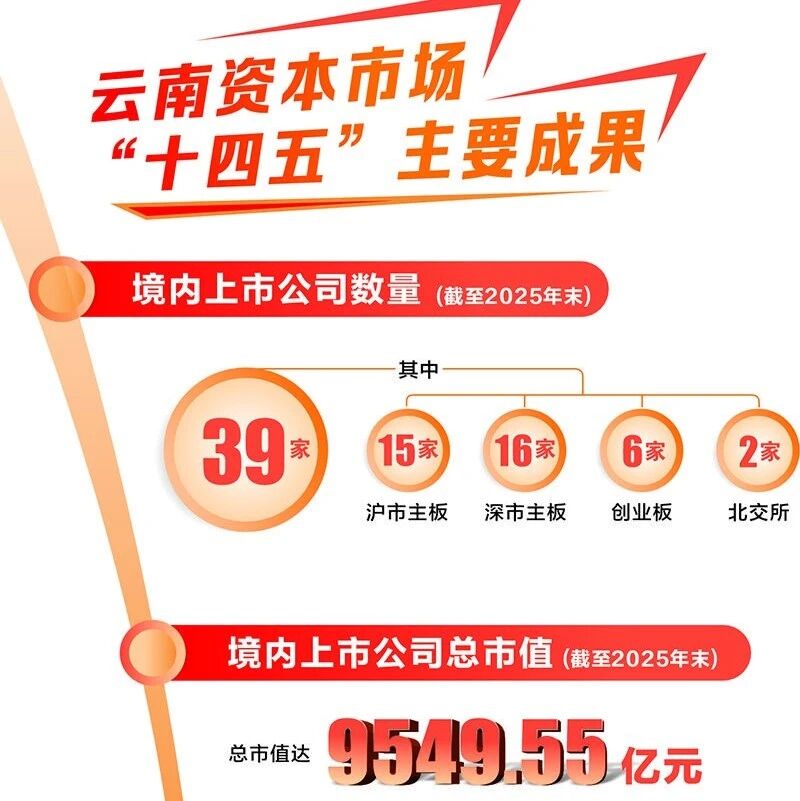
发挥区域特色 多层次资本助云南经济“稳进提质”丨决胜“十四五” 擘画“十五五”·地方资本市场高质量发展之云南篇
证券时报· 2026-01-28 03:18
Core Viewpoint - Yunnan has leveraged its unique geographical position and resource advantages to develop green energy and cultural tourism industries, achieving significant economic growth, with GDP projected to exceed 3 trillion yuan in 2023 and reach 3.28 trillion yuan by 2025, reflecting a 4.1% year-on-year increase [1]. Group 1: Capital Market Development - Yunnan has prioritized the construction and development of a multi-tiered capital market during the 14th Five-Year Plan, with collaborative efforts from various departments to enhance the quality and quantity of listed companies [4][12]. - The establishment of the Yunnan Equity Exchange Center in September 2021 marked the formal establishment of a regional equity market, solidifying the foundation of Yunnan's multi-tiered capital market system [7]. - By the end of 2025, Yunnan is expected to have 39 domestic listed companies, with a total share capital of 70.026 billion shares, including 15 on the Shanghai Stock Exchange and 22 on the Shenzhen Stock Exchange [4]. Group 2: Company Quality and Value Enhancement - The overall quality and value of listed companies in Yunnan have significantly improved during the 14th Five-Year Plan, with the total market capitalization of A-share companies reaching 954.955 billion yuan by the end of 2025 [10]. - Yunnan's listed companies have increasingly contributed to the economy, with a total of 554.33 billion yuan raised through refinancing and 393.16 billion yuan involved in major asset restructurings [10]. - The awareness of shareholder returns has notably increased, with cash dividends amounting to 149.038 billion yuan during the 14th Five-Year Plan, a 95.69% increase compared to the previous five-year period [11]. Group 3: Regulatory and Supportive Measures - The Yunnan Securities Regulatory Bureau has implemented comprehensive measures to ensure the healthy and stable operation of the capital market, focusing on risk prevention and regulatory enforcement [12][14]. - The bureau has actively engaged in promoting the use of capital market tools to support the development of the real economy, facilitating the growth of private enterprises and enhancing their competitiveness [14]. - Future plans include strengthening support for regional capital markets and enhancing the quality of listed companies, with initiatives aimed at fostering a robust industrial cluster in Yunnan [15][16].