
多层次资本市场体系

Search documents
规范商业不动产REITs市场建设
Xin Lang Cai Jing· 2026-02-26 21:46
Core Viewpoint - The development of commercial real estate REITs in China is progressing, with the first batch of products submitted for approval, aiming to enhance resource allocation efficiency and support economic transformation [1][2][3] Group 1: Market Development - The pilot for commercial real estate REITs is set to officially launch in December 2025, with ongoing efforts to build the market [1] - The market is characterized by a focus on market-oriented and legal reforms, aiming to connect quality commercial real estate with capital markets [1][2] - The REITs are expected to facilitate the recycling of funds into technology innovation and industrial upgrades, promoting a more efficient circulation of production factors [1] Group 2: Compliance and Regulation - Compliance remains a fundamental requirement in the approval process for commercial real estate REITs, balancing historical context with market development needs [3] - The complexity of REIT structures and the lengthy operational cycles of underlying assets necessitate a comprehensive approach to compliance, involving multiple regulatory procedures [2][3] - The regulatory framework aims to maintain a balance between risk management and market vitality, ensuring investor protection while respecting market dynamics [3] Group 3: Economic Impact - The introduction of commercial real estate REITs is anticipated to enhance the multi-tiered capital market system, serving as a crucial financial product innovation [3] - This development is aligned with national strategies, promoting economic structural transformation and new development models in the real estate sector [3]
沪市债券新语 | 首批商业不动产REITs项目获受理 市场高质量发展再迈步
Zhong Guo Jin Rong Xin Xi Wang· 2026-01-30 13:32
Core Insights - The first batch of commercial real estate REITs projects has been officially submitted and accepted by the China Securities Regulatory Commission and exchanges, marking the expansion of China's REITs market into the commercial real estate sector [2][3] - This initiative is seen as a significant step towards promoting the healthy development of the REITs market and implementing the new "National Nine Articles" to support the real economy [2][3] Group 1: Project Participants and Assets - The initial projects involve participants such as Poly Developments, Jin Jiang International Group, Shanghai Real Estate, Lujiazui Group, CapitaLand, Vipshop, Sandaohua, and Intime Retail, representing a mix of state-owned enterprises, leading local companies, quality private enterprises, and foreign firms [2][3] - The underlying assets include commercial complexes, retail, office spaces, and hotels located in core areas of cities like Shanghai, Guangzhou, Shenzhen, Wuhan, Hefei, Xi'an, and Zhengzhou [2][3] - The projects are characterized by mature operations and stable cash flows, with Poly Developments focusing on assets in the Guangzhou and Foshan regions, and other key state-owned enterprises in Shanghai submitting diverse asset types [2][3] Group 2: Market Significance and Future Outlook - The acceptance of the first commercial real estate REITs is seen as a landmark event, indicating a new phase in the development of China's REITs market, enhancing the depth and breadth of capital market services for the real economy [3][4] - New products will provide market-based exit channels for companies holding quality commercial real estate, promoting a shift towards a "strong operation, strong return" model [3][4] - The introduction of commercial real estate REITs is expected to enrich the REITs market product supply, offering investors new tools to share in commercial development dividends [3][4] Group 3: Regulatory and Market Development - Industry experts note a high level of participation from market players, including original rights holders and intermediaries, in the asset selection and application process, reflecting strong industry consensus and positive expectations for commercial real estate REITs [4][5] - Regulatory bodies and local governments are actively enhancing policy communication and collaboration to stimulate market participation and build an efficient, risk-controlled, and healthy REITs market ecosystem [4][5] - A transparent regulatory framework has been established to ensure the smooth progress of the pilot program, with a focus on asset quality and timely disclosure of review processes [4][5]


中国上市地图重构:苏州去年A股IPO数量第一,上海掀赴港上市热
Di Yi Cai Jing· 2026-01-21 22:40
Group 1 - Aishalon (920050.BJ), a medical consumables company from Suzhou, debuted on the Beijing Stock Exchange with an initial price of 15.98 CNY per share, achieving a closing price of 44.04 CNY, marking a 175.59% increase and a total market capitalization of nearly 3 billion CNY [1] - Suzhou became the leading city in A-share IPOs in 2023, with 12 new companies listed, surpassing Beijing and Shanghai, and accounting for 10.34% of the total new A-share companies [3][4] - In 2023, a total of 116 companies were listed on the A-share market, representing a 16% increase from 2022, with Jiangsu, Guangdong, and Zhejiang provinces leading the IPO count [2][5] Group 2 - The "Chenglin Plan" implemented by Suzhou aims to support the growth of "hard tech" companies, targeting the addition of 30,000 tech projects and over 100,000 tech enterprises by 2028 [4] - The concentration of new listings is primarily in the Yangtze River Delta, Beijing-Tianjin-Hebei, and Guangdong-Hong Kong-Macau Greater Bay Area, with the top eight cities accounting for 44% of new listings [4][5] - The analysis indicates a regional clustering and structural differentiation in the A-share IPO market, with Jiangsu, Guangdong, and Zhejiang provinces holding nearly 60% of the total IPOs [5][6] Group 3 - The Hong Kong stock market saw a significant increase in IPOs, with 119 companies listed in 2023, a 68% rise from 2022, and a total fundraising amount of 285.8 billion HKD [7] - Shanghai led the number of companies listed in Hong Kong with 19, followed by Guangdong with 17, indicating a strong presence of mainland enterprises in the Hong Kong market [7][8] - The medical and software service sectors are prominent among mainland companies listed in Hong Kong, with a significant concentration in the Yangtze River Delta region [9][10]
首笔以国债作为保证金的QFI商品期货交易完成
Qi Huo Ri Bao Wang· 2025-12-09 18:23
Core Insights - HSBC China has successfully assisted an overseas asset management institution in completing the first QFI commodity futures transaction using government bonds as margin in the domestic market [1] - UBS Futures has also announced its support for the first commodity futures transaction using government bonds as margin, becoming the first futures company to facilitate this for overseas investors [1] Group 1 - HSBC China provided comprehensive services including account management, collateral business application, government bond deposit, and settlement for the overseas institution [1] - The transaction enhances the efficiency of the institution's bond holdings by utilizing government bonds in domestic commodity futures trading [1] - The collaboration involved close cooperation with the Central Government Securities Depository and Clearing Co., relevant commodity futures exchanges, and futures companies [1] Group 2 - HSBC China's Vice President highlighted that using government bonds as margin for commodity futures is a new practice of "interconnectivity" between the bond market and futures market, providing a replicable path for more overseas investors [2] - This development offers a more efficient capital utilization channel for overseas investors and enriches the usage scenarios of government bonds through cross-market collaboration [2] - UBS Futures' Chairman stated that the successful implementation of this first business marks the formal opening of government bonds as margin for overseas investors, reflecting the increasing diversity and openness of the Chinese market [2]
境外投资者参与中国商品期货市场迎来新进展
Zhong Guo Xin Wen Wang· 2025-12-09 08:35
Core Viewpoint - The article highlights a significant development in the participation of foreign investors in China's commodity futures market, facilitated by HSBC China, which successfully assisted a foreign asset management institution in completing the first QFI commodity futures transaction using Chinese government bonds as margin [1]. Group 1: Transaction Details - HSBC China announced the successful completion of the first QFI commodity futures transaction using Chinese government bonds as margin, marking a milestone for foreign investors in the domestic market [1]. - The foreign investor utilized government bonds held in the interbank bond market as margin for commodity futures trading, enhancing the efficiency of bond holdings [1]. Group 2: Market Implications - The use of government bonds as margin for commodity futures trading provides foreign investors with a more efficient capital utilization channel and enriches the usage scenarios of government bonds through cross-market collaboration [1]. - The ongoing development of a multi-tiered capital market system in China is expected to enhance the attractiveness and influence of the Chinese capital market, drawing more quality foreign capital to participate deeply [1].
首笔以国债作为保证金的QFI商品期货交易落地
Xin Hua Cai Jing· 2025-12-09 07:26
Core Viewpoint - The participation of foreign investors in China's commodity futures market has made significant progress, with HSBC China facilitating the first QFI commodity futures transaction using government bonds as margin [1] Group 1: Transaction Details - HSBC China assisted a foreign asset management institution in completing the first QFI commodity futures transaction in the domestic market using government bonds as collateral [1] - The transaction involved comprehensive services including account management, collateral business application, government bond deposit, and settlement [1] Group 2: Market Implications - This transaction represents a new practice of "interconnectivity" between the bond market and the futures market, providing a replicable path for more foreign investors to participate in the domestic commodity futures market [1] - Using government bonds as margin not only offers foreign investors a more efficient capital utilization channel but also enriches the usage scenarios of government bonds through cross-market collaboration [1] Group 3: Regulatory Environment - Regulatory bodies such as the People's Bank of China and the China Securities Regulatory Commission have been promoting high-level institutional opening of financial markets, facilitating efficient capital flow [1] - Since the CSRC allowed QFI to participate in commodity futures options trading in 2020, 91 commodity futures options contracts have been opened to QFI by various commodity futures exchanges [1]
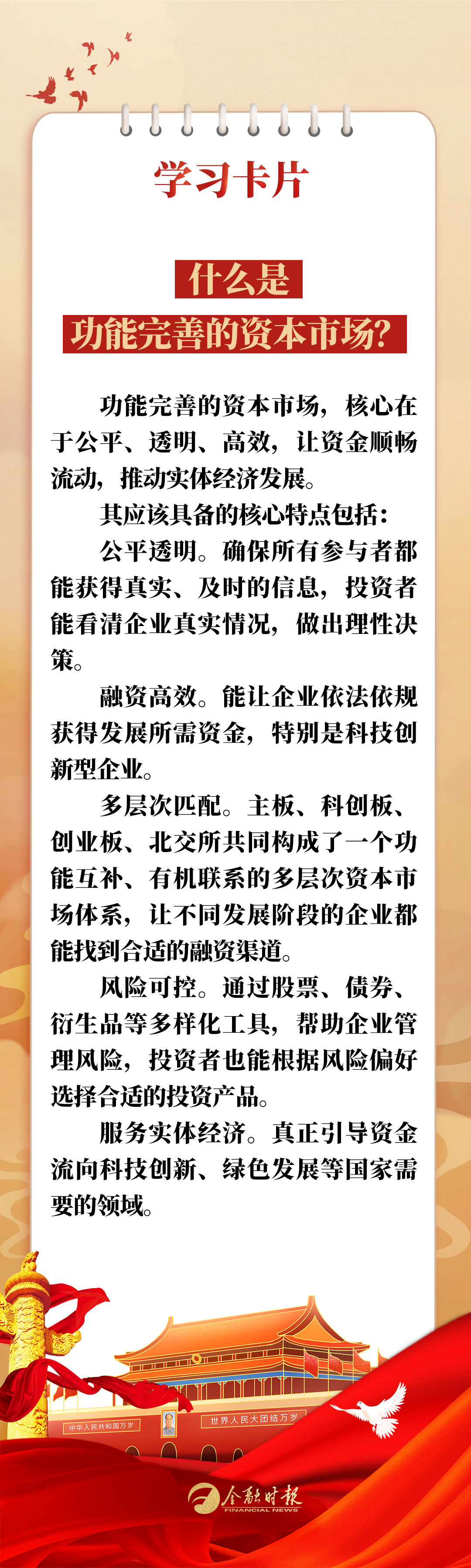
四中全会关键词讲解——什么是功能完善的资本市场?如何建立健全?
Jin Rong Shi Bao· 2025-12-04 15:08
Core Viewpoint - A well-functioning capital market is essential for the smooth flow of funds, promoting the development of the real economy, characterized by fairness, transparency, and efficiency [2][3]. Group 1: Characteristics of a Well-Functioning Capital Market - Fairness and Transparency: Ensures all participants receive real-time information, allowing investors to make informed decisions about the true state of companies [2]. - Efficient Financing: Enables companies, especially those focused on technological innovation, to obtain necessary funding in compliance with regulations [3]. - Multi-layered Matching: The market consists of various boards (Main Board, Sci-Tech Innovation Board, Growth Enterprise Market, and Beijing Stock Exchange) that provide suitable financing channels for companies at different development stages [3]. - Risk Control: Offers diverse tools such as stocks, bonds, and derivatives to help companies manage risks, while investors can choose products based on their risk preferences [3]. - Service to the Real Economy: Directs funds towards areas needed by the country, such as technological innovation and green development [3]. Group 2: Establishing a Sound Capital Market - Strengthening Basic Systems: Emphasizes strict entry standards and the responsibility of intermediary institutions as gatekeepers [5]. - Improving the Quality of Listed Companies: Advocates for strict delisting regulations and a diversified delisting mechanism to accelerate the exit of low-quality enterprises [6]. - Enhancing Regulation: Aims to protect investor rights through a robust regulatory framework that combats illegal activities such as insider trading and market manipulation [6]. - Promoting Long-term Investment: Encourages the establishment of a favorable environment for long-term capital, including mechanisms for assessing long-term investments [6]. - Deepening Reform and Opening Up: Focuses on enhancing market inclusivity and adaptability, particularly for technology companies and new business models, while gradually expanding high-level openness to attract global capital [6].
A股IPO融资额重回千亿
Hua Er Jie Jian Wen· 2025-11-28 00:29
Group 1 - The core viewpoint is that the A-share IPO financing amount has returned to the trillion yuan scale in 2025, reaching 100.36 billion yuan, indicating a recovery in the capital market's support for the real economy [1][2] - The A-share IPO financing amount in 2025 is significantly lower compared to the historical high of over 500 billion yuan in 2021 and 2022, showing that this year's performance is not particularly outstanding [2] - The main board contributed over half of the IPO financing amount, totaling 52.38 billion yuan, driven primarily by the IPO of Huadian New Energy, which raised 18.17 billion yuan [2] Group 2 - The IPO financing growth has positively impacted investment banks' earnings, with five investment banks surpassing 10 billion yuan in IPO sponsorship amounts [2] - The value of IPOs extends beyond capital supply, as they play a crucial role in supporting enterprise growth, industrial upgrading, and economic structure optimization [2] - The future outlook suggests that the improvement of a multi-level capital market system will provide stronger capital support for the development of new productive forces and industrial upgrades [3]
北交所开市四周年:打造服务创新型中小企业主阵地
Sou Hu Cai Jing· 2025-11-15 06:50
Core Insights - The Beijing Stock Exchange (BSE) has achieved significant milestones in its four years of operation, focusing on serving innovative small and medium-sized enterprises (SMEs) and enhancing market functions [1][2][3] Group 1: Market Performance - As of November 14, 2025, the BSE has 282 listed companies, a threefold increase from 81 at its inception, with over 80% being SMEs and nearly 90% being private enterprises [2] - The average revenue of 279 companies that disclosed their Q3 reports is 5.20 billion, reflecting a year-on-year growth of 6%, while the average net profit stands at 32.99 million [2] - The total market capitalization of listed companies is approximately 900.83 billion, with the top companies being Better Ray (42.04 billion) and Jinbo Biological (27.59 billion) [2] Group 2: Institutional Arrangements - The BSE has established inclusive market access for growth-stage and unprofitable companies, with a focus on balancing regulatory costs for SMEs [3] - The introduction of the "920" code signifies the BSE's transition to an independent code era, enhancing market recognition and attracting quality enterprises [3][4] Group 3: Market Ecosystem - The BSE has issued over 13 trillion in government bonds and supported local government bond issuance exceeding 990 billion, contributing to regional economic development [5] - More than 90% of listed companies have distributed dividends, with over 9.5 million qualified investors participating in the market [6] Group 4: Future Directions - The BSE plans to enhance its functions by improving support for technology innovation and refining its listing review system [7] - The focus will also be on stabilizing the market by improving the quality of listed companies and fostering long-term capital investment [8] - The BSE aims to optimize its product offerings and enhance market services, including the introduction of the North Certificate 50 ETF and after-hours fixed-price trading [9]
助力企业高效规范对接资本市场 无锡举办A股港股IPO专业研培活动
Zhong Guo Zheng Quan Bao· 2025-11-05 21:59
Group 1 - The event "Path to New Opportunities - Wuxi Enterprises A-share and Hong Kong Stock IPO Professional Training" was held, focusing on IPO-related matters and capital market policies [1] - Wuxi has 167 listed companies, ranking second in Jiangsu Province, with 46 companies planning to list on A-shares [1] - The A-share market is vibrant, with ongoing reforms and a multi-tiered capital market system that supports companies at different lifecycle stages [1] Group 2 - The Beijing Stock Exchange (BSE) features a high proportion of private enterprises and over 80% of companies are technology-oriented, with more than 50% classified as national-level "specialized and innovative" small giants [2] - The Hong Kong market serves as a crucial link for mainland enterprises to access global capital, with compliance and listing scheme design being key concerns for companies [2] - Key factors for successful overseas listings include understandable business models, verifiable compliance, and sustainable profitability [2] Group 3 - Representatives from participating companies expressed that the training enhanced their understanding of listing options, paths, and standards [3]