
地震预警

Search documents
陕西西安以精细化地震预警护航精密生产——精密制造有了“定制化”地震预警
Ren Min Ri Bao· 2025-09-17 22:00
Core Viewpoint - The article discusses the importance of earthquake monitoring and early warning systems for the semiconductor manufacturing industry, particularly for Samsung (China) Semiconductor Co., Ltd. in Xi'an, Shaanxi Province, to ensure stable production amidst seismic risks [1][2][3]. Group 1: Earthquake Monitoring and Early Warning - Samsung (China) Semiconductor has implemented a high-sensitivity earthquake monitoring station to provide precise earthquake warning information and vibration observation services, crucial for maintaining stable production in precision manufacturing [1]. - The Shaanxi Earthquake Bureau has collaborated with Samsung to offer customized earthquake early warning based on micro-vibration indicators, allowing the company to receive timely alerts about potential impacts from small earthquakes [1][2]. - A dedicated seismic monitoring network consisting of three stations was established around Samsung's facility, enabling real-time data transmission to the Shaanxi Earthquake Early Warning Center for better analysis of seismic impacts on precision manufacturing [2]. Group 2: Industry Standards and Guidelines - The Shaanxi Earthquake Bureau has identified a gap in earthquake safety service standards for high-precision manufacturing enterprises and has developed a technical guide for emergency response to earthquakes [3]. - Other precision manufacturing companies in Xi'an, such as Yiswei Silicon Technology Co., Ltd. and Longteng Semiconductor Co., Ltd., have also adopted customized earthquake warning services to enhance their operational resilience [3]. - The national earthquake early warning project, which aims to support various industries including precision manufacturing, is set to be the largest of its kind globally, with applications in critical infrastructure sectors like transportation, water conservancy, and electricity [3].
华为三折叠屏手机Mate XTs 非凡大师发布 亮点一览 比前代全系便宜2000元
Qi Lu Wan Bao· 2025-09-04 08:54
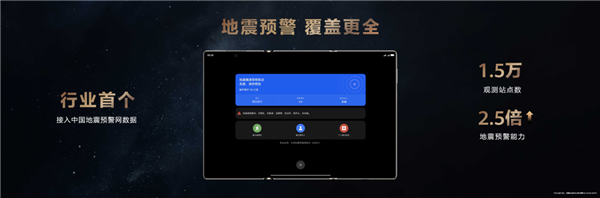
Core Insights - Huawei launched the Mate XTs Ultimate Master, a second-generation flagship foldable smartphone featuring the Kirin 9020 chip and HarmonyOS 5.1 [1][2] - The device boasts a 10.2-inch display with a resolution of 2880*1920 when unfolded and a 6.4-inch single screen when closed, significantly reducing the depth of the fold crease [1] - The camera system includes a 50MP main camera, a 50MP 3.5x telephoto macro lens, and a 13MP ultra-wide lens, along with a new multispectral sensor [1] - The pricing for the Mate XTs Ultimate Master is lower than its predecessor by 2000 yuan, with models priced at 17,999 yuan, 19,999 yuan, and 21,999 yuan for different storage options [11] Technical Specifications - The Kirin 9020 chip enhances overall performance by 36% compared to the previous generation, ensuring smooth multitasking and large application performance [2] - The device features a second-generation hinge design, referred to as "invisible spine," which minimizes the visible crease on the screen [1] Unique Features - The Mate XTs Ultimate Master is the first smartphone to integrate data from the China Earthquake Administration, enhancing its earthquake warning capabilities by 2.5 times [1] - The device connects to 15,000 professional earthquake observation stations nationwide, providing real-time alerts for key regions [1] Marketing and Promotion - Hong Kong celebrity Andy Lau was announced as the brand ambassador for the Mate XTs Ultimate Master [13][15] - A promotional event featuring a live stream with Andy Lau was scheduled to coincide with the product launch [11]

广西地震局织就平陆运河震安网
Guang Xi Ri Bao· 2025-08-06 02:36
Core Viewpoint - The construction of the Pinglu Canal project in Guangxi is progressing steadily, with significant emphasis on earthquake safety measures and risk assessments to ensure the stability and safety of the infrastructure [1][2]. Group 1: Engineering and Safety Measures - The Guangxi Earthquake Bureau plays a crucial role in assessing the geological conditions along the canal, conducting a thorough examination of seismic structures over a 150-kilometer stretch to identify potential hazards [1]. - For the Dingwu Village Bridge, located over the main channel of the Pinglu Canal, engineers identified a fault line that influenced the bridge's design, leading to a significant increase in its seismic safety by relocating the bridge piers away from the fault [2]. Group 2: Risk Assessment and Mitigation - A detailed seismic disaster risk assessment was conducted on 590,000 buildings along the canal, resulting in a model that provides specific guidance for earthquake-resistant renovations for residential structures [3]. - The Guangxi Earthquake Station has developed a rapid response system that can issue earthquake warnings within 10 to 30 seconds after a seismic event, enhancing public safety and emergency response capabilities [4]. Group 3: Community Engagement and Technology - The "Guangxi Earthquake Warning" app has reached over 320,000 users, creating a digital network for disaster prevention and community engagement in earthquake safety [4].
钻孔传感器技术助力提升地震预警能力
Qi Lu Wan Bao· 2025-07-31 21:18
Group 1 - New Zealand and US researchers are utilizing borehole sensor technology to monitor "slow slip earthquakes" in the Hikurangi subduction zone, enhancing earthquake disaster prevention capabilities [1] - The next step involves publishing seismic sensor data from the Hikurangi subduction zone, which will facilitate a deeper analysis of the overall fault zone risk [1] - The research aims to expand understanding of key faults in the Pacific Ring of Fire, providing new insights for earthquake disaster prevention [1]
他们把20亿部手机连成网,“感知”地震
Hu Xiu· 2025-07-31 00:57
Core Viewpoint - Google has developed an innovative Android Earthquake Alerts (AEA) system that connects over 2 billion Android phones globally to create a vast earthquake monitoring network, successfully detecting earthquakes and sending early warnings to users in 98 countries [1][9][62]. Group 1: Technology and Functionality - The AEA system utilizes the accelerometers in Android smartphones to detect ground motion caused by seismic waves, sending data to Google's servers for analysis [12][13]. - From April 2021 to March 2024, the AEA system detected 11,231 suspected earthquake events, with 85% matching traditional earthquake catalogs [18]. - The system's initial magnitude estimation error has significantly improved, with the median absolute error decreasing from 0.50 to 0.25 [23]. Group 2: Alert Mechanism and User Experience - AEA sends alerts for earthquakes with an estimated magnitude of 4.5 or higher, targeting areas expected to experience significant shaking [26][27]. - Two types of alerts are issued: "TakeAction" for immediate action and "BeAware" for caution, with the former designed to capture user attention effectively [29][32]. - Since its launch in August 2020, AEA has reached 2.5 billion people, with a tenfold increase in the number of users receiving alerts compared to 2019 [34][37]. Group 3: Performance and Comparisons - AEA's alert accuracy is comparable to traditional systems like ShakeAlert and JMA, with AEA having the lowest error rates and issuing more alerts [35][37]. - The system has successfully detected significant earthquakes, such as the 7.8 magnitude earthquake in Turkey, providing timely alerts to millions of users [40][41]. Group 4: User Feedback and Trust - A survey indicated that 85% of users found the alerts "very helpful," with a majority expressing increased trust in the system [54][56]. - Only 0.1% of users opted out of receiving alerts, demonstrating high user acceptance and trust in the AEA system [57]. Group 5: Future Prospects - The AEA system represents a significant advancement in earthquake monitoring, leveraging consumer technology to provide timely alerts and improve public safety [58][63]. - Future developments may include enhanced data collection for better understanding of seismic hazards and improved emergency response capabilities [61][64].


热搜第一!微信新功能来了
Zhong Guo Ji Jin Bao· 2025-07-23 02:03
Core Viewpoint - WeChat has initiated a gray testing phase for a new feature that allows automatic voice-to-text conversion and sending, enhancing user convenience in communication [1][3]. Group 1: New Feature Overview - The new feature includes a voice input button that, when activated, converts spoken words into text in real-time [1][3]. - Users can send the converted text by simply saying "over over," eliminating the need to manually click the send button [3]. - This feature is particularly useful for users with busy hands or those who find it difficult to touch the screen [3]. Group 2: User Feedback - Many users have expressed excitement about the new feature, describing it as "fun" and "useful" [3]. - However, some users have criticized the feature for being awkward to use in public settings, describing the command "over over" as embarrassing [3]. Group 3: Industry Insights - Industry experts view this feature as an innovative exploration of voice interaction, which could improve communication efficiency in specific scenarios [3]. - There is a noted need for further optimization in recognition accuracy and interaction naturalness [3]. Group 4: Additional Features and Updates - WeChat is also testing several other features, including the ability to back up chat records to external storage devices, modify video covers and captions, and implement earthquake warning systems [6][7][8]. - The app has introduced a "nearby jobs" feature that matches users with local job opportunities, verified by government departments [11]. - Other updates include automatic translation of messages in 18 languages and the ability to delete contacts that have removed the user [10][12].


日本鹿儿岛县近海频繁发生地震,半个月累计达1500次
news flash· 2025-07-06 07:57
Core Viewpoint - The Japan Meteorological Agency reported a significant increase in seismic activity near the Tokara Islands, with 1,500 felt earthquakes recorded from June 21 to July 6, raising concerns about potential strong earthquakes and geological hazards [1] Group 1: Seismic Activity - A total of 1,500 felt earthquakes occurred in the Tokara Islands region from June 21 to July 6 [1] - The Japan Meteorological Agency issued a warning for the possibility of a weak earthquake with a seismic intensity of 6 [1] - The agency highlighted the risk of building collapses and geological disasters in areas experiencing strong tremors [1] Group 2: Earthquake Intensity Scale - The Japan Meteorological Agency's earthquake intensity scale ranges from 0 to 7, categorized into 10 levels from weak to strong [1] - The scale includes levels such as 5 weak, 5 strong, 6 weak, and 6 strong [1]
我省持续完善防灾减灾体系 预判响应能力不断提升
Xin Hua Ri Bao· 2025-05-12 23:16
Core Viewpoint - The article emphasizes the importance of enhancing disaster prevention and reduction capabilities in Jiangsu Province to support high-quality economic and social development and ensure the safety of people's lives and property [1] Group 1: Meteorological Disaster Prevention - Jiangsu has developed a distinctive meteorological disaster prevention mechanism, particularly in areas prone to strong convective weather, such as tornadoes [2] - The mechanism includes progressive meteorological monitoring and early warning systems, achieving high information sharing and efficient response coordination [2][3] - The accuracy of severe weather warnings in Xiangshui County has reached 80.3%, with an average lead time of 46.3 minutes for alerts [3] Group 2: Geological Disaster Prevention - Jiangsu has implemented a typical geological disaster meteorological risk warning model, which analyzes historical data and geological conditions to predict risks [4] - During a significant rainfall event, the model successfully predicted high geological disaster risks, leading to timely evacuations and preventing casualties [4][5] - The province is utilizing new technologies, such as Beidou and drones, to enhance geological disaster monitoring and response capabilities [5] Group 3: Earthquake Early Warning - Jiangsu has launched a "Jiangsu Earthquake Early Warning Information Service" via WeChat, providing critical seconds of warning before seismic waves arrive [6][7] - The average time for earthquake alerts has improved to 7.4 seconds, significantly reducing potential casualties [7] - The province is expanding its earthquake warning information dissemination channels, with nearly 300 service terminals deployed across various institutions [7]
腾讯微信、QQ双平台实现全国地震预警 可提前数秒至数十秒预警
Shen Zhen Shang Bao· 2025-05-12 17:22
Core Viewpoint - The launch of nationwide earthquake early warning services on QQ and WeChat aims to enhance public safety by providing timely alerts to users, leveraging Tencent's technology capabilities for effective disaster reduction [1][3]. Group 1: Service Launch and Features - On May 12, QQ officially launched its nationwide earthquake early warning function, complementing WeChat's existing service, allowing users to receive alerts across different platforms and operators [1]. - Users can subscribe to earthquake warning information by searching for specific terms in QQ and WeChat, enabling them to set their preferred alert regions and intensity levels [2]. Group 2: Technical Aspects and Impact - The earthquake early warning system relies on a dense network of observation stations to capture early seismic signals, allowing for rapid estimation of earthquake parameters and potential impacts [3]. - Research indicates that a 20-second early warning can reduce casualties by 63%, highlighting the importance of timely alerts for public safety and infrastructure protection [3].
地震怎么防?遇到怎么办?这场发布会详细解答
Xin Hua Wang· 2025-05-12 12:04
Core Viewpoint - The article emphasizes the importance of earthquake preparedness and response in China, highlighting the country's vulnerability to seismic activities and the need for public awareness and education on earthquake safety measures [1][2][3][4]. Group 1: Earthquake Prediction and Warning - China experiences 33% of the world's continental earthquakes, with 57% of its population living in high-risk areas [1]. - Earthquake prediction involves estimating the time, location, and magnitude of potential earthquakes, while forecasting is the government’s formal announcement of these predictions [1]. - Earthquake warning systems provide alerts seconds to minutes before destructive seismic waves arrive, allowing for timely public notifications [1][2]. Group 2: Survival Strategies During Earthquakes - In the event of being trapped, individuals should create a safe space using sturdy furniture and conserve resources like food and water [2]. - Maintaining a positive mindset is crucial for survival, and individuals should signal for help using rhythmic sounds rather than shouting [2]. Group 3: Preparedness Measures - High-rise buildings in China adhere to strict seismic safety standards, reducing the likelihood of collapse during earthquakes [3]. - Residents are encouraged to conduct regular safety checks, eliminate hazards, and stock essential supplies like food, water, and first aid kits [3][4]. - Emergency shelters are being developed with specific service radii to ensure accessibility for all community members, including vulnerable groups [4]. Group 4: Ongoing Initiatives - The government is enhancing earthquake monitoring, risk assessments, and community preparedness through various initiatives [4]. - Public participation in emergency drills and awareness of evacuation routes is encouraged to improve overall readiness [4].