
成本削减计划

Search documents
日产汽车首发盈利指引“出师不利”:预警年度亏损18亿美元,股价暴跌
Zhi Tong Cai Jing· 2025-10-31 03:17
Core Viewpoint - Nissan Motor Co. is expected to record an operating loss of 275 billion yen (approximately 1.8 billion USD) for the current fiscal year, prompting the company to implement aggressive cost-cutting measures to address its deteriorating financial situation [1] Group 1: Financial Performance - This is the first time Nissan has provided earnings guidance for the fiscal year ending March 2026, having previously refrained from offering profit forecasts [1] - Nissan anticipates a loss of 30 billion yen for the first half of the fiscal year (April to September), which is better than its prior forecast of a 180 billion yen loss [1] - The company's stock price fell by 6.1% in early trading on the Tokyo stock market, marking the largest intraday drop since August 26, with a cumulative decline of approximately 27% year-to-date [1][2] Group 2: Challenges and Restructuring - Nissan is facing its most severe financial crisis in over two decades, reminiscent of a previous crisis that led to a bailout by Renault SA [1] - The company is grappling with significant profit declines, high debt levels, frequent management changes, a weak product lineup, and declining sales in the U.S. and Chinese markets [1] - CEO Ivan Espinosa has committed to a series of cost-cutting measures, including laying off 20,000 employees and reducing global production bases from 17 to 10 [2] - Specific actions include transferring production from the Civac plant in Mexico to the Aguascalientes facility by the end of the fiscal year and closing the Oppama flagship plant in Japan by March 2028 [2] - Analyst Tatsuo Yoshida noted that the lower-than-expected loss for the first half of the fiscal year is not due to significant business improvement but rather influenced by one-time costs [2] - CFO Jeremie Papin attributed the reduced loss to expenses related to U.S. emissions regulations, prior liabilities, and other one-time factors [2]

新药接棒乏力!王牌Keytruda销售不及预期 默沙东(MRK.US)下调营收指引上限
智通财经网· 2025-10-30 12:07
Core Viewpoint - Merck & Co. (MRK.US) has lowered its revenue guidance for 2025, indicating challenges ahead as it prepares for the patent expiration of its key cancer drug, Keytruda [1][2] Financial Performance - The company adjusted its 2025 revenue guidance down by $300 million, now expecting sales between $64.5 billion and $65 billion [1] - Third-quarter revenue reached $17.3 billion, a 4% year-over-year increase, surpassing market expectations of $16.96 billion [2] - Net profit for the quarter was $5.79 billion (or $2.32 per share), up from $3.16 billion ($1.24 per share) in the same period last year [2] - Adjusted earnings per share were $2.58, exceeding the market forecast of $2.35 [2] - The company slightly raised its full-year earnings per share forecast to a maximum of $8.98 [2] Product Performance - Keytruda and the anticipated rare lung disease drug Winrevair did not meet sales expectations in the latest quarter [1] - Sales of the new pneumonia vaccine, Capvaxive, reached $244 million, exceeding Wall Street expectations [2] - The vaccine is positioned to compete directly with Pfizer's Prevnar, with Capvaxive showing an 80% efficacy against adult pathogens compared to Prevnar's 50% [2] - Sales of Gardasil, the second-largest product, declined by 24% to $1.7 billion, primarily due to decreased demand in China [3] Cost Management and R&D - R&D spending decreased by over $1.6 billion compared to the previous year, attributed to reduced business development costs [3] - The company announced a cost-cutting plan aiming to save $3 billion annually by 2027 through workforce reductions and real estate downsizing [2][3] Regulatory and Market Challenges - Merck is facing pricing pressures and competition from generics as Keytruda's patent is set to expire in 2028, with potential government-led price negotiations as early as 2027 [1] - The company has not disclosed whether it has reached a pricing agreement with the government, but it has prepared sufficient Keytruda stock to mitigate potential tariff impacts [4] - Merck plans to invest over $9 billion in U.S. manufacturing over the next four years to enhance domestic drug production capabilities [4]

已裁员4.8万人!美国巨头,公布_发现频道_中国青年网
Sou Hu Cai Jing· 2025-10-30 02:04
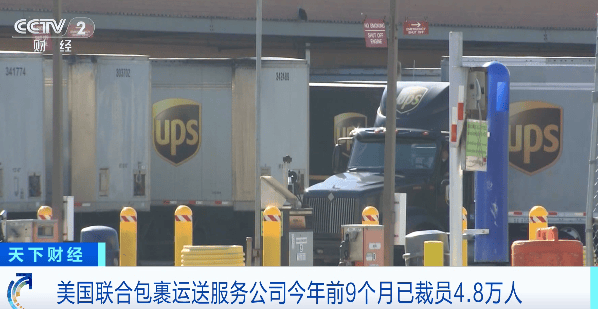
Core Insights - United Parcel Service (UPS) reported a significant workforce reduction, with 48,000 employees laid off in the first nine months of the year, exceeding previous plans [1][3] - The company achieved cost savings of approximately $2.2 billion through layoffs and facility closures, with an annual target of $3.5 billion [1] - UPS's stock price rose about 8% following the earnings report, which exceeded analyst expectations for revenue and earnings per share [5] Group 1 - UPS's layoffs included approximately 34,000 drivers and warehouse workers, while 14,000 were management personnel [1] - Earlier in the year, UPS indicated a shift from growth-oriented strategies to focusing on higher-margin businesses, reducing reliance on low-profit operations and Amazon package deliveries [3] - As of the end of 2024, UPS is expected to have around 490,000 employees globally [3] Group 2 - The cost-cutting measures have positively impacted UPS's financial performance, leading to better-than-expected revenue and earnings for the quarter ending September 30 [5]


诺和诺德董事长携6名董事集体辞职,董事会“大换血”;年薪5000万CEO此前离任,上月宣布裁员9000人,市值一年蒸发近2万亿元
Sou Hu Cai Jing· 2025-10-24 16:03
Core Insights - Novo Nordisk (NVO) is undergoing significant leadership changes, with Chairman Helge Lund and six board members resigning due to disagreements with the controlling shareholder, the Novo Nordisk Foundation, regarding the future composition of the board [1][3][4] - The company has faced challenges in maintaining growth, particularly in the competitive GLP-1 drug market, leading to a series of strategic shifts and management changes throughout the year [7][8] Leadership Changes - On October 21, 2023, Novo Nordisk announced the collective resignation of Chairman Helge Lund and six board members, which will take effect after a special shareholders' meeting on November 14 [1][3] - The board's proposal aimed to maintain continuity while adding new members with specific skills, contrasting with the foundation's desire for a broader restructuring [3][4] - Lars Rebien Sørensen, former CEO from 2000 to 2016, is proposed to be the new chairman, with Cees de Jong as vice-chairman and additional board members suggested [3][4] Financial Performance and Market Challenges - Novo Nordisk's sales of the weight-loss drug semaglutide reached 112.76 billion Danish kroner (approximately $16.63 billion) in the first half of the year, surpassing Merck's Keytruda sales [7][8] - However, the company faces increasing competition from other GLP-1 drugs, particularly from Eli Lilly's tirzepatide, which reported sales of $14.73 billion, narrowing the gap with semaglutide [7][8] - The company has lowered its 2025 sales growth forecast from 13%-21% to 8%-14% and operating profit growth from 16%-24% to 10%-16% due to market pressures [8] Restructuring and Cost-Saving Initiatives - Novo Nordisk announced a global restructuring plan aimed at streamlining operations and reallocating resources to capitalize on growth opportunities in diabetes and obesity treatment [5] - The restructuring is expected to save the company 8 billion Danish kroner (approximately $1.2 billion) annually [5] - Following the appointment of new CEO Maziar Mike Doustdar, the company initiated a significant cost-cutting plan, including a workforce reduction of 9,000 employees, representing about 11.5% of its total workforce [4][5] Stock Performance and Market Capitalization - Novo Nordisk's stock has seen a decline of over 50% in the past year, with its market capitalization dropping from over $500 billion to $236.3 billion, resulting in a loss of approximately $278 billion [8]

暴涨29%!沃尔沃汽车Q3利润增长超预期,成本削减计划抵消关税冲击 | 财报见闻
Hua Er Jie Jian Wen· 2025-10-23 08:15
Core Insights - Volvo Cars reported a slight increase in adjusted operating profit for Q3, indicating the success of its aggressive cost-cutting plan in offsetting the impacts of U.S. tariffs and intense price competition, leading to quarterly profitability exceeding market expectations [1] - Despite a 7% decline in sales, the operating profit for Q3 (July to September) reached 5.9 billion Swedish Krona (approximately 627 million USD), slightly above the 5.8 billion Krona from the same period last year [1] - The CEO Hakan Samuelsson acknowledged ongoing challenges from price competition and U.S. import tariffs but noted that the recent U.S.-EU tariff agreement provided much-needed clarity to the market [1] Cost Control Effectiveness - The profitability of Volvo Cars is improving, with gross margin expanding from 17.7% in the previous quarter to 24.4% [4] - Factors contributing to this improvement include the facelift of the popular XC60 model, deeper collaboration with Geely's supply chain for cost savings, and an aggressive cost control plan initiated by CEO Hakan Samuelsson [4] - Samuelsson's reappointment aimed to boost the company's struggling stock price, and he quickly launched a comprehensive cost-cutting plan, which included cutting 3,000 jobs, withdrawing profit guidance, and slowing down investment [4] Tariff Pressure Mitigation - As one of the European automakers most affected by U.S. tariffs, Volvo Cars exports most of its vehicles to the U.S. from Europe [4] - The company has taken measures to address this by planning to shift some hybrid vehicle production to the U.S. over the next few years [4] Trade Agreement Benefits - Recent U.S.-EU trade negotiations have been favorable for Volvo, with the U.S. government confirming a 15% tariff on EU-imported cars and automotive products effective August 1 [5] - Samuelsson stated that while tariff impacts remain, the new agreement has reduced tariffs for EU imports and provided valuable certainty [5]
刚刚!雀巢计划裁员16000人、公布前9个月财报,称投资成果初现
Sou Hu Cai Jing· 2025-10-17 02:27
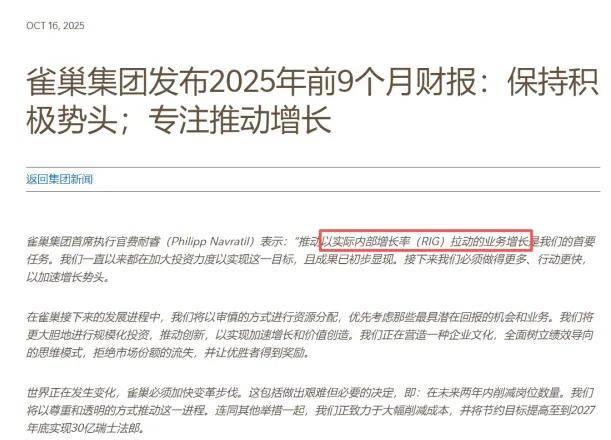
Core Insights - Nestlé reported a total sales of 65.9 billion Swiss francs for the first nine months of 2025, a decline of 1.9% year-on-year, with an organic growth rate of 3.3% and an internal growth rate of 0.6% [2][6] - The company announced a global workforce reduction of approximately 16,000 positions, representing about 6% of its total workforce of 277,000, to enhance operational efficiency and support cost-cutting initiatives [4][5] - The new CEO, Philipp Navratil, emphasized the importance of driving business growth through actual internal growth rates and increasing investments to achieve this goal [2][6] Group 1: Workforce and Cost Management - The workforce reduction includes around 12,000 white-collar jobs and 4,000 positions in manufacturing and supply chain, with the restructuring expected to save 1 billion Swiss francs annually by 2027 [4][5] - The total cost-saving target for the "growth-supporting" initiative has been raised from 2.5 billion to 3 billion Swiss francs [4][5] - The company is focusing on improving operational efficiency through shared services and process automation [4][5] Group 2: Growth Strategy and Financial Performance - Nestlé's organic growth rate improved from 2.0% in the same period last year to 3.3%, with a notable increase in the third quarter reaching 4.3% [6] - The company aims to achieve over 8 billion Swiss francs in free cash flow by 2025, with a commitment to maintaining its long-standing dividend policy [7] - The management team is addressing performance issues in the Greater China region, which negatively impacted overall growth rates [6][7]

J.B. Hunt’s belt tightening yields big Q3 beat
Yahoo Finance· 2025-10-15 23:50
Core Insights - J.B. Hunt Transport Services reported an increase in earnings despite a slight decline in revenue during Q3, attributed to a $100 million cost reduction program [1][2] Financial Performance - Consolidated revenue decreased less than 1% year-over-year to $3.05 billion, slightly above the consensus estimate of $3.02 billion [2] - Operating income rose by 8% year-over-year, with earnings per share increasing by 18% to $1.76, exceeding analysts' expectations by 30 cents [2] - A lower tax rate contributed a 3-cent benefit to EPS compared to Q3 2024 [2] Cost Management - The company analyzed over 100 expense lines, achieving $20 million in cost reductions in Q3, with potential total annual savings exceeding $100 million [3] Intermodal Segment Performance - Intermodal revenue fell by 2% year-over-year to $1.52 billion, with both loads and revenue per load decreasing approximately 1% [5] - A 6% decline in transcontinental loads was offset by a 6% increase in Eastern loads, with monthly loads down 3% in July, 2% in August, and flat in September [5] - The intermodal segment achieved a 91.8% operating ratio, improving by 100 basis points year-over-year and 150 basis points from Q2, driven by better drayage efficiencies and network balance [7] Market Outlook - The ocean shipping peak season began early this year as shippers moved inventory ahead of tariff implementations, but customers still anticipate a ground transportation peak season [6] - Management indicated that the intermodal segment's future will not be dictated by the potential merger of Union Pacific and Norfolk Southern, as they plan to continue using both Eastern railroads [4]

Is There Hope Left for UPS Investors?
The Motley Fool· 2025-09-28 12:35
Core Viewpoint - UPS stock has experienced a significant decline, falling over 30% in the year and more than 60% from its pandemic-era highs, raising concerns among investors about the company's future performance [2][4]. Company Performance - UPS's stock has dropped approximately 31% since the beginning of the year and over 60% from early 2022 pandemic highs [2]. - The company has faced challenges such as a decrease in package deliveries and a strategic decision to prune lower-margin business segments [4][5]. - Average daily volume in the U.S. fell by over 7% in the second quarter, with UPS's operating margin at 7%, a stark contrast to the double-digit margins seen during the pandemic [6]. Strategic Decisions - UPS terminated its acquisition of Mexican company Estafeta, which was aimed at strengthening its presence in Mexico, leading to a downgrade in its price target by an analyst [3]. - The company plans to cut Amazon package volume by approximately 50% by June 2026 due to low margins associated with Amazon deliveries, which accounted for about 11.8% of UPS's revenue in 2024 [7]. Cost Management Initiatives - UPS is implementing a $3.5 billion cost-reduction plan, which includes closing numerous facilities and reducing its workforce by about 20,000 jobs, aimed at improving margins and restoring shareholder confidence [10]. - The consolidated operating margin improved from 7.7% to 8.6% in the second quarter, with a projection of 9% for the next quarter [10]. Future Outlook - Despite current setbacks, UPS maintains a strong competitive position with one of the densest global delivery networks, delivering an average of 22.4 million packages per day [8]. - The company is focusing on replacing lower-margin Amazon volume with higher-margin segments such as healthcare and small-business freight, which are expected to provide more stability in earnings [11]. - There is potential for UPS to recover in the long term, although the path to stronger earnings may involve several more challenging quarters [12].
释放复苏信号!联邦快递(FDX.US)恢复全年业绩指引 预计营收最高增6%
Zhi Tong Cai Jing· 2025-09-18 23:40
Core Viewpoint - FedEx has restored its full-year revenue and profit guidance, indicating a clearer outlook for its business despite ongoing tariff pressures [1] Financial Performance - For fiscal year 2026, FedEx expects adjusted earnings per share to be between $17.20 and $19, slightly below the analyst average estimate of $18.25 [1] - The company anticipates revenue growth of up to 6% for the year, significantly exceeding the analyst forecast of 1.2% [1] - In the first fiscal quarter, FedEx reported adjusted net income of $910 million (or $3.83 per share), surpassing last year's $890 million (or $3.60 per share) and the analyst average estimate of $3.59 [3] - Quarterly revenue reached $22.24 billion, exceeding the market expectation of $21.66 billion [3] Business Operations - FedEx's strong performance is attributed to increased volume in high-margin priority delivery packages, a rise in domestic package volume, and cost-cutting measures [1] - The company has implemented a multi-billion dollar cost reduction plan, achieving a target of $1 billion in cost savings for the fiscal year [2] - Operating margin improved from 5.2% to 6%, supported by a 5% increase in domestic average daily deliveries [2] Market Context - FedEx's stock price rose over 5% in after-hours trading, although it has declined approximately 18% year-to-date, while the S&P 500 index has increased by about 13% [2] - The company is facing challenges from the termination of a long-standing trade policy that exempted low-value packages from tariffs, creating uncertainty in global freight operations [2] - Despite a 3% decline in international average daily export volume, FedEx's overall average daily package volume increased by 4%, and revenue per package rose by 2% [2] Strategic Initiatives - FedEx plans to continue its stock buyback program, having repurchased $500 million worth of shares in the first quarter [3] - The company aims to complete the spin-off of its freight business by June 2026 [3]

Drilling Tools International (DTI) - 2025 Q2 - Earnings Call Transcript
2025-08-14 15:00
Financial Data and Key Metrics Changes - Total revenue for the second quarter grew nearly 5% year-over-year, reaching $39.4 million, while adjusted EBITDA increased by 4% to $9.3 million [6][14] - Adjusted free cash flow was positive for the first time since the company went public, amounting to $1.8 million [7][17] - The company reported a net debt of $55.8 million and cash and cash equivalents of approximately $1.1 million at the end of the second quarter [14] Business Line Data and Key Metrics Changes - Tool rental revenue was approximately $32.8 million, while product sales revenue was $6.7 million, reflecting a drop in deep casing sales due to market conditions [14][15] - The Eastern Hemisphere operations saw a revenue increase of 21%, contributing about 14% of total revenue in the first half of the year [9][16] - The deep casing product line experienced significant softness due to rig declines in the Middle East and Mexico [7][15] Market Data and Key Metrics Changes - The global rig count declined by 7% year-over-year, impacting overall market activity levels [13] - Despite the decline in rig counts, the company managed to maintain operational discipline and benefited from recent acquisitions [13][19] Company Strategy and Development Direction - The company is focused on integrating recent acquisitions and enhancing operational efficiency through a program called "One DTI" [22][23] - A cost reduction program was implemented to cut expenses by $6 million annually, aligning spending with customer activity levels [11][19] - The company is actively pursuing strategic acquisitions to enhance its competitive position and expand its geographic footprint [27][55] Management's Comments on Operating Environment and Future Outlook - Management expressed cautious optimism about the future, noting that while pricing pressures are expected, the company is well-positioned to adapt to market changes [25][26] - The company anticipates continued uncertainty in the market, but remains confident in its ability to deliver shareholder value [25][27] - Management highlighted the importance of maintaining strong communication with clients to navigate pricing pressures effectively [44] Other Important Information - The company repurchased $600,000 of its common stock during the second quarter at an average price of $3 per share [20] - Maintenance capital expenditures for the second quarter were approximately 10% of total revenue, primarily funded by tool recovery revenue [18] Q&A Session Summary Question: How did the company maintain margins despite rig count declines? - Management indicated that they anticipated activity declines and pricing pressures, which were somewhat muted in the first half of the year, allowing margins to hold up [30][31] Question: Will the cost cuts fully impact Q2, or will benefits be seen in Q3 and Q4? - Management stated that more benefits from cost cuts are expected in Q3 and Q4, as the cuts were just being implemented in Q2 [33] Question: What factors will determine the company's position within the guidance range for the year? - The activity level and pricing pressure will significantly impact whether the company reaches the low or high end of its guidance range [36] Question: What drove the sequential international revenue growth this quarter? - Management attributed growth to positive momentum from recent acquisitions and successful re-establishment in the Eastern Hemisphere market [37][39] Question: What is the company's exposure to Western Canada and gas markets in the US? - The company has a solid presence in the Haynesville and Northeast markets, with a strong business in Canada [48][49] Question: Have margins eroded in Q3, and what is the outlook for Q4? - Management acknowledged that while Q1 and Q2 were on plan, they expect pricing pressure to continue impacting margins in Q3 and Q4 [52] Question: What is the current M&A environment like? - Management noted ongoing discussions with potential acquisition targets and emphasized the importance of finding good value in the current cycle [54][55]
