
房企债务重组

Search documents
1.2万亿化债落地!房企告别"展期拖延",靠"真削债"闯重生之路
Xin Lang Cai Jing· 2026-01-01 12:17
Core Viewpoint - The real estate industry in 2025 is undergoing a significant transformation, focusing on debt risk clearance with a total debt resolution scale of 1.2 trillion yuan, involving over 20 billion yuan in total liabilities [1][2]. Group 1: Debt Restructuring - 21 distressed real estate companies have completed or received approval for debt restructuring, with a total debt resolution scale of 1.2 trillion yuan, involving total liabilities exceeding 2 trillion yuan [1]. - The average debt reduction rate has surpassed 50%, with many companies achieving over 50% reduction in overseas debt restructuring, and some like Longguang reaching a 70% reduction [1][2]. - Major companies like Sunac China have achieved a 100% debt clearance through a full debt-to-equity swap, reducing repayment pressure by nearly 60 billion yuan [2]. Group 2: Debt Reduction Strategies - CIFI Holdings has executed simultaneous debt restructuring for both domestic and overseas debts, with a 67% reduction in overseas debt and over 50% in domestic debt, reducing total interest-bearing liabilities from 84.2 billion yuan to around 50 billion yuan [2]. - Country Garden has achieved a 66% reduction in overseas debt and nearly 50% in domestic debt, alleviating financial pressure through debt structure optimization [3]. - Jin Ke Co. has set a record for the largest industry restructuring at 147 billion yuan, effectively addressing the debts of 8,400 creditors [3]. Group 3: Diverse Debt Resolution Approaches - The 1.2 trillion yuan debt resolution has been facilitated by the precise application of diverse tools, including market-based negotiations and judicial restructuring [4]. - Sunac's full debt-to-equity swap received 98.5% creditor support, while Jin Ke's restructuring involved a comprehensive settlement of cash, stock, and trust benefits [4]. - CIFI utilized cash buybacks for efficient debt resolution, allowing it to avoid paying domestic debt principal and interest for the next two years [4]. Group 4: Recovery and Sustainable Operations - Companies that have completed debt restructuring are accelerating their recovery of operational capabilities, with Jin Ke delivering 14,300 residential and commercial projects in 2025 [5]. - The light-asset transformation has shown significant results, with Ruian Real Estate's core profit increasing by 144% year-on-year, and new light-asset projects expected to exceed 30 billion yuan in value [5]. - The sales sector is also showing structural highlights, with high-end residential projects in Shanghai performing exceptionally well [6]. Group 5: Shift Towards Quality Development - The 1.2 trillion yuan debt resolution marks a profound change in the industry's development model, moving away from high-leverage expansion [7]. - CIFI's interest-bearing liabilities are expected to return to 2017 levels, while Ruian Real Estate focuses on stable cash flow without increasing leverage [7]. - The industry is transitioning from scale expansion to quality development, with future competitiveness hinging on asset operation precision and exploration of new avenues [7].


两小时吸金百亿元的深圳顶豪,曾是20年“烂尾地”,记者实探“豪”在何处
Hua Xia Shi Bao· 2025-12-31 16:45
Core Insights - The project "CITIC Xinyue Bay" in Shenzhen achieved over 10 billion yuan in sales within two hours of its launch, setting records for the fastest sales and the number of units sold over 100 million yuan [2][10] - The high-end real estate market in Shenzhen is experiencing a surge in demand, driven by a concentration of high-net-worth individuals and a limited supply of luxury properties [10][11] Sales Performance - The project sold 156 units, with a total sales amount exceeding 100 billion yuan, marking a significant achievement in the luxury real estate sector [2][10] - The highest unit price reached 38,000 yuan per square meter, with a verification requirement of 20 million yuan for potential buyers [2][4] Market Dynamics - The sales success reflects a structural differentiation in the real estate market, where luxury properties are thriving while the broader market remains under pressure [10][12] - The project is positioned in a prime location along the Shenzhen Bay, which is seen as a key factor in its attractiveness to investors [4][10] Customer Insights - Investors are particularly focused on the project's location and unique features, such as sea views and proximity to cultural landmarks like the Shenzhen Opera House [4][10] - Feedback from potential buyers indicates a preference for product quality and service standards, with some expressing concerns about the overall experience during the viewing process [4][6] Historical Context - The development of the site has a complex history, with previous ownership and financial difficulties leading to a long development hiatus before CITIC's involvement [7][9] - The project represents a case study in the restructuring of distressed assets in the real estate sector, highlighting the importance of effective financial and operational strategies [7][9] Industry Trends - The luxury market is characterized by a unique demand from affluent buyers, driven by new wealth from emerging industries, which contrasts with the struggles faced by the broader housing market [11][12] - The current market environment suggests a clear divide between high-end properties and the general market, with luxury segments maintaining their appeal even during downturns [12][13]

旭辉境外债重组生效 今年房企实现化债1.2万亿
2 1 Shi Ji Jing Ji Bao Dao· 2025-12-31 04:16
Core Viewpoint - The completion of debt restructuring by major private enterprises like CIFI Holdings marks a significant milestone in the real estate industry's debt resolution process, but the industry still faces multiple challenges ahead [1][9]. Group 1: Debt Restructuring Details - CIFI Holdings announced the effectiveness of its overseas debt restructuring plan, concluding a three-year process involving both domestic and international debts, totaling approximately 66.76 billion RMB [3]. - The overseas debt restructuring covers a total principal and interest amount of 8.1 billion USD (about 56.7 billion RMB), achieving a debt reduction of 38 billion RMB, with a debt reduction ratio of 67% [3]. - The domestic debt restructuring is expected to reduce over 5 billion RMB of debt through various methods, with a two-year exemption from principal and interest payments [3][4]. Group 2: Industry Trends and Implications - The successful debt restructuring of CIFI, along with other major players like Sunac and Country Garden, indicates a trend towards debt resolution in the real estate sector, with a total of approximately 1.2 trillion RMB in debt restructuring completed by about 21 distressed companies in 2025 [8]. - The industry is witnessing a shift towards two main debt resolution paths: the "coordinated restructuring" model represented by CIFI and Sunac, and the "judicial reorganization" model exemplified by Kaisa, providing valuable case studies for other distressed firms [8]. Group 3: Future Challenges - Despite the progress in debt restructuring, the industry is entering a critical phase where companies must navigate three major challenges: operational efficiency, transformation towards asset-light models, and securing long-term financing [10]. - The upcoming year is expected to be pivotal for the real estate sector, as companies that have completed debt restructuring will need to focus on converting inventory into cash flow and restoring market confidence [9][10].
融创、碧桂园、旭辉相继官宣
第一财经· 2025-12-30 04:10
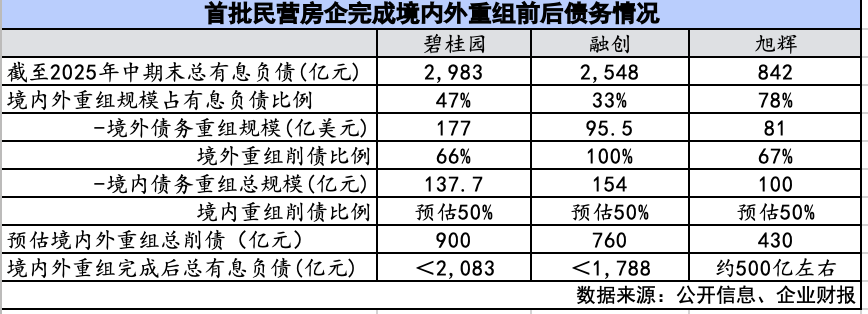
Core Viewpoint - The article discusses the significant progress made by real estate companies in debt restructuring, indicating a shift towards effective debt reduction strategies and a clearer path for recovery in the industry [3][4]. Group 1: Debt Restructuring Achievements - Country Garden, CIFI Holdings, and Sunac have successfully completed their domestic and overseas debt restructuring, significantly reducing their total debt and alleviating immediate repayment pressures [3][5]. - Country Garden's total interest-bearing debt was approximately 298.3 billion yuan, with a restructuring scale accounting for 47% of this debt, resulting in a debt reduction of about 900 million yuan [5]. - CIFI Holdings had a total interest-bearing debt of around 254.8 billion yuan, with a restructuring scale of 33%, leading to a debt reduction of approximately 760 million yuan [5]. Group 2: Changes in Debt Restructuring Strategies - The debt restructuring approach has evolved from "extension strategies" to "deep restructuring," focusing on substantial debt reduction rather than merely extending repayment timelines [4]. - Current typical methods for debt restructuring include debt-to-equity swaps, asset-for-debt exchanges, and long-term extensions, with debt reduction ratios ranging from 40% to 70% [4]. Group 3: Industry Outlook and Future Challenges - Despite the progress, some companies like China Fortune Land Development and Vanke are still facing challenges, indicating that the risk of debt issues persists in the industry [6]. - The real estate sector is expected to continue focusing on risk management and transformation in 2026, with debt restructuring being a critical aspect of this process [6][7]. - The industry is entering a crucial window for risk resolution, supported by favorable policies and improving market conditions, which may accelerate the debt reduction process [7].

融创碧桂园旭辉相继官宣债务重组
Xin Lang Cai Jing· 2025-12-30 03:56
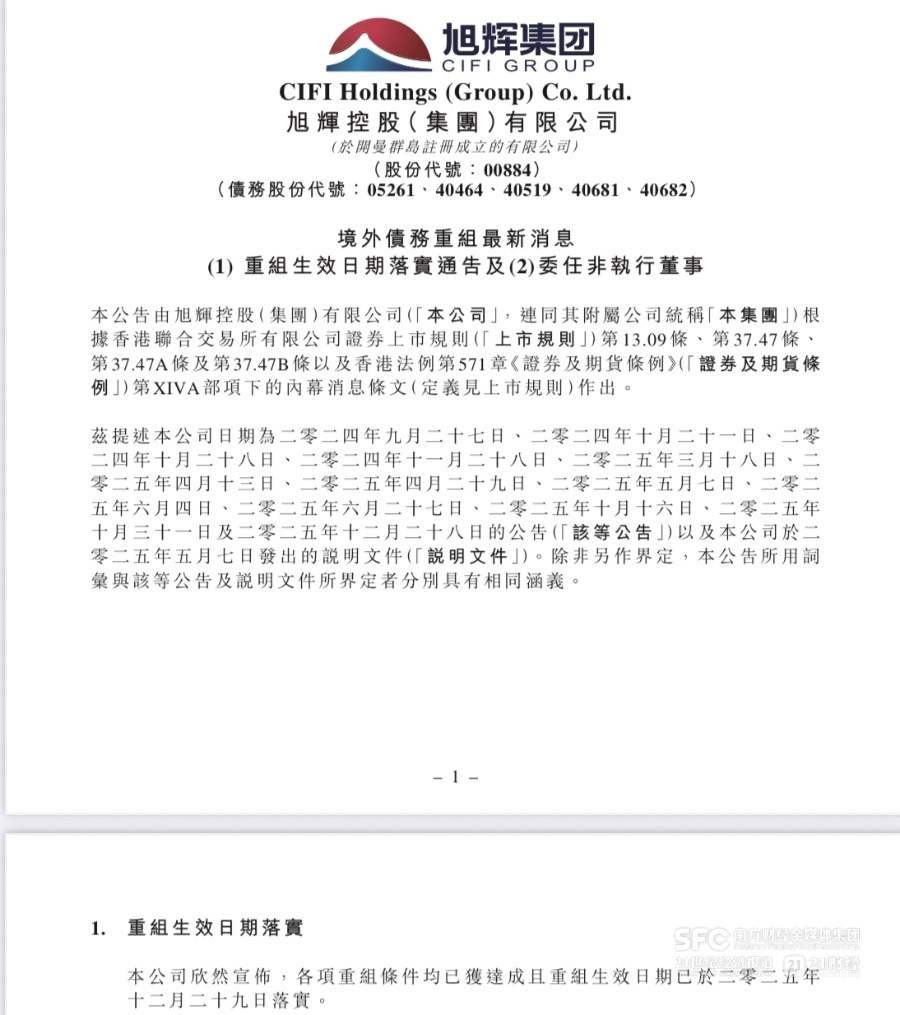
Core Viewpoint - The debt restructuring of three major real estate companies in China, namely Country Garden, CIFI Holdings, and Sunac, has been successfully completed, marking a significant step towards debt reduction and risk clearance in the industry by 2025 [1] Group 1: Debt Restructuring Announcements - Country Garden announced that December 30, 2025, will be the effective date for its debt restructuring [1] - CIFI Holdings confirmed that all conditions for its offshore debt restructuring have been met, with the plan officially taking effect on December 29, 2025 [1] - Sunac declared that all prerequisites for its comprehensive offshore debt restructuring were fulfilled, with the effective date set for December 23, 2025 [1] Group 2: Impact on Financial Health - The debt restructuring has led to a significant reduction in total debt for these companies, alleviating the risk of concentrated repayments in the coming years [1] - The restructuring is expected to save substantial interest expenses annually, providing a buffer for operational recovery [1]
融创碧桂园旭辉相继官宣,一周内三家房企债务重组落地
Di Yi Cai Jing· 2025-12-30 03:32
Core Viewpoint - The debt restructuring of real estate companies has entered a "2.0" phase, with significant progress in reducing debt and improving financial stability, particularly for major private firms like Country Garden, Sunac, and CIFI [2][3]. Group 1: Debt Restructuring Progress - By December 2025, major real estate companies have successfully completed their debt restructuring, significantly reducing their total debt and alleviating immediate repayment pressures [2]. - Country Garden announced a restructuring effective from December 30, 2025, while CIFI and Sunac also confirmed the completion of their overseas debt restructuring [2]. - The total debt reduction achieved by these companies is estimated to be around 1.2 trillion yuan, with approximately 21 distressed firms having completed their debt restructuring this year [4]. Group 2: Changes in Debt Restructuring Models - The debt restructuring model has shifted from "extension strategies" to "deep restructuring," focusing on substantial debt reduction rather than merely extending repayment timelines [3]. - Current typical methods for debt restructuring include debt-to-equity swaps, asset-for-debt exchanges, and long-term extensions, with debt reduction ratios ranging from 40% to 70% [3]. Group 3: Financial Metrics Post-Restructuring - After restructuring, the total interest-bearing liabilities for Country Garden, Sunac, and CIFI are projected to be below 208.3 billion yuan, 178.8 billion yuan, and approximately 50 billion yuan, respectively [4]. - The overseas debt restructuring for these companies has seen significant reductions, with Country Garden reducing its overseas debt by 66% and CIFI by 67% [4]. Group 4: Future Outlook and Challenges - The real estate industry is expected to continue facing challenges, with some companies like China Fortune Land Development encountering new issues in their restructuring processes [5]. - The focus for 2026 will be on balancing risk prevention and transformation, with expectations that the debt restructuring process will accelerate, contributing to the long-term health of the industry [5].
告别旧模式 房地产行业正向新而行迎稳健未来
Zheng Quan Ri Bao· 2025-12-25 16:41
Core Insights - The real estate industry is undergoing significant changes in 2025, moving away from high leverage and high turnover models towards a more stable future, with notable progress in debt risk resolution, housing delivery, and urban renewal initiatives [1] Debt Risk Resolution - In 2025, the debt risk that has plagued the real estate sector is being effectively alleviated, with 21 distressed real estate companies restructuring debts totaling approximately 1.2 trillion yuan, significantly reducing the industry's repayment pressure [2][3] - Notable companies like Sunac China and Country Garden have successfully completed substantial debt restructuring, with reductions of over 50% in some cases, improving their balance sheets and creating favorable conditions for long-term recovery [2] Housing Delivery Progress - The completion of housing delivery tasks is crucial for restoring market confidence, with over 7.5 million previously unsold homes being delivered by October 2025, leading to a significant recovery in buyer sentiment [6][7] - Companies like Far East Horizon have successfully completed their housing delivery commitments, enhancing market trust and demonstrating improved project quality and sustainability [6][7] Urban Renewal Acceleration - The focus of the real estate industry is shifting from expansion to quality improvement, with urban renewal becoming a key driver for investment and domestic demand [8] - Policies supporting urban renewal, including the issuance of special bonds for village renovations, have seen significant growth, with 816 billion yuan issued for urban village renovations in the first three quarters of 2025, a year-on-year increase of approximately 140% [8][9] Financial Tools and Support - The introduction of diverse financial instruments, such as REITs, is enhancing support for urban renewal projects, with the scope of infrastructure REITs expanding to include urban renewal facilities and commercial properties [9][10] - The collaboration between various stakeholders, including financial institutions and asset management companies, is facilitating the revitalization of stalled projects and improving the overall operational mechanisms within the industry [7][10]
孙宏斌两度现身,融创官宣上岸
2 1 Shi Ji Jing Ji Bao Dao· 2025-12-24 11:02
Core Viewpoint - Sunac China has successfully completed a comprehensive restructuring of its offshore debt, amounting to approximately $9.6 billion, marking it as the first major real estate company to achieve full debt restructuring both domestically and internationally, thereby alleviating its debt risks and stabilizing its capital structure [3][4][5]. Group 1: Debt Restructuring Details - The offshore debt restructuring plan was officially effective as of December 23, with nearly 600 billion yuan of debt being reduced, significantly mitigating the company's debt risks [3]. - The restructuring involved the issuance of two types of new mandatory convertible bonds (MCBs) with conversion prices set at HKD 6.80 and HKD 3.85, allowing for conversion within specified timeframes [6]. - A "shareholding stability plan" was introduced to maintain the major shareholders' equity ratio, preventing excessive dilution of shares [6]. Group 2: Company Background and Challenges - Sunac China faced a cash flow crisis starting in 2021, leading to public debt defaults in the first half of 2022, prompting the company to engage in debt restructuring efforts [4][5]. - The company had previously completed a domestic debt extension of 16 billion yuan in January 2023 and a $10 billion offshore debt restructuring in November 2023 [4][5]. - Despite the restructuring, the company still faces challenges in restoring its operational performance and managing its asset-liability structure [11]. Group 3: Industry Context and Future Outlook - As of now, 21 distressed real estate companies have completed debt restructuring, with a total debt reduction of approximately 1.2 trillion yuan, indicating a broader trend of risk clearance in the real estate sector [3][11]. - The Central Economic Work Conference has identified real estate as a key area for risk resolution in the coming year, with expectations that 2026 will be a critical year for clearing corporate risks [11]. - The industry is witnessing a shift towards lighter asset management strategies, such as property management and asset management, as companies aim to recover from their financial difficulties [11].
融创96亿美元境外债清零,孙宏斌安全“落地”
Guan Cha Zhe Wang· 2025-12-24 10:05
Core Viewpoint - Sunac China has successfully completed the restructuring of its offshore debt, marking a significant milestone in mitigating its debt risks and establishing a sustainable capital structure [1][5]. Group 1: Debt Restructuring Process - Sunac announced that all preconditions for the comprehensive offshore debt restructuring have been met, with the effective date set for December 23, 2025, resulting in the full release of approximately $9.6 billion in existing debt [1][2]. - The restructuring plan involves issuing two types of mandatory convertible bonds to creditors, with the first bond having a conversion price of HKD 6.8 per share and the second at HKD 3.85 per share [2][4]. - By June 2025, approximately 75% of the creditors had agreed to the restructuring plan, meeting the necessary voting threshold for court approval [3][5]. Group 2: Market and Industry Context - The successful restructuring of Sunac is part of a broader trend in the real estate industry, where multiple companies are actively pursuing debt restructuring amid increasing policy support [7][8]. - As of October 2025, 21 distressed real estate companies have completed debt restructuring, significantly reducing the industry's short-term debt repayment pressure [8]. - The restructuring of Sunac is expected to decrease its overall debt pressure by nearly RMB 100 billion, leading to substantial annual interest savings and improved financial health [8][9]. Group 3: Operational Challenges and Future Outlook - Despite the successful debt restructuring, Sunac still faces significant operational challenges, including a decline in contract sales and revenue, with a reported net loss of RMB 12.81 billion in the first half of 2025 [10]. - The company holds a substantial land reserve of 12.4 million square meters, primarily located in first- and second-tier cities, which provides a competitive advantage for future sales [10]. - Accelerating the liquidation of existing projects and revitalizing remaining assets are critical for Sunac's operational recovery moving forward [10].

孙宏斌两度现身 融创官宣“上岸”
2 1 Shi Ji Jing Ji Bao Dao· 2025-12-24 09:52
Core Viewpoint - The completion of Sunac China's debt restructuring marks a significant milestone in the real estate sector, indicating a potential turning point for the industry as it moves towards risk clearance in 2026 [1][9]. Group 1: Debt Restructuring - Sunac China announced the effectiveness of its offshore debt restructuring plan, resulting in the comprehensive release or waiver of approximately $9.6 billion in debt [1]. - The company has completed both domestic and offshore debt restructuring, becoming the first large real estate enterprise to achieve this [1]. - The total debt reduction amounts to nearly 60 billion yuan, effectively alleviating the company's debt risk at the listed company level [1]. Group 2: Industry Trends - As of now, 21 distressed real estate companies have completed debt restructuring or reorganization, with a total debt reduction scale of approximately 1.2 trillion yuan [8]. - The acceleration of debt restructuring among real estate firms is expected to facilitate the overall risk clearance process in the sector [9]. - The central economic work conference has identified real estate as a key area for risk resolution in the coming year [8]. Group 3: Future Outlook - Sunac's chairman, Sun Hongbin, has made public appearances signaling positive developments in the company's debt resolution efforts [5][6]. - The focus will shift towards project-level risk resolution and asset revitalization, with a total land reserve of over 124 million square meters, primarily in core first- and second-tier cities [4]. - The industry is expected to face ongoing challenges in project revitalization and operational recovery despite the completion of debt restructuring [9].