房地产行业风险出清

Search documents
融创96亿美元境外债清零,孙宏斌安全“落地”
Guan Cha Zhe Wang· 2025-12-24 10:05
Core Viewpoint - Sunac China has successfully completed the restructuring of its offshore debt, marking a significant milestone in mitigating its debt risks and establishing a sustainable capital structure [1][5]. Group 1: Debt Restructuring Process - Sunac announced that all preconditions for the comprehensive offshore debt restructuring have been met, with the effective date set for December 23, 2025, resulting in the full release of approximately $9.6 billion in existing debt [1][2]. - The restructuring plan involves issuing two types of mandatory convertible bonds to creditors, with the first bond having a conversion price of HKD 6.8 per share and the second at HKD 3.85 per share [2][4]. - By June 2025, approximately 75% of the creditors had agreed to the restructuring plan, meeting the necessary voting threshold for court approval [3][5]. Group 2: Market and Industry Context - The successful restructuring of Sunac is part of a broader trend in the real estate industry, where multiple companies are actively pursuing debt restructuring amid increasing policy support [7][8]. - As of October 2025, 21 distressed real estate companies have completed debt restructuring, significantly reducing the industry's short-term debt repayment pressure [8]. - The restructuring of Sunac is expected to decrease its overall debt pressure by nearly RMB 100 billion, leading to substantial annual interest savings and improved financial health [8][9]. Group 3: Operational Challenges and Future Outlook - Despite the successful debt restructuring, Sunac still faces significant operational challenges, including a decline in contract sales and revenue, with a reported net loss of RMB 12.81 billion in the first half of 2025 [10]. - The company holds a substantial land reserve of 12.4 million square meters, primarily located in first- and second-tier cities, which provides a competitive advantage for future sales [10]. - Accelerating the liquidation of existing projects and revitalizing remaining assets are critical for Sunac's operational recovery moving forward [10].


经济日报|全面客观看待房地产市场变化
Bei Jing Ri Bao Ke Hu Duan· 2025-12-10 00:28
Group 1 - The real estate market is transitioning towards a phase that balances both incremental and stock development, with ongoing policy effectiveness in stabilizing the market [1] - There is a noticeable differentiation in the real estate market, with active transactions in several major and medium-sized cities, showing a year-on-year increase in total transactions from January to November [1] - The decline in housing prices is narrowing, with new residential prices in 70 major cities decreasing by 3.6 percentage points and second-hand residential prices by 3.5 percentage points compared to the same period in 2024 [1] Group 2 - The decline in development investment should be viewed rationally, as the real estate market has entered a phase of basic supply-demand balance, with reduced supply of new residential properties [2] - The "white list" system for real estate financing continues to play a positive role, providing funding support for eligible projects and becoming a key part of the new development model [2] - Progress in debt resolution for real estate companies is being made, with a reduction in the number of new distressed companies and significant advancements in debt restructuring [2] Group 3 - The real estate industry is committed to high-quality, connotative development, with numerous new opportunities and values emerging during the transition towards a healthier market [3]
中经评论:全面客观看待房地产市场变化
Jing Ji Ri Bao· 2025-12-10 00:07
Core Insights - The real estate market is transitioning towards a phase that balances both incremental and stock developments, with ongoing policy effectiveness in stabilizing the market [1][2][3] Group 1: Market Trends - The real estate market is experiencing increasing differentiation, with active transactions in several major and medium-sized cities. From January to November this year, cities like Xiamen, Guiyang, Wuhan, and Shenzhen saw year-on-year growth in total transactions of new and second-hand homes [1] - The proportion of second-hand home transactions has been gradually increasing, indicating that the decline in new home transaction volume does not equate to a stagnant real estate market. Both new and second-hand homes have their unique attractions [1] - The decline in housing prices is narrowing. In October, the price drop for new and second-hand residential properties in 70 major and medium-sized cities decreased by 3.6 and 3.5 percentage points, respectively, compared to the same period in 2024 [1] Group 2: Investment and Financing - The decline in development investment should be viewed rationally, as the real estate market has entered a phase of basic supply-demand balance. The reduction in new residential supply is a positive response to strict control measures and a result of market self-adjustment [2] - The "white list" system for real estate financing continues to play a positive role, providing funding support for eligible projects and becoming a normalized management system in the real estate development framework [2] - Progress in debt resolution among real estate companies is notable, with a decrease in the number of new distressed firms and significant advancements in debt restructuring through various methods, indicating a gradual clearing of industry risks [2] Group 3: Future Outlook - The real estate industry is committed to pursuing an intrinsic, high-quality development path, with ample new opportunities and value in the process of transformation and upgrading [3]
研究中心2025年专题卡(1-8月)
克而瑞地产研究· 2025-08-31 14:00
Core Viewpoint - The article presents a comprehensive overview of the real estate industry, focusing on the trends, challenges, and opportunities for real estate companies in 2025, emphasizing the need for strategic adjustments and innovative approaches to navigate the evolving market landscape [2][8][12]. Group 1: Research Center Overview - The research center offers a systematic intelligence customization solution for real estate companies, providing insights into macro research, market analysis, corporate governance, project benchmarking, marketing cases, product cases, operational models, in-depth company studies, financing, and profit models [2][4]. - Each year, the center provides ten categories and fifty specialized topics for companies to choose from, allowing for tailored research based on specific needs [2][4]. Group 2: 2025 Specialized Topics - The 2025 specialized topics include analyses of real estate debt restructuring, investment prospects, and market trends, highlighting the need for targeted policies to enhance the effectiveness of special bonds and manage risks [6][7][8]. - The report indicates that the real estate investment outlook for 2025 has expanded to cover 297 cities, incorporating new indicators and updated data to refine market forecasts [8]. - The analysis of high-end residential sales trends reveals that luxury properties are performing well, particularly in cities like Shanghai, where demand remains strong despite market fluctuations [9]. Group 3: Financial Trends and Challenges - The financial landscape for real estate companies shows a significant contraction in operational cash flow, with a 16.8% decrease noted for non-state-owned enterprises, indicating a pressing need for companies to enhance their competitive edge and transition effectively [12][20]. - The report highlights that 72% of real estate companies are experiencing net profit losses, with the industry’s gross profit margin declining to 10% [19][20]. Group 4: Market Dynamics and Policy Implications - The article discusses the impact of new housing regulations on product development, shifting the focus from merely increasing usable space to optimizing living scenarios and enhancing service offerings [16]. - It emphasizes the importance of maintaining a stable market through continuous policy support, with a focus on risk mitigation and market stabilization efforts [26][77]. Group 5: Inventory and Supply Analysis - The inventory levels in key cities have reached a critical low, with certain urban areas facing severe supply constraints, necessitating strategic planning for land acquisition and development [18][20]. - The report indicates that the overall market is stabilizing, with a notable increase in second-hand housing transactions, which are seen as leading indicators for new housing market recovery [23][24].

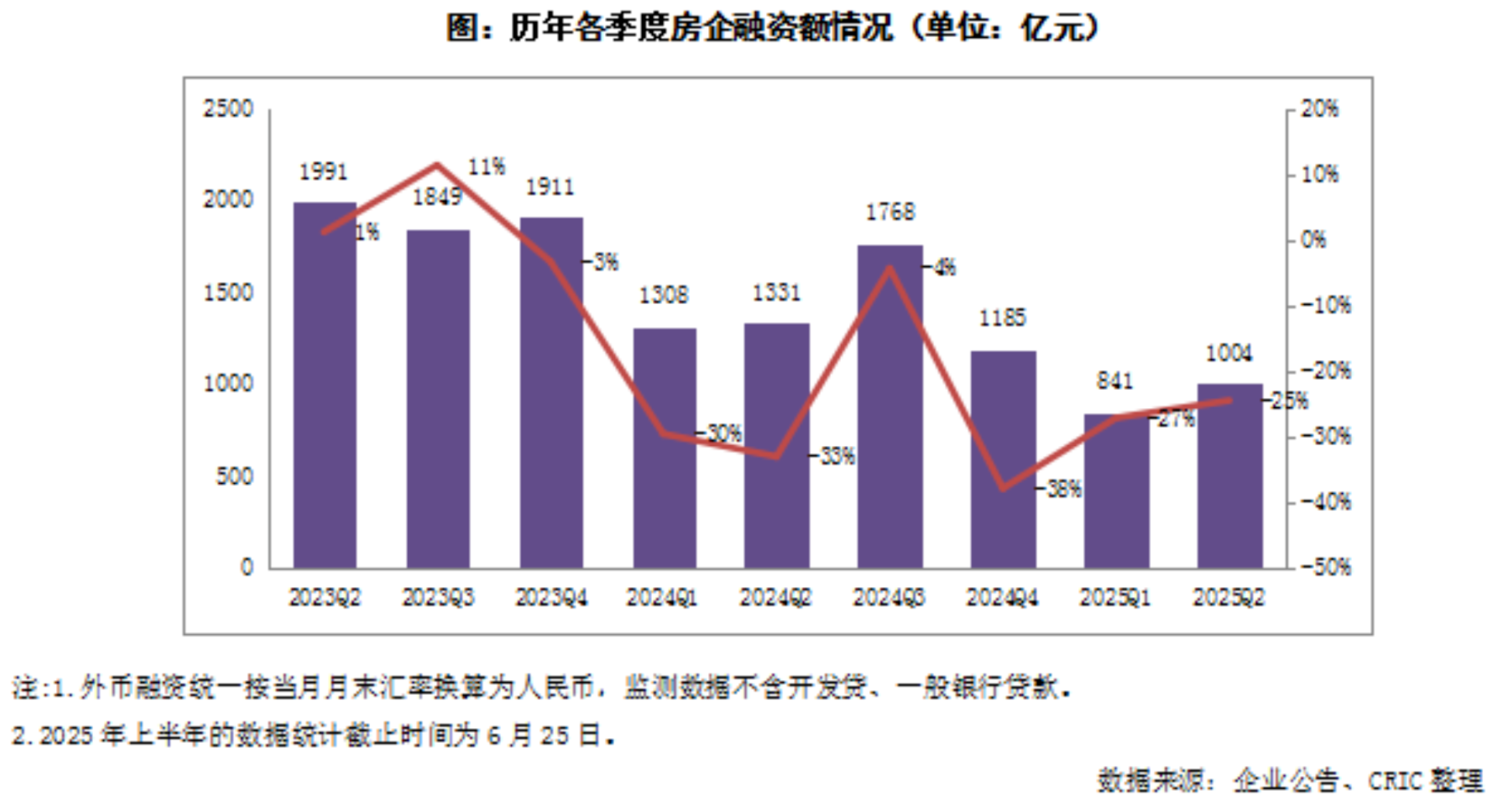
楼市“半年考” | 房企上半年融资收缩三成:境外债重启释放积极信号,下半年仍面临偿债高峰
Mei Ri Jing Ji Xin Wen· 2025-07-10 04:53
Group 1: Financing Trends - The financing scale for real estate companies in the first half of the year was 184.4 billion yuan, a year-on-year decrease of 30% [1] - In Q2, financing reached 100.4 billion yuan, a quarter-on-quarter increase of 19% but a year-on-year decrease of 25% [1] - Despite marginal improvements in financing support policies, the financing situation remains severe, particularly for private real estate companies [1][3] Group 2: Domestic and International Debt - The cost of domestic bond financing decreased to 2.71% in the first half of the year, down 0.2 percentage points from the previous year [4][7] - In contrast, the cost of overseas debt financing remains high, with rates around 8.60% for the first half of 2025 [3][4] - The average financing cost for real estate companies has increased, with New City Development's overseas bond issued at an 11.88% interest rate [3] Group 3: Debt Maturity and Repayment Pressure - The total bond maturity for real estate companies in 2024 is projected to be 482.9 billion yuan, while the issuance scale is only 220.9 billion yuan [13] - The debt pressure is expected to increase in 2025, with maturing debts reaching 532.7 billion yuan [13][16] - The third quarter of this year is anticipated to be a peak period for debt repayment, with approximately 160 billion yuan due [13] Group 4: Alternative Financing Strategies - Real estate companies are exploring various liquidity-boosting strategies, including asset sales and debt restructuring [16][18] - For instance, Aoyuan Group sold a stake in a subsidiary for 191 million yuan to repay debts [16] - The industry is also seeing significant progress in debt restructuring, with several companies completing judicial reorganization [18] Group 5: Policy and Market Outlook - The urban real estate financing coordination mechanism has been accelerated, with over 670 billion yuan approved for loans [17] - The government plans to issue 440 billion yuan in special bonds to support real estate development and debt repayment [17] - The industry is encouraged to explore new sustainable development models, with urban renewal being a key focus area [18][19]