投资周期

Search documents
时间:影响风险和回报的关键因素
Jin Rong Jie· 2025-06-19 09:15
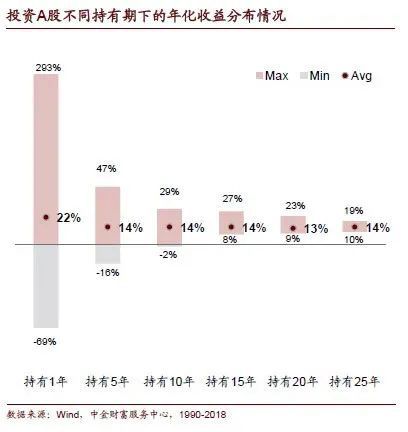
Core Insights - The article emphasizes the importance of time in investment, suggesting that a longer investment horizon allows for better risk management and potential returns [1][5] - It highlights the relationship between expected return rates and volatility, illustrating that short-term investments can lead to extreme fluctuations in returns [2][3] - The article discusses how different holding periods affect return consistency, with longer periods leading to more stable and predictable returns [4] Summary by Sections Time and Investment Strategy - Time is described as a critical factor in investment, serving as a lever for making informed decisions [1] - A longer time frame allows investors to focus on long-term potential rather than short-term volatility [5] Expected Returns and Volatility - A simulation shows that a one-day investment can lead to a wide range of annual returns, highlighting the risks of short-term trading [2] - The average annual return for U.S. stocks is around 10%, but short-term fluctuations can create significant uncertainty [2][3] Holding Period and Return Patterns - The article presents data showing that A-shares can have annual returns ranging from +293% to -69%, indicating high variability in short-term returns [4] - Over a five-year period, return patterns become more consistent, and over ten years, they align more closely with expected averages [4] Long-Term Investment Perspective - Understanding the impact of time can help investors plan better and avoid panic during short-term market fluctuations [5] - Adopting a long-term mindset can lead to different investment choices that yield better returns over time [5]

海能投顾深度解析比特币突破历史新高背后的市场逻辑
Sou Hu Cai Jing· 2025-05-24 00:59
Macro Economic Environment - The global major economies are maintaining loose monetary policies, providing ample liquidity support for the cryptocurrency market [1] - The Federal Reserve's low interest rate policy, combined with inflation pressures in some countries, has led more investors to view Bitcoin as a hedge against currency devaluation [1] - Institutional investors are significantly increasing their allocation to digital assets amid heightened volatility in traditional financial markets [1] Market Supply and Demand - The scarcity of Bitcoin is becoming increasingly evident, with over 90% of Bitcoin already mined, and remaining output expected to decrease gradually [1] - The declining reserves of Bitcoin on major exchanges indicate a strong market sentiment of holding rather than selling [1] - Several publicly listed companies have begun to include Bitcoin on their balance sheets, reshaping the market supply and demand dynamics [1] Technological Advancements - Continuous upgrades to the Bitcoin network are providing stronger support for its value storage function [1] - The rapid development of the Lightning Network has improved payment efficiency, while the Taproot upgrade has enhanced privacy and smart contract capabilities [1] - These technological advancements not only solidify Bitcoin's core position in the cryptocurrency ecosystem but also create conditions for the expansion of its application scenarios [1] Investment Cycle Perspective - The Bitcoin market exhibits clear cyclical characteristics, with historical data showing significant price increases typically occurring 18-24 months after each halving event [2] - The current market is within this cyclical time window, with institutional investors entering the market and altering the previously retail-dominated market structure [2] - A multi-dimensional analytical framework is essential for understanding Bitcoin market dynamics, requiring attention to macroeconomic changes, blockchain technology evolution, and market participant behavior [2]