
操纵市场

Search documents
又有8个大V账号被封!雪球一日连发“两弹”,“游资战法”等遭重点打击
Di Yi Cai Jing Zi Xun· 2026-01-20 10:09
Group 1 - The core viewpoint of the articles highlights the intensified regulatory actions against market manipulation and illegal stock recommendations on online platforms, particularly focusing on the recent permanent bans of 11 accounts on Xueqiu for violating market regulations [1][2] - Xueqiu's special governance initiative targets four types of violations: excessive speculation and market manipulation, illegal securities investment consulting, organized illegal operations, and the dissemination of false information [1] - The platform emphasizes the prohibition of using AI technology or misleading narratives to spread rumors or distort public information, which disrupts market order [1] Group 2 - On January 19, the Zhejiang Securities Regulatory Bureau imposed a fine exceeding 83 million yuan on a prominent Xueqiu influencer, Jin Yongrong, for manipulating 32 stocks using a "hat-snatching" technique, along with a three-year ban from the securities market [2]
严查过度炒作需做好四方面工作
Guo Ji Jin Rong Bao· 2026-01-19 10:10
Core Viewpoint - The China Securities Regulatory Commission (CSRC) emphasizes the need to strengthen trading supervision and information disclosure to maintain market fairness and prevent excessive speculation and market manipulation, particularly in light of the recent positive trends in the A-share market [1][2]. Group 1: Regulatory Focus - The CSRC's reiteration of "seriously investigating excessive speculation" is a targeted response to the increasing market speculation and volatility, especially following the favorable market conditions since September 2024 [2]. - Excessive speculation has been identified as a significant factor contributing to market fluctuations and instability, necessitating a proactive regulatory approach to maintain a stable market environment [2]. Group 2: Implementation Strategies - The CSRC suggests establishing clear quantitative standards for defining "excessive speculation" to minimize subjective enforcement and help investors avoid overly speculative stocks [2][3]. - Regulatory measures should treat new and old stocks equally, ensuring that both are subject to the same scrutiny to uphold fairness in market regulation [3]. - The implementation of effective regulatory measures, such as trading suspensions for stocks involved in excessive speculation and thorough investigations into potential illegal activities, is crucial for enhancing regulatory deterrence [3]. - Distinguishing between excessive speculation and market manipulation is essential, allowing for simultaneous investigations and actions against both types of behavior without conflating them [3].
还没上市,就涉嫌操纵市场?固德电材若上市还能走稳?
Sou Hu Cai Jing· 2025-12-17 08:38
Group 1 - The core issue revolves around the warning letter issued by the Jiangsu Securities Regulatory Bureau to the chairman of Gude Electric Materials, Zhu Guolai, for failing to disclose shareholding arrangements, leading to inaccurate shareholder information in financial reports [2][3] - The shareholding arrangements involved two instances of shareholding on behalf of others, with the first occurring from August to November 2016, where Zhang Aijuan held 65,000 shares on behalf of Zhu Ying, and the second in September 2016, where she held 42,000 shares on behalf of Li Xianggen [2] - The prospectus of Gude Electric Materials explicitly stated that the first shareholding arrangement was intended to enhance trading activity on the New Third Board, indicating a potential manipulation of market perception [3][4] Group 2 - A significant transaction occurred on July 14, 2016, where Zhu Guolai sold 900,000 shares to his wife, Zhu Ying, at a price of 1 yuan per share, followed by Zhu Ying selling 1,000 shares to Zhang Aijuan at 10 yuan per share the next day, indicating a "wash trade" scenario [4] - The trading activities between Zhu Guolai, Zhu Ying, and Zhang Aijuan resulted in a price fluctuation exceeding 50% in the stock price, raising concerns about market manipulation [4][5] - There is an indication that both Zhu Ying and Zhang Aijuan sold shares to a third party, Liang Yongqi, at a price of 11 yuan per share shortly after the company went public, with the brokerage involved being the same for all parties, suggesting coordinated trading [6][7]


恒润股份操纵市场投资者索赔案再提交立案,东方集团(600811)索赔案已开庭
Xin Lang Cai Jing· 2025-12-03 06:41
Group 1 - The core issue involves the manipulation of stock prices of Hengrun Co., Ltd. (603985), leading to investor claims against the company [1][2] - The China Securities Regulatory Commission (CSRC) has imposed administrative penalties on key individuals involved in the manipulation, including the second-largest shareholder and the chairman [1][3] - Between July 29 and November 8, 2023, the stock price of Hengrun Co. increased by 96.65%, significantly outperforming the Shanghai Composite Index, which fell by 6.86% during the same period [1][2] Group 2 - The manipulation involved the use of multiple securities accounts to maintain the stock price, with a total of 15,754,477 shares bought during the price decline, amounting to approximately 457.25 million yuan [2] - The CSRC found that from 2020 to 2023, Dongfang Group engaged in fraudulent activities that inflated reported revenues and costs, with significant discrepancies in financial reporting [3][4] - The inflated revenues for Dongfang Group were reported as 3.90 billion yuan, 4.87 billion yuan, 6.54 billion yuan, and 824.80 million yuan for the years 2020 to 2023, respectively [3]


香港证监会取得法庭命令冻结涉嫌操纵永续农业股份人士高达6260万港元的资产
智通财经网· 2025-12-02 09:13
Core Viewpoint - The Hong Kong Securities and Futures Commission (SFC) has issued a temporary injunction against an individual suspected of manipulating the shares of Perpetual Agricultural Development Co., Ltd., ensuring that assets valued at approximately HKD 62.6 million are preserved pending legal proceedings [1][2]. Group 1 - The temporary injunction was issued by the court as part of legal proceedings initiated by the SFC under Section 213 of the Securities and Futures Ordinance [1]. - The individual in question is accused of manipulating the shares between September 7, 2018, and November 5, 2018, and is prohibited from disposing of or handling assets in certain securities and bank accounts [1]. - The injunction remains in effect until the SFC's legal proceedings under Section 213 are resolved or the court issues further orders [1]. Group 2 - The SFC indicated that this temporary injunction is part of a broader enforcement action targeting a well-organized "pump and dump" market manipulation scheme [2]. - The individual is one of five defendants currently facing criminal charges, with the trial set to commence on July 13, 2026, in the District Court [2]. - The defendants are charged with multiple offenses, including conspiracy to commit fraud and violations of the Securities and Futures Ordinance and/or the Crimes Ordinance [2].
炒作股票名称不可取
Zheng Quan Ri Bao· 2025-11-12 16:20
Core Viewpoint - A listed company has issued multiple announcements indicating that its current price-to-earnings (P/E) ratio is significantly higher than that of its industry peers, suggesting a bubble in its stock price and warning investors of potential risks associated with trading [1] Group 1: Company Performance and Risks - The company has reported a net profit of -5,047,969.82 yuan for the third quarter of 2025, a decline of 225.26% compared to the same period last year, indicating a significant drop in performance [2] - Despite the company's warnings about abnormal stock trading and associated risks, market speculation continues, driven by the company's name rather than its fundamentals [2] - The company has implemented several cost control measures, but these have not yet fully offset the decline in revenue, leading to pressure on short-term operating performance [2] Group 2: Market Manipulation Concerns - There are concerns regarding potential market manipulation, as some individuals may exploit their advantages to artificially inflate stock prices, leading to rapid fluctuations and illegal profits [3] - Such manipulative behaviors distort stock prices and undermine the market's pricing function, misleading investors and disrupting their decision-making processes [3] - The company emphasizes the importance of focusing on fundamental values and sustainable growth rather than engaging in speculative trading based on superficial factors [3]
涉案金额460亿元,受理案件10942件!中证协、北京金融法院最新发布
券商中国· 2025-10-31 02:28
Core Viewpoint - The report highlights the increasing number of securities-related disputes in Beijing, emphasizing the prevalence of securities fraud cases and the expanding range of liable parties involved in these disputes [1][2][3][5]. Group 1: Case Statistics - From March 2021 to August 2025, the Beijing Financial Court accepted a total of 10,942 securities commercial cases, with a significant portion being securities fraud liability disputes [2][3]. - The total amount involved in securities dispute cases reached 45.928 billion yuan, with an average litigation amount of approximately 4.1974 million yuan per case [2][7]. - The number of securities fraud liability disputes accounted for 99.8% of all fraud-related cases, indicating a dominant trend in the types of disputes being filed [4]. Group 2: Types of Disputes - The report categorizes securities fraud liability disputes into four main types: false statements, insider trading, market manipulation, and fraud against clients, with false statements being the most common [4]. - The majority of cases involve false statements related to financial misrepresentation, misleading statements, and failure to disclose critical information [4]. Group 3: Involved Parties - A total of 45 intermediary institutions have been sued, including 11 securities companies, 19 accounting firms, 6 law firms, 5 asset appraisal agencies, and 4 credit rating agencies [5][6]. - The report notes that investors are increasingly suing not only the issuers but also their controlling shareholders, actual controllers, and senior executives, reflecting a trend towards broader accountability [5][6]. Group 4: Emerging Issues - The report identifies new challenges arising from the complexity of financial products and trading models, including potential lawsuits related to companies facing delisting due to fraud [8]. - There is a growing concern regarding large shareholders' illegal share reductions, which may lead to securities fraud claims, especially in light of new regulations governing share reductions [8][9]. - The report anticipates an increase in civil claims related to insider trading and market manipulation as investor awareness and legal frameworks evolve [9].

X @憨巴龙王
憨巴龙王· 2025-10-08 20:56
Market Analysis & Risk Assessment - Arbitrage opportunities arise from mechanism vulnerabilities, but are inherently risky, often leading to losses for early participants and gains for later ones [1] - High-yield arbitrage in 2025 carries significant risk [1] - Bybit's lack of limit orders in contracts can lead to 400% premiums, but implementing limit orders is not a guaranteed solution, as manipulation can still occur [1] - All mechanisms are susceptible to manipulation; imperfect mechanisms create opportunities [1] - Manipulators are not infallible and can also incur losses; participants can choose to avoid or align with manipulators [1] Case Studies & Examples - Recent liquidations on Bybit involving tokens like $SERAPH, $RFC, and $GROK resulted in over $10 million in customer losses [1] - OKEx's FIL futures in 2020 and STAR in 2023 experienced manipulation where limit orders prevented stop-loss execution [1] Investor Behavior & Platform Responsibility - Individuals should not blame platforms for losses incurred during arbitrage attempts if the platform mechanisms have vulnerabilities [1] - The article is a good analysis of the recent Bybit liquidations [1]
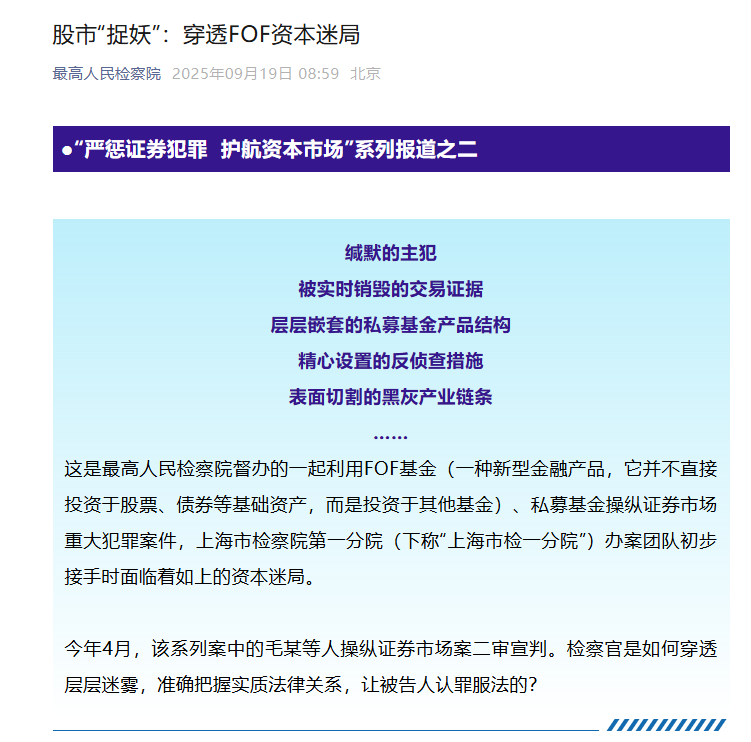
股市“捉妖”!量化私募跑路真相曝光 利用FOF进行场外配资、操纵市场
Shang Hai Zheng Quan Bao· 2025-09-19 09:35
Core Viewpoint - The recent exposure of details regarding the "30 billion quantitative private equity fund run" incident reveals the manipulation of the securities market by the involved parties, leading to significant legal consequences for the perpetrators [1][3][5]. Group 1: Incident Overview - The involved parties, including the actual controllers Mao and Yao of Panjing Investment, utilized FOF funds and private equity funds to manipulate the stock market, specifically targeting a stock code-named "Penguin" [1][3]. - From November 2017 to July 2019, the perpetrators controlled 55 accounts to trade the "Penguin" stock, eventually becoming one of its major shareholders by September 2020 [3][4]. Group 2: Legal Proceedings - The Shanghai First Intermediate Court sentenced Mao, Yao, and another accomplice to prison terms ranging from three years and six months to seven years for manipulating the securities market, along with fines between 1.5 million to 2.5 million yuan [5][6]. - Despite their refusal to confess, the Supreme People's Procuratorate utilized advanced AI tools to analyze the structure and operations of the involved funds, leading to a thorough investigation and eventual convictions [5][6]. Group 3: Industry Implications - The case has highlighted a black and gray industrial chain involving illegal financing practices through FOF and private equity funds, indicating a need for stricter regulatory oversight in the private equity sector [6][7]. - Regulatory bodies have intensified their scrutiny of private equity fund operations, aiming to eliminate illegal practices and promote healthy development within the industry [7][8].
香港证监会寻求法庭颁令以冻结涉嫌操纵智能股份的人士高达8240万港元的资产
智通财经网· 2025-09-12 14:04
Group 1 - The Hong Kong Securities and Futures Commission (SFC) has applied for an asset freeze order in relation to a market manipulation case involving affected investors [1] - The application was first heard on September 12, 2023, with the court directing the evidence to be archived and postponing the hearing to October 24, 2025 [1] - The legal action targets the former chairman and non-executive director of Ding Yi Feng Holdings Group International Limited (now renamed as Jiawen Century Investment Company, stock code 00612), along with 28 other suspects and a corporate entity [1] Group 2 - The alleged market manipulation occurred between October 31, 2018, and March 11, 2019, involving shares of Global Smart Holdings Limited [1] - The SFC seeks multiple court orders under Section 213 of the Securities and Futures Ordinance, including orders for affected counterparties to revert to their pre-trade status and to prevent the disposal of assets of 14 defendants, limited to a total of HKD 82.4 million [1]