
收益管理

Search documents
客座率表现良好,期待向票价传导
HTSC· 2025-07-16 06:36
Investment Rating - The aviation industry is rated as "Overweight" [5] Core Views - The industry is expected to maintain a low supply growth rate, which could improve the supply-demand relationship and enhance airline profitability if demand recovers [1][4] - Despite weak ticket prices recently, the high passenger load factor indicates potential for revenue management improvements [1][4] - The report recommends continuous monitoring of peak season ticket prices and passenger load factors, with a positive outlook for major airlines [1][4] Summary by Sections Passenger Load Factor Performance - In June, the three major airlines maintained a high passenger load factor of 84.1%, up 1.8 percentage points year-on-year [2] - Spring Airlines experienced a slight decline in load factor to 92.1%, while Juneyao Airlines showed improvement with a load factor of 86.7% [3] Revenue and Profitability Outlook - The three major airlines forecasted a narrowing of net losses for Q2 2025, with Air China, China Eastern, and China Southern expected to report net losses of 0.94 billion, 4.05 billion, and 8.00 billion respectively, reflecting a year-on-year reduction of 78.0% [4] - The improvement in profitability is attributed to better revenue levels, with domestic ticket prices showing a smaller decline compared to previous quarters [4] Stock Recommendations - The report highlights several stocks with a "Buy" rating, including Air China (753 HK), China Eastern Airlines (670 HK), China Southern Airlines (1055 HK), and Spring Airlines (601021 CH) [8][21] - Target prices for these stocks are set at 6.90 HKD for Air China, 3.20 HKD for China Eastern, and 5.00 HKD for China Southern, among others [8][21]






三大航减亏折返跑:南航亏损面继续扩大
Bei Jing Shang Bao· 2025-07-15 03:53
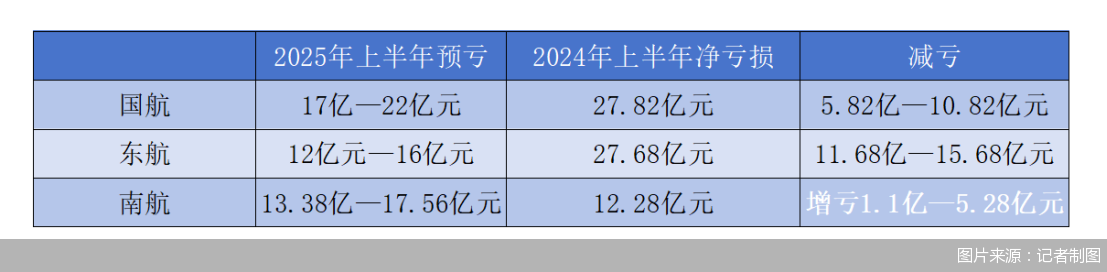
Core Viewpoint - The three major airlines in China reported significant losses for the first half of 2025, with noticeable performance differentiation among them. While Air China and China Eastern Airlines managed to reduce their losses, China Southern Airlines faced an increase in losses due to various challenges, including slow recovery of international routes and competitive disadvantages [1][3]. Group 1: Financial Performance - Air China is expected to report a net loss of 17 billion to 22 billion yuan, a reduction of 5.82 billion to 10.82 billion yuan compared to the previous year [2][3]. - China Eastern Airlines anticipates a net loss of 12 billion to 16 billion yuan, reducing losses by 11.68 billion to 15.68 billion yuan year-on-year [2][3]. - China Southern Airlines, however, is projected to incur a net loss of 11.68 billion to 15.68 billion yuan, an increase in losses by 1.1 billion to 5.28 billion yuan compared to the previous year [2][3]. Group 2: Market Conditions - The domestic passenger market is showing signs of steady recovery, but factors such as declining ticket prices and competition from high-speed rail continue to pressure airline revenues [1][6]. - The average ticket price for domestic economy class in the first half of 2025 was 740 yuan, a decrease of 6.9% year-on-year [6][7]. - The competitive landscape is shifting, with high-speed rail increasingly attracting high-end travelers away from airlines, while discounted airfares are drawing ordinary travelers to aviation [7][9]. Group 3: Operational Strategies - The three major airlines are focusing on expanding their routes in 2025, with Air China emphasizing the importance of both domestic and international route growth for profitability [5][10]. - Air China and China Eastern Airlines reported increases in passenger capacity and turnover, with Air China's capacity up by 3.5% and passenger turnover up by 5.5% in the first five months of the year [5][10]. - China Southern Airlines is also working to enhance its business travel market and international routes to mitigate its geographical disadvantages [10][13]. Group 4: Challenges and Outlook - China Southern Airlines faces significant operational challenges due to its geographical position, which has hindered the recovery of its international routes and increased competition in the domestic market [10][12]. - The airline's performance is further impacted by structural changes in passenger demographics and external factors such as international uncertainties and supply chain disruptions [10][12]. - As the critical summer travel season begins, all three airlines must navigate the dual challenges of revenue management and capacity allocation to improve their financial standings [1][13].

4月客座率突出,收益管理效果渐显
HTSC· 2025-05-19 03:10
Investment Rating - The report maintains an "Overweight" rating for the aviation transportation sector [5]. Core Insights - The aviation industry is experiencing a notable improvement in passenger load factors, with April's load factor increasing by 2.8 percentage points to 84.3% year-on-year, driven by a 7.8% increase in capacity [1][2]. - Revenue management strategies are beginning to show positive results, with domestic ticket prices increasing by 11.5% during the week of May 5-11 [1][4]. - The supply growth in the aviation sector is expected to remain low, which, combined with effective revenue management, suggests a potential for improved profitability for airlines throughout the year [1][4]. Summary by Sections Passenger Load Factors - The three major airlines reported a load factor increase of 3.1 percentage points to 84.0% in April, with domestic routes showing a 3.9 percentage point increase to 85.3% [2][10]. - Spring Airlines experienced a decline in load factor by 2.5 percentage points to 88.2%, while Juneyao Airlines showed a strong performance with a load factor increase of 2.9 percentage points to 86.2% [3][10]. Capacity and Revenue - The total available seat kilometers (ASK) for the three major airlines and Spring Airlines increased by 7.8% year-on-year, indicating a recovery in capacity [10]. - Revenue passenger kilometers (RPK) also rose by 11.5%, reflecting a strong demand recovery [10]. Future Outlook - The report anticipates that the supply-demand structure will continue to improve, leading to a favorable environment for revenue management and profitability enhancement during the peak summer travel season [4][21]. - The expected low supply growth, coupled with rising ticket prices, is likely to support airlines' earnings recovery [1][4]. Stock Recommendations - The report recommends a "Buy" rating for several airlines, including China National Aviation (601111 CH), China Eastern Airlines (600115 CH), and Spring Airlines (601021 CH), with target prices set at 10.20, 5.15, and 69.10 respectively [20][21].
南方航空(600029):归母同比大幅减亏 淡季量价偏离压制盈利能力
Xin Lang Cai Jing· 2025-04-02 12:25
Core Viewpoint - The company reported a revenue of 174.2 billion yuan for 2024, an increase of 8.9% year-on-year, but incurred a net loss attributable to shareholders of 1.7 billion yuan, an improvement from a loss of 4.21 billion yuan in 2023 [1] Group 1: Financial Performance - In Q4 2024, the company generated revenue of 39.6 billion yuan, a decrease of 2.2% year-on-year, with a net loss attributable to shareholders of 3.66 billion yuan, improved from a loss of 5.53 billion yuan in Q4 2023 [1] - The company experienced a decline in overall seat revenue by 5.7% year-on-year, with international seat revenue down 16% and domestic seat revenue down 3.4% [1] - The company confirmed a foreign exchange loss of 910 million yuan for the year, which offset some of the benefits from a 7.9% decrease in unit fuel costs due to lower oil prices [1] Group 2: Fleet and Operational Strategy - The company raised its net fleet growth rate for 2025 to 5.8%, reflecting historical stock orders, which is expected to alleviate pressure on fleet selection for single aircraft models [2] - The company plans to introduce 89, 91, and 71 aircraft from 2025 to 2027, with a focus on A320 and B737 models as the main drivers of fleet growth [2] - Improved passenger load factors and pricing balance during the off-peak season are anticipated to enhance profitability for both the industry and the company [2] Group 3: Market Outlook - The company is optimistic about the potential for profit improvement due to a downward shift in oil prices and enhanced revenue management [3] - The company expects net profits attributable to shareholders to reach 3.19 billion yuan, 4.24 billion yuan, and 7.67 billion yuan from 2025 to 2027, with corresponding price-to-earnings ratios of 32, 24, and 13 [3] - The company suggests that industry-wide profit recovery could lead to investment opportunities with higher profit elasticity [3]