
A320

Search documents
Ducommun (NYSE:DCO) Conference Transcript
2026-03-18 21:02
Ducommun (NYSE:DCO) Conference Call Summary Company Overview - **Company Name**: Ducommun - **Industry**: Aerospace and Defense - **History**: Oldest continuously operating company in California, evolved from a general store to a provider of engineered products for aerospace and defense over 177 years [2][3] Financial Performance - **Market Capitalization**: Increased by almost 400% as of the end of last year, with further growth noted in early 2026 [4] - **Revenue Growth**: Achieved a 50% increase in revenues despite a downturn in commercial aerospace due to the pandemic [4] - **EBITDA Growth**: Increased by 144%, with a margin expansion of 600 basis points under current management [5] Business Segmentation - **Revenue Composition**: - 58% from defense - 38% from commercial aerospace - 4% from niche industrial exposure [5] - **Key Platforms**: Focus on narrow-body platforms (e.g., 737 MAX, A220, A320) and some wide-body exposure (e.g., 787) [6] Strategic Initiatives - **Vision 2027 Strategy**: A five-year plan aiming to grow revenue from approximately $700 million in 2022 to $950 million-$1 billion by 2027, with a target margin expansion from 13% to 18% [10] - **Margin Expansion**: Achieved 340 basis points of margin expansion, primarily through improvements in gross margin, disciplined pricing, and cost management [11][12] Engineered Products Focus - **Engineered Products Growth**: Increased from 15% to 23% of revenue, with a target of over 25% by the end of next year [13] - **Acquisitions**: Completed five acquisitions in the last 8-9 years, focusing on businesses with engineered product attributes [14] Defense Sector Insights - **Defense Business Growth**: - Missiles business grew by 20% in 2025 - Radar business grew by over 30% in 2025 - Overall defense business grew by 14% [16][22] - **Key Programs**: Positioned on critical missile programs identified by the Department of Defense, with long-term agreements in place to ramp up production [24] Manufacturing Capabilities - **Niche Manufacturing**: Capabilities include ruggedized interconnects, circuit card assemblies, and titanium hot forming parts, allowing for decent margins even without design IP [18] - **Capacity for Growth**: Existing capacity allows for significant growth in both commercial aerospace and defense sectors [30] Competitive Landscape - **Market Position**: Sole source for many engineered products, ensuring long-term contracts once specced in [42] - **Competitors**: Diverse competitors across different product lines, including subsidiaries of larger firms like TransDigm and HEICO [42] M&A Strategy - **Acquisition Focus**: Targeting engineered product businesses within aerospace and defense, avoiding industrial companies [46] - **Leverage Management**: Current management has successfully reduced leverage over the past 8-9 years, with a willingness to maintain conservative leverage levels [46][49] Future Outlook - **Investor Day**: Planned for September 17, where the next five-year plan will be announced, building on the progress made towards Vision 2027 [25][26] - **Growth Potential**: Strong positioning in both defense and commercial aerospace sectors, with expectations for continued growth driven by geopolitical events and increased production needs [22][24] This summary encapsulates the key points from the Ducommun conference call, highlighting the company's strategic direction, financial performance, and market positioning within the aerospace and defense industry.

中航西飞20260302
2026-03-03 02:52
Summary of the Conference Call for AVIC Xi'an Aircraft Industry Group Company Overview - AVIC Xi'an Aircraft Industry Group is a major integrated base for the research and manufacturing of large and medium-sized aircraft in China, responsible for the independent development of the Y-20 military strategic transport aircraft, filling a gap in domestic development [2][5][6]. Core Industry Insights - The Y-20 serves as a versatile platform that meets intercontinental and high-speed delivery needs, with capabilities for aerial refueling, emergency rescue, and information support [2][7]. - China is the second-largest single aviation market globally, with a projected compound annual growth rate (CAGR) of approximately 4.4% for new aircraft demand over the next 20 years [2][8]. - The market size for single-aisle jet aircraft is estimated at $900 billion, while the wide-body aircraft market is around $600 billion [2][8]. Key Developments and Performance Metrics - As of the end of 2025, the C919 is expected to have delivered 31 aircraft, with operations in 19 domestic city routes and over 3.6 million passengers carried [2][9]. - The C909 has already carried over 30 million passengers, indicating significant potential in the domestic regional market [2][10]. - The three major airlines (Air China, China Eastern Airlines, and China Southern Airlines) have placed orders for over 300 C919 aircraft, with delivery expected between 2024 and 2031 [2][9]. Business Structure and Strategic Positioning - The company’s business is divided into three main segments: military aircraft, aircraft components, and international cooperation and subcontracting [6][12]. - AVIC Xi'an is the largest supplier of airframe structures for the C919 and C909, with significant contributions to the C929 and new regional aircraft series [2][11]. International Collaboration and Market Dynamics - International subcontracting is a common practice in aircraft manufacturing, with Boeing and Airbus outsourcing about 60% of their components globally [12]. - AVIC Xi'an is one of the largest domestic participants in international subcontracting projects, with a strong track record of over 30 years in the industry [12]. Future Outlook and Growth Projections - The company aims for a compound profit growth target of approximately 15% through 2025, with expectations to maintain similar growth rates in 2026 and 2027 [13][14]. - The focus on low-altitude economy and aerospace as emerging strategic industries is expected to accelerate in 2026, with significant government support [3][15]. Additional Considerations - The company is positioned to benefit from the increasing demand for large transport aircraft, particularly in military trade, as global supply dynamics shift [7][15]. - The domestic regional market is characterized by rapid growth, especially in underserved areas, with the C909 addressing fundamental connectivity issues [10]. This summary encapsulates the key points from the conference call, highlighting AVIC Xi'an's strategic positioning, market insights, and future growth potential in the aviation industry.

Ducommun(DCO) - 2025 Q4 - Earnings Call Presentation
2026-02-26 18:00
Q4 2025 Earnings Call Stephen Oswald - Chairman, President and Chief Executive Officer Suman Mookerji – Senior Vice President, Chief Financial Officer February 26, 2026 Disclosures Forward-Looking Statements: This presentation contains forward-looking statements within the meaning of the Private Securities Litigation Reform Act of 1995. Forward-looking statements may be preceded by, followed by or include the words "believe," "continue," "estimate," "expect," "may," "plan," "potential," "should," "result," ...
Airbus Hits Out at Pratt & Whitney Over Engine Shortages
Yahoo Finance· 2026-02-19 13:03
Airbus is slowing down production of its A320. - sergio yate/Agence France-Presse/Getty Images Airbus said it would deliver fewer aircraft than expected this year because of significant shortages of Pratt & Whitney engines, issuing a sharp public rebuke of one of its largest suppliers. Shares of the European plane maker fell as much as 8% on Thursday after the company said the engine issue had forced it to slow production of its bestselling A320 jets—the latest setback in its efforts to capitalize on a p ...

Airbus CEO: Engine shortages are 'unsatisfactory'
Youtube· 2026-02-19 13:01
Core Viewpoint - The company is facing challenges with engine supply from Pratt & Whitney, which is impacting its production targets for 2026 and beyond. The company is pursuing contractual rights to address these issues. Engine Supply Issues - The company has an order in place with CFM, which is confirming its commitment, but Pratt & Whitney is scaling down its delivery, resulting in fewer engines than needed for 2026 [1][2] - CFM has increased its engine supply incrementally, but cannot guarantee additional deliveries beyond current commitments for 2026 [3] - The company is exploring options with Pratt & Whitney to increase engine supply, but the shortfall from Pratt is significant and difficult to offset [4] Legal and Contractual Actions - The company is considering legal action against Pratt & Whitney to enforce its contractual rights if an amicable resolution cannot be reached [5] Supply Chain Performance - The overall supply chain has improved significantly since the COVID-19 pandemic, although there are still some issues, such as a panel issue on the A320 that will take time to resolve [6][7] - The company enters 2026 in a better position than in previous years, despite ongoing challenges [7] Production Targets - The company aims to deliver around 870 aircraft in 2026, which is considered achievable despite the engine supply challenges [8][10] - The ramp-up of production is supported by increased final assembly lines, including new facilities in Mobile, Alabama, and Tulu [9][10]


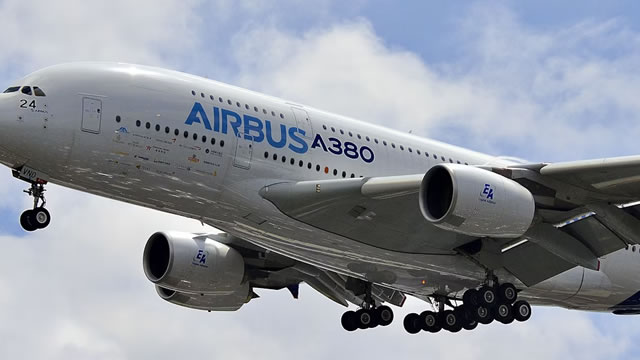
X @Bloomberg
Bloomberg· 2026-02-19 05:08
Airbus said the lack of reliable engine supplies for its A320 family of jets is holding back production and aircraft deliveries https://t.co/kz2VYuYxDr ...
Boeing’s Stepped-Up Plane Deliveries Lift Sales
Yahoo Finance· 2026-01-27 13:39
Group 1 - Boeing's business saw a significant improvement with a 57% increase in sales to $23.95 billion, driven by the highest commercial aircraft deliveries since 2018 [1][2] - The company reported a fourth-quarter profit of $8.22 billion, a turnaround from a loss of $3.87 billion the previous year, largely due to the sale of its digital aviation business, which generated approximately $9.6 billion [2] - Boeing's overall order backlog reached a record $682 billion, indicating strong demand for its products [1] Group 2 - The recovery of Boeing has been uneven since 2024, influenced by regulatory actions that required the company to slow production and address quality-control issues, alongside a significant strike that affected the 737 MAX production [3][4] - The Federal Aviation Administration (FAA) has shown confidence in Boeing by allowing the company to perform final safety checks on planes and increasing the production limit for the 737 MAX to 42 jets per month [4] - Boeing aims to generate more cash than it spends by 2026, necessitating an increase in jet production rates, although achieving a target of $10 billion in annual free cash flow may take several years [5] Group 3 - Faster production is essential for Boeing to compete with Airbus, which has capitalized on Boeing's challenges, leading to comparable delivery rates of Airbus A320 jets and Boeing 737s despite Boeing's earlier market advantage [6]

Airbus (OTCPK:EADS.F) Update / briefing Transcript
2026-01-27 08:02
Airbus Q4 2025 Pre-Call Summary Company Overview - **Company**: Airbus (OTCPK:EADS.F) - **Call Date**: January 27, 2026 - **New Head of Investor Relations**: Jean-Christophe Henoux, appointed December 1, 2025 Key Points Financial Performance - **Aircraft Deliveries**: Delivered 286 aircraft in Q4 2025, an increase of 17 aircraft compared to 269 in Q4 2024, including: - +1 A220 - +9 A320 - +3 A350 - +4 A330 [3] - **Fixed Costs**: Anticipated mechanical under assumption of fixed costs due to shortfall against initially planned delivery volume [3]. - **Foreign Exchange Impact**: Stable average blended rate at 1.21 for Q4 2025, expected to have a neutral financial impact compared to Q4 2024 [3]. - **Recruitment**: Continued hiring in 2025, but at a slower pace than in 2024 [3]. Cost and Inflation - **Inflation Impact**: Expected low triple-digit negative impact in 2025, slightly less than EUR 200 million negative impact recorded in 2024 [4]. - **R&D Expenses**: Anticipated to be slightly lower than in 2024 [4]. - **Tariffs**: Financial impact for 2025 expected to be between EUR 100 million and EUR 200 million, with most recorded in Q4 [4]. Division Performance - **Airbus Helicopters**: Similar volume of helicopters delivered in Q4 2025 compared to Q4 2024, with solid performance expected in services [5]. - **Airbus Defence and Space**: A charge of EUR 0.3 billion recorded in Q4 2024 for contract updates; only two-thirds of this charge is expected to normalize [5]. - **Free Cash Flow**: Expected to reflect higher volume of commercial aircraft deliveries, despite updates to delivery targets impacting inventory levels [6]. Market Outlook - **Order Momentum**: Strong momentum observed in all divisions for both civil and military markets in Q4 2025 [6]. Communication and Guidance - **Quiet Period**: Quiet period begins January 29, 2026, with full year 2025 earnings release scheduled for February 19, 2026, at 7:30 A.M. CET [2][7].
Is Boeing's Q4 Delivery Growth Indicating Better Execution?
ZACKS· 2026-01-14 15:31
Core Insights - Boeing Company reported a significant increase in aircraft deliveries for Q4 2025 and the full year, indicating strong performance in both commercial and defense sectors [1][2][4] Commercial Deliveries - In Q4 2025, Boeing delivered 160 commercial airplanes, a substantial rise from 57 aircraft delivered in the same quarter of the previous year [1] - For the entire year, Boeing delivered 600 commercial jets, up from 348 in 2024, with the majority of Q4 deliveries coming from the 737 program (117 aircraft) [2][9] Defense Deliveries - Boeing's Defense, Space and Security segment delivered 37 aircraft in Q4 2025, slightly higher than 36 units in the same period last year [3] - Total defense deliveries for the year reached 131 aircraft, an increase from 112 units delivered in the prior year, showcasing the segment's contribution to Boeing's diversified aerospace portfolio [4][9] Operational Efficiency - The increase in deliveries is expected to enhance Boeing's ability to convert production into revenues and improve overall cash flow, reflecting better operational control and customer confidence [5] Industry Comparison - In comparison, Airbus delivered 793 commercial aircraft in 2025, surpassing Boeing's 600 deliveries, indicating a competitive landscape in the aerospace industry [6] - Embraer delivered 148 aircraft in the first nine months of 2025, showing steady demand in its market segment, although on a smaller scale than Boeing and Airbus [7] Stock Performance - Boeing's shares have increased by 47.2% over the past year, outperforming the industry's growth of 35.4% [8] - The company's shares are currently trading at a relative discount, with a forward 12-month Price/Sales ratio of 1.96X compared to the industry's average of 2.76X [10]
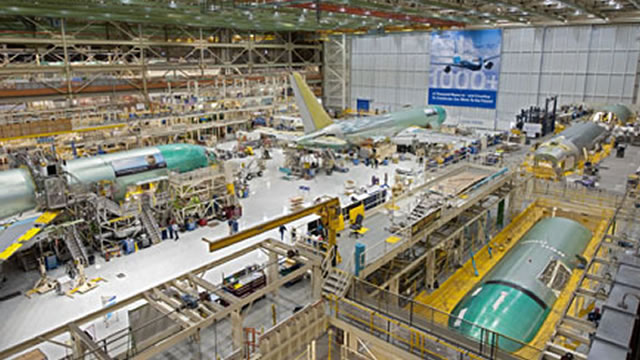
X @Bloomberg
Bloomberg· 2025-12-17 16:18
The European Union Aviation Safety Agency is mandating inspections of some Airbus SE A320 jets and requiring carriers to repair any out-of-spec panels found on the fuselages. https://t.co/Og3I7Whj1P ...