文化创新创造活力

Search documents
王蒙在人民日报撰文:全民阅读,焕发文化活力
Xin Lang Cai Jing· 2025-12-27 23:52
Core Viewpoint - The promotion of reading and learning is emphasized as a crucial aspect of traditional Chinese culture, with the government elevating national reading as a strategic initiative to enhance cultural innovation and creativity [1][2]. Group 1: Importance of Reading - Reading is essential for personal and national development, as highlighted by historical figures and texts that stress the value of education and knowledge acquisition [1]. - The shift towards a national strategy for promoting reading is seen as a positive development, with the introduction of the "National Reading Promotion Regulations" expected to foster a culture of reading [2]. Group 2: Challenges of Modern Reading Habits - Fragmented reading habits, such as skimming through digital content, hinder deep understanding and retention of knowledge, with studies indicating that physical books are more effective for memory and comprehension [2]. - The convenience of modern life should not be an excuse for neglecting reading; individuals are encouraged to utilize available time for reading, drawing on historical examples of dedication to learning [3]. Group 3: Policy and Community Support - There is a call for cultural and educational institutions to support reading initiatives, including recognition for avid readers and the promotion of classic literature through discussions and workshops [4]. - Libraries and community spaces are identified as vital for fostering a reading culture, with suggestions for improving their resources and services to enhance public engagement with literature [4]. Group 4: Family and Societal Influence - The family environment plays a crucial role in developing reading habits, with the contrast between engaging in reading versus screen time having lasting impacts on children [4]. - A thriving reading culture is linked to increased confidence, ambition, and overall happiness within society, suggesting that a collective effort towards reading can lead to a more vibrant cultural atmosphere [4].
让静态文物成为生动教材 激发好奇心和想象力
Bei Jing Wan Bao· 2025-12-01 06:44
Core Insights - The exhibition "Tai Bao Yong Yan - Special Exhibition of Liuli River Site in Fangshan" at the Capital Museum showcased the charm of cultural heritage, attracting many visitors and highlighting the integration of cultural relics into modern creative products [1] - The Beijing Municipal Bureau of Cultural Relics reported significant developments in the "Museum City" initiative during the 14th Five-Year Plan, including the addition of 49 new registered museums and the opening of 56 new types of museums, bringing the total to 266 [2] - The Liuli River site, discovered 80 years ago, is recognized as the earliest urban relic in Beijing and has yielded important archaeological findings, including the first double city wall of the Western Zhou period [2] Digital Innovation in Museums - The Capital Museum is leveraging digital technologies for the preservation and utilization of cultural relics, enabling virtual tours and immersive experiences that allow audiences to engage with history [1] - The museum aims to create more interactive and participatory exhibitions, transforming static artifacts into dynamic educational tools that stimulate public curiosity [1] Archaeological Significance - The Liuli River site has been included in the national list of top ten archaeological discoveries, with significant breakthroughs in understanding the social structure and family relationships of the Western Zhou period through advanced research methods [2] - The site is currently on the preliminary list for UNESCO World Heritage status, with ongoing efforts to develop the Liuli River National Archaeological Park [2]


文博联动让“城之源”活起来
Bei Jing Ri Bao Ke Hu Duan· 2025-11-30 22:41
Core Viewpoint - The article highlights the significance of the "Tai Bao Yong Yan - Fangshan Liuli River Site Special Exhibition" at the Capital Museum, emphasizing the integration of technology in cultural heritage presentation and the ongoing efforts to enhance public engagement with historical artifacts [3][4]. Group 1: Exhibition and Public Engagement - The exhibition attracted many visitors on its last day, showcasing the allure of cultural heritage through interactive multimedia displays [3]. - Visitors expressed pride in their connection to Beijing's historical roots, indicating a successful outreach of the exhibition [3]. - The museum aims to utilize new technologies to make cultural resources more accessible and engaging for the public [4]. Group 2: Technological Integration - The museum is implementing digital technologies for the permanent preservation and sustainable use of cultural artifacts, including virtual exhibitions and 3D modeling [4]. - There is a focus on using immersive technologies, such as artificial intelligence, to recreate historical scenes and enhance visitor experiences [4]. Group 3: Cultural Development Initiatives - The Beijing Municipal Bureau of Cultural Heritage reported the addition of 49 new registered museums and the opening of 56 new types of museums during the 14th Five-Year Plan period, bringing the total to 266 registered museums [4]. - The city is actively promoting cultural innovation and development through various initiatives, including the "Beijing Museum Season" and the "Cultural Relics Tell You Why Chinese Festivals" series [5]. Group 4: Archaeological Significance - The Liuli River site, discovered 80 years ago, is recognized as the earliest urban relic in Beijing, with significant archaeological findings that contribute to understanding the history of the Western Zhou period [5]. - The site has been included in the national list of top ten archaeological discoveries, with ongoing efforts for its inclusion in the UNESCO World Heritage list [5][6].

李书磊在人民日报撰文
Zhong Guo Ji Jin Bao· 2025-11-07 02:44
Core Viewpoint - The article emphasizes that cultural prosperity is a significant indicator of Chinese-style modernization, asserting that without the development of socialist culture, there can be no socialist modernization [2]. Group 1: Importance of Cultural Innovation - The key to building a strong cultural nation lies in stimulating the innovative and creative vitality of the entire nation, which is crucial for the overall construction of Chinese-style modernization and the rejuvenation of the Chinese nation [3]. - Cultural innovation is essential for cultural prosperity, as it is the lifeblood of culture. The article highlights the historical continuity of Chinese civilization as a result of its ability to adapt and innovate [4]. - Meeting the spiritual and cultural needs of the people requires stimulating cultural innovation, as the demand for quality and diverse cultural products is increasing among the populace [5]. - In the context of international cultural competition, fostering cultural innovation is necessary to enhance China's cultural competitiveness and influence on the global stage [6]. Group 2: Basic Requirements for Cultural Innovation - The article outlines that stimulating cultural innovation must adhere to the leadership of the Communist Party and follow the path of socialist cultural development [8]. - It emphasizes the importance of rooting cultural innovation in the profound heritage of Chinese civilization, advocating for the creative transformation and innovative development of traditional culture [9]. - The necessity of aligning cultural innovation with contemporary practices is highlighted, suggesting that cultural creation should draw from the realities of modern society [10]. - Embracing the trends of information technology is crucial, as technological advancements can significantly drive cultural innovation and creativity [11]. - The article advocates for an open and inclusive approach to cultural development, encouraging the exchange of ideas and learning from other civilizations [12]. Group 3: Measures to Promote Cultural Prosperity - The article calls for the promotion and practice of socialist core values as a foundation for cultural cohesion and development [13]. - It stresses the importance of fostering a vibrant cultural ecosystem that encourages diverse artistic expressions and high-quality creative works [15]. - The need for rapid development of the cultural industry is emphasized, particularly as China transitions from a middle-income to a high-income country, suggesting that this phase is critical for cultural industry growth [17]. - Enhancing the global influence of Chinese civilization is deemed essential, with recommendations for improving international communication strategies and cultural exchanges [18].
李书磊在人民日报撰文
中国基金报· 2025-11-07 01:52
Core Viewpoint - The article emphasizes that cultural prosperity is a significant indicator of Chinese-style modernization, asserting that without the development of socialist culture, there can be no socialist modernization [6][7]. Group 1: Importance of Cultural Innovation - The key to building a cultural power lies in stimulating the innovative and creative vitality of the entire nation, which is crucial for the overall construction of Chinese-style modernization and the rejuvenation of the Chinese nation [8]. - Cultural innovation is essential for cultural prosperity, as it is the lifeblood of culture. The article highlights the historical continuity of Chinese civilization through innovation and adaptation [9]. - Meeting the spiritual and cultural needs of the people requires stimulating cultural innovation, as the demand for quality and diverse cultural products is increasing among the populace [10]. - In the context of international cultural competition, enhancing cultural innovation is necessary to establish cultural competitiveness and influence on the global stage [11]. Group 2: Basic Requirements for Cultural Innovation - The article outlines that stimulating cultural innovation must adhere to the leadership of the Communist Party and follow the path of socialist cultural development [12]. - It stresses the importance of maintaining Marxism's guiding position in the ideological realm to ensure the correct direction of cultural development [13]. - Rooting cultural innovation in the profound Chinese civilization is essential, promoting the creative transformation and innovative development of traditional culture [14]. - Cultural innovation must be based on the great practices of the new era, addressing new challenges and drawing inspiration from the people's creative practices [15]. - Embracing the trends of information technology is crucial, as technological advancements can significantly drive cultural innovation [16]. - The article advocates for an open and inclusive approach to cultural development, learning from other civilizations to inspire innovation [17]. Group 3: Measures to Promote Socialist Culture - The article proposes several major initiatives to stimulate cultural innovation and promote socialist culture, emphasizing the need for a strong sense of political responsibility and urgency [18]. - Promoting and practicing socialist core values is essential, as they serve as the moral foundation for the nation [19]. - A thriving cultural ecosystem is necessary for cultural prosperity, encouraging diverse artistic expressions and high-quality creative works [20]. - The protection and respect for cultural heritage are vital, ensuring the preservation and transmission of historical culture [21]. - Accelerating the development of the cultural industry is crucial, especially as China transitions from a middle-income to a high-income country, leveraging this opportunity for rapid cultural industry growth [22]. - Enhancing the influence and dissemination of Chinese civilization globally is important for establishing China's position in the world cultural landscape [23].
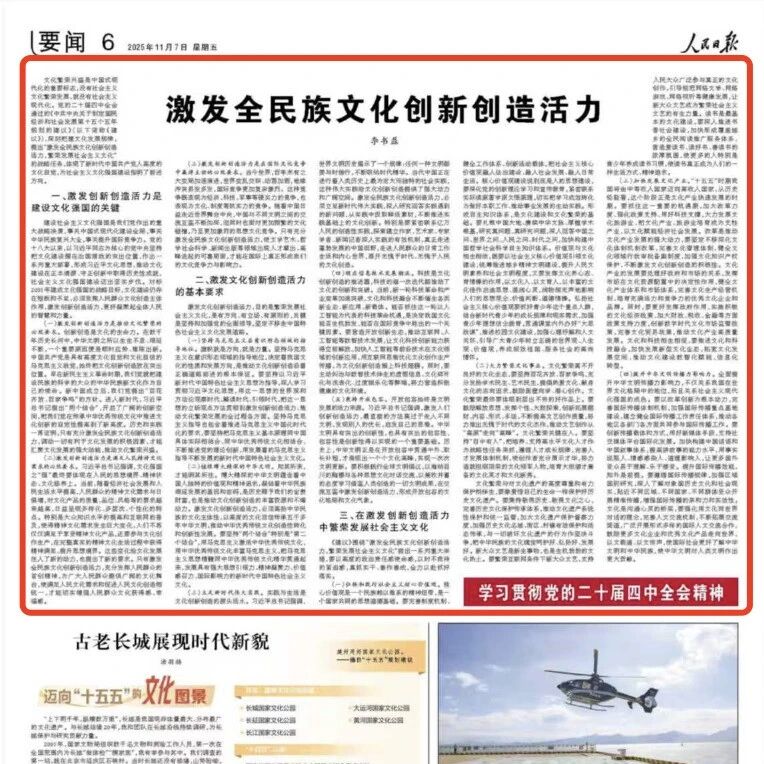
激发全民族文化创新创造活力(学习贯彻党的二十届四中全会精神)
Ren Min Ri Bao· 2025-11-06 22:11
Core Viewpoint - The prosperity of culture is a significant indicator of Chinese-style modernization, emphasizing that without the development of socialist culture, there can be no socialist modernization [1] Group 1: Importance of Cultural Innovation - Stimulating innovation and creativity is crucial for building a cultural powerhouse, impacting the overall modernization of China and the rejuvenation of the Chinese nation [2][3] - Cultural innovation is essential for cultural prosperity, as it has been a vital force throughout Chinese history, enabling the continuous evolution of civilization [3] - Meeting the increasing spiritual and cultural needs of the people requires fostering cultural innovation and creativity, as demands for quality and diversity in cultural products grow [4] Group 2: International Cultural Competition - In the context of global changes and intensified cultural competition, enhancing cultural innovation is necessary to gain an advantage in international cultural exchanges [5] Group 3: Basic Requirements for Cultural Innovation - Adhering to Marxism's guiding role in the ideological domain is fundamental for advancing cultural innovation and ensuring it aligns with socialist values [6] - Rooting cultural innovation in the rich heritage of Chinese civilization is essential for fostering cultural confidence and creativity [7] - Engaging with contemporary practices and addressing new challenges through cultural innovation is vital for relevance and growth [8] - Embracing technological advancements, particularly in artificial intelligence, is key to driving cultural innovation and overcoming challenges posed by misinformation and superficiality [9] - Maintaining an open and inclusive approach to cultural exchange enhances creativity and innovation by learning from diverse civilizations [10] Group 4: Measures for Cultural Prosperity - Promoting and practicing socialist core values is essential for cultural cohesion and development [12] - Fostering a vibrant cultural ecosystem through diverse expressions and encouraging artistic exploration is critical for cultural prosperity [13][14] - Accelerating the development of the cultural industry, particularly during the transition to a high-income nation, is crucial for economic and cultural growth [16] - Enhancing the global influence of Chinese civilization through innovative communication strategies and cultural exchanges is vital for establishing a prominent position in the world cultural landscape [17]
锚定方向 在新的起点上接续奋斗
Bei Jing Ri Bao Ke Hu Duan· 2025-10-26 21:18
Group 1 - The 20th Central Committee's Fourth Plenary Session emphasizes the importance of achieving socialist modernization and encourages continuous efforts towards national rejuvenation [1] - The Beijing Municipal Social Work Department aims to enhance social governance, focusing on new economic organizations and employment groups, while improving community service systems [1] - The Beijing Municipal Bureau of Ecology and Environment highlights significant improvements in air quality during the 14th Five-Year Plan and sets goals for a harmonious relationship between humans and nature in the next five years [2] Group 2 - The Beijing Municipal Federation of Industry and Commerce plans to strengthen political guidance for private enterprises and improve the business environment to support high-quality development [2] - The Beijing Internet Court will focus on digital rights, artificial intelligence, and algorithm governance to provide judicial support for the healthy development of the digital economy [3] - The Capital Airport Economic Zone aims to develop a modern industrial system that supports international exchanges and enhances its role as a comprehensive international aviation hub [3] Group 3 - The National Grand Theatre plans to enhance various platforms for performing arts and cultural education to meet the growing cultural needs of the public [4] - Community initiatives like the "Hutong Discussion Council" aim to engage residents in local governance and improve living conditions through digital empowerment [5] - The Beijing Municipal People's Procuratorate focuses on enhancing its service system to support the capital's functional development and improve the quality of its work [5]

第一观察|加快建设文化强国,总书记作出五方面部署
Xin Hua She· 2025-04-16 14:57
Core Points - The article emphasizes the importance of building a cultural power in China as part of the modernization process and national rejuvenation, highlighting its role in enhancing international competitiveness [3][9] - Xi Jinping outlines five key areas for accelerating the construction of a cultural power, which include adhering to the socialist cultural development path, stimulating cultural innovation, focusing on people-centered cultural construction, creatively transforming and innovating Chinese cultural heritage, and enhancing national cultural soft power and influence [3][4][5][6][7][8][9] Group 1: Cultural Development Path - The article asserts that the path of socialist cultural development is the only correct way to promote cultural prosperity, emphasizing the need for the Party's leadership [4] - It highlights the necessity to adapt to changes in the digital age, particularly in the context of the internet and information technology [4] Group 2: Cultural Innovation - The focus is on stimulating the cultural innovation and creativity of the entire nation, with a call to improve the cultural system and mechanisms to promote cultural prosperity [5] - It stresses the importance of enhancing original cultural capabilities and integrating technology into cultural production processes [5] Group 3: People-Centered Approach - The article emphasizes that the strength of a cultural power is reflected in the people's spiritual and cultural development [6] - It calls for improving cultural services and products to meet the evolving cultural demands of the populace [6] Group 4: Heritage and Innovation - The article discusses the importance of preserving and promoting Chinese civilization, linking it to the responsibilities of contemporary Chinese communists [7][8] - It advocates for the integration of Marxism with traditional Chinese culture to strengthen cultural identity [8] Group 5: Cultural Soft Power - The article highlights the need to enhance China's cultural soft power and influence on the international stage, especially in the context of global competition [9] - It calls for a proactive approach in promoting Chinese culture and narratives to improve international standing [9]