
煤炭供需格局

Search documents
红利情报局:港股红利低波风格受关注,煤炭供需格局再变
Xin Lang Ji Jin· 2025-11-19 03:20
Core Insights - The article highlights the increasing attention on the low volatility dividend style in the Hong Kong stock market, particularly in the context of changing coal supply and demand dynamics [1][5]. Group 1: Dividend Low Volatility Style - The low volatility dividend style index has shown superior risk-return ratios this year, with a median Sharpe ratio and Calmar ratio indicating strong performance [4]. - The annualized return of the low volatility dividend style index is the highest this year, with a maximum drawdown recovery time of only 21 days, suggesting a favorable holding experience [5]. - The index has constraints on individual stock weights (0.05% to 5%) and industry weights (not exceeding 30%), leading to a high degree of asset risk diversification [5]. Group 2: Coal Industry Dynamics - The coal industry is experiencing a tightening supply side, which is becoming a key investment theme, with coal prices expected to rise further due to increased demand in the fourth quarter [5]. - The State-owned Assets Supervision and Administration Commission (SASAC) has prioritized "stabilizing electricity prices" alongside "stabilizing coal prices," providing policy support that may enhance the valuation of high-dividend companies [5]. - The top five sectors by dividend yield over the past 12 months include: - Commercial Banks: 5.45% - Coal Mining: 4.95% - White Goods: 4.59% - Rural Commercial Banks: 4.20% - Shipping and Ports [5].


动力煤持续创年内新高 煤炭企业盈利有保障(附概念股)
Zhi Tong Cai Jing· 2025-11-11 00:30
Group 1 - The core viewpoint indicates that the demand for thermal coal remains strong, leading to a continuous rise in prices, with expectations for further increases in the fourth quarter [1][2] - As of November 10, the reference prices for thermal coal in the Bohai Rim region are reported at 817, 725, and 633 CNY/ton for 5500K, 5000K, and 4500K grades respectively, showing daily increases of 8, 8, and 6 CNY/ton, but still lower year-on-year by 35, 28, and 28 CNY/ton [1] - The report from Zheshang Securities suggests that the coal price may reach 800 CNY/ton, with potential upward movement to 850 CNY/ton due to supply constraints and increased consumption during the winter peak [1] Group 2 - The tightening of supply in the coal industry is becoming a key investment theme, with expectations that the supply-demand imbalance will improve in the fourth quarter, leading to higher coal prices [2] - Companies with a high proportion of long-term contracts, such as Shenhua and China Coal, are expected to have stable performance, while undervalued stocks like Yanzhou Coal may see valuation recovery if coal prices continue to rebound [2] Group 3 - Related Hong Kong-listed coal companies include China Shenhua (01088), China Coal Energy (601898) (01898), Yanzhou Coal (01171), Yancoal Australia (03668), Power Development (01277), Yida Zong (01733), and China Qinfa (00866) [3]
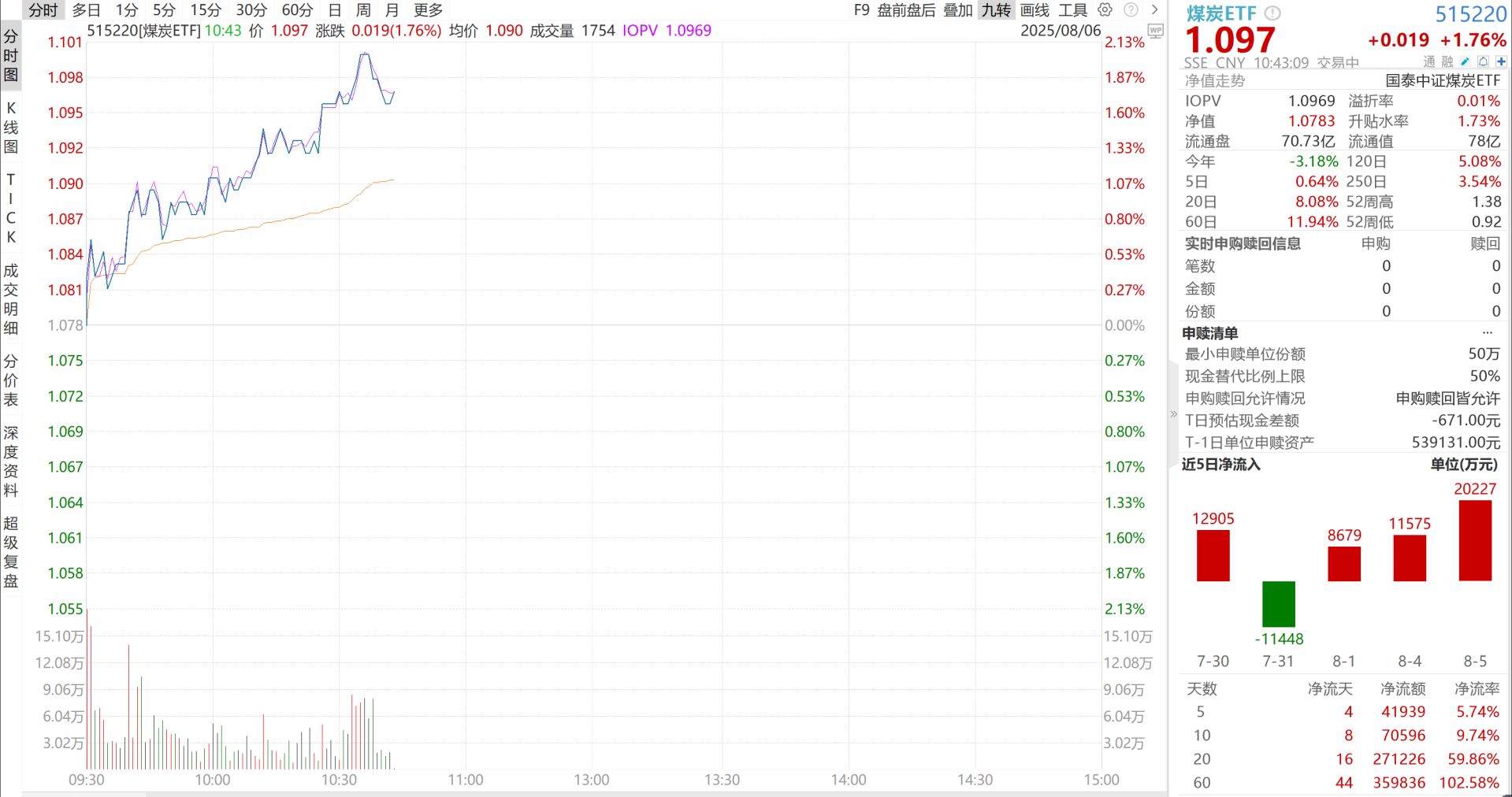
焦煤价格持续上涨,煤炭ETF(515220)盘中涨超2%
Mei Ri Jing Ji Xin Wen· 2025-08-06 03:05
Group 1 - The coal market is currently operating steadily with a slight upward trend, influenced by rainfall that has limited production in some open-pit coal mines, alongside some mines halting or reducing production after meeting monthly targets, leading to a tightening of overall supply in production areas [1] - Rainfall has also caused transportation disruptions, resulting in low port inflow and a continuous decline in inventory, making high-quality resources scarce in the market [1] - Stable demand from end-users, recent price increases by large groups, and the ongoing decline in inventory at northern ports have boosted market confidence, leading to increased purchasing activity among traders and a slight rise in coal prices [1] Group 2 - The supply-demand dynamics in the coal industry are improving, with strong expectations for coal price recovery. Since the supply-side reform in 2016, outdated production capacity has been continuously eliminated, optimizing the capacity structure [3] - The "anti-involution" policy is expected to further control the increase in coal supply, while coal imports hit a two-year low in June, indicating a strong certainty of declining import volumes [3] - From the demand side, electricity generation from thermal power has shown positive year-on-year growth since late May, with a notable increase in national power load, which is expected to support strong demand for coking coal [3] Group 3 - The coal ETF (515220), which tracks the CSI Coal Index (399998), has a dividend yield of 5.45% as of July 22, highlighting its investment value in a declining risk-free interest rate environment [3] - Investors are encouraged to consider gradually accumulating positions in the coal ETF (515220) and its related funds to capitalize on investment opportunities in the coal sector [3]
中国神华(601088):2025 年半年报业绩预告点评:行业底部显龙头本色,下行风险充分释放
GUOTAI HAITONG SECURITIES· 2025-07-17 07:05
Investment Rating - The report maintains an "Accumulate" rating for China Shenhua [7][14] Core Views - The company is positioned as a leading beneficiary in the coal sector, with expected capacity increases in the future. The report suggests that the coal market has reached its bottom, with supply and demand expected to improve in Q2 2025, enhancing the investment value of Shenhua [2][14] - The forecast for the first half of 2025 indicates a net profit attributable to shareholders of 23.6-25.6 billion yuan, representing a year-on-year decline of 13.2%-20%. The second quarter's net profit is projected to be around 12.7 billion yuan, showing a quarter-on-quarter increase [14] - The report anticipates a recovery in coal demand and a decrease in costs, which will mitigate the impact of falling prices. In Q2, the company is expected to achieve coal production of 82.9 million tons and sales of 105 million tons, reflecting a 6.3% increase from Q1 [14] Financial Summary - Total revenue for 2023 is projected at 343.074 billion yuan, with a slight decrease of 0.4% year-on-year. The net profit attributable to shareholders is expected to be 59.694 billion yuan, down 14.3% from the previous year [4][15] - Earnings per share (EPS) for 2025 is forecasted at 2.49 yuan, with a gradual increase to 3.25 yuan by 2027. The report adjusts the EPS estimates downward for 2025-2027 [4][15] - The company’s price-to-earnings (P/E) ratio is projected to be 15.04 for 2025, with a target price set at 44.79 yuan, reflecting a slight decrease from previous estimates [14][16] Market Data - The stock has a 52-week price range of 35.35-43.60 yuan, with a total market capitalization of 744.473 billion yuan [8] - The company has a net asset value per share of 21.80 yuan and a price-to-book (P/B) ratio of 1.7 [9]

【煤炭开采】煤价下行拖累业绩,企业盈利分化加剧——煤炭行业2025年一季报综述(李晓渊/蒋山)
光大证券研究· 2025-05-08 09:13
Core Viewpoint - The coal industry is experiencing a supply-demand imbalance, with limited reduction in imports and increased domestic production leading to oversupply [2][5]. Group 1: Fundamentals - In Q1 2025, China's total coal imports reached 110 million tons, a year-on-year decrease of 0.9%, maintaining a high level. Notably, imports from Indonesia were 52.59 million tons (down 6.6%), Australia 16.45 million tons (up 3.7%), Mongolia 17.49 million tons (up 3.1%), and Russia 19.62 million tons (up 7.9%) [2]. - Domestic raw coal production in Q1 2025 was 1.2 billion tons, a year-on-year increase of 8.8%. The production growth rates in Xinjiang, Shanxi, Shaanxi, and Inner Mongolia were 16.9%, 19.8%, 4.1%, and 2.1%, respectively [2]. - In Q1 2025, China's thermal power generation was 1.5 trillion kWh, down 4.4% year-on-year, while pig iron production was 220 million tons (up 1.4%), cement production was 330 million tons (down 1.7%), and chemical coal consumption was 80 million tons (up 14.8%) [2]. Group 2: Coal Prices - In Q1 2025, the average price of 5500 kcal thermal coal at ports was 721 CNY/ton, down 20% year-on-year and 12% quarter-on-quarter. The average price of long-term contract thermal coal was 690 CNY/ton, down 3% year-on-year and 1% quarter-on-quarter [3]. - The pithead coal prices followed the downward trend of port coal prices, with average prices in Yulin, Datong, and Ordos down 24%, 26%, and 24% year-on-year, respectively [3]. - Coking coal prices saw a more significant decline, with the average price of coking coal in Shanxi's Lüliang at 1252 CNY/ton, down 44% year-on-year and 19% quarter-on-quarter [3]. Group 3: Sector Profitability - In Q1 2025, the total operating revenue of the coal mining industry was 284.56 billion CNY, down 17.8% year-on-year, and the net profit attributable to shareholders was 30.1 billion CNY, down 27.5% year-on-year, with an annualized return on equity of 9.6%, down 4.2 percentage points year-on-year [4]. - Among the four coal companies with a market capitalization exceeding 100 billion CNY (Shenhua, China Coal, Shaanxi Coal, and Yanzhou Coal), the net profit attributable to shareholders was 23.44 billion CNY, down 19.9% year-on-year, while the remaining 20 coal companies reported a net profit of 7.25 billion CNY, down 46.0% year-on-year, indicating a divergence in profitability [4]. Group 4: Future Outlook - In March, coal imports decreased by 6.4% year-on-year, and future coal import volumes are expected to contract [5]. - Some coal companies are already facing accounting losses, which may lead to production cuts or shutdowns [5]. - Since the beginning of the year, thermal power generation has significantly underperformed expectations, and the upcoming summer peak in electricity demand may lead to a marginal improvement in coal demand [5].
需求疲软是本轮煤价下行的最核心因素
GOLDEN SUN SECURITIES· 2025-03-18 05:54
Investment Rating - The report maintains a rating of "Buy" for several key companies in the coal mining sector, including China Qinfa, China Shenhua, Shaanxi Coal, and others [6][10]. Core Insights - The primary factor driving the recent decline in coal prices is weak demand [1]. - In the first two months of 2025, raw coal production increased by 7.7% year-on-year, with a daily average production of 12.97 million tons [1][13]. - Coal imports for the same period reached 7.619 million tons, reflecting a year-on-year increase of 2.1% [2][15]. - The report anticipates a slight decline in thermal coal imports for 2025, projecting a total of approximately 38.5 million tons, down 4.9% from the previous year [2][15]. - The report highlights a significant drop in thermal power generation, which decreased by 5.8% year-on-year in January and February 2025 [3][17]. - The crude steel production in the same period saw a decline of 1.5% year-on-year, amounting to 16.63 million tons [4][24]. Summary by Sections Production - In January and February 2025, raw coal production was 77 million tons, marking a 7.7% increase year-on-year, with an expected net increase of 55-60 million tons for the year [1][13]. Imports - The total coal imports for the first two months of 2025 were 7.619 million tons, a 2.1% increase compared to the same period last year [2][15]. The report predicts a stable to slightly declining trend in thermal coal imports for the year [2][15]. Demand - The report notes a 5.8% year-on-year decrease in thermal power generation, with total industrial power generation down by 1.3% [3][17]. The growth rates for other energy sources like wind and solar power were noted, with wind power increasing by 10.4% and solar power by 27.4% [3][17]. Investment Recommendations - The report emphasizes a focus on companies showing potential for recovery, such as China Qinfa and China Shenhua, and highlights the importance of companies engaging in share buybacks, like Pingmei Shenma [5][26].