
科研诚信

Search documents
报告:全球超半数科研人员科研时间遭行政事务等严重侵蚀
Di Yi Cai Jing· 2025-12-08 10:08
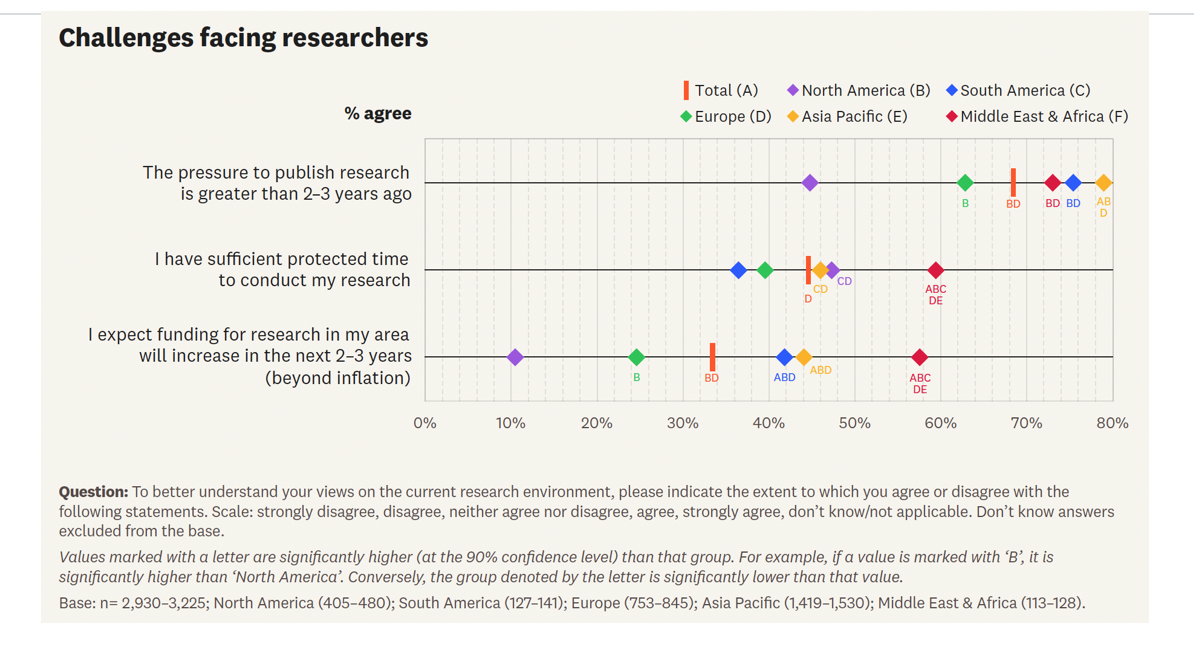
Core Insights - A significant 58% of researchers globally are utilizing AI tools in their research, reflecting a notable increase from 37% in 2024 [4] - Researchers are facing increasing pressures from administrative tasks, teaching responsibilities, and funding uncertainties, leading to concerns about time constraints and career development [2][3] - The report highlights a growing recognition of the importance of research quality and integrity, with 74% of respondents trusting peer-reviewed research [3] Group 1: Research Environment - Only 45% of researchers feel they have sufficient time for research, with a mere 33% expecting an increase in funding over the next two to three years, particularly in North America and Europe [3] - 68% of respondents report that publication pressure has increased compared to two to three years ago [3] - The report emphasizes the critical role of research quality, transparency, and reliability in addressing complex global challenges [3] Group 2: AI Utilization in Research - 58% of researchers believe AI can help save time in the research process, with 61% using AI to find and summarize recent studies [5] - Chinese researchers exhibit a higher confidence in AI's role in research, with 68% believing AI tools provide more options, compared to only 29% in the US and 26% in the UK [4] - 79% of Chinese respondents think AI can effectively save research time, while only 54% of American and 57% of British researchers share this view [4] Group 3: Attitudes Towards AI - Despite the positive outlook on AI, only 32% of researchers believe their institutions have adequate AI governance frameworks, and just 27% feel they have received sufficient training on AI usage [4] - Researchers remain cautious about using general AI tools for creative tasks, preferring safe and reliable AI assistants tailored for research [5] - The report indicates a significant gap in the perception of AI's empowering potential, with 64% of Chinese researchers affirming its benefits compared to only 25% in the US and 24% in the UK [4]

香港大埔火灾已造成至少36人遇难、279人失联,不排除刑案可能;六部门发文!事关促消费;万科债券疑将展期;俄回应“和平计划”丨每经早参
Mei Ri Jing Ji Xin Wen· 2025-11-26 21:56
Group 1 - The U.S. stock market saw all three major indices rise, with the Dow Jones up 0.67%, S&P 500 up 0.69%, and Nasdaq up 0.82% [4] - Major tech stocks mostly increased, with Oracle rising over 4%, AMD over 3%, and other notable gains from Nvidia, Tesla, Netflix, and Microsoft [4] - The U.S. economy is reportedly experiencing stagnation, with manufacturing and retail sectors facing cost pressures due to tariffs, impacting consumer decisions [4] Group 2 - European stock indices collectively rose, with the Euro Stoxx 50 up 1.50%, FTSE 100 up 0.89%, CAC 40 up 0.88%, DAX 30 up 1.19%, and FTSE MIB up 1.01% [5] Group 3 - The Hong Kong fire incident resulted in at least 36 fatalities and 279 missing, with the situation now under control [6] - The Hong Kong government is investigating the fire for potential criminal activity [6] Group 4 - The Chinese Ministry of Commerce held a video conference with the EU regarding semiconductor trade issues, emphasizing the need for constructive solutions from the Netherlands [7] Group 5 - A joint announcement from six Chinese departments aims to enhance consumer goods supply-demand adaptability, targeting significant improvements by 2027 and 2030 [8] Group 6 - Xiaomi Group repurchased 7.5 million shares for over 300 million HKD, marking its fourth buyback this month, totaling 31.5 million shares and over 1.2 billion HKD [18] - Ideal Auto reported Q3 revenue of 27.4 billion CNY, maintaining a leading position among new energy vehicle manufacturers [19] Group 7 - Vanke's bond meeting indicates potential extension of bond repayment, reflecting the company's debt pressure [17] - The departure of a prominent analyst from GF Securities highlights significant changes in the brokerage industry amid competitive pressures [20] Group 8 - Tesla's VP clarified that the company's supply chain strategy does not exclude Chinese components, with over 95% localization for parts produced in Shanghai [26] - Meta faces scrutiny from Italian antitrust authorities for potentially abusing market dominance through WhatsApp [28]


【8点见】损失超20亿元!网警发出紧急预警
Yang Shi Wang· 2025-11-23 00:04
Group 1 - China's Ministry of Foreign Affairs issued a letter to UN Secretary-General António Guterres, warning that if Japan dares to intervene militarily in the Taiwan Strait, China will exercise its right to self-defense [1] - During the 14th Five-Year Plan period, significant progress has been made in air pollution prevention and control in the Beijing-Tianjin-Hebei region [1] - The electronic savings bonds will be included in the personal pension product range [1] Group 2 - The global largest "Hualong One" nuclear power base has successfully connected its second unit to the grid [3] - The Hong Kong Education Bureau confirmed the cancellation of a student-teacher delegation's exchange trip to Japan [3] - The U.S. Federal Aviation Administration issued a safety warning for Venezuelan airspace, advising civil aircraft to remain vigilant [3] Group 3 - A total of 33.78 billion tons of goods were transported by national railways in the first ten months, setting a historical record for the same period [1]

构建AI时代的科研诚信体系
Ke Ji Ri Bao· 2025-09-30 01:20
Core Viewpoint - The emergence of artificial intelligence (AI) has led to new challenges in research integrity, including issues like "AI ghostwriting," "data embellishment," and "ghost authorship," which are critical for the healthy development of scientific endeavors [1][2]. Group 1: AI's Impact on Research Integrity - AI has significantly enhanced efficiency in knowledge acquisition, data analysis, and academic writing, but it has also fundamentally changed the composition of academic activities, leading to issues such as blurred contribution definitions, lack of transparency in research processes, and decreased interpretability of results [1][2]. - The rapid development of AI detection technologies has not kept pace with AI generation technologies, making traditional plagiarism detection methods less effective and allowing research misconduct to become more concealed and complex [1][2]. Group 2: New Challenges and Concerns - The application of generative AI has lowered the cost of academic fraud and increased the difficulty of detecting such actions due to the high quality of content generated by large language models [2]. - AI's involvement has blurred the boundaries of responsibility, raising questions about whether errors generated by AI should be considered "honest mistakes" or attributed to the user, and whether AI can be regarded as an author or co-author [2]. - There are concerns that AI-generated content could contaminate the human knowledge system, as evidenced by cases where fabricated "scientific news" has misled the public and undermined the credibility of knowledge [2]. Group 3: Recommendations for Addressing Challenges - A systematic and comprehensive approach is necessary to embrace technological innovation while firmly upholding research integrity, including deepening theoretical discussions and case studies to clarify AI's impact on research integrity [3]. - There is a need for comprehensive education on scientific ethics and AI skills training to guide researchers in the responsible use of AI tools [3]. - It is essential to build a governance system for scientific ethics that adapts to the AI era through global consensus and collaboration [3].
新华时评:决不让歪风侵蚀科研生态!
Xin Hua She· 2025-09-22 03:46
Core Points - The Chinese Association for Science and Technology (CAST) has revoked awards from five individuals due to violations of academic integrity and misconduct, signaling a strong stance against unethical practices in the scientific community [1][2] - The actions taken by CAST aim to uphold academic integrity, which is essential for the development of a strong scientific nation, and to prevent a negative impact on young researchers [1][2] Group 1 - The revoked awards include the China Youth Science and Technology Award, which is significant for recognizing both academic ability and ethical standards in research [1] - The individuals involved engaged in various unethical behaviors, such as soliciting favors during project applications and leaking confidential information, which undermines the integrity of the research environment [1][2] - The announcement emphasizes the need for strict measures against academic misconduct to maintain a healthy research ecosystem and to protect dedicated researchers [1][2] Group 2 - CAST has established a permanent ban on individuals with serious academic misconduct from participating in its awards or talent programs, reinforcing the importance of accountability [2] - The initiative to combat academic misconduct is a collective responsibility across the scientific community, requiring collaboration among various departments and organizations [2] - The revocation of awards is part of a broader effort involving multiple agencies, including the Ministry of Science and Technology and the Natural Science Foundation, to address and document serious breaches of research integrity [2]
他们因何被撤销了科技奖励?
2 1 Shi Ji Jing Ji Bao Dao· 2025-09-21 05:28
Group 1 - The Chinese Youth Science and Technology Award and the Chinese Young Female Scientist Award have had their first-ever recipients disqualified due to violations of scientific integrity and misconduct [2][3] - Five individuals had their awards revoked, with the time span from their original awards to revocation reaching up to 21 years [2][3] - The Chinese Youth Science and Technology Award has recognized 1,804 young scientists since its inception, with approximately 10% of recipients later becoming academicians [3] Group 2 - The Chinese Young Female Scientist Award has been awarded to 204 female scientists and 19 teams since 2004, with 9 recipients later becoming academicians [3] - The announcement regarding the revocation of awards did not specify the exact misconduct of the individuals involved, but it was revealed that some were involved in criminal activities while others engaged in scientific misconduct [5][6] - Previous instances of award revocation in China include the 2011 case involving a professor from Xi'an Jiaotong University, which was due to academic fraud [4] Group 3 - Zhou Xinyuan, one of the revoked awardees, was convicted of embezzlement and sentenced to four years in prison for misappropriating over 20 million yuan [5][6] - Chen Zheyu, another revoked recipient, was sentenced to two and a half years for misusing research funds [7][8] - Sun Beicheng and Zhao Yuanjin were involved in a case of improper solicitation during project evaluations, leading to their disqualification from future funding activities [9][10] Group 4 - Liu Jianni, the only female recipient among the revoked individuals, was found guilty of multiple violations during the evaluation process of her research projects [11][12] - The revocation of these awards serves as a reminder of the importance of scientific integrity and the consequences of misconduct in research [12][13]

新华时评|决不让歪风侵蚀科研生态!
Xin Hua She· 2025-09-19 10:55
Core Viewpoint - The Chinese Association for Science and Technology (CAST) emphasizes the importance of maintaining academic integrity and has taken action against individuals involved in academic misconduct by revoking their awards, sending a strong message against unethical practices in the scientific community [1][2]. Group 1: Actions Taken - CAST announced the revocation of awards from five individuals, including the China Youth Science and Technology Award, due to violations of academic integrity and misconduct [1]. - The actions include the withdrawal of medals, certificates, and monetary rewards, highlighting a zero-tolerance approach towards academic misconduct [2]. Group 2: Implications for the Scientific Community - The revocation of awards serves as a warning that unethical behavior undermines the integrity of the scientific community and can lead to a negative impact on young researchers [1]. - The need for a robust regulatory framework to prevent academic misconduct is emphasized, including the establishment of a long-term monitoring mechanism for research integrity [2]. Group 3: Collaborative Responsibility - The responsibility for maintaining research integrity is shared across the entire scientific community, requiring collective efforts to combat academic misconduct [2]. - The actions taken against the individuals involved are part of a coordinated effort among multiple departments, reinforcing the message that academic integrity is a priority [2].
用于检测非标准短语 施普林格·自然推出科研诚信新工具
Zhong Guo Xin Wen Wang· 2025-07-18 08:15
Core Insights - Springer Nature has launched a new tool to detect non-standard phrases in journal and book submissions, aimed at maintaining research integrity and safeguarding academic records [1][2] - The tool identifies awkward or overly complex phrases that may indicate the use of paraphrasing tools to evade plagiarism detection, leading to the rejection of submissions with excessive non-standard phrases [1] - The development of this tool is part of a long-term project involving collaboration between Springer Nature's research integrity team and various technical teams, utilizing insights from academic integrity detectives [1] Tool Features - The non-standard phrase detector is the latest addition to Springer Nature's research integrity solutions, complementing existing tools such as meaningless text detectors and tools for identifying image duplication or tampering [2] - The tool is based on the "Problem Paper Screening" (PPS) system, which initially focused on computer science papers but has since expanded to screen all published literature [2] - Springer Nature has contributed to the STM Integrity Hub, providing a meaningless text detection tool for broader industry use, reinforcing its commitment to publishing integrity [2]
川北医学院本科生“逆天学术履历”引争议,校方通报
券商中国· 2025-07-17 11:22
Group 1 - The core issue revolves around the scrutiny of a student, Luo, from North Sichuan Medical College, regarding the authenticity of his research achievements and publications [1][2] - Luo has published a total of 7 papers, including 1 article as the first author in Frontiers in Nutrition, 1 meta-analysis in Frontiers in Public Health, and 1 correspondence in Nature Machine Intelligence, along with 4 letters as a corresponding author in various journals [1] - The school has taken the allegations seriously, forming a special working group to investigate and verify the claims made against Luo [1] Group 2 - The controversial PPT image in question was related to the 2024 "Changhua Scholarship" evaluation, where Luo's presentation was criticized for being overly self-promotional and lacking rigor in the representation of his achievements [2] - The institution emphasizes its commitment to cultivating students' innovative capabilities and will enhance guidance, supervision, and management to foster a positive research environment [2]
特朗普“科学黄金标准”行政令:借科研诚信之名强化政治控制
Di Yi Cai Jing· 2025-07-06 11:08
Group 1 - The core argument of the articles is that the recent executive order by the Trump administration, titled "Restoring Gold Standard Science," is perceived as a political maneuver that undermines scientific autonomy in the U.S. by placing scientific evaluation under political control [1][2][3] - The executive order aims to reform research integrity policies, promoting a "transparent, rigorous, and impactful" scientific standard, but it raises concerns among researchers about increased political interference in scientific activities [2][3] - Critics argue that the order could lead to the appointment of political officials to oversee research integrity investigations, which may result in punitive actions against scientists based on vague criteria [3][4] Group 2 - The order has sparked significant backlash from the scientific community, with many scientists signing an open letter condemning the initiative as a means to reinforce political control over national research infrastructure [2][4] - Historical context reveals that during Trump's first term, there were multiple accusations of government interference in scientific independence, leading to a lack of trust in scientific integrity [3][4] - The order's implications extend beyond the U.S., providing insights for China to refine its own research integrity policies, emphasizing the need for stable and continuous policy frameworks [5][6] Group 3 - The articles highlight the importance of maintaining a clear separation between science and politics, suggesting that the U.S. experience serves as a cautionary tale for other countries [5][6] - Recommendations for China include institutionalizing research integrity norms and ensuring that political influence does not compromise scientific investigations [5][6][7] - The current state of research integrity in China shows improvement, with a reported 31.2% decrease in research misconduct cases in 2023, indicating progress in fostering a culture of integrity [7][8]