
稀土反制

Search documents
关税贸易谈判凸显稀土反制影响力,央企现代能源ETF(561790)早盘涨近1%,中国稀土涨超%
Xin Lang Cai Jing· 2025-06-11 05:08
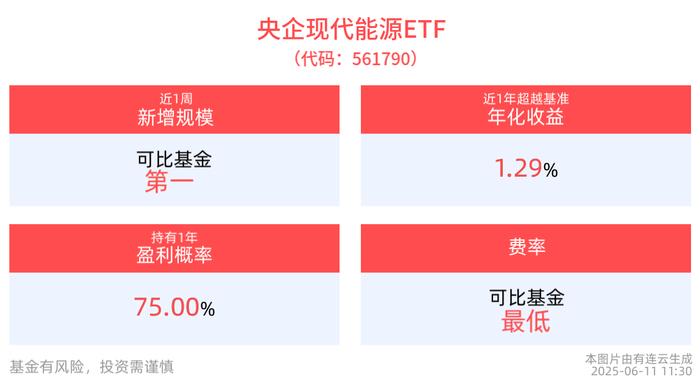
Core Viewpoint - The news highlights the performance and growth of the Central State-Owned Enterprises Modern Energy ETF, driven by the rising prices and demand for rare earth materials due to export controls and supply shortages [3][4]. Group 1: ETF Performance - As of June 11, 2025, the Central State-Owned Enterprises Modern Energy ETF (561790) increased by 0.75%, with a trading volume of 443.69 million yuan and a turnover rate of 9.04% [3]. - The ETF has seen a significant growth in scale, with an increase of 138.79 million yuan over the past week, ranking it in the top third among comparable funds [4]. - Since its inception, the ETF has achieved a maximum monthly return of 10.03% and a longest consecutive monthly gain of 7 months, with an average monthly return of 3.17% [4]. Group 2: Market Dynamics - The recent export controls on rare earth materials have tightened global supply, impacting traditional and new energy vehicle manufacturers, leading to a significant increase in overseas rare earth prices compared to domestic prices [3]. - Following the issuance of export licenses to some domestic rare earth material companies, there is an expectation of price recovery in domestic rare earth materials, which could benefit leading domestic companies in this sector [3]. Group 3: Index Composition - The top ten weighted stocks in the Central State-Owned Enterprises Modern Energy Index (932037) account for 51.1% of the index, with notable companies including Changjiang Electric Power, Guodian NARI, and China Nuclear Power [5]. - The weightings of the top stocks include Changjiang Electric Power at 10.48%, Guodian NARI at 7.31%, and China Nuclear Power at 6.30% [7].


为何稀土不卖高价?在下一盘更大的棋
Hu Xiu· 2025-06-09 00:37
Core Viewpoint - China holds a dominant position in the global rare earth industry, primarily due to its unique capabilities in high-purity extraction technology, which is not yet matched by other countries [1][2][6]. Group 1: China's Dominance in Rare Earths - China is not only the largest holder of rare earth reserves but also the only country with the technology for high-purity extraction, making it a critical player in the global supply chain [1][6]. - Other countries, such as Ukraine, may have rare earth resources, but they lack the necessary processing capabilities to compete with China [1][2]. Group 2: Market Dynamics and Competition - The U.S. has historically imported rare earth materials worth only a few hundred million dollars annually, indicating a low profit margin in this market [3]. - If the U.S. were to develop its own production capabilities, it could lead to price wars that would challenge existing supply chains [4][5]. Group 3: Strategic Considerations - The U.S. faces internal political challenges that complicate the establishment of a state-owned rare earth enterprise, which could hinder its ability to compete effectively [5]. - China's strategy involves maintaining low prices for rare earth products to prevent competitors from gaining a foothold in the market [8][9]. Group 4: Future Outlook - The current market conditions suggest that it is not yet the right time for China to significantly increase the profitability of rare earths, as the industry is still in a competitive phase [16].
稀土反制战奏效!特斯拉低头求供,三大稀土永磁巨头谁将改写全球格局?
Sou Hu Cai Jing· 2025-05-07 04:42
Core Insights - The competition over rare earth materials, particularly permanent magnets, is becoming a critical factor in global technology industries, with China leveraging its dominance in this sector [1][5] - Rare earth permanent magnets are essential for advanced technologies such as humanoid robots and solid-state batteries, making them a strategic asset in international relations [1][3] Industry Overview - Rare earth permanent magnets are crucial for various applications, enhancing efficiency and reducing energy consumption in technologies like robotics and renewable energy [3] - The U.S. military relies heavily on rare earth permanent magnets, with over 60% of the F-35 fighter jet's radar and guidance systems composed of these materials [4] China's Strategic Position - China controls approximately 70% of global rare earth refining and separation capacity and 90% of heavy rare earth supply, positioning itself as a strategic player in the industry [5] - Starting in 2024, China will implement a rare earth export licensing system, restricting supplies for non-military uses, which could significantly impact global supply chains [5] Key Players in the Rare Earth Market - Mindong Electric: Demonstrates a strong position with technological barriers and resource reserves, achieving a 162.02% increase in net profit in Q1 2025, with a gross margin of 48% in its rare earth permanent magnet business [6] - Northern Rare Earth: The largest rare earth company globally, controlling 60% of domestic light rare earth reserves and achieving a 735.7% increase in net profit in Q1 2025, with a focus on a full industry chain [7] - A third company has seen a staggering 14,698% increase in net profit in Q1 2025, with significant orders from major clients like Tesla and Apple, indicating strong future growth potential [8]

