
稀土磁材

Search documents
稀土行业深度报告:供给蓄力需求破局
Dongguan Securities· 2026-03-25 12:46
Investment Rating - The report maintains a standard rating for the rare earth industry, indicating a cautious optimism regarding supply and demand dynamics [2]. Core Insights - The rare earth market is expected to see price recovery in 2026 due to improved supply-demand balance and stricter export controls, with light rare earth prices stabilizing and medium-heavy rare earth prices under pressure [3][12]. - China's rare earth production is projected to reach 270,000 tons in 2025, accounting for nearly 70% of global output, with a significant focus on optimizing supply-side reforms and reducing competition within the industry [19][21]. - Emerging sectors such as humanoid robots and low-altitude economy are anticipated to drive new demand for rare earth materials, further enhancing the industry's growth prospects [34][50]. Supply-Side Optimization - The supply of rare earths is tightening due to a slowdown in domestic quota growth and limited overseas increments, with China's production expected to remain dominant globally [19][20]. - The establishment of the China Rare Earth Group aims to consolidate the industry and enhance strategic control over the supply chain, marking 2026 as a critical year for resolving intra-industry competition [21][22]. - Global supply constraints are expected to persist, with domestic controls and overseas disruptions limiting significant increases in supply [23]. Demand Highlights - The demand for rare earth materials is steadily increasing in traditional industries and emerging sectors, including electric vehicles, wind power, and humanoid robots, which are set to open new growth avenues [34][50]. - Humanoid robots are projected to require approximately 3.5-4 kg of high-performance neodymium-iron-boron magnets per unit, surpassing the demand from electric vehicles [37]. - The electric vehicle sector is expected to continue driving demand for rare earth materials, with significant growth in production and sales anticipated in 2025 [51]. Investment Recommendations - The report suggests focusing on companies such as China Rare Earth (000831.SZ), Northern Rare Earth (600111.SH), Xiamen Tungsten (600549.SH), and Jinli Permanent Magnet (300748.SZ) as potential investment opportunities [3].


稀土行业深度报告:供给蓄力,需求破局
Dongguan Securities· 2026-03-25 10:40
Core Insights - The report emphasizes that the supply-demand optimization in the rare earth industry is expected to drive prices upward in 2026, with a notable increase in demand from sectors like humanoid robots and low-altitude economy [3][12][19]. - China's rare earth industry remains dominant globally, with a projected production of 270,000 tons in 2025, accounting for nearly 70% of global output [19][22]. - The report highlights the strategic importance of rare earth materials in traditional industries and emerging sectors, indicating a robust growth trajectory for demand [33][49]. Supply Side Optimization - The report notes a continuous tightening of supply due to a slowdown in domestic quota growth and limited overseas increments, with China's rare earth production expected to increase only marginally in 2024 [19][20]. - The establishment of the China Rare Earth Group has created a "South Heavy North Light" industry structure, enhancing industry concentration and control over the supply chain [20][21]. - The report identifies 2026 as a critical year for resolving intra-industry competition, which could strengthen strategic collaboration and control within the rare earth sector [21]. Demand Highlights - The demand for rare earth materials is steadily increasing in various sectors, including electric vehicles, wind power, and energy-efficient appliances, with humanoid robots and low-altitude economy sectors opening new growth avenues [33][49]. - The humanoid robot industry is projected to transition from experimental phases to commercial viability in 2026, significantly increasing the demand for rare earth magnetic materials [34][42]. - The report indicates that the automotive sector, particularly electric vehicles, remains the largest consumer of rare earth materials, with a notable increase in production and sales expected in 2025 [50][49]. Investment Recommendations - The report suggests monitoring companies such as China Rare Earth (000831.SZ), Northern Rare Earth (600111.SH), Xiamen Tungsten (600549.SH), and Jinli Permanent Magnet (300748.SZ) for potential investment opportunities [3].
55国围堵中国稀土!70%产量被卡脖子,万斯喊破喉咙能成功吗?
Sou Hu Cai Jing· 2026-02-09 18:42
Core Viewpoint - The recent "Critical Minerals Ministerial Meeting" held in Washington, attended by representatives from 55 countries and the European Commission, aims to address the geopolitical leverage of critical minerals, particularly rare earths, which are predominantly controlled by China [1][3]. Group 1: Rare Earths Market Dynamics - China holds 38% of the world's rare earth reserves but accounts for 70% of global production, demonstrating its dominance in the sector [3]. - China possesses 90% of the global rare earth separation and purification capacity, making it essential for processing even the ores extracted from the largest U.S. rare earth mine [3]. - In 2023, China's rare earth exports increased by 12.3%, with 70% directed towards U.S. allies in Japan and Europe, highlighting the ongoing reliance on Chinese supplies [3]. Group 2: U.S. Response and Challenges - The U.S. proposed initiatives such as a "critical minerals preferential trade zone," setting reference price lines, and utilizing tariffs, alongside a $100 billion funding plan for allies [3][4]. - However, there are significant challenges, including the fact that U.S. allies like Australia heavily depend on China for rare earth exports, with 82% of Australia's rare earth exports going to China in 2023 [4]. - The U.S. faces a substantial technological gap in rare earth processing, with a Pentagon report indicating that rebuilding the entire supply chain could take at least 15 years and require over $500 billion, while only $2.3 billion has been allocated so far [4]. Group 3: Competitive Advantages of China - Chinese companies hold 90% of rare earth patents, making it difficult for U.S. military contractors to source materials without relying on Chinese suppliers [4]. - China maintains strict environmental standards in rare earth mining, having shut down 12 non-compliant mines in 2023, which could hinder U.S. efforts to restart high-pollution mines [4]. - China's investments in processing facilities in Africa and South America, such as holding 60% of a rare earth mine in the Democratic Republic of Congo, expand its influence and complicate U.S. attempts to bypass Chinese supply chains [4]. Group 4: Market Realities - Despite U.S. efforts to set price floors, rare earth prices fell by 40% in 2023, yet Chinese companies continue to profit due to lower processing costs, which are 58% cheaper than those in the U.S. [4]. - The global market for electric vehicles heavily relies on Chinese rare earth materials, with two out of three electric vehicles using Chinese components, underscoring the critical role of China's supply chain [4]. - The ongoing geopolitical maneuvering suggests that the U.S. may invest heavily without achieving significant changes in supply dynamics, as China remains a key player in the rare earth market [4].

2月9日盛和资源(600392)涨停分析:业绩暴增、人形机器人需求与海外资源落地驱动
Sou Hu Cai Jing· 2026-02-09 07:50
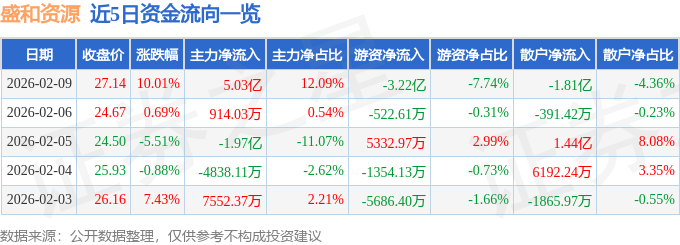
Core Viewpoint - Shenghe Resources experienced a significant stock price increase, closing at 27.14 yuan on February 9, 2026, with a potential net profit growth forecast of 281.28% to 339.20% for 2025, driven by rising rare earth prices and strong demand from sectors like new energy vehicles and wind power [1] Group 1: Company Performance - The stock reached its daily limit increase at 9:37 AM, with four subsequent openings before closing [1] - The closing price represented a 10.01% increase from the previous trading day [2] - The company completed the acquisition of the Ngualla rare earth mine project, enhancing its overseas resource portfolio [1] Group 2: Market Dynamics - The average price of neodymium oxide increased by 27.4% year-on-year, contributing to the company's profit outlook [1] - On February 9, 2026, the net inflow of main funds was 503 million yuan, accounting for 12.09% of the total trading volume [2] - The stock is part of the CSI 500 index, which has attracted increased policy and funding attention [1] Group 3: Sector Performance - On the same day, the neodymium concept stocks rose by 5.66%, while rare earth magnetic materials and non-ferrous zirconium concepts increased by 4.09% and 3.37%, respectively [2]

湘财证券晨会纪要-20260201
Xiangcai Securities· 2026-02-01 15:21
Macro Strategy - In January 2026, PMI fell below the threshold, with manufacturing PMI at 49.3%, non-manufacturing PMI at 49.4%, and composite PMI at 49.8%, indicating a decline in economic prosperity [2] - The production index was at 50.6%, indicating manufacturing expansion, while the new orders index dropped to 49.2%, reflecting a decrease in market demand [2] - Industries such as agricultural food processing and aerospace equipment showed production and new orders indices above 56.0%, while sectors like petroleum and automotive saw indices below the threshold, indicating a slowdown in market demand [2] Stock Market Overview - A-shares experienced fluctuations after a "good start," with the Shanghai Composite Index down 0.44% and the Shenzhen Component down 1.62% from January 26 to January 30, 2026 [3] - The market's volatility was attributed to a strong dollar affecting gold and other previously rising sectors, leading to a broad decline in indices [3][4] - The overall market trend remains strong, supported by the central bank's policies and the expectation of continued economic stability in 2026 [7] Industry Analysis: Non-ferrous Metals and New Materials - The rare earth magnetic materials sector saw a slight increase of 0.16%, outperforming the benchmark [9] - Domestic light rare earth concentrate prices stabilized, while medium and heavy rare earth prices declined, with praseodymium and neodymium prices showing weak fluctuations [10] - The supply side remains tight, with market demand expected to support high rare earth prices, while the demand for downstream applications like new energy vehicles is showing signs of marginal decline [11] Investment Recommendations - The non-ferrous metals sector is rated as "overweight," with expectations of stable demand and pricing trends, particularly in the rare earth segment [11] - Focus on upstream rare earth resource companies and downstream magnetic material firms with strong customer structures and growth potential [12]
金属行业2026年度策略系列报告之小金属&新材料篇:地锁金戈,云生万象
Guolian Minsheng Securities· 2026-01-23 00:50
Investment Rating - The report maintains a "Buy" rating for the metal industry, specifically recommending companies such as Huaxi Nonferrous, Xiyegongsi, Boqian New Materials, and others [2][3]. Core Insights - The report highlights the tightening supply of strategic metals due to export controls and geopolitical factors, which is expected to drive prices upward. The integration of AI technology is anticipated to create new opportunities in electronic materials [9][10]. - Tin supply is under pressure due to slow recovery in Myanmar and regulatory changes in Indonesia, leading to a persistent shortage [26][35]. - Tungsten is positioned as a critical material for high-end manufacturing, with supply constraints expected to support long-term price increases [9][10]. - Antimony supply remains rigid, with recent export control relaxations likely to narrow the price gap between domestic and international markets [9][10]. - The rare earth materials sector is expected to see price stabilization and growth due to increasing demand from electric vehicles and energy-efficient technologies [9][10]. Summary by Sections 1. Strategic Metals and Supply Dynamics - The report emphasizes the strategic importance of metals like tungsten, antimony, and rare earths, which are crucial for technology and military applications. China holds a dominant position in the supply of these metals, with import dependency for many industrial metals exceeding 50% [16][20]. - Export controls on strategic metals have led to significant price increases domestically, with prices expected to continue rising as global demand grows [21][22]. 2. AI Technology and Electronic Materials - The report discusses the impact of AI technology on the demand for electronic materials, predicting a dual increase in both volume and price as the technology evolves [9][10]. - The need for advanced electronic components that can handle higher power and efficiency is driving innovation in materials used in AI applications [9][10]. 3. Investment Recommendations - The report recommends focusing on domestic strategic resource sectors and companies benefiting from AI technology advancements. Key companies highlighted include Huaxi Nonferrous, Xiyegongsi, Boqian New Materials, and others [13][10].





金属行业2026年度策略系列报告之小金属:新材料篇:地锁金戈,云生万象
Guolian Minsheng Securities· 2026-01-22 11:13
Group 1 - The report emphasizes the strategic importance of key metals, highlighting that supply control and application demand in critical fields like technology and military are crucial for pricing [16][20][21] - The report identifies significant supply disruptions in tin due to slow recovery in Myanmar and regulatory changes in Indonesia, leading to a persistent tight supply situation [26][35][40] - The report notes that tungsten is a backbone of high-end manufacturing, with supply tightening driving significant price increases, supported by steady demand from sectors like photovoltaics and military applications [9][16][21] Group 2 - The report discusses the impact of AI technology on the development of electronic new materials, indicating that advancements in AI will drive demand for upgraded materials to meet higher performance requirements [9][10][12] - The report recommends investing in domestic strategic resource sectors and electronic new materials benefiting from AI technology, highlighting specific companies such as Huaxi Nonferrous, Xiyegongsi, and others [13][21] - The report outlines the tightening supply of antimony and the potential for price convergence due to the relaxation of export controls, which may benefit domestic demand [9][10][12]
特朗普向全球发出通牒:180天内必须对中国动手,不配合就加税
Sou Hu Cai Jing· 2026-01-20 09:44
Group 1 - The core viewpoint of the articles suggests that the Trump administration's shift in attitude towards China is primarily due to the failure of the tariff war, leading to a renewed aggressive stance against China, including the formation of a new alliance aimed at reducing China's dominance in global mineral resources [1][6][10] - The newly formed alliance includes Japan, South Korea, Singapore, Australia, and Israel, with the objective of decreasing reliance on Chinese minerals, as directed by Trump [3][5] - Trump's ultimatum to initiate negotiations with allies on mineral imports is seen as a coercive tactic rather than a collaborative effort, highlighting the vulnerabilities of the allied nations that depend on the U.S. for military and economic support [5][6][12] Group 2 - The U.S. is facing a paradox where it seeks to maintain its global leadership while being dependent on China for critical industries, particularly in rare earth elements, which are essential for advanced technologies [8][10] - Despite the U.S. having its own rare earth resources, it lacks the necessary processing technology, making it difficult to establish an alternative supply chain within the proposed 180-day timeframe [10][12] - China has prepared for potential disruptions by restricting the export of key technologies and maintaining a complete rare earth industry chain, ensuring its position as the dominant supplier globally [12][13]
G7密谋稀土断供?中国遭西方联手围堵!北约竟称我们属于北极,背后有何玄机
Sou Hu Cai Jing· 2026-01-15 12:38
Group 1 - The G7 finance ministers reached a consensus to reduce imports of rare earths from China, indicating a desire to dominate the discourse on critical minerals [1][3] - Rare earths are essential for high-end manufacturing, particularly in sectors like renewable energy, electronics, and aerospace, with China holding a significant advantage in production and technology [3][5] - Despite the G7's intentions, countries like Germany and France are heavily reliant on Chinese rare earths for their automotive and wind energy sectors, making a complete decoupling challenging [3][5] Group 2 - NATO Secretary General Jens Stoltenberg's remarks about China being considered in Arctic affairs reflect a strategic adjustment, acknowledging China's presence and interests in the region [7][9] - The Arctic has become a focal point for geopolitical interests, with Europe balancing its relationship with the U.S. and its own regional concerns, particularly regarding Russia [7][11] - The G7's internal conflicts regarding the decoupling from China in the rare earth sector may hinder the effectiveness of their supply chain plans, while China's role in the Arctic is expected to gain more international recognition [11][13] Group 3 - The G7's political stance on reducing reliance on China for rare earths is likely to remain a short-term posture, as long-term economic and technical constraints will complicate these efforts [13] - China's strategy involves deepening processing capabilities, enhancing technological barriers, and expanding high-performance production while fostering diverse international partnerships [11][13] - The ongoing geopolitical tensions and differing priorities among Western nations may create opportunities for China to strengthen its position in both the rare earth and Arctic domains [11][13]

每日投行/机构观点梳理(2026-01-13)
Xin Lang Cai Jing· 2026-01-13 11:44
Group 1: Concerns about Federal Reserve Independence - UBS suggests that concerns over the independence of the Federal Reserve may lead to a more hawkish stance in monetary policy [1] - Goldman Sachs expects the Federal Reserve to continue making data-driven decisions despite the pressure from the criminal investigation against Chairman Powell [1][2] - Rabobank indicates that increasing political pressure on the Federal Reserve could result in higher volatility for the dollar in 2026 [1] Group 2: Market Reactions and Implications - Rabobank warns that the investigation into Powell could reignite "sell-America" trades, posing significant downside risks for the dollar [2] - ABN Amro suggests that the investigation may delay any potential interest rate cuts by the Federal Reserve as officials may adopt a more hawkish stance to defend the institution [2] - The Swiss franc has become a favored safe-haven currency amid concerns regarding the Federal Reserve's independence [4] Group 3: Economic Forecasts and Trends - State Street Global Advisors reports a greater than 30% probability that spot gold will exceed $5,000 per ounce this year, driven by geopolitical dynamics and Federal Reserve policies [2] - Fitch Ratings anticipates a moderate recovery of the Japanese yen from historical lows by 2026, despite ongoing challenges in the labor market [4] - Zhongjin Securities predicts that the Federal Reserve may cut interest rates by approximately 50 basis points in 2026 due to weak employment data [8]