统建统服

Search documents
充电服务能力如何“倍增”(经济聚焦)
Ren Min Ri Bao· 2025-11-17 22:40
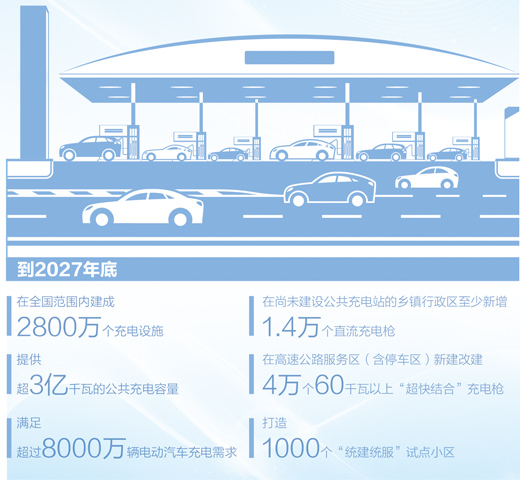
Core Insights - The National Development and Reform Commission and five other departments have launched the "Three-Year Doubling Action Plan for Electric Vehicle Charging Facility Service Capacity (2025-2027)", aiming to double the charging service capacity by the end of 2027 [3][5] - By 2027, the plan targets the establishment of 28 million charging facilities nationwide, providing over 300 million kilowatts of public charging capacity to meet the charging needs of over 80 million electric vehicles [3][5] - The plan is expected to stimulate over 200 billion yuan in investment in charging facility equipment manufacturing and construction [3][5] Infrastructure Development - The current charging service capacity is relatively sufficient in urban areas, but rural areas face challenges due to weaker power grids and lower electric vehicle ownership [4][5] - The plan includes adding at least 14,000 direct current charging guns in townships without public charging stations by 2027, aiming for comprehensive coverage of public charging facilities in rural areas [5][6] - The average power of public charging facilities in China is currently only 45.5 kilowatts, which is insufficient for high-demand scenarios during holidays [6] Technological Innovation - The plan emphasizes the need for high-power charging facilities, with a goal to build 40,000 charging guns of 60 kilowatts or more at highway service areas by 2027 [6] - The introduction of vehicle-grid interaction technology is highlighted, allowing electric vehicles to discharge energy back to the grid during peak hours, thus enhancing grid stability [7][8] Community Engagement - The "Unified Construction and Service" model is being piloted in residential areas, allowing for the installation of charging facilities without residents bearing the costs [9][10] - By 2027, the plan aims to establish 1,000 pilot residential communities under this model, significantly improving the accessibility and management of private charging stations [10]

到2027年底满足超8000万辆电动汽车充电需求 充电服务能力如何“倍增”(经济聚焦)
Ren Min Ri Bao· 2025-11-17 21:51
国家发展改革委等6部门日前联合印发《电动汽车充电设施服务能力"三年倍增"行动方案(2025—2027 年)》,明确到2027年底,实现充电服务能力翻倍增长。充电设施空间布局将迎来怎样的调整?技术上 会有哪些新突破?居住区充电将有哪些新变化?记者进行了采访。 ——编者 全球一半以上的新能源汽车行驶在中国。截至今年6月底,全国新能源汽车保有量达3689万辆,仅今年 上半年就新注册登记新能源汽车562.2万辆。随着新能源汽车保有量持续增长,充电需求大幅攀升。尽 管充电基础设施快速发展,但在节假日等出行高峰期,不免出现"排队等桩""里程焦虑"等现象。公共充 电网络布局不均衡、居住区服务供给不充分、运营管理质效有待提升等问题亟须破解。 充电设施作为新能源汽车产业的关键支撑,其服务能力直接影响消费者的购买信心。国家发展改革委等 部门日前联合印发《电动汽车充电设施服务能力"三年倍增"行动方案(2025—2027年)》,提出到2027 年底,在全国范围内建成2800万个充电设施,提供超3亿千瓦的公共充电容量,满足超过8000万辆电动 汽车充电需求,实现充电服务能力的翻倍增长。 国家发展改革委能源研究所副研究员付毕安表示,行动 ...
家充桩要迈向能建设、有人管和可持续
Zhong Guo Qi Che Bao Wang· 2025-10-24 08:25
Core Insights - The article highlights the significant growth and development of China's electric vehicle charging infrastructure over the past decade, emphasizing the transition from basic functionality to enhanced usability for better service in the electric vehicle industry [2] - The successful listing of Zhida Technology, the first company focused on home charging solutions, on the Hong Kong Stock Exchange reflects strong market confidence in the home charging sector [3] - The residential charging market is projected to grow rapidly, with a significant increase in the number of private charging piles expected in the coming years, driven by the rising number of private electric vehicle users [4] Industry Overview - As of October 10, 2023, there are approximately 16 million home charging piles in China, with Zhida Technology's stock price surging by 192.14% on its debut, indicating strong investor interest [3] - The residential charging segment is becoming increasingly important, with projections suggesting that 75% of the 4.53 million new charging piles expected by 2025 will be private residential piles [4] - The charging infrastructure is facing challenges such as resource constraints, management difficulties, and the need for sustainable development, particularly in older residential communities [6][7] Challenges and Solutions - Key challenges include insufficient power supply during peak usage, especially in older communities, which limits the construction of new charging piles [6][7] - The lack of effective management and oversight in residential charging infrastructure has led to safety concerns, with many charging piles lacking emergency features and proper maintenance [8] - The "Unified Construction and Service" model is proposed as a solution to address the challenges in residential charging, aiming for integrated planning, construction, and operation to enhance efficiency and safety [9][10]

重大利好:六部门部署,超级赛道
Jing Ji Ri Bao· 2025-10-18 02:16
Core Insights - The "Three-Year Doubling" Action Plan aims to establish 28 million charging facilities by the end of 2027, providing over 300 million kilowatts of public charging capacity to meet the charging needs of more than 80 million electric vehicles [1][2] Industry Overview - The rapid development of new energy vehicles (NEVs) in China is evident, with production and sales reaching 11.24 million and 11.23 million units respectively in the first nine months of the year, marking year-on-year growth of 35.2% and 34.9% [2] - The current NEV ownership in China has surpassed 40 million units, highlighting the increasing demand for charging infrastructure [2] Infrastructure Challenges - Despite the growth in NEVs, there are significant shortcomings in charging infrastructure, including uneven public charging network distribution, inadequate service supply in residential areas, and the need for improved operational management [2][4] - The average power of public charging piles in China is only 45.5 kilowatts, which is insufficient for high-demand scenarios such as holidays and urban hotspots [2] Action Plan Implementation - The Action Plan proposes differentiated strategies for urban, intercity, and rural charging networks, focusing on fast charging as the primary method, with slow charging as a supplementary option [4] - It emphasizes the need for innovative approaches, such as expanding vehicle-grid interaction pilot programs to create new business models that allow NEV owners to earn income by selling electricity [4] Service Quality Enhancement - The plan includes measures to improve the service quality of public charging stations, such as optimizing station environments, standardizing fees, and enhancing operational management [5] - It also suggests a unified planning and management model for residential charging facilities to ensure sustainable development [5] Grid Integration and Capacity Building - The Action Plan requires integrating charging facility demands into distribution network planning, focusing on areas with weak grid structures and low supply capacity [7] - The initiative aims to transition charging facilities from being mere supporting projects to becoming integral energy projects, enhancing overall charging efficiency and service quality [7]

老旧小区“统建统服”充电桩落地
Mei Ri Shang Bao· 2025-08-13 02:44
Core Viewpoint - The "Unified Construction and Service" public charging pile initiative in Chun'an County addresses the charging difficulties faced by residents in old communities, enhancing convenience for electric vehicle owners and promoting green travel [2][3] Group 1: Project Overview - The first batch of 32 "Unified Construction and Service" public charging piles was officially powered on in the Nanyuan New Village community, significantly alleviating the charging challenges for residents [2] - The initiative was proposed by the State Grid Chun'an County Power Supply Company to systematically resolve the charging issues in old communities through a coordinated approach involving government, power supply enterprises, and residents [2] Group 2: Implementation and Community Engagement - Prior to project initiation, the construction plan and its effects were widely solicited for resident feedback, leading to the formal launch of the "Public Charging Pile Construction in Old Communities" project [2] - A specialized working group composed of power supply and community representatives was established to conduct thorough research in five selected communities, ensuring the chosen locations were convenient for residents and suitable for grid access [2]