绿电转型

Search documents
国君煤炭:调控再度出手,价值发现行情开启
Ge Long Hui· 2025-05-19 01:25
Core Viewpoint - The coal prices have significantly increased since the beginning of the year, and the National Development and Reform Commission (NDRC) has intervened to stabilize supply and prices, indicating that coal prices will operate at the upper limit of a reasonable range. The focus for coal stock investments should shift towards high dividends and transformation opportunities throughout the year [1]. Investment Highlights - Since the beginning of the year, coal prices have continued to rise, supported by fundamentals. The spot price of Qinhuangdao (Q5500) coal increased from 790 RMB/ton at the beginning of January to 1070 RMB/ton by the end of January. The rise is attributed to the rapid decline in port coal prices and the inversion of pit coal prices, leading to decreased enthusiasm among traders to pull coal to ports and low port inventories. The sentiment was further catalyzed by Indonesia's announcement to restrict coal exports. Demand has exceeded expectations due to strong electricity consumption and power plant restocking, with economic growth policies expected to further strengthen demand, providing effective support for coal prices [2]. - The NDRC has taken measures to consolidate supply and price stability, indicating that coal prices will operate at the upper limit of a reasonable range. A meeting held on February 9 emphasized that coal companies should resume normal production and supply, strictly implement supply and price stabilization policies, and regulate pricing behavior. It is believed that the rise in coal prices may pause, but there is no risk of a rapid short-term decline due to factors such as increased demand for coal and electricity from a cold spring and economic growth, as well as the increase in Indonesia's benchmark coal price to 188.4 USD/ton, which translates to a domestic cost of over 1237 RMB/ton, exceeding domestic coal prices, limiting the increase in imported coal supply [2]. Investment Strategy - In 2022, investments in coal stocks should not overly focus on coal prices but rather seek alpha opportunities, as high dividends and transformation present greater potential for increases. Following the volatility in the coal market in 2021, the government has sufficient means to maintain price stability. The significant rise in prices leading to high earnings elasticity is unlikely to occur in 2022. However, the government shows tolerance for relatively high coal prices, which are expected to fluctuate at high levels. The long-term contract prices have significantly increased year-on-year, leading to an elevation in corporate profit levels. Value discovery will be the main theme for coal stock investments in 2022. The long-term contract price for Qinhuangdao Q5500 coal in February 2022 was 725 RMB/ton, and under the new mechanism, high long-term contract prices are expected to be maintained, leading to sustainable optimization in capital expenditure, cash flow, finance, profit, and dividends. New dividend plans are anticipated following the disclosure of annual reports by coal companies in March 2022. Additionally, the government encourages the construction of photovoltaic projects to address mining subsidence, suggesting that some coal companies may leverage local resources to acquire green energy projects, accelerating transformation [3]. Investment Recommendations - The coal sector is currently at a projected bottom, with valuations significantly low. With the increase in benchmark long-term contract prices for thermal coal and expected high prices for coking coal, high-quality resource companies possess long-term value, while transformation companies have growth potential. The sector is set to see valuation increases. The main investment themes for the year include high dividends, green energy transformation, and growth-oriented coal chemical projects. Recommended companies include China Shenhua, Jingyuan Coal Electricity, Energy Investment, Yanzhou Coal, China Xuyang Group, and Baofeng Energy. Additionally, high-quality resource companies recommended are Shaanxi Coal and Chemical Industry, Huaibei Mining, China Coal Energy, Shanxi Coking Coal, Lu'an Environmental Energy, Lanhua Sci-Tech, Panjiang Coal and Electricity, and Pingdingshan Coal [4].




国泰君安:煤价如期回落,持续看好价值发现行情
Ge Long Hui· 2025-05-19 01:25
Core Viewpoint - The decline in coal prices is in line with expectations, and the sector shows strong resilience, indicating that there is no need for concern regarding coal prices. The off-peak season may not be as weak as anticipated, and investment in coal stocks should focus on alpha opportunities rather than beta, with high dividends and transformation prospects being key themes throughout the year [1][3]. Investment Highlights - The significant drop in the CCTD reference price for Q5500 coal to 900 RMB/ton from 1020 RMB/ton reflects a decrease of 120 RMB, aligning with the government's price control measures. The coal sector experienced a slight adjustment, with CS coal down by 1.25%, showing relative resilience compared to the Shanghai and Shenzhen 300 index [2]. - The government’s control over coal prices, alongside measures such as increased production and port adjustments, is expected to stabilize the coal market. Anticipation of the upcoming Two Sessions and the 20th National Congress later in the year suggests that supply capacity will be maintained, supporting coal prices. Additionally, the benchmark price for Indonesian thermal coal rose to 188.4 USD/ton, which translates to a domestic cost exceeding 1237 RMB/ton, likely increasing demand for domestic coal [2]. - In 2022, investment in coal stocks should not overly focus on coal prices and government controls. Instead, identifying alpha opportunities through high dividends and transformation potential is crucial. The long-term contract price for Qinhuangdao Q5500 coal in February was 725 RMB/ton, indicating a significant year-on-year increase. This suggests a sustainable optimization of capital expenditure, cash flow, and dividends, with new dividend plans expected following the annual reports in March [3]. Investment Recommendations - The coal sector is currently at a perceived bottom with low valuations. With the expected increase in long-term contract prices for thermal coal and coking coal, high-quality resource companies are seen as having long-term value, while transformation-focused companies offer growth potential. The sector is poised for valuation improvement [4]. - Recommended investment themes include high dividends, green energy transformation, and growth-oriented coal chemical companies. Specific recommendations include China Shenhua, Jingyuan Coal Electricity, Electric Power Investment Energy, Yanzhou Coal, China Xuyang Group, and Baofeng Energy. Additionally, high-quality resource companies such as Shaanxi Coal and Chemical Industry, Huaibei Mining, China Coal Energy, Shanxi Coking Coal, Lu'an Environmental Energy, Lanhua Sci-Tech, Panjiang Coal, and Pingmei Shenma are also recommended [4].
国家电投一年甩卖180亿风光项目,“绿电之王”到底怎么了?
Sou Hu Cai Jing· 2025-04-27 11:23
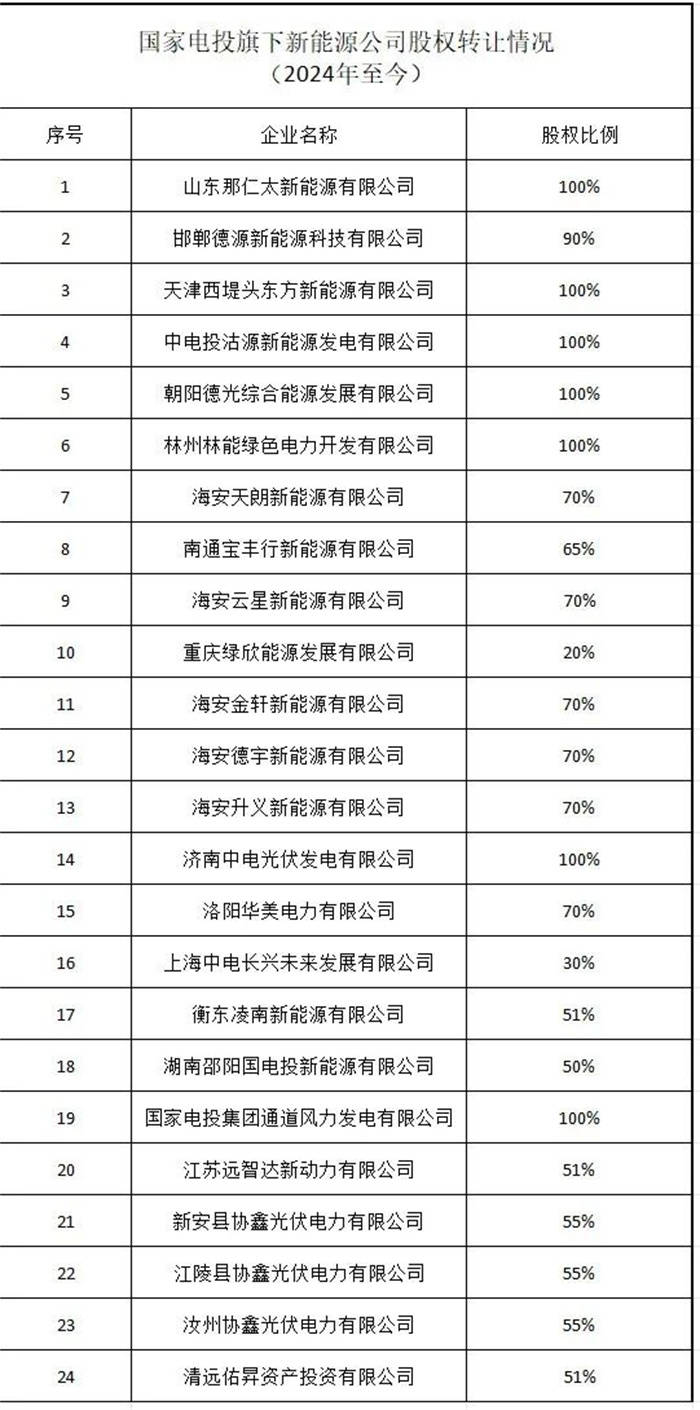
Core Viewpoint - Since 2024, state-owned enterprises have been actively selling photovoltaic power station assets, with China Power Investment Corporation (known as "State Power Investment") leading the trend, indicating a significant shift in the market dynamics of renewable energy assets [1][3]. Group 1: Asset Sales by State Power Investment - State Power Investment has transferred stakes in nearly 40 renewable energy companies, involving a total installed capacity of over 3.2 GW and an estimated transaction value of approximately 18 billion yuan [1][3]. - The company has initiated a series of asset sales, including the termination of projects like the 100 MW household photovoltaic project in Shandong due to rising rooftop leasing costs and low return on assets [3][4]. - By April 2024, State Power Investment had transferred stakes in 24 renewable energy companies, marking a significant shift in its operational strategy [4][6]. Group 2: Changes in Renewable Energy Development Logic - The underlying logic of renewable energy development has changed, with increasing uncertainty in electricity generation and pricing, posing challenges for future growth [8][9]. - Previously, renewable energy enjoyed priority purchasing rights and higher subsidy prices, but the market has shifted towards lower prices and increased competition, leading to a decline in project return rates [9][10]. - State Power Investment has recognized the need to adapt to these changes by prioritizing projects with higher return rates and disposing of underperforming assets [10][11]. Group 3: Transition to Comprehensive Smart Energy Operations - To ensure sustainable development, State Power Investment is transitioning from being a pure project developer to a comprehensive smart energy operator, focusing on local energy consumption and flexible energy management [11][12]. - This transition is crucial for improving the utilization rate of renewable energy projects and ensuring their profitability in a constrained system [12][14]. - Other state-owned enterprises are also following suit, with over 30 companies reportedly listing renewable energy assets for sale as they seek to maintain project profitability [12][13].

中来股份2024年年报:营收承压下的技术突围与全球化布局
Zheng Quan Shi Bao Wang· 2025-04-26 00:50
Core Viewpoint - Suzhou Zhonglai Photovoltaic New Materials Co., Ltd. reported a "bottoming" financial performance for the year, achieving a revenue of 6.096 billion yuan, while facing pressure on net profit due to declining prices across the photovoltaic industry chain, but maintaining positive operating cash flow and sufficient inventory impairment provisions for future recovery [2] Group 1: Financial Performance - The company achieved an annual revenue of 6.096 billion yuan, meeting market expectations [2] - Net profit was under pressure due to a significant decline in prices across the photovoltaic industry, with polysilicon prices down over 39%, wafer prices down over 50%, cell prices down over 30%, and module prices down over 29% [2] - The operating cash flow remained positive, indicating resilience despite industry challenges [2] Group 2: Industry Context - The photovoltaic industry is experiencing a collective downturn, with profitability compressed to historical lows [2] - The global export growth rate for photovoltaic modules slowed to 13% in 2024, with an average export price decline of 49.3%, highlighting a trend of "price for volume" [2] Group 3: Strategic Initiatives - The company is implementing a "mainly leading, dual-wheel drive" strategy, focusing on n-type TOPCon technology, which has been a core business since 2016 [3] - The JSIM 2.0 technology has improved the conversion efficiency of 210-size TOPCon cells to 26.99% [3] - The company has established a differentiated competitive barrier through its technology and product offerings, including the "Yufeng" series of modules designed for extreme weather conditions [3] Group 4: Global Expansion - The company is pursuing a "two-legged" strategy for overseas expansion, focusing on the "Belt and Road" markets and enhancing brand influence in Europe [4] - As the world's leading supplier of photovoltaic back sheets, the company has shipped over 280 GW, providing cost and supply chain advantages for its module business [4] Group 5: Investment Logic - The market demand for TOPCon products is rapidly increasing, with domestic bifacial module market share rising from 14% in 2019 to 77.6% in 2024 [5] - The company has invested 850 million yuan in R&D over the past three years, holding 310 patents, including 136 invention patents, establishing a solid technological moat [5] - The company is expanding into commercial distributed and ground centralized power station businesses, aiming to create a second growth curve [6] Group 6: Future Outlook - The company is expected to benefit from the stabilization of industry prices in the second half of 2025, with leading enterprises likely to achieve profit recovery [5] - The domestic "dual carbon" goals and international green energy transition trends are anticipated to provide favorable policy support for the company's long-term development [6] - The company is showing signs of loss reduction in its Q1 2025 report, positioning itself as a benchmark case for navigating through industry cycles [6]