
网络舆论环境

Search documents
人民日报三评西贝关店事件:罗永浩吃着流量饭,平台乐见其热,网友成为各方的筹码
21世纪经济报道· 2026-01-20 12:57
Core Viewpoint - The article emphasizes the responsibility of self-media in shaping public opinion and highlights the negative impact of irresponsible comments, using the Xibei store closure incident as a case study [3][5]. Group 1: Self-Media Responsibility - Self-media, due to its media attributes, must fulfill corresponding responsibilities and cannot treat its platform as a private domain for unrestrained expression [3][4]. - Influential figures in self-media, especially those with large followings, should contribute to a positive online environment and meet public expectations for rational discourse [3][4]. Group 2: Xibei Incident Analysis - The Xibei store closure incident serves as a mirror reflecting the complexities of the online public opinion environment [3]. - Comments made by influential figures, such as Luo Yonghao, can significantly impact public sentiment, especially when they misrepresent facts or consumer psychology [5][6]. - The article critiques the tendency of some self-media to blur the lines between private and public discourse, leading to harmful consequences for businesses and public perception [4][5].

人民日报再评西贝关店事件
Xin Lang Cai Jing· 2026-01-20 11:33
Core Viewpoint - The article emphasizes that honesty is the best public relations strategy for companies facing crises, using the case of Xibei's store closures as a focal point [1][2]. Group 1: Economic Context - China's economy demonstrated resilience with a total output exceeding 140 trillion yuan and a growth rate of 5.0%, highlighting the importance of both entrepreneurs and consumers in driving domestic demand [1]. - The interaction between entrepreneurs and consumers is identified as a vital source of strength for the Chinese economy [1]. Group 2: Xibei's Crisis Management - The incident involving Xibei and its response to criticism about its use of pre-prepared dishes reveals a lack of effective crisis management, with the company's leader, Jia Guolong, failing to turn the situation into an opportunity [2]. - Jia Guolong's admission of not understanding public relations is seen as a misdirection in addressing the core issues, which revolve around sincerity and transparency with consumers [2]. Group 3: Consumer Expectations and Transparency - The article argues that pre-prepared dishes should not be viewed negatively; instead, promoting transparency and standardization in the industry can enhance food safety and consumer experience [3]. - Companies are encouraged to openly communicate about their use of pre-prepared dishes and to educate consumers on the benefits of the pre-prepared food industry [3]. Group 4: Internet and Consumer Engagement - In the internet age, consumer sentiments are easily shared and resonate widely, making it crucial for companies to acknowledge issues, correct mistakes, and accept scrutiny [4]. - The article suggests that by addressing problems directly and effectively, companies can gain consumer trust and support, ultimately contributing to economic growth [4].

人民日报三评西贝关店事件
财联社· 2026-01-20 10:23
Core Viewpoint - The article discusses the West B's store closure incident, emphasizing the need for responsible behavior from social media influencers and the importance of a healthy online discourse for business development [3][4][13]. Group 1: Incident Overview - The West B incident was triggered by a social media influencer's comment about the restaurant's use of pre-prepared dishes, leading to a public outcry and subsequent business crisis [3][4][13]. - The incident resulted in West B announcing the closure of 102 stores, affecting 4,000 employees and causing over 5 billion yuan in losses [13]. Group 2: Online Discourse and Responsibility - Social media influencers, due to their reach, have a significant impact on public opinion and should exercise social responsibility in their communications [4][5]. - The article highlights the negative consequences of irresponsible comments from influencers, which can mislead the public and escalate conflicts [5][10]. Group 3: Industry Implications - The West B incident reflects broader issues within the online discourse environment that can affect the survival and development of private enterprises in China [13][14]. - The need for a clear distinction between private and public discourse is emphasized, as careless remarks can lead to significant repercussions for businesses [4][14]. Group 4: Constructive Dialogue and Future Directions - The article calls for a more constructive and rational online environment that encourages dialogue rather than conflict, which is essential for industry growth and consumer trust [17][19]. - It suggests that the discussions surrounding the West B incident should lead to improved standards and transparency in the food industry, particularly regarding pre-prepared dishes [18][19].
人民日报三评西贝关店事件:自媒体不是私域不可肆意
Xin Lang Cai Jing· 2026-01-20 09:49
Core Viewpoint - The article discusses the impact of online public opinion on businesses, particularly focusing on the recent crisis faced by the restaurant chain Xibei due to negative comments from influential online figures [1][6]. Group 1: Online Public Opinion and Business Impact - A comment from an online influencer stating "almost all are pre-made dishes, and they are so expensive" triggered a dispute, leading to a business crisis for Xibei [1][6]. - Many entrepreneurs feel anxious about the complex and severe nature of the online public opinion environment, but the article suggests that there is no need for excessive worry as the overall situation has improved in recent years [1][6]. Group 2: Responsibilities of Influencers - The Xibei incident serves as a mirror reflecting the responsibilities that come with the media attributes of self-media; influencers must not treat their platforms as private domains [2][7]. - Influencers with large followings have a significant impact on public opinion and should contribute to creating a clear online space, fulfilling their social responsibilities [2][7]. Group 3: Negative Influences of Self-Media - Recent irresponsible behaviors from a minority of self-media can be categorized into several types, including misinterpretation of government policies, biased views on public issues, and using public sentiment for personal gain [3][8]. - The article highlights that the comment from influencer Luo Yonghao, while perceived as consumer feedback, was a public expression that could ignite public emotions, demonstrating the potential for online disputes to affect offline consumer behavior [3][8]. Group 4: Legal and Regulatory Framework - The Private Economy Promotion Law explicitly states that no individual or entity should maliciously harm the rights of private economic organizations through online channels [4][9]. - The article notes recent actions taken against accounts that spread false information and the importance of creating a healthy online public opinion environment to promote the healthy and high-quality development of the private economy [4][9].
人民日报再评西贝事件,西贝发文回应
Sou Hu Cai Jing· 2026-01-20 01:20
Core Viewpoint - The recent closure of 102 stores by Xibei has sparked a public dispute between its founder, Jia Guolong, and entrepreneur Luo Yonghao regarding the prepared food industry, highlighting the challenges faced by the restaurant sector in the current market environment [6]. Group 1: Company Actions and Responses - Xibei announced the closure of 102 stores nationwide, indicating significant operational challenges [6]. - Jia Guolong responded to accusations from Luo Yonghao, promising a comprehensive rebuttal to what he termed "serious defamation" [6]. - Following public feedback, Xibei's official social media account adjusted its messaging to reflect a more engaging tone, emphasizing accountability and improvement [3]. Group 2: Industry Context and Reactions - The incident has drawn attention to the broader implications of online discourse for businesses, with commentary from the People's Daily suggesting that the online environment should not hinder corporate development [6]. - Sina Weibo's CEO emphasized the need for media interviews for public disputes, indicating a shift in how companies might handle conflicts in the digital age [6]. - The commentary from the People's Daily and subsequent reactions from both Xibei and Luo Yonghao reflect the evolving dynamics of public relations and crisis management in the restaurant industry [6].
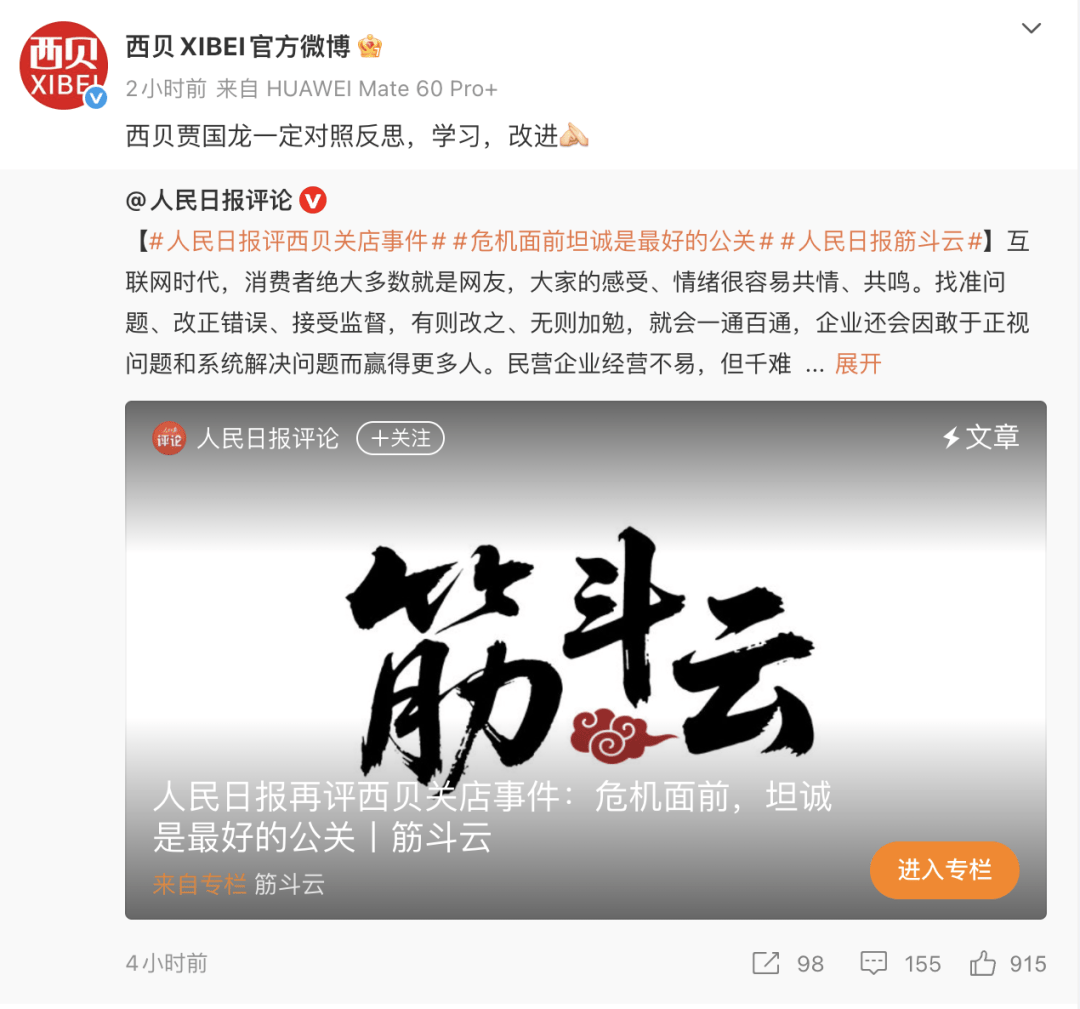
西贝回应:贾国龙一定对照反思,学习,改进
Xin Lang Cai Jing· 2026-01-19 15:08
Core Viewpoint - The article discusses the recent crisis faced by XIBEI, highlighting the importance of transparency and consumer understanding in public relations, particularly in response to criticism regarding the use of pre-prepared dishes [3]. Group 1: Company Response - XIBEI's official Weibo account shared a commentary from the People's Daily, indicating that the company's founder, Jia Guolong, should reflect, learn, and improve in light of the criticism [1]. - The commentary emphasizes that while Jia Guolong claims to not understand public relations, the real issue lies in the company's lack of sincerity towards consumers [3]. Group 2: Industry Commentary - The People's Daily article critiques the online discourse surrounding XIBEI, suggesting that the criticism from influential figures like Luo Yonghao should be analyzed more deeply, as it has escalated beyond mere online disputes [3]. - It stresses the need for a rational and objective approach to corporate criticism, warning against malicious intent in public discussions, and calls for all parties involved to contribute to a healthier online environment [3].

人民日报再评西贝关店事件
中国能源报· 2026-01-19 11:56
Group 1 - The core issue in the Xibei store closure incident is the lack of sincerity from the company, which is more critical than the pre-prepared food controversy [4][5] - The response from the entrepreneur, Jia Guolong, appears strong but is ineffective, leading to a more passive situation for the company [4] - The incident highlights the importance of understanding consumer needs and being transparent, as consumers will "vote with their feet" if they feel misled [5] Group 2 - The pre-prepared food industry should be standardized and regulated to ensure safety and quality for consumers, benefiting the overall food supply chain [5] - Companies should not fear pre-prepared foods but should embrace transparency and promote their use to enhance consumer trust and experience [5] - The online criticism from influencers can be turned into an opportunity for companies to clarify their practices and engage with consumer concerns sincerely [5]
人民日报再评西贝关店事件:危机面前 坦诚是最好的公关
Ren Min Ri Bao· 2026-01-19 10:30
Group 1 - The core viewpoint of the articles revolves around the resilience and vitality of the Chinese economy, highlighted by the 2025 economic data showing a total of over 140 trillion yuan and a growth rate of 5.0% [1] - The interaction between entrepreneurs and consumers is emphasized as a vital source of strength for the Chinese economy, showcasing the importance of internal demand driven by consumer spending [1] - The incident involving Xibei's store closures serves as a case study for the importance of sincerity in corporate communication, particularly in the face of consumer concerns regarding pre-prepared food [3][4] Group 2 - The commentary on the Xibei incident reflects a broader societal consensus on the need for a positive online discourse to support the development of the Chinese economy [2] - The response from Xibei's entrepreneur, Jia Guolong, is critiqued for lacking sincerity and failing to turn a crisis into an opportunity, highlighting the need for better public relations strategies [2][3] - The articles advocate for the standardization and transparency of the pre-prepared food industry, suggesting that proper regulation can enhance food safety and consumer experience while stabilizing prices [3][4]

人民日报再评西贝关店事件:危机面前,坦诚是最好的公关
Ren Min Ri Bao· 2026-01-19 10:07
Group 1 - The core viewpoint of the news highlights the resilience and vitality of the Chinese economy, showcasing a total economic output exceeding 140 trillion yuan and a growth rate of 5.0% in 2025, driven by the efforts of enterprises and consumer demand [1] - The interaction between entrepreneurs and consumers is identified as a vital source of strength for the Chinese economy, emphasizing the importance of a robust domestic demand engine [1] Group 2 - The incident involving Xibei's store closures has sparked significant public discourse, reflecting a societal consensus on the need for a positive public opinion environment to support the development of the Chinese economy [2] - The response from entrepreneur Jia Guolong to criticism regarding the use of pre-prepared dishes is seen as inadequate, highlighting the necessity for businesses to engage sincerely with consumers during crises [3] - The article argues that transparency and honesty in communication with consumers are essential for businesses, particularly in the context of the pre-prepared food industry, which should be regulated and standardized to ensure safety and quality [3][4] - The commentary suggests that the criticism from internet influencers can present opportunities for companies like Xibei to clarify misconceptions and build trust with consumers through transparent communication [4]
罗贾之战再升级,《人民日报》下场点评!贾国龙暂无停战意愿,第三发朋友圈再“斗”老罗
Sou Hu Cai Jing· 2026-01-19 09:25
作者:张伟坚 编辑:乔风雷 罗永浩和贾国龙之间的"战事"愈演愈烈,高层已经关注到此事,1月18日《人民日报》下场点评,大有调解双方矛盾之意。 来源:《人民日报》评论公众号截图 《人民日报》的点评十分客观,从这几天的舆论场中可以看出,罗永浩有"退战"的意思,然而贾国龙似乎并无停战意愿,1月18日下午17时56分,贾国 龙"第三发"朋友圈更新直指罗永浩,大有不把罗撂倒誓不罢休的味道。 贾国龙至今还在自证到底是不是预制菜,在自己世界的预制菜标准,售卖价格贵不贵,消费者是有感知的。 这样概念性的收割,老百姓用脚投票是自发的选择。所谓假的真不了,真的也假不了,正如网络有言,没有一家企业是被点评死的,死都是自己作的。 以下是《人民日报》关于"罗永浩与贾国龙事件"的部分点评: 《人民日报》评论文章指出,透过西贝这起事件,人们痛心的远不止于其"4000名员工将面临转岗或失业、超5亿元亏损"的损失,更忧心于为何一条社交 媒体发文就能让一家经营38年、拥有数百家门店的企业陷入发展困境?有两个当事人、平台的问题,有企业轻视消费者意见建议的问题,更要看到当下网 络舆论环境的问题。 文章称,从一些企业近年来遭遇的网络困境看,网络舆论环 ...
