美国移民政策

Search documents
【环时深度】美国移民政治如何被制度塑造和围困
Huan Qiu Shi Bao· 2026-01-20 23:21
Core Viewpoint - The article discusses the significant impact of immigration policies in the United States over the past year, highlighting the political, economic, and social ramifications of these policies, particularly under the Trump administration, which has led to a net outflow of immigrants for the first time in decades and sparked widespread protests against violent enforcement actions [1]. Historical Context - The history of immigration in the U.S. dates back to 1607 with the establishment of Jamestown, which became a permanent British colony, attracting many Europeans [2]. - By the time of the American Revolutionary War, the population was predominantly white, with the first naturalization law in 1790 allowing only "free white" individuals to become citizens, reflecting early racial biases in U.S. immigration policy [2][3]. Legislative Developments - The original Naturalization Act was replaced by the Immigration and Nationality Act of 1952, which incorporated similar racial and nationalistic principles, allowing the president to restrict immigration based on national interest [3]. - Significant immigration laws, such as the Emergency Quota Act of 1921 and the Immigration Act of 1924, were enacted to maintain the U.S. as a nation of Northern and Western European descent, reflecting economic pressures and racial biases [4]. Political Dynamics - Both Republican and Democratic administrations have utilized the Immigration and Customs Enforcement (ICE) agency for immigration enforcement, with funding exceeding $170 billion over four years, indicating a bipartisan approach to immigration issues [8]. - The political landscape surrounding immigration has become increasingly polarized, with recent events, such as the shooting of a U.S. citizen by ICE agents, igniting nationwide protests and calls for the abolition of ICE [7][8]. Current Challenges - The debate over birthright citizenship has resurfaced, with a significant portion of the population opposing changes to this policy, which is rooted in the post-Civil War amendments aimed at ensuring citizenship for former slaves and their descendants [9][10]. - The complexities of immigration issues are exacerbated by the intersection of economic, social, and racial factors, leading to heightened tensions and divisions within American society [11][13]. Future Implications - The ongoing immigration debate reflects deeper questions about national identity and citizenship in the U.S., with implications for future immigration policies and societal cohesion [10][12].
美国政府的子弹,射向自己的公民
Xin Lang Cai Jing· 2026-01-17 15:37
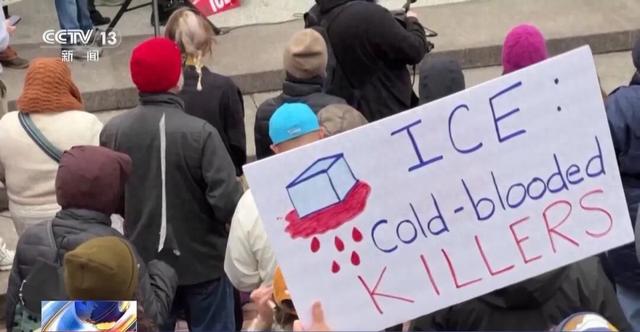
Core Viewpoint - The recent police shooting of a U.S. citizen in Minneapolis has reignited nationwide protests against immigration enforcement and police violence, highlighting deep political divisions and social unrest in the U.S. [1][3][11] Group 1: Incident Overview - The shooting of 37-year-old U.S. citizen, Reign Good, by ICE agents during an immigration enforcement operation has sparked significant public outrage and protests across major U.S. cities [1][3][9] - The incident occurred near the site of George Floyd's death, which had previously ignited nationwide protests against police brutality [1][3] - Following the shooting, over 1,500 arrests were made in Minnesota as part of a broader crackdown on illegal immigration, described as the largest operation of its kind in U.S. history [7][11] Group 2: Public Response and Protests - Protests erupted in Minneapolis and spread to cities like Washington, New York, and Seattle, with demonstrators calling for the abolition of ICE and demanding accountability for the shooting [3][11][13] - The protests saw participation from thousands, with slogans like "ICE: Cold-Blooded Killers" and "No ICE, Yes Peace" being prominently displayed [3][20] - The public response has been characterized by a mix of support for strong immigration enforcement and calls for civil rights protections, reflecting a polarized national sentiment [18][20] Group 3: Political Implications - The incident has become a focal point for political debate, with both Republican and Democratic parties using it to galvanize their bases ahead of the 2026 midterm elections [18][20] - The White House has framed the shooting as a case of self-defense by ICE agents, while local officials have criticized the federal government's handling of the situation [13][15] - The ongoing tensions between federal and state authorities are likely to exacerbate divisions within the U.S. political landscape, as both sides seek to leverage the incident for electoral gain [17][20]

重磅!特朗普将于周四10点发表全美直播讲话:直言“最好的还在后头”
智通财经网· 2025-12-17 00:45
Group 1 - President Trump will deliver a prime-time address to the nation, aiming to promote his agenda amid declining public support for his economic policies [1][2] - The speech will highlight Trump's historical achievements over the past year and preview upcoming policies for the new year [1][2] - The address comes at a critical time as Trump's approval ratings are softening, and economic indicators show warning signs, including slowing wage growth and rising living costs [2][3] Group 2 - Trump has been reshaping the federal government by reducing its size and cutting funding for long-criticized programs, while also focusing on immigration policies [2] - The upcoming midterm elections in November will serve as a test of Trump's power and legislative agenda, with the potential for the Republican Party to lose seats in Congress [2] - Political opponents are criticizing Trump's tariffs, linking them to rising consumer prices and inflation, which have become key concerns for voters [2]
美国“绿卡”变“金卡”
Xin Lang Cai Jing· 2025-12-15 04:15
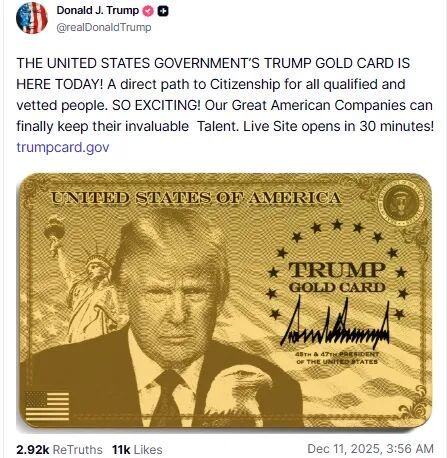
Core Viewpoint - The "Trump Gold Card" program aims to attract wealthy individuals to the U.S. by offering permanent residency in exchange for significant fees, reflecting a shift in U.S. immigration policy towards favoring affluent applicants [1][3][6] Group 1: Program Details - The "Trump Gold Card" is priced at $1 million for individuals and $2 million for businesses, with an additional processing fee of $15,000, allowing for expedited permanent residency [3][4][13] - The program simplifies the application process for EB-1 and EB-2 visa categories, requiring only a background check and payment, contrasting with traditional requirements for extensive documentation [4][14] - A "Platinum Card" option is also proposed at $5 million, allowing holders to stay in the U.S. for up to 270 days annually without paying U.S. taxes on foreign income [15] Group 2: Financial Implications - The U.S. government openly acknowledges the financial motivations behind the program, with Trump suggesting it could raise substantial funds to address national debt [6][18] - The program's goal includes raising $1 trillion to help pay down the national debt, which currently exceeds $38 trillion, highlighting the ambitious nature of the initiative [7][18] - The program faces challenges regarding market demand, as the high entry cost may exclude many potential applicants, raising questions about its effectiveness [18][23] Group 3: Policy Controversies - The "Gold Card" initiative has sparked significant debate, with critics arguing it prioritizes the wealthy and effectively "sells" citizenship [8][19] - Legal experts question the legitimacy of the president's unilateral creation of this program, indicating potential legal challenges ahead [8][19] - The program's timing and design, featuring Trump's image, have raised concerns about the politicization of immigration policy [21][23]
美媒:美国执法机构已逮捕7.5万无犯罪记录移民
Zhong Guo Xin Wen Wang· 2025-12-08 00:12
Core Viewpoint - The report highlights a significant contradiction in the U.S. government's immigration enforcement narrative, revealing that over one-third of individuals arrested by ICE in the first nine months of the Trump administration had no criminal record, despite claims that operations target serious offenders [1] Group 1: Arrest Data - Approximately 220,000 individuals were arrested by ICE during the first nine months of the Trump administration, with more than 75,000 of these arrests involving individuals without any criminal record [1] - The data does not include arrests made by the Border Patrol, which has been actively conducting operations in various cities, including Chicago and Los Angeles [1] Group 2: Government Claims - U.S. government officials have stated that immigration actions are focused on apprehending "murderers, rapists, and gang members," which contradicts the arrest data showing a high number of non-criminal arrests [1] - Ariel Ruiz Soto, a senior policy analyst at the Migration Policy Institute, pointed out the inconsistency between the government's claims and the actual data regarding arrests [1]
Melania Trump's Former Immigration Lawyer Slams Republican Bill To End Dual Citizenship In The US
Benzinga· 2025-12-04 08:31
Core Viewpoint - The proposed "Exclusive Citizenship Act of 2025" by Senator Bernie Moreno aims to eliminate dual citizenship in the U.S., requiring citizens to renounce any foreign citizenship they hold, which has drawn criticism from legal experts and immigration attorneys [1][4][5]. Group 1: Bill Overview - The "Exclusive Citizenship Act of 2025" mandates U.S. citizens to have exclusive allegiance to the U.S. and requires those with dual citizenship to renounce their foreign citizenship within one year of the bill's enactment [4][5]. - Failure to comply with the renunciation requirement would result in individuals being considered to have voluntarily relinquished their U.S. citizenship [5]. - The bill is set to take effect 180 days after it becomes law if passed [5]. Group 2: Legal and Historical Context - Michael Wildes, an immigration attorney, argues that the bill lacks legal force and is merely symbolic, as the U.S. has historically allowed dual citizenship [2][3]. - He highlights that several early American leaders, including presidents, were dual nationals, questioning the rationale behind the bill [3]. Group 3: Broader Immigration Policy Context - The proposal aligns with the Trump administration's ongoing efforts to tighten immigration policies, including plans for a more challenging citizenship test and scrutiny of applicants' moral character [6]. - The administration has also sought to redefine citizenship parameters, including an executive order aimed at ending birthright citizenship under specific conditions [6].
美媒:白宫新闻秘书莱维特侄子的母亲,被美国移民执法局拘捕
Huan Qiu Wang· 2025-11-27 03:43
Core Points - The article discusses the arrest of Bruna Ferreira, the mother of the niece of White House Press Secretary Levitt, by ICE in Boston [1][3] - Ferreira, who entered the U.S. from Brazil as a child, was apprehended while picking up her son from school [3] - Ferreira's legal status is complicated; she was a beneficiary of the Deferred Action for Childhood Arrivals (DACA) program but could not renew her status due to the Trump administration's attempts to terminate the program [3] Immigration Policy Context - The Trump administration has been tightening immigration policies, increasing the enforcement of deportations for illegal immigrants [4] - There is also a heightened scrutiny of legal visa holders, with reports indicating that the administration is reviewing approximately 55 million visa holders for potential violations [4] - The Department of Homeland Security stated that all individuals illegally residing in the U.S. will be deported under the current administration's leadership [3][4]
烽火戏“牛马”:10万美元签证费引发的中国打工人荒诞剧
Hu Xiu· 2025-09-30 08:50
Core Points - A sudden announcement from major U.S. companies required all H-1B visa holders to return to the U.S. immediately, causing widespread panic among foreign employees [1][3] - The situation was later clarified by U.S. officials, stating that the new regulations only applied to first-time applicants, not current holders [4] - The H-1B visa system, designed to attract high-skilled talent, has a limited quota of 85,000 annually, with a selection rate often below 20%, leading to a precarious situation for many foreign workers [3][12][13] Group 1: Impact on Employees - Many employees faced personal dilemmas, such as abandoning family events or vacations, due to the urgency of returning to the U.S. [2][6] - The fear of losing their jobs and the associated visa status led to frantic travel arrangements, with some employees paying exorbitant prices for last-minute flights [9][10] - The term "obedience test" was used to describe the situation, highlighting the anxiety and uncertainty faced by H-1B holders regarding their future in the U.S. [5][11] Group 2: H-1B Visa System Challenges - The H-1B visa is characterized by its temporary nature, with a maximum stay of six years, creating a "systemic dilemma" for workers who must secure a green card to remain in the U.S. [20][22] - Changes in U.S. immigration policy have led to increased scrutiny and higher rejection rates for H-1B applications, particularly during the Trump administration [13][14] - The recent announcement of a weighted lottery system prioritizing high-skill, high-salary applicants indicates a trend towards an "elite" immigration system, further limiting opportunities for average international students [27] Group 3: Employee Perspectives - Many employees expressed feelings of being treated as expendable, with a constant fear of job loss and the associated visa implications [11][15][17] - The emotional toll of the situation was evident, with some contemplating returning to their home countries due to the instability of their work status in the U.S. [18][28] - The contrast between life in the U.S. and their home countries has led to a reevaluation of priorities among H-1B holders, with some considering the benefits of returning home [31][34]
H-1B 设置10万美元门槛,华人留在硅谷更难了
3 6 Ke· 2025-09-28 02:14
Core Viewpoint - Trump's recent executive order imposing a $100,000 fee for H-1B visa holders has caused panic among tech giants and their employees, particularly affecting high-skilled foreign workers in the U.S. [1][2] Group 1: Importance of H-1B Visa - The H-1B visa program has been crucial for U.S. tech companies, allowing them to hire skilled foreign workers in STEM fields since its inception in 1990 [2][5] - Approximately 700,000 individuals currently hold H-1B visas in the U.S., with a significant number being from India and China [6][7] - Major tech companies like Amazon, Microsoft, and Apple heavily rely on H-1B visa holders for talent acquisition [7] Group 2: Immediate Reactions - Following the announcement, companies like Microsoft and Amazon issued urgent advisories to H-1B holders to remain in the U.S. and return quickly if they were abroad [13][14] - The panic was evident, with reports of H-1B holders on flights expressing fear and confusion about the new regulations [8] Group 3: Clarifications and Confusion - The White House later clarified that the $100,000 fee applies only to new applicants and is a one-time charge, alleviating some immediate concerns but leaving uncertainty for the future [15][16] - Initial confusion stemmed from unclear communication regarding the scope of the new fee, leading to widespread speculation among H-1B holders [12][14] Group 4: Industry Perspectives - Some industry leaders view the fee as a less aggressive measure compared to potential alternatives like completely abolishing the H-1B program [17][18] - However, the financial burden of the new fee could deter many companies, especially smaller firms, from hiring H-1B candidates, potentially reducing opportunities for foreign workers [19][21] - The new fee structure may favor larger tech companies with more resources, while making it harder for smaller firms to compete for talent [21]

H-1B设置10万美元门槛,华人留在硅谷更难了
Hu Xiu· 2025-09-25 08:17
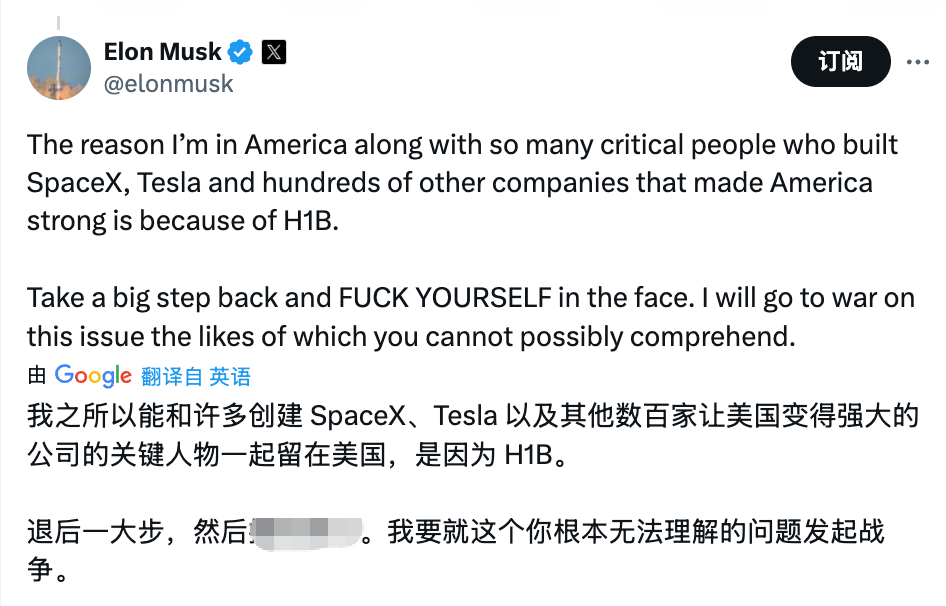
Core Viewpoint - The recent executive order signed by Trump imposing a $100,000 fee for H-1B visa applicants has caused significant concern among tech giants and H-1B holders, highlighting the importance of the H-1B visa in the U.S. tech industry and the potential implications for talent acquisition and retention [2][6][7]. Group 1: Importance of H-1B Visa - The H-1B visa is crucial for the U.S. tech industry, with approximately 700,000 holders, primarily from India and China [3][21]. - Many prominent tech leaders, including Elon Musk and Sundar Pichai, have immigrated to the U.S. through the H-1B program [4][19]. - The demand for H-1B visas has led to a lottery system since 2004 due to overwhelming applications exceeding the annual cap [11][12]. Group 2: Reaction from Tech Companies - Following the announcement of the new fee, major companies like Microsoft and Amazon issued urgent advisories to H-1B holders to remain in the U.S. [6][30]. - The initial confusion surrounding the executive order led to panic among H-1B holders, prompting some to cancel travel plans [23][31]. - The White House later clarified that the fee applies only to new applicants and is a one-time charge, alleviating some concerns but leaving uncertainty for the future [7][34]. Group 3: Mixed Reactions from Industry Leaders - Some industry leaders view the $100,000 fee as a less aggressive measure compared to potential complete cancellations of the H-1B program [36][39]. - High-profile figures like Musk and Nvidia's Jensen Huang have expressed support for reforms to the H-1B system, emphasizing the need for attracting top talent [38][42]. - However, the financial burden of the new fee could deter many potential applicants, particularly affecting smaller companies more than tech giants [44][47].