考公热

Search documents
2026年国考招录年龄放宽 报名人数创新高
Zhong Guo Qing Nian Bao· 2025-10-24 13:29
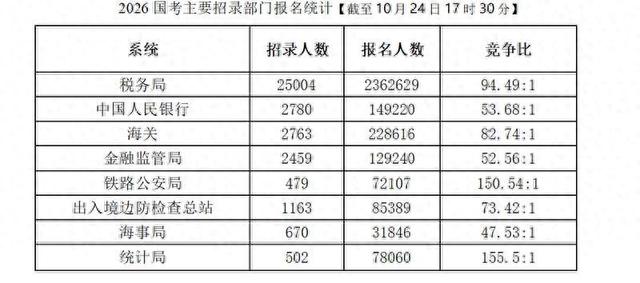
Core Points - The 2026 National Civil Service Examination (国考) has a total recruitment of 38,119 positions, with a record number of 3,515,251 applicants, an increase of nearly 260,000 compared to the previous year, marking a historical high [1][5] - The average competition ratio stands at 92:1, with 3,207,060 applicants passing the recruitment unit's review [1][6] - The age limit for applicants has been relaxed, allowing candidates aged 18 to 38, and for 2026 graduates with master's and doctoral degrees, the limit is extended to 43 [2][3] Recruitment Data - The recruitment numbers and competition ratios for various agencies are as follows: - Tax Bureau: 25,004 positions, 2,362,629 applicants, competition ratio of 94.49:1 - People's Bank of China: 2,780 positions, 149,220 applicants, competition ratio of 53.68:1 - Customs: 2,763 positions, 228,616 applicants, competition ratio of 82.74:1 - Financial Regulatory Bureau: 2,459 positions, 129,240 applicants, competition ratio of 52.56:1 - Railway Public Security Bureau: 479 positions, 72,107 applicants, competition ratio of 150.54:1 [2] Policy Implications - The relaxation of age limits is seen as a response to the delayed retirement policy, suggesting a need for adjustments in recruitment criteria [3][4] - The adjustment reflects a broader trend in various regions, with several local governments already implementing similar age relaxations for public service examinations [4][5] - Experts suggest that this move could create a "demonstration effect" in the job market, encouraging a more inclusive approach to age in recruitment [5] Trends and Observations - The recruitment plan from 2019 to 2025 shows a steady increase in the number of positions, although the growth rate has slowed down, with a slight decrease of about 1,600 positions for 2026 compared to the previous year [5] - The tax system is expected to account for approximately 65.6% of the total recruitment, driven by a wave of retirements and the need for skilled professionals in finance, accounting, and technology [6] - The "public service examination craze" reflects a strategic career adjustment by graduates in response to economic changes, highlighting the stability and social recognition associated with civil service roles [7]

日本学历贬值30年:博士批量失业、大学生无奈啃老
商业洞察· 2025-06-02 04:47
Core Viewpoint - The article discusses the phenomenon of "degree devaluation" in the context of the increasing number of university graduates in China, drawing parallels with Japan's historical experience during the 1990s economic downturn [2][3]. Group 1: Current Job Market Situation - The number of university graduates in 2023 is projected to reach a record 12.22 million, leading to the largest job-seeking wave in history [1]. - The offer acquisition rate for 2024 master's and doctoral graduates is only 44.4%, a decrease of 12.3% year-on-year, which is lower than the 45.4% rate for undergraduate graduates [1]. - The job market is increasingly competitive, with the employment rate for undergraduate graduates being lower than that of vocational school graduates [1]. Group 2: Historical Context and Lessons from Japan - Japan experienced a similar "degree devaluation" phenomenon in the 1990s, where a significant economic downturn led to a drastic drop in employment rates for university graduates [10][12]. - The 1990s marked a turning point for Japan, where the employment rate for graduates fell from 80% to below 70%, leading to a generation labeled as "lost" due to their struggles in the job market [10][30]. - The Japanese government attempted various measures to alleviate the employment crisis, including increasing the number of graduate students, but these efforts did not address the underlying issues of economic stagnation and job market demand [21][35]. Group 3: Economic Implications - The article highlights that the root cause of degree devaluation is not merely the oversupply of graduates but the lack of corresponding job opportunities due to economic stagnation and a failure to innovate [35][37]. - Japan's experience illustrates that without significant economic growth and innovation, an increase in educational attainment can lead to a surplus of graduates without adequate job prospects [35][37]. - The article concludes that creating new job opportunities through industrial upgrades and innovation is essential to prevent degree devaluation and ensure that higher education translates into economic productivity [35][37].

日本学历贬值30年:博士批量失业、大学生无奈啃老
凤凰网财经· 2025-05-29 11:45
Core Viewpoint - The article discusses the phenomenon of "degree devaluation" in the context of the increasing number of university graduates in China and draws parallels with Japan's historical experience during its economic downturn in the 1990s [4][20]. Group 1: Current Situation of Graduates - In 2024, the number of university graduates in China is expected to reach a record 12.22 million, leading to the largest job-seeking wave in history [4]. - The offer acquisition rate for master's and doctoral graduates is only 44.4%, a decrease of 12.3% year-on-year, which is lower than the 45.4% for undergraduate graduates [4]. - The trend of increasing university graduates is projected to continue until 2038, when it will peak at 14.45 million [4]. Group 2: Historical Context from Japan - In the 1980s, Japan experienced a booming economy where university graduates were highly sought after, with many receiving multiple job offers before graduation [5][6]. - The economic bubble burst in the 1990s led to a drastic decline in job opportunities, with the employment rate for graduates dropping significantly [8][9]. - The term "lost generation" emerged in Japan, referring to those who graduated during the economic downturn and faced severe employment challenges [12]. Group 3: Government Responses and Consequences - The Japanese government implemented various measures to address the employment crisis, including increasing the number of graduate students and promoting vocational training [13][15]. - Despite these efforts, the oversupply of graduates and the lack of corresponding job opportunities led to a rise in "high-education refugees" and "浪人博士" (wandering PhDs) [15][19]. - The shift towards non-regular employment, such as temporary and contract work, became prevalent, further complicating the job market for graduates [16][19]. Group 4: Lessons Learned - Japan's experience highlights the importance of aligning higher education with market needs and the dangers of overemphasizing degree attainment without corresponding job creation [21]. - The article suggests that economic growth and innovation are crucial for creating job opportunities that can absorb the increasing number of graduates [21].