
考公热

Search documents
粉笔在“考公热”中冻伤了:2025年营收净利双降,上市至今股价跌超八成。
Xin Lang Cai Jing· 2026-02-25 08:44
Core Viewpoint - The article discusses the recent developments in the financial market, highlighting significant trends and potential investment opportunities in various sectors [1]. Group 1: Financial Market Trends - The financial market has shown a notable increase in volatility, with major indices experiencing fluctuations due to economic uncertainties [1]. - Analysts predict a potential rebound in certain sectors, particularly technology and renewable energy, as companies adapt to changing market conditions [1]. Group 2: Investment Opportunities - There is a growing interest in green technologies, with investments in renewable energy sources expected to rise significantly in the coming years [1]. - Companies focusing on digital transformation are likely to attract more capital, as businesses seek to enhance operational efficiency and customer engagement [1].
就业难微观体感强烈?赵忠:就业阵痛期核心矛盾是结构性失衡
Nan Fang Du Shi Bao· 2026-01-23 11:12
Core Viewpoint - The average urban survey unemployment rate in China is projected to be 5.2% in 2025, indicating a stable employment situation at the macro level, but individuals are feeling significant employment pressure at the micro level. The core contradiction of current employment pressure lies in structural issues, exacerbated by technological advancements and economic changes, necessitating macro reforms and lifelong learning for resolution [1][4][5]. Macro Economic Indicators - The 2025 target for the urban survey unemployment rate is around 5.5%, and achieving a 5.2% rate is considered commendable given the current economic context. However, this figure does not fully capture the employment landscape, as different demographics and regions face varying employment pressures, highlighting the need for more comprehensive evaluation metrics beyond just unemployment rates [4][6]. Structural Employment Issues - The primary challenge is structural, particularly concerning skill mismatches. Economic transitions and technological advancements are creating and eliminating jobs, leading to a disconnect between existing workforce skills and new job requirements. This is compounded by regional disparities in labor supply and demand, as well as a mismatch between job offerings and job seekers' preferences, especially among the youth [6][7]. Youth Employment and Education - The number of college graduates is expected to reach 12.22 million in 2025, with a projected increase to 12.7 million in 2026. The key to ensuring youth employment lies in adapting educational programs to meet market demands. The government should implement targeted policies to encourage employers to hire graduates, while educational institutions must align their curricula with labor market needs [9][10]. Age Discrimination and Career Development - The "35-year-old employment crisis" reflects a broader societal issue where workers face career stagnation and increased competition from younger individuals. This demographic often bears family pressures, making job transitions challenging. Addressing this requires collaborative efforts from society, businesses, and individuals to create equitable employment opportunities and promote lifelong learning [10][11]. Work-Life Balance and Employment Quality - There is a growing emphasis on work-life balance among younger generations, with a shift in focus towards the quality of employment rather than just job availability. The government has recognized the importance of high-quality employment, which includes maintaining a balance between work and personal life as a fundamental aspect of job quality [14][16]. AI and Employment Dynamics - The rapid advancement of AI technology poses both challenges and opportunities for employment. While some jobs may be at risk of automation, new roles are also emerging. The key lies in how AI is integrated into the workforce, emphasizing the need for continuous learning and adaptation among workers to remain competitive in an evolving job market [22][23].


AI面试产品“三国杀”
Bei Jing Shang Bao· 2026-01-15 16:32
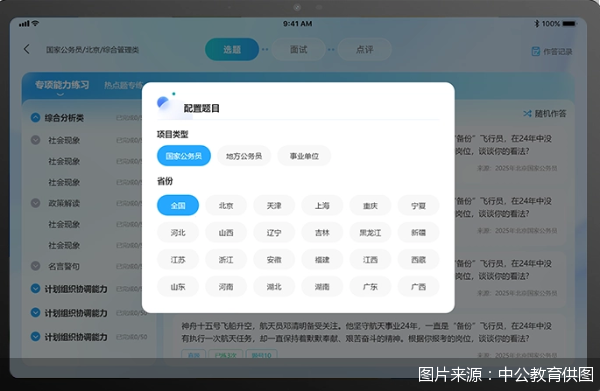
Core Insights - The competitive landscape in the vocational education sector is intensifying as major players like Zhonggong Education, Fenbi, and Huatu Shanding launch AI interview products to capture market share amid rising demand for civil service exam preparation [1][3][7] Group 1: AI Product Launches - Zhonggong Education has introduced the "Zhonggong AI Interview" training product, featuring four core functions: interview simulation training, multi-dimensional evaluation system, personalized improvement guidance, and targeted knowledge supplementation [3][4] - Fenbi and Huatu Shanding had previously launched their own AI interview products, with Fenbi's offerings including AI interview evaluations for civil service and teaching qualification exams [3][6] Group 2: Market Demand and Trends - The civil service exam's popularity is increasing, with 3.718 million candidates passing the qualification review for the 2026 exam, resulting in a ratio of approximately 98:1 between candidates and available positions [6][7] - The relaxation of age limits for applicants, from 35 to 38 years, is expected to expand the candidate pool, particularly among older professionals seeking efficient and precise preparation methods [6][8] Group 3: Industry Challenges and Opportunities - Traditional interview training faces challenges such as a lack of quality instructors, high costs, and inconsistent feedback, which AI products aim to address by providing scalable services and immediate feedback [4][8] - The increasing competition in the AI vocational education market is leading to a "pyramid" structure, where leading companies dominate the high-end market while smaller firms focus on niche segments [8][9] Group 4: Investment in R&D - Companies are investing significantly in R&D to enhance their AI products, with Zhonggong Education reporting R&D expenses of 110 million yuan in the first three quarters of 2025, and Huatu Shanding's R&D expenses rising by 160.41% year-on-year [8][9] - Fenbi's R&D spending reached 108 million yuan in the first half of 2025, indicating a robust commitment to developing competitive AI solutions [8]



中公入局,职业教育上演AI面试产品“三国杀”
Bei Jing Shang Bao· 2026-01-15 12:40
Core Viewpoint - The competition in the vocational education sector is intensifying as major players like Zhonggong Education, Fenbi, and Huatu Shanding launch AI interview products to meet the growing demand from candidates preparing for civil service exams [1][2][6]. Group 1: AI Interview Product Launches - Zhonggong Education has introduced the "Zhonggong AI Interview" training product, featuring four core functions: interview simulation training, multi-dimensional evaluation system, personalized improvement guidance, and targeted knowledge supplementation [2][6]. - Fenbi and Huatu Shanding had previously launched their own AI interview products, with Fenbi's offerings dating back to December 2024 and Huatu Shanding's in April 2025, indicating a strong market demand for AI interview coaching [2][5]. Group 2: Market Dynamics and Candidate Trends - The number of candidates for the 2026 National Civil Service Exam reached 3.718 million, with a qualification review ratio of approximately 98:1, leading to an expanded candidate pool and increased demand for efficient preparation tools [5][6]. - The relaxation of age limits for applicants, from 35 to 38 years, is expected to activate the interest of older candidates, further diversifying the candidate demographic and increasing the need for personalized and flexible training solutions [5][6]. Group 3: Industry Challenges and Competition - The entry of multiple companies into the AI interview product space is intensifying competition, with a projected market structure resembling a "pyramid," where leading firms dominate the high-end market while smaller firms focus on niche segments [7][8]. - High research and development costs are creating barriers to entry, with Zhonggong Education reporting R&D expenses of 110 million yuan and Huatu Shanding 145 million yuan in the first three quarters of 2025, indicating significant investment in AI product development [8]. Group 4: Future Outlook and Product Differentiation - The future of the AI vocational education market will depend on the ability to provide personalized and differentiated services that truly address the diverse needs of candidates, as generic AI training may lead to homogenized responses and undermine the interview process [9].
公考培训频频“注水” 控本不是欺客理由
Xin Lang Cai Jing· 2026-01-08 19:02
Group 1 - The "public examination fever" has led to a surge in public exam training, but many training institutions face complaints regarding inconsistent course quality, erroneous materials, and refund issues [1] - The public exam training sector has seen the emergence of several industry giants, benefiting from brand and chain operations, yet increasing competition has intensified revenue pressures, leading institutions to engage in price wars and aggressive marketing strategies [1] - Public exam training institutions lack strong competitive advantages, with their most valuable asset being "famous teachers," who often attract students independently, posing a challenge to the institutions [1] Group 2 - The trend in public examination questions is shifting towards less emphasis on rote memorization and more on creativity, critical thinking, and broad knowledge, presenting significant challenges to public exam training institutions [2] - If institutions continue to dilute their offerings, they may face increasingly limited prospects in the future [2]
对话李燕萍:“考公热”深刻塑造一代年轻人
经济观察报· 2025-12-14 04:51
Core Viewpoint - The increasing trend of civil service examinations among young people is a rational risk management decision based on current employment conditions, rather than a sign of lost dreams or conservatism [1][4][11]. Group 1: Examination Trends - The number of candidates for the national civil service examination surpassed that of graduate school entrance examinations for the first time in history in 2026, with a significant increase from 157.6 million in 2021 to 371.8 million in 2026, marking a growth rate of 235.9% [2][4]. - In contrast, the number of graduate school applicants has been declining rapidly, with a drop from a peak of 4.74 million in 2023 to 3.43 million in 2026, a decrease of over 1.3 million [2][4]. Group 2: Competitive Landscape - The competition for civil service positions is intense, with an admission ratio of approximately 98:1 for the national examination compared to 3.2:1 for graduate school [4]. - The phenomenon of "civil service examination fever" reflects a broader societal anxiety that transcends age and class, indicating a shift from a growth-oriented mindset to one focused on job security and stability [4][19]. Group 3: Long-term Implications - The long-term effects of failing the civil service examination can lead to significant career disadvantages, including lower starting salaries and limited advancement opportunities, as candidates return to the job market with gaps in their resumes [6][8]. - The current employment pressure is characterized as a systemic anxiety affecting various demographics, including young graduates and middle-aged workers, indicating a shift away from the belief that hard work guarantees better outcomes [19]. Group 4: Changing Definitions of "Good Jobs" - The definition of a "good job" has shifted from seeking high growth opportunities to prioritizing job security and stability, reflecting a broader change in societal values and economic conditions [9][11]. - The current job market emphasizes the importance of practical skills and experience over academic credentials, leading to a more competitive environment for graduates [23][24]. Group 5: Structural Employment Issues - There exists a structural mismatch in the job market, where the increase in job postings does not align with the expectations of recent graduates, leading to a perception of difficulty in finding suitable employment [13][14]. - The employment landscape is increasingly complex, with various groups, including young graduates, middle-aged workers, and small business owners, facing unique challenges that contribute to a pervasive sense of job insecurity [19][18].

对话李燕萍:“考公热”深刻塑造一代年轻人
Jing Ji Guan Cha Bao· 2025-12-14 03:44
Group 1 - The number of candidates for the National Examination (国考) surpassed that of the Graduate Entrance Examination (考研) for the first time in history in 2026, with 371.8 million candidates for the National Examination compared to 343 million for the Graduate Entrance Examination, marking a significant shift in trends [1] - The National Examination has seen a rapid increase in candidates from 157.6 million in 2021 to 371.8 million in 2026, representing a growth rate of 235.9% [1] - The competition for the National Examination is intense, with a reported admission ratio of approximately 98:1, compared to a ratio of 3.2:1 for graduate studies [1] Group 2 - The phenomenon of "考公热" (the craze for civil service exams) is not indicative of young people losing their dreams but rather reflects a rational decision-making process in response to current employment pressures [2][3] - The long-term impact of the "考公热" may reshape career trajectories and influence the economic structure, as individuals face opportunity costs and potential career stagnation due to failed attempts at civil service exams [3][4] - The current employment pressure is characterized as a systemic anxiety affecting various demographics, leading to a chain reaction that exacerbates job scarcity and economic challenges [14] Group 3 - The definition of a "good job" has shifted from seeking growth opportunities to prioritizing job security, reflecting a broader change in societal values and economic conditions [6] - The increase in job postings does not correlate with the expectations of recent graduates, as many positions are concentrated in lower-tier roles, leading to a mismatch between job availability and graduate aspirations [7][9] - The current employment landscape is marked by a structural contradiction where the growth in job postings does not meet the expectations of graduates, resulting in a perception of difficulty in finding suitable employment [9][10] Group 4 - The decline in graduate school applications from 2024 to 2026 is attributed to an oversupply of master's graduates and a shift in employer expectations towards practical skills over academic credentials [16][17] - The competition for graduate programs remains intense at top-tier universities, while some less prestigious institutions face declining enrollment in certain fields [18] - The changing landscape of employment has led to a more pragmatic approach among students and parents regarding the value of graduate education, emphasizing the importance of skills and experience over mere academic qualifications [17][18]
没考上可退费?“考公”培训靠谱吗?
Ren Min Ri Bao· 2025-12-08 01:00
Core Viewpoint - The increasing popularity of civil service exam preparation ("考公") among college graduates has led to a surge in various training programs, raising concerns about their effectiveness and legitimacy [1][2][3]. Group 1: Training Programs and Costs - Many students are investing in civil service exam training, with costs for interview training programs reaching up to 9,800 yuan for an 8-day course, and 23,800 yuan for a "guarantee course" that offers partial refunds if the student fails [2]. - Training programs vary in price based on location and exam type, with small group classes typically costing around 10,000 yuan per week, while one-on-one tutoring can exceed this amount [2]. - The quality and legitimacy of these training programs are inconsistent, with some institutions operating without the necessary educational licenses, which raises concerns about regulatory compliance [2][3]. Group 2: Refund Policies and Student Experiences - Some training institutions promise full support and refunds if students do not pass the exam, but many students report difficulties in obtaining refunds, with delays and unresponsive staff being common issues [3]. - Students express mixed feelings about the effectiveness of these training programs, with some believing they provide valuable insights into exam formats, while others feel they may lead to overly formulaic responses [3]. Group 3: Alternatives and Recommendations - Students often prefer commercial training programs over university career services, citing a lack of practical job-seeking skills offered by their schools [4]. - Experts recommend that students be cautious of contract pitfalls and misleading advertisements when selecting training programs, and suggest attending trial classes to assess the quality of instruction [4]. - There is a call for improved public employment services and better integration of career guidance within universities to reduce reliance on commercial training services [4][5].
没考上可退费?“考公”培训靠谱吗?(百姓关注)
Ren Min Ri Bao· 2025-12-07 22:02
Core Viewpoint - The increasing trend of graduates opting for civil service examinations, referred to as "考公热," highlights the appeal of job stability and fairness in the selection process [1] Group 1: Training and Costs - Various "考公" training programs have emerged, with prices for interview training courses reaching up to 9,800 yuan for an 8-day program and 23,800 yuan for a "guarantee course" that offers a refund if the candidate does not pass [2] - Training costs vary by region and exam type, with small group classes typically charging around 10,000 yuan per week, while one-on-one tutoring can exceed this amount [2] - Some training institutions operate without the necessary licenses, raising concerns about the legitimacy of their services [2] Group 2: Refund and Effectiveness Issues - Refund processes for training fees can be complicated, with students facing delays and difficulties in obtaining their money back after failing the exams [3] - While structured interview training can help familiarize candidates with exam formats, it may lead to overly formulaic responses, potentially hindering individual expression [3] - Some successful candidates report that training may only serve as a motivational tool rather than a significant advantage in the competitive exam landscape [3] Group 3: Perception of Training Institutions - Graduates prefer commercial training programs over university career services due to perceived inadequacies in job-seeking skills offered by educational institutions [4] - Experts suggest that students should be cautious of contract pitfalls and misleading advertisements when selecting training programs, recommending trial classes and feedback from former students [4] - There is a call for universities to enhance their employment services, providing comprehensive support that includes resume reviews and interview coaching to mitigate the issues associated with unregulated paid services [4] Group 4: Broader Employment Context - The need for practical skills and cross-disciplinary competencies is emphasized, alongside a call for rational perspectives on career choices to avoid intense competition in specific job markets [5]
341.6万考生抢3.9万岗:考公热为何十年不退?
3 6 Ke· 2025-12-03 23:37
Core Insights - The increasing competition for civil service exams reflects a mismatch between the growing number of applicants and the limited job openings available, leading to a record competition ratio of approximately 86:1 for the 2025 national exam [2][3] - The trend of rising applicants is driven by a combination of high university graduation rates and a backlog of unemployed candidates, indicating a long-term persistence of the civil service exam popularity [2][3] - The structure of the applicant pool is diversifying, including not only fresh graduates but also working professionals seeking stability amid industry uncertainties [6][7] Recruitment Trends - The number of positions available for the national civil service exam is increasing, with 39,721 planned for 2025, but the number of applicants has surged to around 3.416 million, more than doubling the recruitment numbers from 2019 [2][3] - The focus of recruitment is shifting towards grassroots positions, with approximately 27,500 roles aimed at county-level and below, which may deter applicants due to the associated service commitments [3][4] Applicant Demographics - The applicant demographic is expanding beyond traditional graduates to include older candidates and those from various professional backgrounds, driven by the need for job security [6][8] - The trend of older candidates entering the civil service exam space is supported by relaxed age restrictions, providing new opportunities for those over 35 [7][8] Training Industry Dynamics - The civil service exam has led to a significant transformation in the training industry, with a shift from reliance on renowned instructors to a focus on technology and data integration, particularly AI [10][12] - AI is becoming essential in the training sector, enhancing personalized learning experiences and improving efficiency for both students and institutions [10][11] Market Competition - The training market is experiencing a polarization, with larger institutions leveraging technology to create competitive advantages, while smaller entities struggle to maintain quality and relevance [12][13] - The competitive landscape is evolving, with a clear distinction between institutions that can effectively utilize AI and those that cannot, leading to a potential consolidation in the industry [14][15] Societal Context - The civil service exam trend is a reflection of broader societal changes, where job stability is increasingly prioritized due to economic uncertainties in various sectors [15][16] - The perception of stability within civil service roles varies significantly based on geographic and positional factors, influencing applicants' decisions [16][17]