
职业技能提升

Search documents
广东东莞连续两年实施国家级试点数字化人才培训 政企协同锻造数字化人才“新质生产力”
Zhong Guo Fa Zhan Wang· 2025-08-12 14:28
Group 1 - The core viewpoint emphasizes the necessity of digital transformation for survival in the current global industrial landscape, with Dongguan's training program as a key initiative to enhance competitiveness and activate local manufacturing capabilities [2][3] - Dongguan's electronic information industry has surpassed 1.1 trillion yuan, accounting for approximately 25% of the province's total, with major companies like Huawei, OPPO, and VIVO producing 15% of the world's mobile phones [2] - The training program aims to address the challenges faced by small and medium-sized enterprises (SMEs) in digital transformation, particularly the lack of strategic direction and skilled personnel [2] Group 2 - The program includes zero-cost training for enterprises, with full coverage of tuition fees by special financial funds, allowing companies to participate without financial burden [3] - Customized courses will be developed based on local enterprise transformation cases to ensure practical applicability [3] - Participants who pass assessments will receive a vocational competency certificate from the Ministry of Industry and Information Technology, serving as a credential for future opportunities [3] Group 3 - Dongguan has been recognized as a national benchmark for policy innovation and resource integration in digital transformation training, with its model being replicated in other cities [4] - The program has established a linkage mechanism between skill training subsidies and vocational certification, making it the first city to implement a comprehensive vocational skills enhancement initiative [4] - The training initiative is part of a broader national strategy to enhance vocational skills and support the digital economy [4] Group 4 - The training will provide a full-cycle talent innovation service, including top-tier instructors and practical training that combines theory with real-world application [5][6] - Participants will have access to a unique industrial software title evaluation service, facilitating their career advancement in the digital transformation ecosystem [6] - The program aims to create a collaborative environment among participants, fostering knowledge sharing and resource linking to enhance enterprise vitality [5][6] Group 5 - The program encourages participants to adopt a sponge-like learning approach, actively engage in practical applications, and become internal digital coaches within their organizations [6][7] - The collective commitment from 300 participants signifies a strong resolve to transition Dongguan from a "world factory" to a "smart warehouse" through digital transformation [8] - Experts highlight Dongguan's approach as a replicable model for implementing national strategies in skill enhancement and digital transformation [9]
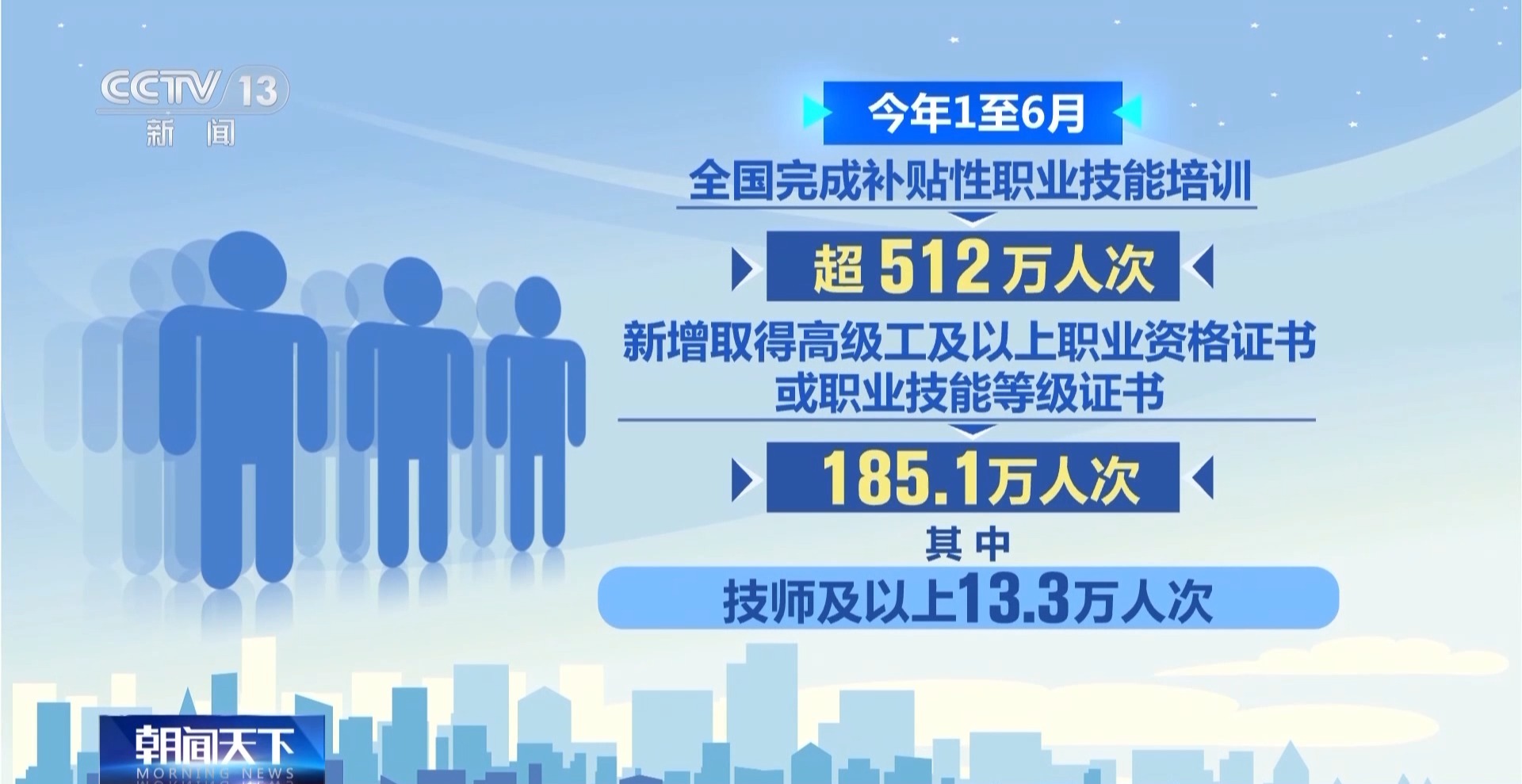
精准投喂“技能包” 结业即上岗 全国开展补贴性职业技能培训超512万人次
Yang Shi Xin Wen· 2025-08-09 02:52
Group 1 - The core focus of the national initiative is to enhance the supply of skilled talent in manufacturing and service industries through large-scale vocational training, with over 5.12 million subsidized training sessions completed in the first half of the year [1][4]. - The training programs target specific sectors such as advanced manufacturing, digital economy, low-altitude economy, transportation, agriculture, and life services, with a particular emphasis on groups like college graduates and migrant workers [2][4]. - The training aims to align with market demand and employment services, facilitating a connection between training and job opportunities in urgent labor sectors [5][16]. Group 2 - In Jiangxi Province, the "5+2 Employment Home" online platform has been utilized to gather market demand and training intentions, resulting in 76,500 targeted vocational training sessions [13]. - The training model combines "job needs + skills training + skills evaluation + employment services" to enhance workers' skills and income potential [16]. - The demand for elderly care workers has surged, with specialized training programs being launched to meet this need, resulting in high employment rates for graduates [17][25]. Group 3 - The training for childcare professionals is also gaining traction, with a focus on enhancing the qualifications of practitioners in response to the increasing demand for professional and refined childcare services [34][40]. - In Nantong, Jiangsu Province, over 1,000 individuals have participated in vocational skills training for childcare and elderly care, reflecting a 30% increase compared to the previous year [40][41]. - The "order-based" training model in Bijie, Guizhou Province, has successfully matched training programs with local employment needs, resulting in immediate job placements for graduates [43][45].

冲一波夜校,“打工人”也要偷偷逆袭
Zhong Guo Qing Nian Bao· 2025-07-17 02:56
Core Viewpoint - The rise of "night schools" in cities like Beijing and Shanghai is providing young professionals with opportunities to enhance their skills, explore new career paths, and increase their income through flexible learning options [2][9]. Group 1: Night School Trends - Young professionals are increasingly attending night schools during their lunch breaks or after work to learn new skills and improve work efficiency [2][9]. - Night schools offer a variety of courses, including practical skills and interest-based classes, catering to the needs of different individuals [10][11]. - The demand for skill-based courses is growing, with many students seeking to transition careers or enhance their job prospects [10][11]. Group 2: Course Offerings and Impact - Courses such as "Internet Marketing" and AI-related classes are popular, helping students combine practical experience with theoretical knowledge [4][9]. - Students report significant improvements in their professional capabilities, such as faster project completion times and enhanced creativity in design work [7][9]. - Night schools are also addressing specific community needs, offering tailored courses for various demographics, including new job seekers and stay-at-home parents [9][10]. Group 3: Student Experiences - Students like Zhang Wei and Wu Ruoting have shared positive experiences, highlighting how night school has opened up new career possibilities and improved their skill sets [3][5]. - The learning environment is described as supportive, with hands-on teaching methods that make complex topics accessible to beginners [6][9]. - Many students are motivated to continue learning independently after completing their courses, indicating a strong desire for personal and professional growth [6][9].

影响市场重大事件:中国人民银行开展14000亿元买断式逆回购操作
Mei Ri Jing Ji Xin Wen· 2025-07-16 00:58
Group 1 - The Chinese government is launching a large-scale vocational skills training initiative from 2025 to the end of 2027, targeting the manufacturing and service sectors to address talent shortages [1] - The initiative aims to provide over 30 million subsidized training sessions, focusing on high-tech industries and urgent sectors, with a particular emphasis on key groups such as enterprise employees, college graduates, and migrant workers [1] Group 2 - The People's Bank of China conducted a 14 trillion yuan reverse repurchase operation to maintain liquidity in the banking system, marking the second consecutive month of increased operations [2] - The operation included 8 trillion yuan for a 3-month term and 6 trillion yuan for a 6-month term, indicating a proactive approach to liquidity management [2] Group 3 - Guangzhou is enhancing its emergency management capabilities by focusing on key core technology breakthroughs and building a robust emergency technology framework [3] - The city aims to accelerate the transformation of innovative results into practical applications, creating a comprehensive innovation ecosystem from research and development to industrial incubation [3] Group 4 - Global investor sentiment has reached its highest level since February 2025, with profit optimism showing the largest increase since July 2020 [4] - A record rise in risk appetite has been observed over the past three months, with a significant number of investors favoring the euro [4] Group 5 - The China International Game Developers Conference (CIGDC) will be held for the first time during ChinaJoy at the end of July, focusing on providing guidelines for companies looking to expand overseas [5] - A research center for game exports will be established in Shanghai to facilitate information sharing and risk management for companies facing geopolitical and compliance challenges [5] Group 6 - CITIC Securities' chief economist noted that China's economy has shown stable growth with a 5.3% increase in the first half of the year, exceeding market expectations [6] - The second half of the year may see new policies driven by innovative policy tools, targeting weak areas of the macro economy [6] Group 7 - The National Bureau of Statistics is formulating measures to enhance market order and address issues of chaotic competition in certain industries [8] - These measures aim to improve market supply-demand relationships and promote reasonable price recovery, ultimately benefiting corporate profits and economic structure adjustment [8] Group 8 - Shanghai is advancing major engineering projects, particularly in the smart glasses industry, by signing strategic cooperation agreements and enhancing policy support [9] - The city plans to focus on technological breakthroughs and support the development of key products in AI and robotics [9] Group 9 - The Tianjin AI (AI + Xinchuang) Innovation Ecological Alliance has been established to promote collaboration and innovation in artificial intelligence technology [10] - The alliance aims to enhance the core competitiveness of Tianjin's AI sector, with over 290 member units already participating [10] Group 10 - TrendForce estimates that China's Robotaxi market will reach a scale of 44.5 billion USD by 2035, with a compound annual growth rate (CAGR) of 96% from 2025 to 2035 [11] - The market is expected to be dominated by local players such as Baidu and Pony.ai, as well as international competitors like Tesla and Waymo [11]
国办:鼓励技工院校与企业合作开展订单定向培养班、企业冠名班培养
news flash· 2025-07-09 09:19
Core Viewpoint - The State Council's notice emphasizes the need to enhance employment support policies, particularly by encouraging vocational schools to enroll unemployed individuals with a willingness to improve their skills [1] Group 1: Employment Support Policies - The notice encourages vocational schools to recruit unemployed individuals, particularly targeting youth and migrant workers who wish to enhance their skills [1] - It suggests relaxing age restrictions for enrollment in vocational schools to accommodate more individuals seeking skill improvement [1] Group 2: Curriculum and Collaboration - Vocational schools are guided to offer programs in high-demand fields such as advanced manufacturing and service industries [1] - The notice promotes collaboration between vocational schools and enterprises to establish targeted training programs, including order-based training classes and enterprise-named classes [1]