股票策略

Search documents
私募11月备案产品环比激增近30% 股票策略占比超六成
Zheng Quan Shi Bao Wang· 2025-12-04 07:53
Core Insights - Despite the ongoing fluctuations in the A-share market since November, the enthusiasm for private equity product registration remains high, with a significant increase in the number of registered products [1][3] Group 1: Private Equity Product Registration - A total of 1,285 private equity securities products were registered in November, marking a 29.28% increase from 994 products in the previous month [1] - The stock strategy continues to dominate, with 849 products registered, accounting for 66.07% of the total [1] - Multi-asset strategies saw 193 products registered, representing 15.02% of the total, while futures and derivatives strategies accounted for 121 products, or 9.42% [1] Group 2: Quantitative Private Equity Products - Quantitative private equity products performed exceptionally well, with 565 products registered in November, making up 43.97% of the total [2] - Within quantitative strategies, stock strategies led with 402 products, while futures and derivatives strategies had 80 products registered [2] - The quantitative long strategy was particularly notable, with 310 products registered, representing 54.87% of quantitative products [2] Group 3: Market Sentiment and Factors - The high registration enthusiasm is driven by optimistic market expectations, as private equity institutions believe equity asset valuations are now reasonable, and economic stabilization is underway [3] - The continuous decline in risk-free interest rates has diminished the appeal of traditional fixed-income products, prompting investors to reallocate assets towards higher-yielding private equity securities [3] - The overall performance of private equity securities products has been strong this year, especially in quantitative strategies, with over 90% of products showing positive returns, boosting confidence among channels and high-net-worth clients [3]
私募11月备案产品激增近30%,股票策略占比近七成
Sou Hu Cai Jing· 2025-12-04 06:43
Group 1 - The private equity market in China is experiencing a surge in product registrations, with November seeing a 29.28% increase compared to the previous month, totaling 1,285 registered private equity securities products, marking the second-highest monthly registration this year [1] - Equity strategies remain the dominant focus for private equity firms, with 849 equity strategy products registered in November, accounting for 66.07% of total registrations, indicating strong investor interest despite recent adjustments in the A-share market [1] - Multi-asset strategies and futures and derivatives strategies are also maintaining high levels of activity, with 193 multi-asset strategy products registered, representing 15.02% of the total [1] Group 2 - Quantitative private equity products are particularly noteworthy, with 565 products registered in November, making up 43.97% of total registrations; equity strategies dominate this category as well, with 402 products registered [2] - A total of 719 private equity firms registered products in November, with 49 firms registering five or more products, highlighting a strong enthusiasm for product registration, especially among leading quantitative firms [2] - Century Frontier leads in product registrations with 20 products, followed by Starstone Investment with 15, and Mingchao Investment, Shanghai Xiaoyong Private Equity, and Tiansuan Quantitative each with 12 products [2] Group 3 - The A-share market has seen fluctuations around the 3,900-point mark, but long-term trends remain positive according to DWSQ, which believes that current adjustments do not alter the medium to long-term bullish outlook for A-shares [3] - Support for market risk appetite is expected from policy and liquidity environments, with expectations of the Federal Reserve entering a rate-cutting phase and overall liquidity in the A-share market remaining ample [3] - Corporate earnings are showing signs of stabilization, with the technology and advanced manufacturing sectors expected to contribute positively to market opportunities due to external demand and technological upgrades [3]
私募年均收益超24%
Sou Hu Cai Jing· 2025-11-14 23:15
Core Insights - The A-share market has shown a slow upward trend this year, supported by policy measures in the bond market, which has seen a recovery in the latter half of the year. The commodity futures market has displayed significant differentiation, with stock index futures and precious metals performing particularly well [1] Summary by Category Private Fund Performance - As of the end of October, 91.33% of the 10,969 private funds achieved positive returns, with an average return rate of 24.32%. The top 5% of funds recorded an impressive return rate of 72.03% [1] Strategy Types - Equity strategies led the five major strategies with an average return rate of 29.52%, and 92.73% of these products generated positive returns. Among 6,931 products, 6,427 were profitable, with the top 5% achieving a return of 82.48%, significantly higher than other strategies [1] - Multi-asset strategies ranked second with an average return rate of 19.71% and a positive return product ratio of 91.61%. This strategy effectively captured the equity market's upward momentum while diversifying risks through bonds and commodities [1] - Combination funds demonstrated strong profitability stability, with 96.85% of products yielding positive returns. Out of 476 products, only 15 reported losses, although the average return rate of 17.86% was slightly lower than that of multi-asset strategies [1]
年内私募分红逾150亿元 同比大增逾263%
Xin Hua Cai Jing· 2025-11-14 08:27
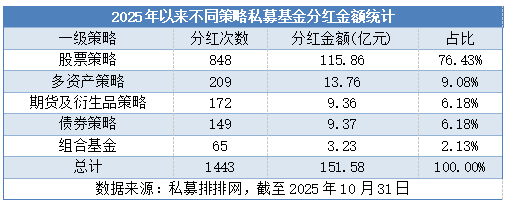
Core Insights - The private equity fund distribution scale has significantly increased this year, with a total distribution amount exceeding 15.158 billion yuan, marking a year-on-year increase of 263.76% compared to 4.167 billion yuan last year [1][2] Distribution Overview - As of October 31, 2025, out of 5,558 private equity products with performance displays, 1,135 products have implemented distributions, accounting for 20.42% of the total [1] - The total number of distributions reached 1,443 times, with the distribution amount surpassing 15.158 billion yuan [1][2] Strategy Analysis - Stock strategy products are the main contributors to distributions, with 848 distributions totaling 11.586 billion yuan, representing 76.43% of the total distribution amount [2][3] - Multi-asset strategies had 209 distributions amounting to 1.376 billion yuan, accounting for 9.08% [2][3] - Futures and derivatives strategies and bond strategies had similar distribution amounts of approximately 936 million yuan and 937 million yuan, each accounting for 6.18% [2][3] - Combination funds had a smaller distribution scale, with 65 distributions totaling 323 million yuan, representing 2.13% [2][3] Performance Drivers - The significant increase in distribution scale is attributed to three main factors: strong overall performance of private equity funds, with an average return of 24% this year, and over 90% of products achieving positive returns [2][4] - Stock strategies performed particularly well, with average returns close to 30%, providing a solid foundation for distributions [2][4] - Distributions help investors convert paper profits into actual gains, enhancing confidence in holding and trust in fund managers [2][4] Management Approach - Subjective private equity funds have shown a higher distribution frequency, with 943 distributions totaling 10.042 billion yuan, accounting for 66.25% of the total [3][4] - Quantitative private equity funds, despite strong performance, had a distribution amount of only 5.116 billion yuan, representing 33.75% [3][4] - The distribution strategy differs, with subjective funds focusing on long-term value investment and quantitative funds being more conservative in distribution frequency and amount [4] Scale Impact - Private equity funds with over 10 billion yuan in assets have a dominant position in distributions, with 152 distributions totaling 5.479 billion yuan, accounting for 36.14% of the total distribution amount [4]

私募年内平均收益超24%,量化多头完胜主观策略
Sou Hu Cai Jing· 2025-11-14 07:19
Core Insights - The A-share market has shown a slow upward trend this year, with 91.33% of private equity funds achieving positive returns and an average return rate of 24.32% as of the end of October [1] - Stock strategies lead the performance among five major strategies with an average return of 29.52%, and 92.73% of products reporting positive returns [1] - Multi-asset strategies have an average return of 19.71% and a positive return rate of 91.61%, effectively capturing market gains while diversifying risks [1] Group 1: Private Equity Fund Performance - As of October, 10,969 private equity funds were tracked, with 91.33% achieving positive returns and an average return rate of 24.32% [1] - The top 5% of funds achieved a remarkable return of 72.03%, indicating a strong performance in high-yield products [1] - Stock strategies outperformed with an average return of 29.52%, and 92.73% of products in this category reported positive returns [1] Group 2: Strategy Analysis - Multi-asset strategies ranked second with an average return of 19.71% and a positive return rate of 91.61%, benefiting from timely stock asset allocation [1] - Bond strategies showed a conservative approach with an average return of 8.77%, but 90.09% of products achieved positive returns, highlighting their risk defense capability [2] - Quantitative long strategies excelled with an average return of 36.76% and a positive return rate of 96.52%, outperforming subjective long strategies by 7.04 percentage points [2]
年内私募分红逾150亿元,同比大增近三倍,百亿私募分红更积极!
私募排排网· 2025-11-14 03:34
Core Viewpoint - The private equity fund distribution scale has significantly increased in 2025, with a total distribution amount exceeding 15.158 billion yuan, marking a year-on-year increase of 263.76% compared to 4.167 billion yuan in the same period last year [2][3]. Group 1: Distribution Performance - A total of 1,135 private equity products have distributed dividends this year, accounting for 20.42% of the 5,558 products with performance displays [2]. - The average return of private equity funds this year has reached 24%, with over 90% of products achieving positive returns, particularly stock strategies with an average return close to 30% [3]. - Stock strategy products have become the main force in dividend distribution, with 848 distributions totaling 11.586 billion yuan, representing 76.43% of the total distribution amount [4][10]. Group 2: Distribution by Strategy - Multi-asset strategies have distributed dividends 209 times, amounting to 1.376 billion yuan, accounting for 9.08% of the total [6]. - Futures and derivatives strategies and bond strategies have similar distribution amounts, approximately 936 million yuan and 937 million yuan respectively, each accounting for about 6.18% [6]. - Combination funds have a relatively small distribution scale, with 65 distributions totaling 323 million yuan, representing 2.13% [6][10]. Group 3: Management Mode - Subjective private equity funds have shown more active distribution, with 943 distributions totaling 10.042 billion yuan, accounting for 66.25% of the total, while quantitative private equity funds have distributed only 5.116 billion yuan, representing 33.75% [7][8]. - Subjective private equity focuses on long-term value investment and tends to distribute dividends after achieving expected profits, while quantitative private equity is more conservative in distribution decisions [7][8]. Group 4: Distribution by Fund Size - Private equity funds with a scale of over 10 billion yuan have dominated the distribution amount, with 152 distributions totaling 5.479 billion yuan, accounting for 36.14% [9]. - Smaller private equity funds (0-5 billion yuan) have the highest number of distributions at 713 times, but their total distribution amount is only 2.86 billion yuan, accounting for 18.87% [9]. - The 50-100 billion yuan scale private equity funds have shown fewer distributions with a total of 49 times and 1.122 billion yuan, representing 7.40% [9].

10月私募备案股票策略占近七成
Shen Zhen Shang Bao· 2025-11-10 07:11
Core Insights - The number of private equity securities products registered in October reached 994, representing a year-on-year increase of 205.85% [1] Strategy Distribution - Stock strategy products dominated the registration, with 679 products accounting for 68.31% of the total, indicating strong demand for equity assets among investors [1] - Multi-asset strategy products gained popularity, with 122 products registered, making up 12.27% of the total, positioning them as the second most common strategy type [1] Private Equity Institution Types - Subjective private equity institutions maintained a dominant position, comprising over 70% of the total, while purely quantitative private equity institutions accounted for about 10% [1] - Despite the smaller share, quantitative private equity products showed a "reverse" trend, with their registration numbers exceeding 40% of the total private equity products, highlighting their growing appeal among investors [1]
百亿元级私募机构增至101家
Zheng Quan Ri Bao· 2025-10-26 16:16
Group 1 - The number of private equity firms with over 10 billion yuan in assets has reached 101 as of October 26, 2023, an increase of 5 from 96 at the end of September [1] - Among the 101 firms, quantitative private equity firms dominate with 47 firms, accounting for approximately 46.53%, while subjective private equity firms follow closely with 44 firms, making up about 43.56% [1] - In October, the new entrants included 2 subjective strategy firms, 2 quantitative strategy firms, and 1 mixed strategy firm [1] Group 2 - Stock strategies remain the primary focus, with 77 firms employing this strategy, representing a high proportion of 76.24% [2] - The new entrants in October included 3 firms focusing on stock strategies, while the remaining 2 firms adopted multi-asset and combination fund strategies [2] - The increase in the number of private equity firms is attributed to the stabilization and recovery of the A-share market, which has enhanced the performance of equity assets [2] Group 3 - In the first three quarters of the year, the average return of products from 62 recorded private equity firms reached 28.80%, showcasing strong market adaptability [2] - Notable firms with outstanding performance include Shanghai Fusheng Asset Management, Ningbo Lingjun Investment Management, and Shanghai Kaishi Private Fund Management [2]
基金经理十强巨震!量化巨头幻方量化、九坤投资旗下基金经理上榜
Sou Hu Cai Jing· 2025-10-25 10:12
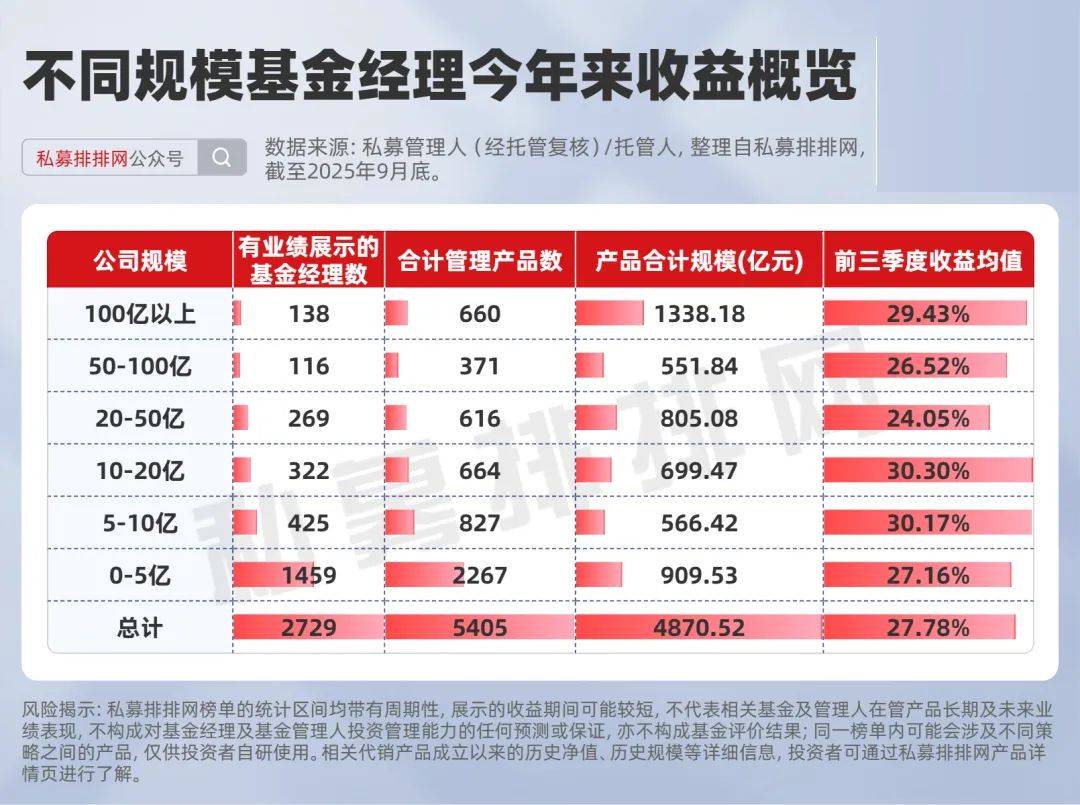
Core Insights - The average return of private equity fund managers in China reached 27.78% as of September 2025, significantly outperforming the market [1][2] - A total of 2,729 fund managers managed 5,405 private equity products, with a combined management scale of approximately 487.05 billion yuan [1][2] - The data indicates a strong performance across various fund sizes, with managers from the 10-20 billion yuan category achieving an average return of 30.30% [1][2] Fund Manager Performance by Size 100 Billion and Above - There are 138 fund managers managing 660 products with a total scale of 133.82 billion yuan, achieving an average return of 29.43% [2][3] - The top three fund managers in this category are Lu Hang from Fusheng Asset, Jiang Yunfei from Duration Investment, and Wang Penghui from Wangzheng Asset [3][5] 50-100 Billion - This category includes 116 fund managers managing 371 products with a total scale of 55.18 billion yuan, with an average return of 26.52% [2][7] - The top three fund managers are Tong Xun from Tongben Investment, Wang Shichao from Ruiyang Investment, and Cai Zhijun from Shengqi Asset [7][8] 20-50 Billion - There are 269 fund managers managing 616 products with a total scale of 80.51 billion yuan, achieving an average return of 24.05% [2][13] - The top three fund managers are Yuan Hao from Beijing Xiyue Private Equity, Zhai Jingyong from Rongshu Investment, and He Yuqing from Yidian Najin [13][15] 10-20 Billion - This category has 322 fund managers managing 664 products with a total scale of 69.95 billion yuan, with an average return of 30.30% [2][17] - The top three fund managers are He Zhenquan from Liangli Private Equity, Cai Yingming from Longhang Asset, and Zhou Yifeng from Beiheng Fund [17][19] 5-10 Billion - There are 425 fund managers managing 827 products with a total scale of 56.64 billion yuan, achieving an average return of 30.17% [2][21] - The top three fund managers are Liu Xianglong from Fuyuan Capital, Luo Huasen from Shanghai Hengsui Asset, and Wu Yintong from Longyin Huaxiao [21][23] 0-5 Billion - This category includes 1,459 fund managers managing 2,267 products with a total scale of 90.95 billion yuan, with an average return of 27.16% [2][27] - The top three fund managers are Yang Zhongguang from Longhuixiang Investment, Xie Libo from Jingying Zhitu, and Yao Yong from Qinxin Fund [27][30]
主观私募霸榜“量化之都”10强!幻方位居杭州10强!深圳私募整体业绩领先!
私募排排网· 2025-10-25 10:00
Core Insights - The private equity industry in China is concentrated in economically developed cities such as Beijing, Shanghai, Shenzhen, Guangzhou, and Hangzhou, with a total of 633 private equity firms across 45 cities as of September 2025 [2] - Shenzhen leads with a median return of over 30% in the first three quarters of 2025, outperforming other major cities [2] Summary by Region Shanghai - Shanghai has 195 private equity firms, with a median return of 22.04% in the first three quarters of 2025 [3][7] - The top five firms in Shanghai by average return are Shanghai Hengsui Asset, Tongben Investment, Jiugao Investment, Longhang Asset, and Ruiyang Investment [8] - Only one firm, Fusheng Asset, is a hundred-billion private equity firm, achieving significant returns [11] Shenzhen - Shenzhen has 111 private equity firms, with a median return of 30.12% [13] - The top five firms in Shenzhen by average return are Fuyuan Capital, Rongshu Investment, Nengjing Investment Holdings, Shenzhen Zeyuan, and Yiku Capital [14] - Wangzheng Asset is the only hundred-billion private equity firm in Shenzhen, ranking second among hundred-billion firms [17] Beijing - Beijing has 87 private equity firms, with a median return of 22.61% [19] - The top five firms in Beijing by average return are Beijing Xiyue Private Equity, Beiheng Fund, Guiding Fund, Yuanxin Investment, and Lingjun Investment, with the latter two being hundred-billion firms [22] Guangzhou - Guangzhou has 35 private equity firms, with a median return of 29.03% [24] - The top five firms in Guangzhou by average return are Jingyan Private Equity, Sanhe Chuangying, Hainan Xiangyuan Private Equity, Zeyuan Investment, and Lisi Fund, with Abama Investment being the only hundred-billion firm [28] Hangzhou - Hangzhou has 47 private equity firms, with a median return close to 29% [30] - The top five firms in Hangzhou by average return are Nongfu Private Equity, Haokun Shengfa Asset, Berkshire Investment, Yunqi Quantitative, and Hangzhou Boyan Private Equity [31] Other Regions - Other regions have 158 private equity firms, with the top five being Luyuan Private Equity, Longyin Huaxiao, Yidian Najin (Quanzhou) Private Equity, Yijiu (Hainan) Private Fund, and Juli Fund [35][36] - Luyuan Private Equity, a newly established firm, has shown significant growth in its first year [41]