主观多头策略

Search documents
沪深300ETF再现集中买入,释放了哪些策略信号?
私募排排网· 2026-03-27 12:00
Core Viewpoint - The continuous net inflow into the CSI 300 ETF over the past seven trading days serves as a stabilizing signal amidst a declining A-share market, indicating institutional confidence in current valuations [2][3]. Group 1: Market Performance and ETF Inflows - Since March 16, 2026, the CSI 300 ETF has seen a net inflow of approximately 12.9 billion yuan over seven consecutive trading days, marking the first significant inflow this year after a period of net selling since January [2]. - The Shanghai Composite Index experienced a decline of over 4% on March 23, 2026, but the CSI 300 ETF and other major ETFs like the SSE 50 ETF and CSI 500 ETF attracted net purchases of around 4.2 billion yuan and 4.2 billion yuan, respectively [2]. - Historical data shows that during periods of significant net buying in the CSI 300 ETF, the market tends to respond positively, with an average return of 1.28% for the CSI All Share Index during these inflow periods [7]. Group 2: Regulatory Support and Institutional Behavior - The People's Bank of China emphasized the importance of maintaining stability in financial markets, prioritizing stocks, bonds, and foreign exchange, which reflects a strong commitment to market stability [3]. - The behavior of institutional investors, particularly the "national team" such as Central Huijin and the central bank, often correlates with net buying in broad-based ETFs during market downturns, indicating a strategic approach to stabilize the market [3]. Group 3: Historical Analysis of ETF Buying Patterns - An analysis of the CSI 300 ETF's inflow patterns from 2024 onwards identified nine distinct periods of continuous net buying lasting seven days or more, with an average net purchase of approximately 73.2 billion yuan per period [5]. - The longest recorded net buying period was from July 15 to August 9, 2024, lasting 19 days with a total net inflow of about 127 billion yuan [5]. - Following the end of net buying periods, historical data indicates a high probability of market recovery, with average returns of 5.77% after 20 trading days and 7.80% after 40 trading days [10]. Group 4: Investment Strategy Recommendations - Investors are advised to monitor the net inflow trends of major ETFs like the CSI 300 ETF as a key timing signal for entering the market, particularly during significant net buying periods [15]. - For clients holding long positions in subjective or quantitative strategies, maintaining patience is recommended, as historical data suggests favorable returns in the months following periods of substantial ETF inflows [15].


你上天他入地,为什么同策略的私募差别这么大?
雪球· 2026-03-03 08:52
Core Viewpoint - The article discusses "non-hardcore" investment strategies, emphasizing their performance dependence on market conditions and the individual capabilities of fund managers [6][10]. Group 1: Characteristics of Non-Hardcore Strategies - Non-hardcore strategies are influenced by both "heavenly timing" (market conditions) and "human factors" (managerial skills) [6][10]. - A typical non-hardcore strategy is the subjective long position, which relies heavily on the fund manager's ability to identify high-potential stocks and assess industry cycles [12]. - Market-neutral strategies, while removing beta exposure, remain sensitive to market environments, with potential for significant losses during style shifts [17][20]. - Pure trend CTA strategies depend on capturing trends in various assets, but can struggle in sideways markets, leading to frequent trading and potential losses [26][29]. Group 2: Performance Variability - Non-hardcore strategies exhibit high variability, with performance differing significantly based on market conditions and the individual manager's decisions [33][34]. - The same strategy can perform exceptionally well in one year and poorly in another due to changing market environments [34]. - Even in similar market conditions, different managers can achieve vastly different results, highlighting the importance of selecting the right fund manager [35][37]. Group 3: Advantages of Non-Hardcore Strategies - Non-hardcore strategies offer the potential for higher returns, as they can achieve significant gains in favorable conditions, unlike more stable strategies [42][44]. - They provide flexibility to adapt to unprecedented market changes, allowing managers to adjust their strategies based on experience and intuition [47][48]. - The article compares hardcore strategies to industrial products (standardized) and non-hardcore strategies to art (subjective and variable), suggesting that the latter can yield above-average returns due to their unique nature [52][54].

2026年2月私募月度市场研报
私募排排网· 2026-02-07 01:40
Investment Rating - The report indicates a positive investment sentiment towards the A-share market, particularly favoring small-cap and technology sectors, with a focus on structural rotation and high volatility [1][30]. Core Insights - The A-share market experienced a strong start in January 2026, with significant gains in various indices, particularly the ChiNext and small-cap indices, reflecting a robust market environment [1]. - The precious metals sector showed strong performance driven by both safe-haven demand and capital allocation needs, while the banking sector faced a decline, breaking a long-standing trend of outperformance [2][12]. - The overall market saw a high number of stocks achieving positive returns, with 3,631 stocks recording monthly gains, and 16 stocks doubling in price during January [2]. Market Review and Outlook - The A-share market indices recorded substantial monthly gains, with the ChiNext Index rising by 12.29% and the CSI 500 Index by 12.12%, indicating a strong performance in small-cap stocks [1]. - The average daily trading volume reached 30,147.10 billion yuan, reflecting increased trading enthusiasm among retail investors [1]. - The report anticipates continued structural rotation in February, with a focus on precious metals and certain new energy sectors due to supply constraints and capital allocation needs [30]. Futures Market - The commodity futures market showed an overall upward trend in January, with the precious metals sector leading the gains, while agricultural products like live pigs and soybean meal faced declines [11][12]. - The report highlights that the macroeconomic environment is characterized by weak recovery and strong differentiation, impacting demand for cyclical commodities [12]. Private Fund Strategies - In January, the average return for private funds was 5.71%, with equity and commodity long strategies showing significant profitability [22]. - The report notes that January was a month of systematic recovery, with many strategies achieving returns in the 7%-10% range, particularly those focused on equities and high elasticity [24]. - The report emphasizes the importance of diversified strategies and risk management in the current market environment, suggesting that private fund strategies can provide opportunities for excess returns while managing risks effectively [33].
全市场重点私募基金跟踪周报0204
私募排排网· 2026-02-05 01:40
Investment Rating - The report does not explicitly provide an investment rating for the industry or specific companies [1]. Core Insights - The overall market performance for the week ending January 30, 2026, showed an average increase of 2.38% and a decrease of 2.31% across various strategies, with 39% of strategies gaining and 60.3% losing [2]. - The performance distribution of different strategies indicates that subjective long/short strategies had a positive return of 41.10% this week, while quantitative strategies showed a lower positive return of 9.38% [3]. - Major indices such as the Shanghai Composite Index and Shenzhen Component Index experienced slight declines of -0.44% and -1.62% respectively, while the ChiNext Index remained relatively stable with a -0.09% change [4][5]. - The South China Commodity Index increased by 2.60%, indicating a positive trend in commodity markets [7]. Summary by Sections Market Index Performance - The Shanghai Composite Index closed at 4117.95, with a weekly decline of -0.44% and a year-to-date gain of 3.76% [4]. - The Shenzhen Component Index closed at 14205.89, down -1.62% for the week but up 5.03% year-to-date [4]. - The ChiNext Index showed a minor decline of -0.09% this week, with a significant annual increase of 62.14% [4]. Strategy Performance - Subjective long/short strategies had a positive return of 41.10% this week, while quantitative strategies had a lower positive return of 9.38% [3]. - The macro strategy performed well with a 68.86% positive return this week, indicating strong market conditions for macroeconomic investments [3]. Stock Style Index - Large-cap value stocks increased by 1.87%, while small-cap growth stocks decreased by -3.58% this week, reflecting a divergence in performance across different market segments [6]. Commodity Index - The South China Commodity Index rose by 2.60%, with notable increases in the agricultural and energy sectors, indicating a robust performance in commodity markets [7].
主观多头年度十强产品!超100只收益翻倍!远信、复胜、东方港湾、日斗等齐上榜!
私募排排网· 2026-01-25 03:04
Core Insights - The subjective long-only strategy remains the core focus in the domestic private equity sector, serving as a benchmark for fund managers' decision-making and a key tool for investors seeking alpha returns [3] - In 2025, major indices in A-shares, Hong Kong stocks, and US stocks recorded varying degrees of gains, with subjective long-only products in private equity achieving commendable performance [3] - As of the end of 2025, the average return for 2048 qualifying subjective long-only products was 37.78%, with 1923 products achieving positive returns, representing a 93.90% positive return rate [4] Performance by Fund Size 100 Billion and Above - In the 100 billion and above category, 184 qualifying products had an average return of 21.61%, with 172 products achieving positive returns (93.48% positive return rate) [5] - The top three products in this category for 2025 were from Yuanxin Investment, Duration Investment, and Silver Leaf Investment [5] 50-100 Billion - For the 50-100 billion category, 114 qualifying products had an average return of 34.52%, with 110 products achieving positive returns (96.49% positive return rate) [12] - The top three products were from Xishirun Investment, Tongyuan Investment, and Shengqi Asset [12] 20-50 Billion - In the 20-50 billion category, 220 qualifying products had an average return of 44.58%, with 204 products achieving positive returns (92.73% positive return rate) [18] - The top three products were from Shanghai Ge Ru Private Equity, Beijing Xiyue, and Qiantu Investment [18] 10-20 Billion - For the 10-20 billion category, 235 qualifying products had an average return of 42.93%, with 225 products achieving positive returns (95.74% positive return rate) [24] - The top three products were from Nengjing Investment, Shanghai Hengsui, and Xinchili Asset [24] 5-10 Billion - In the 5-10 billion category, 337 qualifying products had an average return of 43.37%, with 318 products achieving positive returns (94.36% positive return rate) [30] - The top three products were from Shanghai Yixin Private Equity, Fangxin Wealth, and Shangya Investment [30] Below 5 Billion - For the below 5 billion category, 958 qualifying products had an average return of 36.48%, with 894 products achieving positive returns (93.32% positive return rate) [36] - The top three products were from Longhui Xiang Investment, Chengpu (Shenzhen) Asset, and Guanglong (Shenzhen) Investment [36]

高手,是怎么玩转黄金的?
雪球· 2026-01-06 08:46
Core Viewpoint - Gold has emerged as the strongest asset of the year, with a price increase from below 2800 to over 4300, representing a year-to-date growth of over 50% [2][3]. Group 1: Gold's Role in the Market - Gold plays three roles in the market: as a commodity, currency, and investment [5]. - As a commodity, gold prices are driven by supply and demand dynamics, particularly influenced by central bank purchases and jewelry consumption [7]. - As a currency, gold prices typically move inversely to the US dollar index, meaning that a weaker dollar leads to higher gold prices [9][13]. - As an investment, gold's value is compared against other asset classes, and its opportunity cost is considered when evaluating potential returns from other investments [15][16][19]. Group 2: Investment Strategies in Gold - Private equity managers can leverage gold investments through three main strategies: subjective long strategies, macro multi-asset strategies, and CTA strategies [23]. - Subjective long strategies involve managers making investment decisions based on the current market value of gold, often focusing on its currency attributes during periods of weak dollar and low interest rates [25]. - Macro multi-asset strategies view gold as part of a broader asset allocation, using it to hedge against risks in other assets like stocks and bonds [33][37]. - CTA strategies focus on price movements without delving into fundamental analysis, using quantitative models to respond to market trends and relative strength among commodities [45][55]. Group 3: Conclusion on Gold Investment - Gold serves as both an offensive tool based on macroeconomic judgments and a stabilizing asset in a diversified portfolio, as well as a signal in quantitative models [57]. - The ability to identify diverse strategies and utilize flexible trading tools is crucial for successful gold investment [58].

小得盈满,恰是自然
Xin Lang Cai Jing· 2025-12-30 11:04
Group 1: Global Asset Performance and Strategy Evolution in 2025 - In 2025, global financial markets exhibited a "high volatility, high return" structural characteristic, driven by the Federal Reserve's preventive interest rate cuts and a shift towards loose monetary policy globally [2][11] - A-shares and H-shares were at historical low valuations, leading to excellent risk-adjusted returns in equity assets, with AH shares achieving steady returns amidst relatively low volatility [2][11] - The US dollar index fell by 8.5% in the first three quarters, marking the largest decline since 2018, which boosted the revaluation of non-US assets and led to record inflows into emerging market equity funds, totaling $52 billion [2][11] - Gold and other safe-haven assets performed exceptionally well due to geopolitical tensions, trade frictions, and dollar depreciation, becoming important hedging and value-adding tools in portfolios [2][11] - Fixed income assets showed a mixed pattern, with US Treasury yields remaining high and attractive for allocation, while the Chinese bond market experienced significant volatility with limited yield contribution [2][11] Group 2: Asset Management Industry Trends in 2025 - The iteration of quantitative strategies accelerated, driven by AI, with end-to-end models achieving scalable application, demonstrating stronger generalization and adaptability [13][14] - Competition in the quantitative space intensified, leading to product innovation as managers optimized terms and introduced new product forms to enhance client experience [13][14] - Subjective long-only managers faced redemption pressures despite positive returns, with trust in subjective strategies not fully restored, highlighting the need for transparency and long-term performance validation [13][14] - All-weather strategies entered a rapid development phase, with the "stock + gold" allocation further enhancing their effectiveness, showing lower drawdowns and higher Sharpe ratios compared to traditional single-asset strategies [13][14] Group 3: Building Differentiated Competitive Advantages - The company has focused on a "small steps, continuous evolution" development path, building a compounding capability flywheel [5][17] - A subjective manager selection capability has been established, focusing on genuine Alpha creation ability rather than manager history or size [5][17] - A deep evaluation system for quantitative managers has been developed to identify those with differentiated data, computational power, or strategic advantages [6][15] - The company actively covers over 2,000 private equity managers, employing a "broad net, deep digging" approach to capture emerging forces with non-consensus but correct characteristics [7][16] - The company embraces product and tool innovation, maintaining an open attitude towards derivatives, structured design, and risk control mechanisms to enhance client experience [8][17]

2023年来各年收益排名均居上游有多难?明汯、茂源、翰荣等私募旗下产品做到了!
私募排排网· 2025-12-28 03:04
Core Viewpoint - The article emphasizes the challenges of consistently outperforming in the private equity market, particularly in the context of the rapidly changing capital market environment since 2023, highlighting the importance of fund managers' research capabilities and strategy adaptation [2]. Summary by Strategy Quantitative Long-Only - A total of 16 quantitative long-only products have consistently ranked in the top tier from January to November 2023, 2024, and 2025, with notable contributions from firms like Minghong, Maoyuan, and Hanrong [2]. - As of November 2025, there are 640, 462, and 325 quantitative long-only products reported for the years 2023, 2024, and 2025 respectively, with only 16 products making it to the top 30% in all three years [3]. - The top five cumulative return products since 2023 are from firms including Huijing Asset, Shanghai Zijie Private Equity, and Abama Investment [3]. Subjective Long-Only - There are 14 subjective long-only products that have maintained top-tier rankings across the same periods, with notable firms like Kaishi Private Equity and Yidian Najin included [7]. - The number of subjective long-only products reported as of November 2025 is 1,089, 979, and 838 for the years 2023, 2024, and 2025 respectively, with only 14 products achieving top 30% rankings in all three years [7]. - The top five cumulative return products since 2023 are from Beiheng Fund, Ding Tai Sifang (Shenzhen), and Guangdong Guangjin [8]. CTA (Commodity Trading Advisor) - A total of 12 CTA products have consistently ranked in the top tier from January to November 2023, 2024, and 2025, with leading products from Guanjing Fund and other firms [13]. - The number of CTA products reported as of November 2025 is 256, 226, and 187 for the years 2023, 2024, and 2025 respectively, with only 12 products making it to the top 40% in all three years [13]. - The top five cumulative return products since 2023 are from Guanjing Fund, Gongqingcheng Guangju Xinghe Private Equity, and Caoben Investment [14]. Multi-Asset - There are 22 multi-asset products that have consistently ranked in the top tier from January to November 2023, 2024, and 2025, with significant contributions from firms like Luyuan and Junfu [18]. - The number of multi-asset products reported as of November 2025 is 414, 337, and 265 for the years 2023, 2024, and 2025 respectively, with only 22 products achieving top 40% rankings in all three years [18]. - The top five cumulative return products since 2023 are from Luyuan Private Equity, Henan Zhi Ying Private Equity, and Junfu Investment [18].

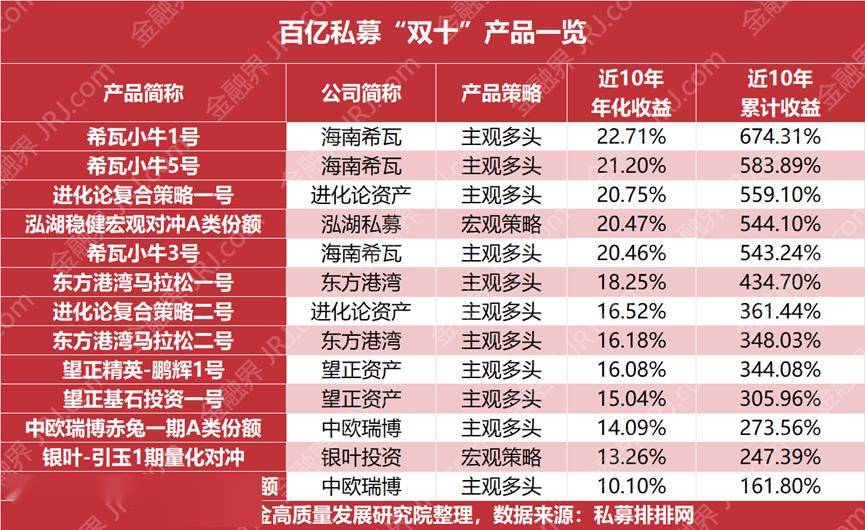
谁能持续赚钱?百亿私募“双十”基金长跑榜揭晓
Sou Hu Cai Jing· 2025-12-27 05:06
Core Insights - The private equity market has seen significant fluctuations this year, with a focus on products that can navigate market cycles and provide long-term returns for investors [1] Group 1: Performance of "Double Ten" Billion Private Equity Products - A total of 13 products have made it to the "Double Ten" list, indicating they have been established for at least ten years and achieved an annualized return of over 10% in the last decade [2] - Among these products, 11 are based on subjective long/short strategies, highlighting the enduring value of active stock selection by fund managers [2] - The remaining 2 products utilize macro strategies to generate returns by understanding economic cycles [2] Group 2: Investment Strategies and Insights - Fund managers exhibit clear investment philosophies and strong execution, with a focus on dividend and technology sectors [3] - The founder of Xiva Asset, Liang Hong, emphasizes a portfolio that includes stable cash flow assets like oil and insurance, alongside growth sectors such as consumer electronics and innovative pharmaceuticals [3] - Dongfang Gangwan's Dan Bin suggests that artificial intelligence is not a short-term trend but rather a long-term cycle that could last over a decade, urging investors to focus on not missing out on this era [3]
主观多头十强产品!远信、望正领衔!喜世润、盛麒“含金”位居前三!
私募排排网· 2025-12-16 07:09
Core Viewpoint - The A-share market has shown a clear slow bull characteristic in 2023, with significant returns from sectors like technology growth and resource cycles, leading to an overall increase of over 15% in major indices from January to November, with the ChiNext Index leading at 42.54% [2][3]. Summary by Sections A-share Market Performance - The three major A-share indices have all risen over 15% from January to November, with the ChiNext Index achieving a remarkable 42.54% increase [2]. - A-share indices exhibit lower volatility compared to the Hang Seng Index and Nikkei Index, aligning with the characteristics of a slow bull market [2]. Index Data - The performance data for major indices from January to November is as follows: - CSI 300: 15.04% return, 15.69% annualized volatility, 127.80% turnover rate, 10.49% maximum drawdown - Shanghai Composite: 16.02% return, 14.09% annualized volatility, 245.70% turnover rate, 9.71% maximum drawdown - Shenzhen Component: 24.67% return, 21.71% annualized volatility, 394.74% turnover rate, 14.98% maximum drawdown - ChiNext Index: 42.54% return, 30.21% annualized volatility, 576.46% turnover rate, 20.79% maximum drawdown [3]. Fund Performance - The average return for 2049 subjective long-only products from January to November is 34.39%, significantly outperforming most A-share indices [3]. - Among the 197 subjective long-only products from billion-yuan private equity firms, the average return is 23.72%, with 94.42% of products showing positive returns [4]. Top Performing Funds - The top three subjective long-only products from billion-yuan private equity firms are: 1. Yuanxin Investment's "Yuanxin China Active Growth C" managed by Wang Aoye 2. Jiuku Investment's "Jiuku Value Selection No. 1" managed by Jiang Yunfei 3. Wangzheng Asset's "Wangzheng Win-Win No. 3" managed by Wang Penghui [4][5]. Sector Focus - The focus on gold investment is highlighted, with managers like Guan Xin from Xishirun Investment emphasizing a new "reflexive" cycle in gold prices, suggesting a strategic allocation towards gold as a long-term investment [11][12]. - The performance of funds in the 50-100 billion category shows an average return of 29.83%, with 95.49% of products yielding positive returns [8]. Emerging Trends - The report indicates a trend of adjusting portfolios to optimize returns, with managers actively seeking undervalued quality companies while maintaining a core and satellite investment strategy [7].