行业分化

Search documents
化工板块:稳的基础更加巩固——石油和化工板块一季报业绩盘点(下)
Zhong Guo Hua Gong Bao· 2025-05-20 02:46
Core Viewpoint - The chemical sector in China is maintaining its development momentum despite external challenges, supported by strong domestic demand and favorable policies, with a notable recovery in product demand driven by various industries [1][6]. Group 1: Industry Performance - In Q1, the chemical sector's 529 listed companies reported a total revenue of 621.73 billion yuan, a year-on-year decline of 15.33%, while net profit reached 36.208 billion yuan, showing a slight increase of 1.58% [1]. - The refrigerant industry benefited from regulatory policies, leading to a revenue increase of 23.31% to 14.654 billion yuan and a net profit surge of 140.16% to 1.77 billion yuan [2]. - The chlor-alkali industry saw a net profit increase of 84.55% to 3.117 billion yuan, despite a revenue decline of 13.98% to 45.922 billion yuan [2]. - The food and feed additive sector achieved a revenue of 37.773 billion yuan, up 4.21%, with net profit rising 75.57% to 5.369 billion yuan [3]. - The agricultural chemical sector reported a revenue of 49.378 billion yuan, down 6.51%, but net profit increased by 25.12% to 3.093 billion yuan [3]. Group 2: Industry Challenges - The organic silicon industry faced significant challenges, with net profit dropping by 37.74% despite stable revenue [4]. - The titanium dioxide sector experienced a revenue decline of 14.35% and a net profit drop of 35.61% due to high production levels and weak downstream demand [4]. - The nitrogen fertilizer industry reported a revenue decrease of 4.28% and a significant net profit decline of 56.82% [4]. - The tire industry showed a revenue increase of 6.34% but faced a net profit decline of 24.84%, attributed to rising production costs [4][5]. Group 3: Future Outlook - The refrigerant industry is expected to maintain its growth cycle due to quota systems and increasing downstream demand [6]. - The agricultural chemical market is anticipated to stabilize as the peak usage season approaches, with active trading expected [6]. - The chemical industry must navigate challenges such as increased competition in the titanium dioxide market and the need for innovation in the daily chemical sector [6].
周大福、周大生等关店自救
Xin Jing Bao· 2025-05-12 13:25
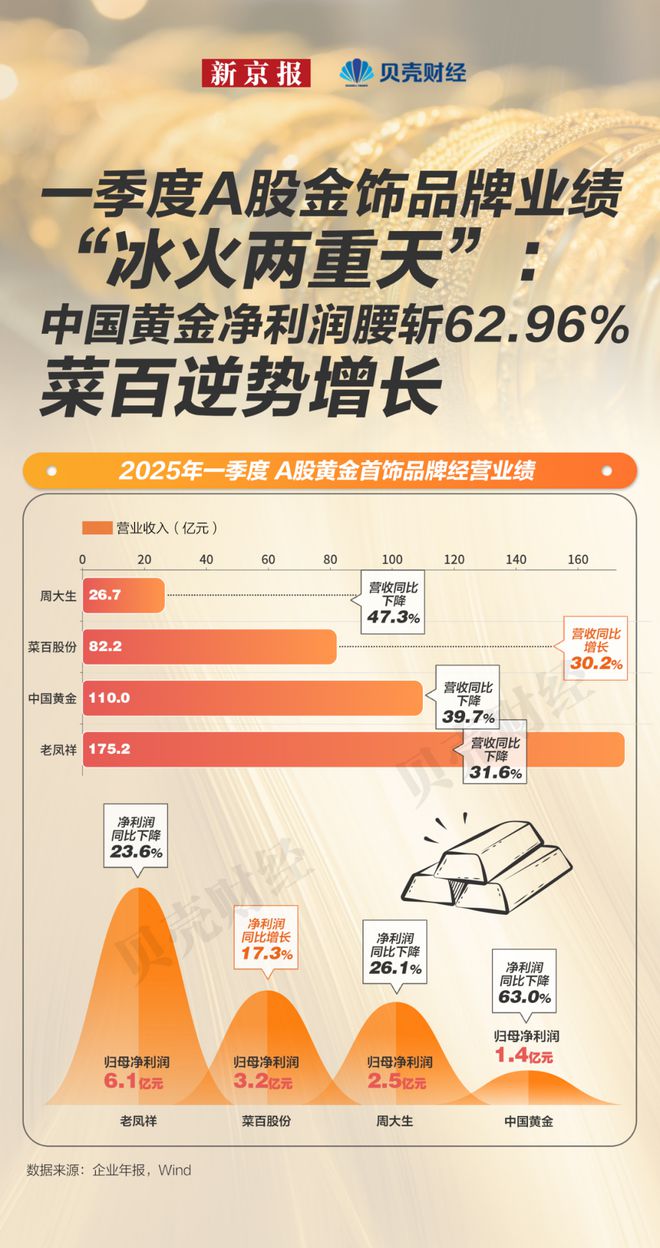
Core Viewpoint - The high volatility of gold prices has led to a decline in consumer demand for gold jewelry, with many consumers adopting a wait-and-see attitude regarding purchases [1][2][3] Industry Overview - Gold jewelry consumption in China has been weak, with a reported 5.96% year-on-year decline in gold consumption, and a significant 26.85% drop in gold jewelry consumption in Q1 [1][5] - Major gold jewelry companies such as China Gold, Lao Feng Xiang, and Zhou Da Sheng have reported substantial declines in both revenue and net profit, indicating a challenging market environment [1][5][7] Company Performance - China Gold's net profit decreased by 62.96%, while Lao Feng Xiang and Zhou Da Sheng also experienced declines exceeding 20% in net profit [1][5] - In contrast, Cai Bai Co. has seen growth in revenue and net profit, attributed to an increased focus on gold bar sales, which are more resilient in the current market [2][11] Market Dynamics - The gold price has fluctuated significantly, with a peak of 1082 yuan per gram in late April, followed by a drop to 998 yuan per gram by May 5, reflecting the volatility that affects consumer purchasing behavior [3][4] - The trend of "cold jewelry, hot investment" has emerged, with consumers increasingly favoring investment products like gold bars over traditional jewelry [13][14] Retail Strategies - Many traditional brands are closing underperforming stores to optimize their retail networks, with Zhou Da Fu and Lao Feng Xiang among those reducing their store counts significantly [18][14] - Companies are encouraged to enhance in-store experiences and diversify product offerings to meet changing consumer preferences, including the rise of "she economy" and personalized products [18][19]


主动纾压,分化延续,高端显韧性
HTSC· 2025-05-06 04:05
Investment Rating - The report maintains an "Overweight" rating for the liquor industry, specifically for high-end liquor stocks [6]. Core Insights - The liquor industry is experiencing a deceleration in revenue growth, but high-end products show resilience, with significant differentiation across segments [1][4]. - In 2024, the high-end liquor segment achieved a revenue growth of 12% and a net profit growth of 11%, indicating strong operational resilience [2]. - The report anticipates a recovery phase in the second half of 2025, driven by policy support and gradual external demand recovery [4]. Summary by Sections Industry Overview - The liquor industry saw a revenue growth of 7.7% and a net profit growth of 8.1% in 2024, despite a slowdown in growth rates [10]. - In Q1 2025, the industry reported a revenue increase of 1.8% and a net profit increase of 2.4%, with major companies meeting their initial targets [11]. High-End Liquor Performance - High-end liquor revenue grew by 8% in Q1 2025, with notable contributions from leading brands like Guizhou Moutai and Wuliangye [2][31]. - Guizhou Moutai's product matrix has improved, leading to a rise in both volume and price, while Wuliangye has effectively managed inventory and pricing strategies [2]. Mid-Range and Low-End Liquor Performance - The mid-range and low-end segments are experiencing significant differentiation, with regional leaders like Gujing Gongjiu and Jianshe Yuanyuan outperforming national brands [3][31]. - In Q1 2025, mid-range liquor revenue declined by 12%, while low-end liquor saw a similar trend, indicating ongoing pressure in these segments [37]. Financial Metrics - The overall gross margin for the liquor sector was 81.1% in Q1 2025, reflecting a slight increase from the previous year, while net profit margins also showed improvement [22][43]. - The report highlights that high-end liquor companies maintain strong profitability, with Guizhou Moutai achieving a net profit margin of 52.2% in Q1 2025 [44]. Future Outlook - The report suggests that the liquor industry is likely to enter a phase of healthy recovery in the latter half of 2025, supported by improved consumer demand and favorable policies [4][12]. - The current valuation of the liquor sector is at a historical low, indicating potential for upward adjustment as market conditions improve [4].




2月动力电池产业链观察
高工锂电· 2025-03-03 09:55
Core Viewpoint - The article highlights the strong performance of leading electric vehicle manufacturers in February, indicating a positive trend in the electric vehicle industry despite ongoing cyclical adjustments and price pressures [1][4]. Group 1: Sales Performance - In February, major electric vehicle manufacturers reported significant sales figures, with BYD selling 322,846 units (up 161.4% year-on-year, up 8.9% month-on-month), Xpeng delivering 30,453 units (up 570% year-on-year, up 0.3% month-on-month), Li Auto with 26,263 units (up 29.7% year-on-year, down 12.2% month-on-month), Leap Motor at 25,287 units (up 285.1% year-on-year, up 0.5% month-on-month), and Aion with 20,863 units (up 25.1% year-on-year, up 45% month-on-month) [2]. - The overall sales growth in January and February is notable, contrasting with previous years where the electric vehicle industry typically underperformed during this period due to the Spring Festival and market off-season [2]. Group 2: Industry Dynamics - The market is showing a clear trend of differentiation, with leading companies maintaining their strong positions. The growth in the electric vehicle industry is increasingly favoring top-tier companies, which have shown more robust performance during both industry pressures and recoveries [3]. - The strong sales in the downstream automotive market are positively impacting the upstream battery and materials sectors, leading to an upward revision in production and shipment forecasts for battery and material manufacturers [3]. Group 3: Price and Competitive Landscape - Despite the positive sales trends, the industry has not fully escaped the cyclical adjustment challenges, with limited room for price increases in the supply chain. Some equipment manufacturers are still facing significant pricing pressures in competitive bidding [5]. - The ongoing price war in the industry is creating difficulties for companies, particularly smaller lithium battery firms, leading to challenges in profitability and operational efficiency. The article suggests that technological and product strengths are essential for companies to escape low-end and homogeneous competition [5].