诈骗罪

Search documents
最高人民法院关于 审理伪造货币等案件具体应用法律若干问题的解释(二)
Sou Hu Cai Jing· 2025-12-08 10:08
Group 1 - The Supreme People's Court has issued an interpretation regarding the application of laws in cases of counterfeiting currency and related crimes, aiming to enhance legal clarity and enforcement [1] - The act of illegally manufacturing counterfeit currency that mimics the design, shape, and color of real currency is classified as "counterfeiting currency" under Article 170 of the Criminal Law [1] - Altering genuine currency through methods such as cutting, modifying, or reprinting is classified as "forgery of currency" under Article 173 of the Criminal Law [1] Group 2 - If both counterfeiting and forgery methods are used to create mixed currency, it will be prosecuted as counterfeiting currency under Article 170 [1] - Crimes involving counterfeit foreign currency will be prosecuted according to Articles 170 to 173 of the Criminal Law, with the amount calculated based on the exchange rate published by the China Foreign Exchange Trading Center or authorized institutions [2] - Counterfeit ordinary commemorative coins and precious metal commemorative coins will also be prosecuted under Articles 170 to 173, with the amount for counterfeit ordinary coins calculated by face value and for precious metal coins by initial sale price [2] Group 3 - Using or attempting to use counterfeit discontinued currency will be prosecuted for fraud under Article 266 of the Criminal Law [2] - This interpretation supersedes any previous judicial interpretations that are inconsistent with it [3]
女子对225个快递“仅退款”,然后转售商品,还高调“炫富”!商家损失5.4万余元后报警,律师:她可能面临多年刑期
Mei Ri Jing Ji Xin Wen· 2025-12-07 14:12
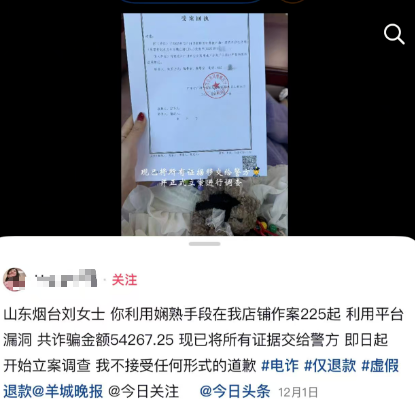
每经编辑|许绍航 近日,有商家在社交媒体曝光:半年来她被一买家刘某利用平台漏洞,用6个账号"仅退款"225件331单,她因此损失5.4万余元,目前已报案。 图:时女士称自己已报案 据悉,刘某每次会在店铺购买多样商品,商品价格从十几元到几百上千元不等,然后在快递还未签收时,将贵价商品申请仅退款"拦截快递",再将低价商 品的面单与贵价商品交换,把低价商品当成贵价商品退回。 时女士表示,她事后了解到,刘某将骗来的物品在二手平台和粉丝群内低价销售,给顾客排单发货,营造供不应求的氛围。 此外,刘某还经常在粉丝群里炫富,营造富婆人设。有网友向时女士提供的截图显示,2020年,刘某曾经发朋友圈称:"你们都在搬砖,我在搬人民币, 都是一袋子一袋子给,这两天光安排人存钱了!" 图:刘某高调"炫富",来源:极目新闻 时女士将此事在网上曝光后,立即引起了网友的激烈讨论。12月7日,话题#仅退款225个快递女子打造富婆人设#还一度冲上微博热搜。 有关此事报道的评论区内,不少网友认为刘某应该被严惩,也有网友指出这个事件中快递员和驿站没有尽到保护义务,也有责任。 图:部分网友就此事的评论,来自极目新闻 时女士称,在事件曝光后,她收到了多 ...

打击金融黑灰产升级:“征信修复”等非法代理维权被定为敲诈勒索
2 1 Shi Ji Jing Ji Bao Dao· 2025-11-20 10:13
Core Viewpoint - The rise of illegal debt optimization and rights protection organizations has led to a significant shift in judicial recognition from "fraud" to "extortion," indicating a new phase in the crackdown on financial black and gray industries [1][2][3] Group 1: Nature of Illegal Activities - These organizations operate under the guise of helping overdue clients reduce debts but engage in coercive tactics against financial institutions, including forgery and malicious complaints, to extract profits [1][2] - A recent case revealed a gang that, since 2022, used purchased overdue customer information to lure clients into paying for their "rights protection" services, resulting in illegal gains exceeding one million yuan [2][3] Group 2: Legal and Judicial Developments - The judicial system has begun to classify the actions of these organizations as extortion, which carries heavier penalties compared to fraud, thus increasing the legal risks for offenders [3][4] - The shift in legal classification allows for a comprehensive crackdown on the entire criminal chain, targeting both the deception of clients and the coercion of financial institutions [3][4] Group 3: Impact on Financial Institutions - The illegal activities have raised operational costs for financial institutions and disrupted the normal regulatory environment, leading to broader implications for social credit systems [5][6] - The involvement of personal information violations is prevalent, as criminals require sensitive data to execute their schemes, which can lead to further criminal activities such as fraud and money laundering [5] Group 4: Collaborative Governance Efforts - A multi-departmental approach is being implemented to combat the black and gray financial industries, with law enforcement and regulatory bodies working together to enhance legal enforcement and administrative oversight [5][6] - Recent initiatives include the establishment of risk models using technology to identify and warn against malicious complaints, demonstrating a proactive stance in regulatory measures [5][6] Group 5: Achievements in Law Enforcement - Significant progress has been made in various regions, with numerous cases being prosecuted and substantial amounts of money involved, indicating a strong legal deterrent against these illegal activities [6]
村干部能否构成滥用职权罪?
Zhong Yang Ji Wei Guo Jia Jian Wei Wang Zhan· 2025-11-12 00:38
Core Viewpoint - The case discusses the legal implications of a village official's abuse of power in the context of public property and compensation, highlighting differing opinions on whether the actions constitute a crime under the law [1][2]. Group 1: Legal Classification of Actions - There are three opinions regarding the classification of Chen's actions: 1. Chen and Pan are co-conspirators in embezzlement due to Chen's facilitation of Pan's fraudulent claims [2]. 2. Pan committed fraud independently, while Chen's actions, though improper, do not constitute complicity in fraud due to lack of intent to illegally possess public property [2]. 3. Chen, while assisting the government, can be considered a public official and his actions amount to abuse of power, leading to significant losses for the state [2][3]. Group 2: Definition of Public Officials - Village officials can be recognized as public officials when assisting government functions, as per legal interpretations that include those acting on behalf of state agencies [3][4]. - The case illustrates that Chen, as a village party secretary and committee director, was acting under government delegation, thus qualifying as a public official [4]. Group 3: Subjective Intent and Actions - Chen lacked the intent to illegally possess public property, as his actions were driven by personal relationships rather than a desire for personal gain [5][6]. - The absence of a conspiracy to embezzle public funds between Chen and Pan indicates that Chen's actions were not criminally conspiratorial [5][6]. Group 4: Objective Consequences of Actions - Chen's failure to properly audit compensation claims led to significant financial losses for the state, amounting to over 4 million yuan in fraudulent compensation [1][6]. - The abuse of power manifested through Chen's negligence in fulfilling his duties, resulting in substantial harm to public interests [6].
常被遗忘的商场消费小票,成了某些人眼中的不法“商机”……
Sou Hu Cai Jing· 2025-08-12 01:52
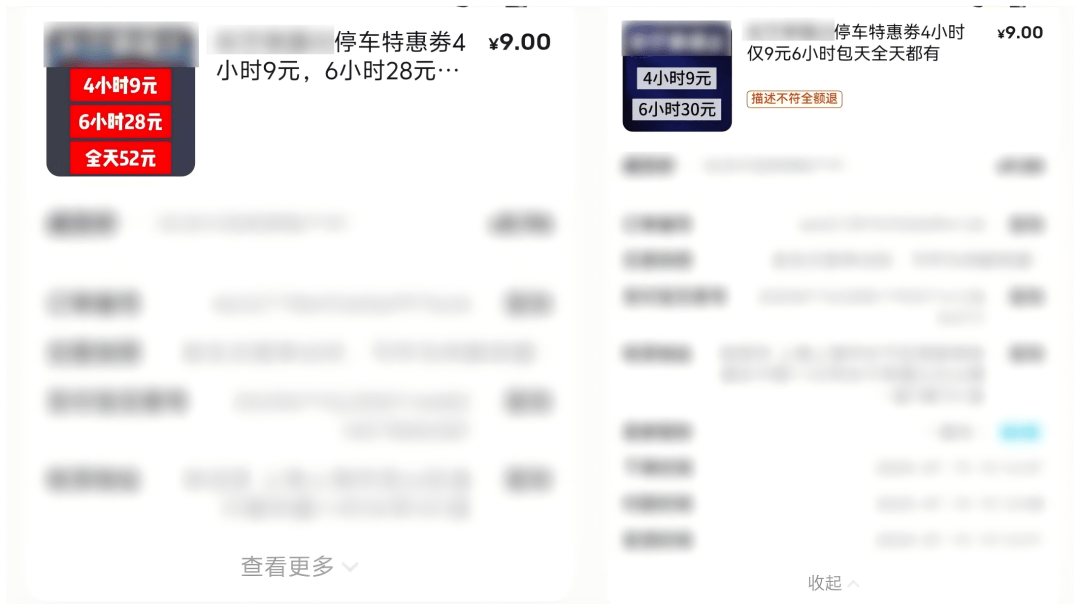
Core Viewpoint - The article highlights a case of fraud involving the forgery of consumer receipts to redeem shopping mall points, which were then used to pay for parking fees on behalf of others, leading to criminal charges against the perpetrators [1][7]. Group 1: Incident Overview - Shanghai Changning police uncovered a fraudulent scheme during the "Lijian 2025" operation, where two suspects were arrested for allegedly using fake consumption records to redeem shopping mall points [1][7]. - The management of a shopping mall reported an unusual spike in points redeemed from various dining merchants, prompting an investigation into the sale of these points on a second-hand trading platform [1][3]. Group 2: Method of Fraud - The suspects, employees at a gold sales counter in the mall, exploited customers' lack of request for receipts by collecting these receipts and using their registered accounts to exchange them for points [5]. - To meet the increasing demand for points, the suspects resorted to using photo editing software to fabricate receipts, resulting in the creation of nearly 500 fake receipts within two months, amounting to hundreds of thousands of yuan [5][6]. Group 3: Legal Consequences and Recommendations - The suspects have been taken into custody under criminal coercive measures for fraud, and the case is under further investigation [7]. - Authorities have urged shopping mall management to enhance daily oversight and improve verification mechanisms to prevent similar fraudulent activities in the future [7][8].
承诺斡旋并收钱但未实施斡旋是否为受贿既遂
Zhong Yang Ji Wei Guo Jia Jian Wei Wang Zhan· 2025-07-16 00:30
Core Viewpoint - The article discusses the legal classification of a case involving a public official, highlighting the distinction between bribery and fraud in the context of influence peddling [1][2][3]. Group 1: Case Overview - The case involves a public official (甲) who accepted 1 million yuan from a private entrepreneur (乙) in exchange for a promise to influence another official (丙) to assist乙 in avoiding criminal charges [1][2]. - There are three differing opinions on how to classify 甲's actions: as fraud, as attempted bribery, or as completed bribery [2][3]. Group 2: Legal Framework - According to Article 388 of the Criminal Law, public officials who use their position to obtain improper benefits for others and accept money can be charged with bribery, specifically influence peddling [2][5]. - Influence peddling is not a separate crime but a form of bribery that protects the integrity of public officials' duties [2][4]. Group 3: Analysis of Actions - 甲's actions meet the criteria for using his position to provide improper benefits, as he had the potential to influence丙 due to their relationship [3][5]. - The payment of 1 million yuan was based on 乙's trust in 甲's influence, indicating a direct relationship between the payment and 甲's position [6]. Group 4: Conclusion - The article concludes that 甲's acceptance of the payment, despite not having communicated with丙, constitutes completed influence peddling, as the act of accepting the money itself indicates a breach of duty [6].
“薅羊毛”竟涉犯罪?沪上首例政府消费券补贴诈骗案宣判
证券时报· 2025-05-29 14:04
Core Viewpoint - The article discusses the first case of government consumption voucher subsidy fraud in Shanghai, highlighting the fraudulent activities of an individual who exploited the system to illegally obtain government subsidies totaling over 130,000 yuan [1][6]. Summary by Sections Fraud Case Details - The defendant, Xia, fabricated in-store consumption orders to fraudulently claim government subsidies, resulting in a conviction for fraud with a sentence of three years in prison, suspended for three years, along with a fine [1][6]. - Xia, as the legal representative of a restaurant management company, discovered that some lottery winners were selling the "Le Pin Shanghai" consumption vouchers online for 50-80 yuan, prompting him to purchase these vouchers and create fictitious transactions to redeem them [4][5][6]. Government Consumption Voucher Program - In 2024, the Shanghai government launched the "Le Pin Shanghai" dining consumption voucher program, which allowed consumers to receive discounts such as 300 yuan off a 1,000 yuan purchase through a lottery system [4]. - The program aimed to stimulate consumption and support the economy, but it was undermined by fraudulent activities that violated the rules of the subsidy program [4][6]. Legal Implications of Fraudulent Activities - The court emphasized that the fraudulent actions not only harmed legitimate consumers but also severely impacted the effectiveness of government policies designed to promote economic activity [6]. - The article outlines the legal boundaries of "crawling wool," indicating that actions taken with the intent to illegally acquire government subsidies can constitute fraud under Chinese law [8][9]. - It warns that using illegal methods to obtain vouchers or engaging in fraudulent transactions can lead to severe legal consequences, including potential criminal charges [9].