
转移支付

Search documents
江苏“十三太保”,都是“二级财政”?
Hu Xiu· 2025-07-29 06:11
Core Viewpoint - The concept of "secondary finance" and "tertiary finance" in discussing China's regional economic issues, particularly in Jiangsu, is widely misunderstood and oversimplified [1][4][7]. Group 1: Understanding Jiangsu's Fiscal System - Jiangsu's 13 prefecture-level cities, including Nanjing, are often described as having a "secondary finance" system, directly connecting with the central government without provincial mediation [2][3]. - This perception of Jiangsu's fiscal structure as entirely "secondary finance" is a significant misconception [4]. - To comprehend Jiangsu's fiscal system, a broader understanding of China's fiscal hierarchy is necessary, which consists of five levels: central, provincial, prefectural, county, and township [6]. Group 2: Taxation and Revenue Distribution - China transitioned from a fiscal package system to a tax-sharing system, where the central and local governments share tax revenues, significantly enhancing central government finances while weakening local government finances [8]. - In Jiangsu, the provincial tax revenue is only 23.11 billion, while the total provincial revenue reaches 7642.03 billion, indicating that provincial revenue constitutes a mere 0.3% of the total [12]. - The "lower-level revenue sharing" in Jiangsu is substantial, with 2055.39 billion received from lower-level governments, which is about eight times the provincial revenue [12][13]. Group 3: Unique Fiscal Logic in Jiangsu - Jiangsu's fiscal model operates on a "package logic" where cities retain most of their revenue after meeting provincial obligations, contrasting with the tax-sharing logic seen in other provinces [15]. - The proportion of local fiscal revenue retained at the city level in Jiangsu is 77.02%, higher than in Guangdong and Zhejiang [16]. - Recent government initiatives aim to reform Jiangsu's fiscal system to align more closely with the national tax-sharing model, moving away from the unique "package logic" [16][17].
通过再分配提振消费、促进经济增长
Bei Jing Shang Bao· 2025-05-28 14:46
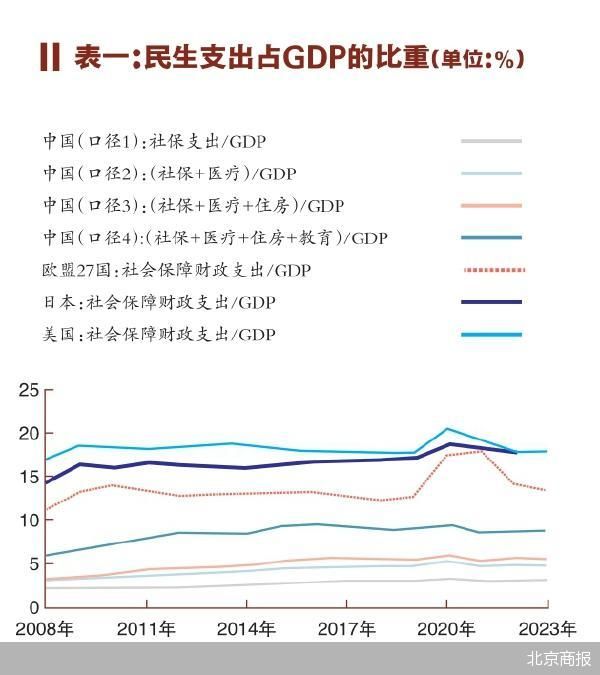
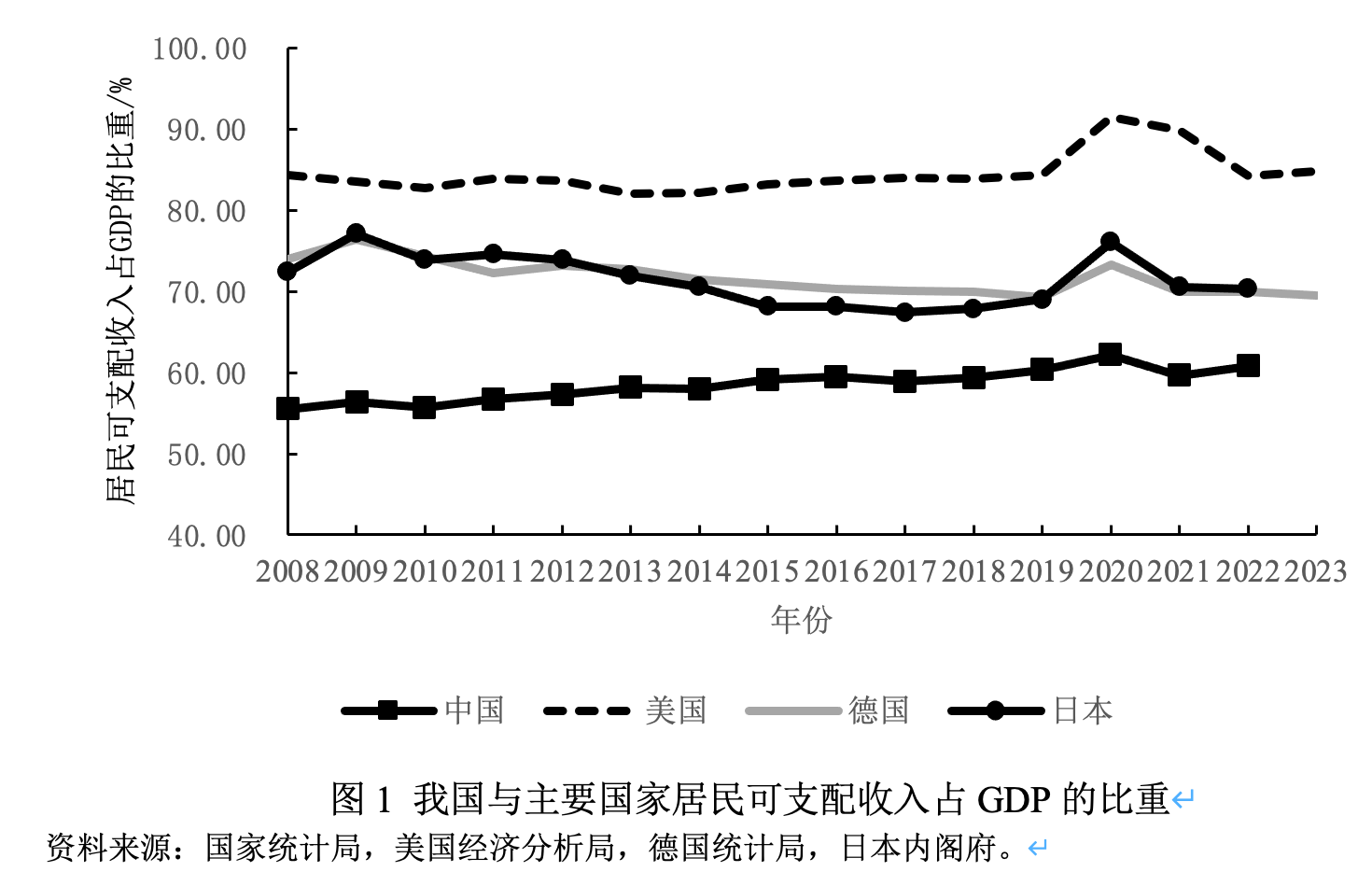
Core Viewpoint - The article emphasizes the importance of income distribution structure in relation to consumption promotion and economic growth, suggesting that improving the redistribution mechanism can stimulate internal consumption and drive economic growth [1][2]. Economic Growth and Income Distribution - The relationship between macro income distribution structure and economic growth is a long-standing research theme, where the distribution of income among enterprises, government, and households influences consumption and investment, thereby affecting economic growth [4]. - A reasonable income structure that covers different income levels can create a diversified consumer market, promoting economic optimization and upgrading [4]. Current State of Income Distribution in China - China's household disposable income as a percentage of GDP is significantly lower than that of major economies, with 60.8% in 2022 compared to Japan (70.3%), Germany (69.5%), and the US (84.9%) [5][6]. - The proportion of disposable income has been persistently lower than the initial distribution since 2000, indicating an unreasonable redistribution mechanism [7]. Policy Recommendations - Policies should focus on increasing transfer payments to households, optimizing government spending structure, and enhancing tax reforms to stimulate consumption [3][11]. - Short-term transfer payments are essential for boosting consumption demand, especially in underdeveloped regions [9][10]. - Long-term improvements in the transfer payment system are necessary to address regional economic imbalances and enhance disposable income [12]. Consumption Structure and Government Spending - The article advocates for increasing government spending in the livelihood sector to shift economic demand towards consumption, particularly in services [16][17]. - The current fiscal expenditure structure favors construction over services, necessitating a reallocation to enhance market supply and related investments [17][18]. Tax Reforms and Pension System - Tax reforms should address structural contradictions in the economy and enhance consumer capacity, including raising the personal income tax threshold and lowering rates for middle and low-income groups [19][11]. - Increasing tax incentives for personal pension accounts can improve the overall pension replacement rate, thereby enhancing current consumption tendencies [20]. Fiscal Policy and Debt Management - There is significant room for increasing government debt and deficit levels, with a current debt ratio of 65.7%, allowing for potential fiscal expansion to support consumption [22][23]. - The article suggests that issuing special government bonds can help bridge funding gaps while balancing consumption and investment needs [25][26].

盛松成:如何通过再分配提振消费、促进经济增长 | 宏观经济
清华金融评论· 2025-04-23 10:30
Core Viewpoint - The article emphasizes the importance of improving the income distribution structure to stimulate consumption and promote economic growth in China, suggesting that enhancing disposable income for residents is crucial for driving internal demand and economic recovery [1][2][3]. Group 1: Economic Growth and Income Distribution - The relationship between macro income distribution structure and economic growth is a long-standing research theme, indicating that the distribution of income among enterprises, government, and households can significantly influence economic growth through consumption and investment [6][7]. - China's current economic challenges include over-investment and under-consumption, with a low share of disposable income for residents compared to developed countries, which hinders consumption growth [11][14][17]. - The article highlights that the income distribution structure in China has been increasingly skewed, with a significant gap between urban and rural incomes, necessitating government intervention through effective redistribution mechanisms [7][8][14]. Group 2: Policy Recommendations - To stimulate consumption and economic growth, the article suggests increasing transfer payments to households, optimizing government spending, and reforming the tax system to enhance disposable income [4][22][25]. - Specific measures include raising the personal income tax threshold, reducing tax rates for low- and middle-income groups, and improving the transfer payment system to ensure funds reach those in need [26][27]. - The article advocates for a balanced approach in fiscal policy, emphasizing the need to support both consumption and investment while addressing social welfare and public service spending [40][41]. Group 3: Consumption Structure and Service Sector - The article notes that service consumption is on the rise globally, and China should aim to increase the share of service consumption in total household expenditure, which currently lags behind developed countries [29][31]. - It suggests that government purchases can stimulate market supply and related investments, particularly in the service sector, to enhance overall economic demand [32][33]. - The article also emphasizes the need for tax reforms that align with economic structure adjustments, supporting modern industries and consumption upgrades [33][34].

盛松成:如何通过再分配提振消费、促进经济增长 | 宏观经济
清华金融评论· 2025-04-23 10:30
文/ 中欧国际工商学院经济学与金融学教授、中欧陆家嘴国际金融研究院高级学 术顾问 盛松成 稳增长政策应重视收入分配结构与促消费、稳增长的关系。在已有研究的基础 上,分析宏观收入分配结构对经济增长的影响,并针对我国居民可支配收入占 比低、再分配调节不够合理、民生领域支出有待增加等实际情况,从增加居民 部门可支配收入、提高边际消费倾向、引导需求结构向消费倾斜等方面,提出 一系列政策建议。 2024年我国顺利实现经济社会发展预期目标,全年GDP同比增长5.0%,其中四季度增长5.4%,为年内最高增速,成绩来之不易。但也要看到,很多积极 变化只是初步的,仍须夯实经济回升向好的基础。随着外部环境不确定性加大,内需重要性将更加突出,尤其是消费将在今年经济增长中扮演更重要的角 色。从2024年底召开的中央经济工作会议看,政策着力点也将更多转向惠民生、促消费。 由于居民和政府两大部门在收入分配中的份额及其消费支出在很大程度上直接决定了一个经济体的消费发展水平,完善再分配机制,可能是激发消费内生 动力、促进经济增长的一把"钥匙"。"再分配"是指政府或公共部门通过税收、社会保障、财政转移支付等政策工具,对初次分配(往往是由市场机 ...
盛松成:如何通过再分配提振消费,促进经济增长
Di Yi Cai Jing· 2025-04-15 03:12
Group 1 - The article emphasizes the need for targeted redistribution policies to boost consumption and promote economic growth, especially in the context of increasing external uncertainties [1][2] - It highlights that improving the redistribution mechanism could be key to stimulating internal consumption and economic growth, as the current income distribution structure is inadequate [1][3] - The article points out that the disposable income of residents in China is significantly lower compared to major economies like Japan, Germany, and the United States, indicating a need for better redistribution adjustments [3][4] Group 2 - The article suggests that policies should balance short-term and long-term goals, combining growth stabilization with reform promotion to enhance the social welfare system and shift economic demand towards consumption, particularly in services [2][16] - It recommends increasing transfer payments to households and optimizing government spending structures to improve efficiency and stimulate market supply and investment [2][17] - The article discusses the importance of tax reforms that align with economic structural adjustments to address constraints on high-quality economic development and guide consumption through tax policies [2][18] Group 3 - The article notes that the growth rate of urban residents' disposable income has generally lagged behind GDP growth, particularly in urban areas, indicating a need for policy intervention [4][11] - It highlights that social security spending in China is relatively low, accounting for only 3.1% of GDP, suggesting significant room for improvement in public spending on social welfare [4][20] - The article emphasizes the potential of government investment in social services to stimulate market demand and improve living standards, particularly in areas like elderly care and childcare [17][19] Group 4 - The article discusses the potential for issuing additional government bonds to finance consumption-oriented policies, indicating that there is still room for fiscal expansion [20][22] - It suggests that the government should balance funding between consumption and investment to ensure sustainable economic growth, especially in light of external uncertainties [23] - The article concludes that enhancing domestic consumption is crucial for stabilizing foreign investment and fostering high-quality development in the consumer market [23]
划水
猫笔刀· 2024-10-25 14:18
其实这个数据和经济强省不矛盾,江苏的gdp数据一直很优秀,在中国仅次于广东,但是江苏省gdp最后 转化为老百姓收入的比例确实比较低。我去网上找了一下数据,搜到一个2022年的表格,你们可以看 看,重点是最右边一栏。 昨天评论里聊到江苏有一项数据全国倒数,即居民可支配收入占gdp的比例,常年徘徊在34-35%左右, 基本都在倒数第一第二。后台很多读者留言表示非常意外,因为在他们印象中江苏一直是国内顶尖的经 济强省。 上半年有一个词很流行,叫做远洋捕捞,很多民营企业家一听就浑身哆嗦。10月8日那次国务院新 闻发布会还特地回应了这件事,"纠偏违规异地执法,杜绝企业远洋捕捞"。 | | | | 2022年各省市GDP含金量分析 | | | | | --- | --- | --- | --- | --- | --- | --- | | 序号 | 地区 | 人口(万人) | 地区生产总值 (亿元) | 人均地区生产 总值(元) | 人均可支配收 入(元) | 人均收入占 人均GDP比重 | | 1 | 黑龙江省 | 3099 | 15901 | 51310 | 28346 | 55. 24% | | 2 | 河北省 | ...