
集团化办学

Search documents
云南永仁机构改革破题“县中困境”:一本上线率大涨
Yang Shi Wang· 2025-10-19 23:06
Core Insights - The article discusses the institutional reform process and outcomes in Yongren County, Yunnan, highlighting its efforts to optimize governance and enhance service delivery in the context of urbanization challenges faced by small counties in China [2][3]. Group 1: Institutional Reform and Efficiency - Yongren County has implemented a "big department system" reform, consolidating responsibilities to improve efficiency, resulting in a reduction of office space by 4,554 square meters and annual operational cost savings of approximately 5 million yuan [3]. - The county's administrative restructuring has led to the repurposing of idle office spaces into community facilities, enhancing local services and supporting the development of the health and wellness industry [4]. Group 2: Economic Development and Investment - The reform has facilitated a more efficient project approval process, significantly reducing the approval time from over 90 days to a streamlined approach, which has positively impacted the local real estate market, with a reported investment of 8.05 billion yuan in health and wellness real estate [4]. - The county's proactive governance and improved service environment have attracted around 30,000 health and wellness tourists, contributing to a notable increase in real estate sales [4]. Group 3: Social Services and Community Engagement - The merger of the cultural tourism and sports bureau with the county's publicity department has led to the creation of public spaces for the elderly and children, addressing community needs effectively [5]. - The implementation of "flexible governance" has resulted in a 22.73% decrease in total petitions, indicating improved community satisfaction and engagement [6]. Group 4: Educational Reform and Outcomes - The educational management reform has allowed school principals to focus more on teaching rather than administrative tasks, leading to a significant increase in the number of students achieving high scores in college entrance examinations, from single digits to 75 students [7]. - The establishment of a centralized financial and construction management system has relieved school leaders from operational burdens, enabling a focus on educational quality and resource sharing among schools [7].


赋能一座名城 绘就幸福教育底色
Hang Zhou Ri Bao· 2025-10-16 02:38
Core Viewpoint - The article highlights the 20-year journey of Jiangnan Experimental School, showcasing its evolution from a single institution to a significant educational group in Hangzhou, emphasizing its commitment to high-quality education and community development [3][5][16]. Group 1: Development and Growth - Jiangnan Experimental School was established in 2005 as a nine-year integrated school, combining the poetic essence of Jiangnan with a tranquil educational environment [3]. - The school has transformed from a collaboration with Hangzhou No. 2 High School to a public institution, becoming the largest educational group in Hangzhou's compulsory education phase [3][5]. - The school has undergone multiple phases of development, evolving from a single school to a group with seven member schools and nearly 10,000 students, thus becoming a "education aircraft carrier" in the region [7][16]. Group 2: Educational Philosophy and Curriculum - The school emphasizes a philosophy of "broad international vision, harmonious physical and mental development, and a happy starting point in life," which has guided its educational practices [3][10]. - The "Jiangnan Four Institutes" platform promotes a combination of differentiated and comprehensive development, offering over 80 courses across various disciplines [9][10]. - The school encourages students to explore their interests from an early age, allowing them to develop unique talents that can be further refined in higher education [10][11]. Group 3: Internationalization Efforts - Jiangnan Experimental School has established international partnerships, including a recent collaboration with a school in Belgium, enhancing students' global perspectives [12][13]. - The school integrates international understanding education into its curriculum, fostering cultural exchange and awareness among students [13][14]. - Students and teachers actively participate in international events, showcasing Chinese culture and achievements on global platforms [15]. Group 4: Future Aspirations - Looking ahead, the school aims to continue its commitment to group-based, specialized, and internationalized education, contributing to the development of a "Silicon Valley of Education" [16][17]. - The school plans to enhance its educational modernization and maintain a focus on nurturing talents with both high-tech qualities and global perspectives [17].

松山湖“百千万”:从“环松山湖辐射带”到“湾区创新集群”
Nan Fang Du Shi Bao· 2025-10-13 06:56
Core Viewpoint - In 2024, Songshan Lake successfully entered the "trillion-yuan park" club, ranking among the top 20 national high-tech zones, and is poised to leverage the "Hundred Million Project" for further development towards the next trillion [1] Group 1: Innovation and Industry Development - Songshan Lake is focusing on building a high-end industrial cluster and a source of technological innovation, while also attracting outstanding talent and enhancing urban construction [1][2] - The "Lake R&D, Town Manufacturing" model is transforming local industries, with significant expansions in production space by 50 companies in surrounding towns, covering various sectors such as new materials and semiconductors [3][4] - The collaboration between Songshan Lake and surrounding towns is fostering a more integrated industrial ecosystem, enhancing the flow of innovation resources and creating a shared development model [4][5] Group 2: Education and Public Services - Songshan Lake is extending high-quality educational resources to surrounding areas, establishing multiple educational groups and enhancing the quality of education through innovative models [6][7] - The establishment of new schools, such as the Dongguan Zhongxue Songshan Lake School, aims to fill educational gaps and promote balanced development in the region [8][9] Group 3: Regional Integration and Collaboration - Songshan Lake is actively seeking integration within the Greater Bay Area, establishing collaborative mechanisms with neighboring scientific cities to enhance resource sharing and innovation [10][11] - The construction of transportation infrastructure is crucial for improving connectivity between Songshan Lake and neighboring regions, significantly reducing travel time and enhancing the flow of innovation elements [12][13] - The "Hundred Million Project" emphasizes the importance of seamless integration of innovation resources, demonstrating that collaboration can lead to greater development potential [14]
乡村振兴离不开乡村教育的振兴
Zhong Guo Qing Nian Bao· 2025-09-28 23:36
Core Insights - The article emphasizes the importance of rural education as a foundational support for rural revitalization, highlighting its significant impact on achieving comprehensive rural development goals [1] - Experts at a recent conference reached a consensus on the need for equitable and high-quality education, advocating for the integration of urban and rural education systems [2][9] Group 1: Current State of Rural Education - Significant improvements have been made in rural education regarding school conditions and the universalization of compulsory education, yet challenges remain, such as the disconnect between rural education and society, incomplete educational structures, and insufficient participation from diverse stakeholders [1][2] - The concept of "simple yet happy" rural education is being promoted, focusing on leveraging rural education's unique advantages while learning from urban education without merely replicating it [2][9] Group 2: Strategies for Improvement - In Chongming District, Shanghai, a strategy of group-based schooling is being implemented to enhance the supply of quality educational resources and promote educational equity [3] - Small-scale rural schools face challenges such as low student enrollment and resource utilization, necessitating reforms like small class teaching to provide personalized education [3][4] Group 3: Teacher Retention and Development - The retention and effectiveness of rural teachers are critical, with policies regarding material benefits, professional development, and job security being essential for attracting and retaining talent [4][5] - In Xupu County, a systematic approach to teacher professional development has led to increased participation in training programs, with the training participation rate rising from 65% to 98% [8] Group 4: The Concept of "Big Education" - The notion of "big education" in rural areas is introduced, which encompasses a broader perspective on education's role in rural revitalization and its integration with local culture and community [9][10] - A systematic design for educational reform is deemed necessary, involving collaboration across various sectors to align educational goals with rural development strategies [11]
随迁子女超93万 河南如何做到“有学上”“上好学”?
Zhong Guo Xin Wen Wang· 2025-09-25 06:16
Core Points - The article discusses how Henan Province has successfully ensured that over 937,000 migrant children have access to quality education, with more than 94% attending public schools [1][2] - The provincial government has implemented policies to integrate migrant children's education into urban development plans and financial support [1][2] Group 1: Enrollment and Policy Measures - As of the end of 2024, the number of students in compulsory education in Henan is projected to reach 14.2368 million [1] - Henan has adopted a principle of "government of the receiving area as the main body, public full-time schools as the main body" to facilitate the enrollment of migrant children [1][2] - The province has introduced a "first enroll, then supplement the certificate" policy to ease the enrollment process for migrant children [1][2] Group 2: Infrastructure and Quality Improvement - By the end of 2024, Henan plans to build 60 new compulsory education schools and renovate or expand 260 schools, adding 112,600 quality school places [2] - The province has implemented a group-based schooling model to enhance the quality of education in weaker and newly established schools, covering 10,600 schools with a coverage rate of 53% [2] - Initiatives such as "county management of school hiring" and "excellent teacher programs" have been introduced to promote the balanced distribution of quality teaching resources [2] Group 3: Integration and Support for Migrant Children - The province ensures that migrant children and local students are treated equally in terms of enrollment, class assignments, teaching, and activities [2] - Emphasis is placed on the integration and growth of migrant children through the establishment of standardized parent schools, fostering closer ties between schools and families [2]
叶牛平检查秋季开学工作
Xi An Ri Bao· 2025-09-02 02:29
Core Viewpoint - The city is focusing on enhancing the quality and balanced development of basic education, ensuring that all schools are prepared for the new academic year with a total of 3728 schools and 2.0775 million students successfully starting classes on time [1][2]. Group 1: Education Development Strategy - The city aims to create a batch of high-quality public schools to promote the balanced and in-depth development of basic education, addressing the public's need for quality education [2]. - Emphasis is placed on optimizing the layout of quality educational resources and accelerating the improvement of infrastructure to ensure convenient access to schools for students [2]. - The management system will be improved to leverage the advantages of quality schools, exploring a group-based operation mechanism to enhance resource sharing and complementarity [2]. Group 2: School Management and Quality Assurance - There is a focus on enhancing teaching quality and management levels through improved management systems and mechanisms, ensuring better educational outcomes [1][2]. - Safety management of food, school buildings, and facilities will be strengthened, alongside a focus on students' physical and mental health to create a safe and comfortable learning environment [2].
小学老师教中学?师资小学富余、中学紧缺问题求解
2 1 Shi Ji Jing Ji Bao Dao· 2025-08-29 07:37
Core Viewpoint - The article discusses the structural changes in teacher resources in China, highlighting the surplus of elementary school teachers and the shortage of middle and high school teachers due to demographic shifts in the student population [1][2][3]. Group 1: Teacher Resource Changes - The number of teachers needed is primarily determined by the number of students enrolled, with significant changes in student populations across different education levels due to declining birth rates [2]. - By 2024, the number of elementary school teachers is projected to decrease by 66,200 to 6.5901 million, indicating that the number of teachers leaving the profession exceeds those being hired [2]. - In contrast, the number of middle and high school students is expected to peak in the coming years, with middle school enrollment increasing by 1.4247 million and high school enrollment by 1.1865 million in 2024 [3]. Group 2: Cross-Stage Teaching - Cross-stage teaching is seen as a flexible solution to address the mismatch between teacher supply and student demand, allowing teachers from elementary schools to teach in middle and high schools [4][5]. - The difficulty of cross-stage teaching varies, with subjects like political education being easier to transition into due to the ongoing integration of political education across all school levels [5][6]. - However, the lack of a streamlined process for teachers to obtain qualifications for different educational stages poses a challenge, as teachers must undergo retraining or requalification to teach at different levels [7]. Group 3: Educational Models and Mechanisms - The implementation of integrated educational models, such as nine-year and twelve-year continuous education systems, can facilitate cross-stage teaching and improve educational continuity [9][10]. - Schools like Chongqing Xiejiawan School exemplify successful cross-stage teaching by allowing teachers to work across different educational levels, enhancing the integration of knowledge [8][9]. - To effectively manage teacher allocation across stages, it is suggested to optimize hiring standards and prioritize hiring teachers with qualifications for higher educational levels [10]. Group 4: Teacher Adaptability and Quality - While encouraging cross-stage teaching, it is crucial to consider the adaptability of teachers, as not all elementary teachers may be suited for middle or high school teaching [11]. - The approach to addressing the teacher shortage should not compromise the quality of education, as forced transitions may lead to dissatisfaction with middle and high school education [11].
一批中小学幼儿园新学期启用
Nan Jing Ri Bao· 2025-08-26 23:41
Core Insights - The article highlights the opening of several newly constructed and renovated schools in Nanjing, which aim to enhance the quality of education and optimize resource allocation in the city [2][5]. New Schools: Emphasis on Aesthetics and High Standards - Newly built schools, such as Mingdao School Research and Innovation Park, feature modern architectural designs and high-quality facilities, including spacious outdoor activity areas and advanced teaching equipment [3][4]. - The Mingdao School will implement its educational philosophy and management strategies, ensuring a high standard of education [3]. Renovated Schools: Maximizing Existing Resources - The transformation of existing schools, like Tianyin High School Mixiu Street Campus, aims to increase the availability of high school placements by repurposing former junior high facilities [4]. - The new campus design accommodates 2,100 high school students, with a focus on enhancing sports facilities and classroom resources [4][5]. Expanding Access to Quality Education - The Nanjing education authorities are increasing the supply of quality educational resources, with several new schools and kindergartens set to open, including five new institutions in Jianye District and multiple others across various districts [5]. - The initiative aims to improve the educational environment and enhance the overall educational experience for students, thereby increasing public satisfaction and sense of well-being [5].
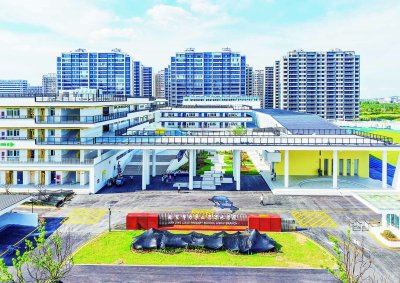
黄城根小学房山分校阎村校区正式签约落地
Xin Jing Bao· 2025-08-25 02:21
Group 1 - The core point of the article is the collaboration between Fangshan District Education Committee and Huangchenggen Primary School to establish a branch school in Yan Village, aiming to enhance quality education through integrated management and resource sharing [1] - The partnership marks a deepening of educational cooperation between Fangshan District and Xicheng District, focusing on promoting balanced development in compulsory education [1] - Huangchenggen Primary School will provide management concepts, curriculum systems, and cultural resources to the Yan Village campus, ensuring a unified management approach [1] Group 2 - The Yan Village Central School will officially become the Yan Village campus of Huangchenggen Primary School, with the principal of Huangchenggen serving as the honorary principal [1] - The collaboration includes sending outstanding teachers and expert teams to guide teaching, as well as providing on-the-job training for Yan Village teachers [1] - Both parties will work together in areas such as curriculum reform, teaching research, and teacher development to promote the sharing of quality educational resources [1]
区域教育优质均衡发展的“东营解法”
Qi Lu Wan Bao Wang· 2025-08-05 11:46
Group 1 - The core objective of the educational reform in the Kenli District is to create high-quality high schools within the community, aiming for significant improvements over three to five years [1] - The establishment of the Dongying No. 1 Middle School Education Group Kenli Campus marks a successful transformation, showcasing a vibrant and confident educational environment [1][2] - The collaboration between Kenli No. 1 Middle School and Dongying No. 1 Middle School involves a deep integration of resources and management practices, enhancing educational quality [2][3] Group 2 - The initiative began with a top-level design approach, leading to a partnership agreement signed in November 2022, which facilitated the entry of experienced educators into Kenli No. 1 Middle School [2] - A team of ten distinguished teachers from Dongying No. 1 Middle School was deployed to Kenli, bringing advanced educational concepts and management experiences [2][3] - The management structure has been reformed to a flat model, promoting teacher competition and collaboration between the two campuses [3] Group 3 - The introduction of a personalized training mechanism aims to address the diverse learning needs of students, focusing on a three-pronged approach of high-stakes exams, foundational skills, and competitions [4] - The classroom transformation emphasizes efficiency, shifting from traditional teaching methods to a student-centered learning approach [4][5] - A new evaluation system has been implemented, focusing on student progress rather than just rankings, encouraging teachers to support individual student growth [5] Group 4 - The collaboration has fostered innovative educational practices, such as the "appreciative education" model, which recognizes and rewards outstanding contributions from both teachers and students [7][8] - The integration of resources and ideas between the two schools has led to significant improvements in student performance, exemplified by notable achievements in examinations [7][8] - The partnership represents a deep-rooted transformation in educational practices, moving beyond superficial collaborations to a profound integration of educational philosophies and methodologies [8]