
小班化教学

Search documents
我国小学初高中学生人数将排浪式达峰,小班化教学时代来了
第一财经· 2026-03-19 07:12
Core Viewpoint - The article emphasizes the importance of promoting small class teaching as outlined in the "14th Five-Year Plan," highlighting its potential to improve educational quality and address the needs of students more effectively [3][4]. Group 1: Policy and Educational Reform - The "14th Five-Year Plan" aims to advance quality and balanced development in compulsory education, including the promotion of small class teaching and the establishment of necessary small-scale rural schools [3]. - National People's Congress representative Liu Xiya noted the challenges of large class sizes, which hinder personalized teaching and the emotional support of students [3][4]. - Experts argue that reducing class sizes can enhance teacher-student interactions, allowing for more tailored educational approaches and improving overall teaching quality [3][4]. Group 2: Demographic Changes and Educational Needs - With changing population structures, the school-age population in compulsory education is expected to decline over the next decade, creating a "window period" for small class teaching [5]. - Current trends indicate that the number of primary school students peaked in 2023, with junior high and high school populations expected to peak in 2026 and 2029, respectively [5]. Group 3: Resource Allocation and Implementation - During the National Two Sessions, suggestions were made to monitor demographic trends dynamically and optimize educational resource allocation based on future population changes [6]. - Liu Xiya proposed a proactive approach to guide educational resources towards smaller class sizes, aiming for around 30 students per class [6]. - Some regions have already begun implementing small class teaching, with Shandong Province planning to establish small class sizes as the norm by 2035 [7].

多维发力绘就教育强国新图景
Xin Hua Ri Bao· 2026-02-09 23:26
Core Viewpoint - The article emphasizes the ambitious goal of building a strong education nation by 2035, as outlined in the "Education Strong Nation Construction Plan Outline (2024-2035)", marking a fundamental shift in the development stage of China's education sector [1] Group 1: Resource Allocation - The changing scale and structure of school-age population is a fundamental variable affecting education development, with Jiangsu province utilizing census data and predictive models to assess trends in school-age population changes [2] - Education resource allocation is transitioning from "experience-driven" to "data-driven", establishing a dynamic allocation mechanism that adapts to population changes [2] Group 2: Small Class Teaching - The implementation of small class teaching is a key requirement of the "Education Strong Nation Construction Plan" and is seen as essential for enhancing educational quality [3] - Jiangsu has made significant progress in small class teaching, addressing challenges such as uneven implementation pace and insufficient teacher allocation through various measures [3] Group 3: Elite Talent Cultivation - The cultivation of elite innovative talents is crucial for achieving technological self-reliance and enhancing national competitiveness, as highlighted by national policies [4] - Jiangsu is actively working on early-stage cultivation of elite talents but faces challenges such as an incomplete competition management system and a weak professional coaching team [4] Group 4: Digital Transformation - Education digitalization is viewed as a critical breakthrough for shaping new competitive advantages, with a focus on transforming educational concepts, teaching models, and governance systems [5] - Jiangsu's progress in building smart campuses is uneven between urban and rural areas, prompting initiatives to strengthen strategic leadership and enhance digital resource availability [6] Group 5: Teacher Education - Teacher education reform is essential for building a strong education system, with various explorations underway to enhance teacher training and development [7] - Jiangsu has implemented innovative teacher education models and is focusing on creating a collaborative mechanism among universities, government, schools, and communities to support teacher development [7] Group 6: Future Outlook - To achieve the goal of becoming a strong education nation by 2035, continuous theoretical research and practical exploration are necessary, addressing resource imbalances, enhancing quality through small class teaching, and leveraging digital technology [8]
试点小班化教学,怎样推进?成效如何?
Xin Lang Cai Jing· 2025-12-21 16:36
Core Viewpoint - The article discusses the implementation and positive outcomes of small class teaching in various regions and schools in China, aiming to enhance educational quality and meet the evolving needs of students and parents [1][2]. Group 1: Implementation of Small Class Teaching - In Baolun Town, Guangyuan City, Sichuan Province, a small rural school has successfully implemented small class teaching with 83 students and 13 teachers, focusing on personalized attention and utilizing local resources for education [2]. - The "Education Strong Nation Construction Plan Outline (2024-2035)" emphasizes the need for a resource allocation mechanism that adapts to population changes and promotes small class teaching [2]. - Nanjing City has been promoting small class teaching since 2001, with a recent initiative to institutionalize this approach across all primary schools [3]. Group 2: Positive Reception and Educational Transformation - Educators, parents, and students generally welcome small class teaching, as it enhances the feasibility of personalized education and improves overall educational service quality [4]. - The shift from large to small classes reflects a desire for more individualized attention and a move away from traditional teaching methods, with a focus on student engagement and participation [5]. - Schools are restructuring classroom environments to support diverse learning activities, fostering collaboration and exploration among students [6]. Group 3: Regional Adaptation and Curriculum Innovation - In rural areas, small class teaching emphasizes local cultural and agricultural resources, integrating them into the curriculum to make learning more relevant and engaging [7]. - The educational philosophy shift has led to increased student enthusiasm for learning, with more time available for extracurricular activities and exploration [7]. Group 4: Future Directions and Challenges - Experts suggest that the future of small class teaching should focus on comprehensive improvements beyond just reducing class sizes, including innovative teaching methods and flexible management [8]. - Teachers face higher demands for their teaching capabilities, necessitating ongoing professional development and support from educational authorities [9]. - Collaboration among government, educational institutions, and community organizations is essential to create a supportive ecosystem for small class teaching, including funding and resource sharing [10].
乡村振兴离不开乡村教育的振兴
Zhong Guo Qing Nian Bao· 2025-09-28 23:36
Core Insights - The article emphasizes the importance of rural education as a foundational support for rural revitalization, highlighting its significant impact on achieving comprehensive rural development goals [1] - Experts at a recent conference reached a consensus on the need for equitable and high-quality education, advocating for the integration of urban and rural education systems [2][9] Group 1: Current State of Rural Education - Significant improvements have been made in rural education regarding school conditions and the universalization of compulsory education, yet challenges remain, such as the disconnect between rural education and society, incomplete educational structures, and insufficient participation from diverse stakeholders [1][2] - The concept of "simple yet happy" rural education is being promoted, focusing on leveraging rural education's unique advantages while learning from urban education without merely replicating it [2][9] Group 2: Strategies for Improvement - In Chongming District, Shanghai, a strategy of group-based schooling is being implemented to enhance the supply of quality educational resources and promote educational equity [3] - Small-scale rural schools face challenges such as low student enrollment and resource utilization, necessitating reforms like small class teaching to provide personalized education [3][4] Group 3: Teacher Retention and Development - The retention and effectiveness of rural teachers are critical, with policies regarding material benefits, professional development, and job security being essential for attracting and retaining talent [4][5] - In Xupu County, a systematic approach to teacher professional development has led to increased participation in training programs, with the training participation rate rising from 65% to 98% [8] Group 4: The Concept of "Big Education" - The notion of "big education" in rural areas is introduced, which encompasses a broader perspective on education's role in rural revitalization and its integration with local culture and community [9][10] - A systematic design for educational reform is deemed necessary, involving collaboration across various sectors to align educational goals with rural development strategies [11]
不需要那么多小学老师了,他们都去做什么?
虎嗅APP· 2025-09-16 08:58
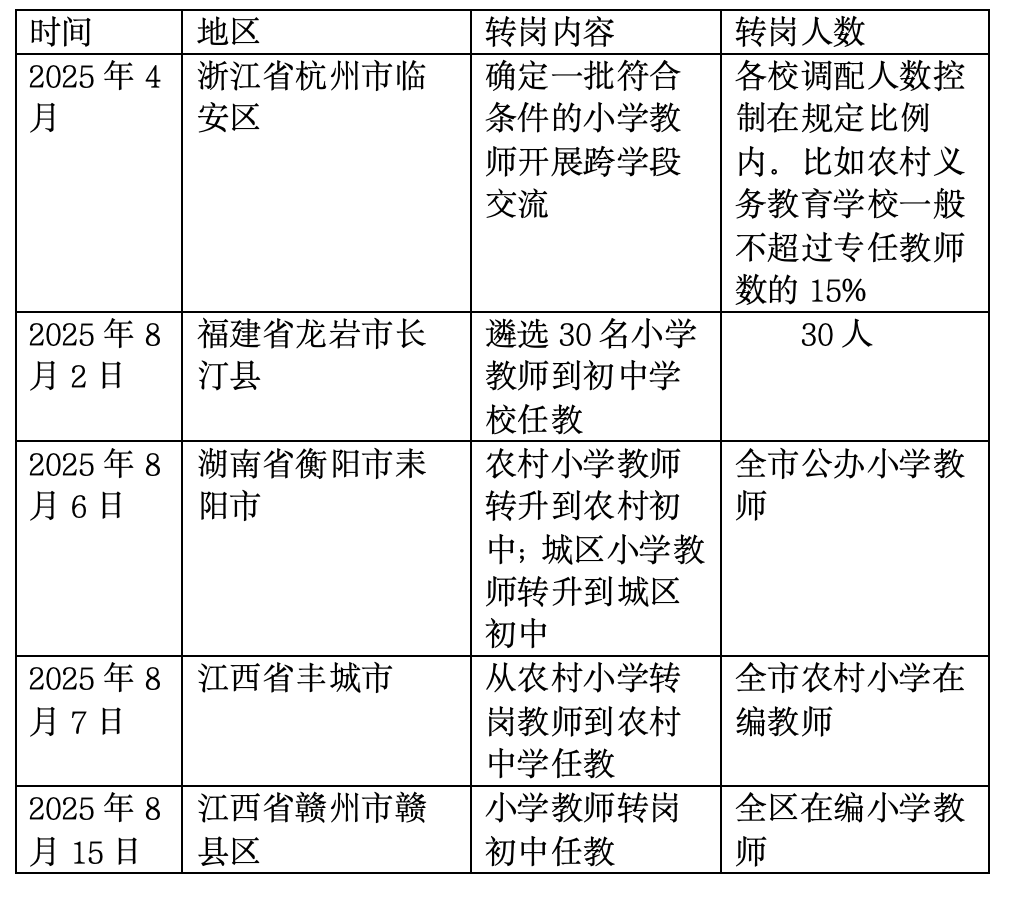
Core Viewpoint - The article discusses the impact of declining birth rates on primary education in China, highlighting the phenomenon of schools closing due to insufficient student enrollment and the resulting surplus of teachers [4][5][6]. Group 1: Declining Student Enrollment - The closure of Shanghai Sanqiao Primary School, which had more teachers than students, exemplifies the trend of declining student enrollment due to falling birth rates [4]. - Nationally, primary school enrollment dropped to 16.17 million in 2024, a decrease of 2.61 million from the previous year, with the number of primary schools also declining by 7,200 [4][5]. - The birth rate in China peaked in 2016 at 17.86 million and has since declined, leading to a significant drop in the number of school-age children [7][8]. Group 2: Teacher Surplus and Reallocation - By 2035, the total demand for primary education teachers in China is projected to decrease from 15.70 million in 2025 to 10.37 million, a reduction of 5.33 million [6][9]. - Many regions are experiencing a surplus of primary school teachers, prompting some to be reassigned to teach middle and high school students [11][12]. - In 2024, the teacher-student ratio in primary schools was reported at 1:16.06, the lowest in a decade, indicating an oversupply of teachers [9][10]. Group 3: Teacher Transition Strategies - Various regions have initiated programs to transition primary school teachers to middle schools, with many teachers required to possess relevant qualifications [14][16]. - The transition of teachers is seen as a strategy to address the shortage of middle school teachers while managing the surplus in primary education [16][17]. - The article highlights the need for a structured mechanism to facilitate teacher mobility and ensure that teachers are adequately prepared for their new roles [21]. Group 4: Small Class Teaching as a Response - Experts advocate for the implementation of small class teaching as a means to optimize teacher resources and improve educational quality amidst declining student numbers [23][24]. - Small class teaching, which limits class sizes to no more than 35 students, is viewed as a way to enhance personalized education and better utilize existing teaching staff [24][25]. - However, there are concerns that small class teaching may not fully address the underlying issues of teacher surplus and resource allocation [25][26].
不需要那么多小学老师了,他们都去做什么?
Hu Xiu· 2025-09-15 23:46
Core Points - The closure of Shanghai Sanqiao Primary School, which had more teachers than students, highlights the issue of resource wastage in education due to declining student enrollment [1][2] - The trend of declining student numbers is a reflection of the broader demographic changes in China, particularly the decrease in birth rates since 2016 [3][7] - The Ministry of Education has reported a significant drop in primary school enrollment, with 16.16 million students enrolled in 2024, a decrease of 2.61 million from the previous year [3][10] Group 1: Declining Enrollment and Teacher Surplus - The phenomenon of schools announcing closures or mergers due to insufficient enrollment is becoming common across the country, with many parents expressing sadness over the closure of their alma maters [3][4] - Predictions indicate that the total demand for primary education teachers in China will decrease from approximately 15.70 million in 2025 to about 10.37 million by 2035, a reduction of 5.33 million [5][12] - The teacher-student ratio in primary schools has reached its lowest in a decade at 1:16.06 in 2024, indicating a surplus of teachers [10] Group 2: Teacher Reallocation and Transition - Many regions are implementing teacher reallocation strategies, moving surplus primary school teachers to teach in middle and high schools due to declining student numbers [14][19] - The Ministry of Education has emphasized the need for dynamic adjustments in teacher allocation to address the surplus in primary education while meeting the demand in higher education levels [24][22] - The transition of teachers from primary to secondary education is seen as a necessary strategy to manage the imbalance in teacher supply and demand [22][19] Group 3: Small Class Teaching and Resource Optimization - Experts advocate for the promotion of small class teaching as a means to improve educational quality and better utilize existing teaching resources [31][32] - Small class teaching, which limits class sizes to enhance personalized education, has been implemented in some regions, such as Jiangsu Province [36] - However, there are concerns that small class teaching alone cannot resolve the fundamental issues of teacher surplus and resource allocation [35][34] Group 4: Future Strategies and Recommendations - The need for a robust mechanism for teacher mobility and resource allocation is highlighted, with suggestions for policies that encourage teachers to move between urban and rural areas [29][30] - Recommendations include developing a teacher retirement and reallocation system to address the surplus while ensuring educational quality [37][38] - The experience of countries with low birth rates, such as South Korea and Japan, suggests that managing teacher numbers through natural attrition may be a viable long-term strategy [38]
小班化教学正在崇明更多小规模学校展开 共筑个性化成长场域
Jie Fang Ri Bao· 2025-09-08 02:00
Core Insights - The article discusses the transformation of small-scale schools in Chongming District, focusing on the implementation of small class teaching and innovative learning environments to enhance student engagement and educational outcomes [2][3][4]. Group 1: Educational Transformation - The introduction of "Learning Stations" in classrooms represents a bold attempt to reshape teaching spaces, serving as knowledge conversion hubs, capability enhancement stations, and emotional support areas [3]. - The shift from large class sizes to small class teaching allows teachers to observe and respond to each student's learning status more effectively, fostering a more personalized educational experience [3][4]. Group 2: Resource Sharing and Collaboration - Chongming education has partnered with East China Normal University to promote small class cooperative teaching research, enhancing teaching methods and resource sharing across schools [4][5]. - The establishment of the Chongxi Education Group facilitates collaborative teaching and research activities among schools, encouraging cross-grade and cross-school lesson sharing [5]. Group 3: Outdoor and Practical Learning - The integration of local resources into the curriculum, such as ecological exploration and hands-on agricultural activities, enriches the learning experience for students in small-scale schools [6][7]. - The introduction of outdoor classrooms allows students to engage in practical learning experiences, enhancing their problem-solving skills and providing diverse educational opportunities [7].