非利息收入

Search documents
Truist Financial Corporation's Upcoming Earnings Report: A Detailed Analysis
Financial Modeling Prep· 2026-01-20 20:00
Core Viewpoint - Truist Financial Corporation (TFC) is expected to report strong quarterly earnings, with significant year-over-year growth in earnings per share (EPS) and revenue, indicating positive market sentiment and growth prospects for the company [1][2][6] Financial Performance - TFC is projected to report EPS of $1.09 and revenue of approximately $5.32 billion for the upcoming quarter [1][6] - The anticipated EPS represents a 19.8% increase compared to the same period last year, driven by a 4.1% year-over-year revenue increase [2][6] - The consensus EPS estimate has been revised upward by 0.7% over the past 30 days, reflecting positive analyst sentiment [2][6] Income and Revenue Growth - TFC's net interest income (NII) is expected to rise by 3.2%, attributed to strong loan demand and reduced deposit costs [3] - Non-interest income is projected to grow by 6.5%, supported by stronger fee income across various segments [3] - Adjusted fourth-quarter revenues are anticipated to see a sequential growth of 1-2% [3] Loan Portfolio and Asset Growth - TFC's loan portfolio shows promising trends, with commercial and industrial loans comprising nearly half of total loans and leases [4] - Consumer loan demand, accounting for about 40% of total loans, remains solid [4] - The Zacks Consensus Estimate for TFC's average earning assets is set at $490.4 billion, reflecting a 3.7% increase [4] Market Valuation Metrics - TFC has a price-to-earnings (P/E) ratio of approximately 12.29 and a price-to-sales ratio of about 2.11 [5] - The enterprise value to sales ratio is around 3.23, while the enterprise value to operating cash flow ratio is approximately 25.01 [5] - Despite a debt-to-equity ratio of about 1.08, the current ratio is low at approximately 0.13, indicating potential liquidity concerns [5]



IBN's Q3 Earnings Dip on Higher Provision & Expenses, NII Rises Y/Y
ZACKS· 2026-01-19 18:32
Core Insights - ICICI Bank Ltd. reported a profit after tax of INR113.2 billion ($1.3 billion) for Q3 FY26, reflecting a 4% decline year over year due to increased provisions, higher operating expenses, and treasury losses, despite growth in net interest income and solid loan growth [1][9] Financial Performance - Net interest income (NII) increased by 7.7% year over year to INR219.3 billion ($2.4 billion), with a net interest margin of 4.30%, up 5 basis points [2] - Non-interest income (excluding treasury) rose to INR75.3 billion ($837 million), marking a 12.4% year-over-year growth, while fee income grew by 6.3% to INR65.7 billion ($731 million) [2] - Operating expenses reached INR119.4 billion ($1.3 billion), up 13.2% year over year [3] Loan and Deposit Growth - As of December 31, 2025, total advances were INR14,661.5 billion ($163.1 billion), a sequential increase of 4.1%, driven by growth in domestic, retail, rural, business banking, and corporate loans [4] - Total deposits amounted to INR16,596.1 billion ($184.6 billion), reflecting a 3.2% increase from the previous quarter [4] Credit Quality - The net non-performing assets (NPA) ratio improved to 0.37%, down from 0.42% in the prior year, with recoveries and upgrades of NPAs totaling INR32.8 billion ($365 million) [5] - There were net additions of INR20.7 billion ($231 million) to gross NPA, with gross NPA additions at INR53.6 billion ($596 million) and write-offs of INR20.5 billion ($228 million) [5] Provisions and Capital Ratios - Provisions (excluding tax) increased to INR25.6 billion ($285 million) compared to INR12.3 billion ($136.8 million) in the prior-year quarter [6] - ICICI Bank's total capital adequacy ratio was 17.34%, with a Tier-1 capital adequacy of 16.46%, both exceeding minimum requirements set by the Reserve Bank of India [7]


WaFd Bank(WAFD) - 2026 Q1 - Earnings Call Transcript
2026-01-16 16:00
Financial Data and Key Metrics Changes - WaFd Inc. reported net income available to common shareholders of $60.5 million or $0.79 per diluted share for Q1 2026, an increase from $0.54 per share in Q1 2025 and $0.72 per share in the previous quarter [6][10] - Net interest income increased by $1.2 million from the prior quarter, with a net interest margin of 2.7% for the December quarter, slightly down from 2.71% in the September quarter [9][10] - Total non-interest income increased by $1.9 million to $20.3 million, driven by a $3.2 million gain on the sale of a branch property [11] Business Line Data and Key Metrics Changes - Loan originations for active loan types were $1.1 billion, outpacing repayments of $1 billion, with significant contributions from commercial and industrial loans [7][13] - Total loans receivable decreased by $240 million, primarily due to a decline in inactive loan types [6][7] - Non-performing assets increased to $203 million, or 0.75% of total assets, reflecting a rise in non-accrual loans [14][15] Market Data and Key Metrics Changes - Total deposits decreased by $21 million, with non-interest-bearing deposits increasing by 4.9% and interest-bearing deposits by 4.5%, while time deposits decreased by 6.4% [9] - The loan-to-deposit ratio ended the quarter at 92.7%, down from over 110% two years ago [9] Company Strategy and Development Direction - The strategic plan, BUILD 2030, aims to increase non-interest-bearing deposits from 11% to 20% of total deposits by 2030 [20] - The company is focusing on serving small businesses to achieve a lower cost of funds, with a goal of growing active loan portfolios by 8%-12% over the next one to two years [21][24] - WaFd Wealth Management was launched to grow assets under management, targeting $1 billion in the first two years [25] Management's Comments on Operating Environment and Future Outlook - Management expressed optimism about future prospects, citing a 10% linked quarter EPS growth and a 40% year-over-year growth [20] - The company anticipates continued pressure on margins due to the economic environment but expects to benefit from a shift to lower-cost deposits [10][19] - Management noted that credit quality metrics remain healthy despite some increases in delinquencies and non-performing assets [18] Other Important Information - The company repurchased 1.95 million shares at a weighted average price of $29.75, with a remaining authorization of 6.3 million shares [12][26] - WaFd is appealing its CRA rating to improve its standing, which could facilitate future branching and acquisition activities [27] Q&A Session Summary Question: Margin outlook and plans for borrowings - Management plans to replace $800 million of borrowings due within the next three months with current borrowings, expecting rates to decrease if the Fed cuts rates [28][29] Question: Interest income reversals - Non-accrual interest for the quarter amounted to just over $5 million [29] Question: Expense growth and hiring plans - Management indicated no significant plans for large team increases but will continue to make strategic technology investments [32][33] Question: Margin pressure and growth expectations - Management expects further margin pressure but growth in net interest income dollars, with optimism for future quarters [36][37] Question: Loan portfolio and inactive runoff - Inactive runoff is expected to be around $200 million-$250 million per quarter, with hopes for active loan growth of 8%-10% [38][39] Question: CRA rating and branching opportunities - Improving the CRA rating would ease branching activities and potential mergers and acquisitions, although the company is not actively seeking deals [55][56]

WAFD Q1 Earnings Beat Estimates on Higher NII, Expenses Decline
ZACKS· 2026-01-16 14:50
Core Insights - WaFd, Inc. (WAFD) reported first-quarter fiscal 2026 earnings of 79 cents per share, exceeding the Zacks Consensus Estimate of 76 cents, with a year-over-year increase of 46% [1][8] Financial Performance - Quarterly net income available to common shareholders was $60.5 million, reflecting a 38.8% increase from the prior-year quarter, surpassing the estimate of $57.3 million [2] - Total net revenues were $191.4 million, an 11.8% increase year over year, although it fell short of the Zacks Consensus Estimate of $193.5 million [3] - Net interest income (NII) for the quarter was $171.1 million, up 10.1% year over year, with a net interest margin (NIM) of 2.70%, an increase of 31 basis points from the previous year [3] - Total non-interest income was $20.3 million, a 29% increase year over year, driven by higher other income and increased deposit fee income, exceeding the estimate of $19.8 million [4] - Total non-interest expenses decreased by 5% to $105.7 million, better than the estimate of $110.2 million [4] Efficiency and Returns - The efficiency ratio improved to 55.25%, down from 65.04% in the prior-year quarter, indicating enhanced profitability [5] - Return on average common equity rose to 8.86%, up from 6.42% in the prior-year quarter, while return on average assets increased to 0.96% from 0.69% [5] Loan and Deposit Trends - As of December 31, 2025, net loans receivable decreased by 5.8% year over year to $19.85 billion, below the projected $20.3 billion [6] - Total customer deposits remained stable at $21.42 billion, nearly flat year over year, compared to the estimate of $21.67 billion [6] Credit Quality - The allowance for credit losses was 1.05% of gross loans outstanding, up from 1.00% in the prior-year quarter, indicating a decline in credit quality [7] - The ratio of non-performing assets to total assets increased to 0.75% from 0.29%, with provisions for credit losses recorded at $3.5 million, compared to none in the previous year [7][8] Share Repurchase Activity - In the reported quarter, WAFD repurchased 1.95 million shares at a weighted average price of $29.75 per share [9] Market Outlook - The company is expected to benefit from declining interest rates, business restructuring, and a solid balance sheet, although it faces near-term challenges from a tough macroeconomic environment and deteriorating asset quality [10]

JPM's Q4 Earnings Beat Estimates on Solid Trading & NII, Weak IB Hurts
ZACKS· 2026-01-13 15:36
Core Insights - JPMorgan's adjusted fourth-quarter 2025 earnings reached $5.23 per share, exceeding the Zacks Consensus Estimate of $5.01, driven by strong trading performance and higher net interest income (NII) [1][10] Group 1: Revenue Performance - Markets revenues increased by 17% to $8.2 billion, surpassing management's expectations of low-teens growth [2] - Fixed-income markets revenues rose 7% to $5.38 billion, while equity markets revenues surged 40% to $2.86 billion [2] - Total net revenues were reported at $45.79 billion, a 7% year-over-year increase, exceeding the Zacks Consensus Estimate of $45.69 billion [6] Group 2: Investment Banking Performance - Investment banking (IB) business underperformed expectations, with advisory fees declining 3% and debt and equity underwriting fees falling 16% and 2%, respectively [3] - Total IB fees in the Commercial & Investment Bank segment decreased by 5% year-over-year to $2.35 billion, contrary to management's projection of low single-digit growth [3] Group 3: Net Interest Income and Loan Growth - NII increased by 7% year-over-year to $25 billion, with management projecting NII to reach nearly $103 billion for the year, up 7.4% from $95.9 billion in 2025 [4][6] - Total loans saw an 11% year-over-year increase, contributing to the rise in NII [4] Group 4: Operating Expenses and Provisions - Operating expenses rose, with adjusted non-interest expenses expected to be $105 billion for the year, up from $96 billion in 2025 [5] - Provisions for credit losses surged 77% year-over-year to $4.66 billion, which included reserves for the Apple credit card portfolio [9][10] Group 5: Credit Quality and Asset Performance - Net charge-offs increased by 5% to $2.51 billion, while non-performing assets rose 11% to $10.36 billion as of December 31, 2025 [11] - The performance of business segments showed a rise in net income for CIB and Asset & Wealth Management, while CCB and Corporate segments experienced a decline [8] Group 6: Capital Position and Share Repurchases - Tier 1 capital ratio was estimated at 15.5%, down from 16.8% in the prior year, while the total capital ratio was 17.3%, compared to 18.5% a year ago [12] - The company repurchased 26.7 million shares for $7.9 billion during the reported quarter [13]


星展:升汇丰控股(00005)目标价至139.2港元 收入与盈利增长展望乐观
智通财经网· 2026-01-07 03:14
Core Viewpoint - DBS has a positive outlook on HSBC Holdings, projecting a return on equity of approximately 16% for the fiscal years 2026-2027, despite a decline from the high base of fiscal year 2025 [1] Group 1: Earnings Forecast - DBS has raised its earnings forecasts for HSBC for fiscal years 2026 and 2027 by 2% and 7% respectively [2] - The net interest income forecast for HSBC from 2025 to 2027 has been increased to over $43 billion [2] - The headwinds facing net interest income in fiscal year 2026 are expected to be smaller than last year due to a reduced rate of interest cuts in the US and a recovery in Hong Kong interbank offered rates since the historical lows in Q2 2025 [2] Group 2: Dividend and Return Projections - Expected dividend yields for HSBC from 2025 to 2027 are projected at 5.2 cents, 5.6 cents, and 6.3 cents respectively [2] - Average return on equity for shareholders is anticipated to be 12.6%, 15.3%, and 16.1% for the years 2025 to 2027 [2] Group 3: Factors Supporting Growth - The decline in net interest income is expected to be offset by structural hedges and favorable factors such as reduced funding costs [1] - Non-interest income is anticipated to maintain strong growth momentum, with expectations of a robust Hong Kong capital market in fiscal year 2026 [1] - Credit costs are expected to remain manageable, as there are no significant signs of deterioration in credit risk within Hong Kong's commercial real estate sector [1]

The PNC Financial Services Group (PNC) Up 3.2% Since Last Earnings Report: Can It Continue?
ZACKS· 2025-11-14 17:31
Core Viewpoint - The PNC Financial Services Group reported strong third-quarter earnings, with adjusted EPS surpassing estimates, driven by increases in net interest income (NII) and fee income, despite rising expenses [2][4]. Financial Performance - Adjusted EPS for Q3 2025 was $4.35, exceeding the Zacks Consensus Estimate of $4.05, and up from $3.49 in the prior-year quarter [2]. - Net income on a GAAP basis was $1.82 billion, reflecting a 21.1% increase year over year [3]. - Total revenues reached $5.91 billion, an 8.9% year-over-year increase, surpassing estimates by 1.4% [4]. Income and Expenses - NII was reported at $3.65 billion, a 6.9% increase from the previous year, with a net interest margin of 2.79%, up 15 basis points [4]. - Non-interest income rose 12.1% year over year to $2.3 billion, driven by increases in most fee income components [5]. - Non-interest expenses totaled $3.46 billion, a 4% increase from the prior year, with an efficiency ratio improving to 59% from 61% [5]. Loan and Deposit Growth - Total loans as of September 30, 2025, were $326.6 billion, showing slight sequential growth, while total deposits increased by 1.4% to $432.7 billion [6]. Credit Quality - Non-performing loans decreased by 17.1% year over year to $2.1 billion, and net loan charge-offs fell 37.4% to $179 million [7]. - The provision for credit losses was $167 million, down 31.2% from the previous year [7]. Capital Position - The Basel III common equity tier 1 capital ratio improved to 10.6% from 10.3% year over year [9]. - Return on average assets and average common shareholders' equity were 1.27% and 13.24%, respectively, compared to 1.05% and 11.72% in the prior-year quarter [9]. Capital Distribution - In Q3 2025, PNC returned $1 billion to shareholders, including $0.7 billion in dividends and $0.3 billion in share repurchases [10]. Future Outlook - For Q4 2025, PNC expects average loans to remain stable to up 1%, with NII anticipated to increase by approximately 1.5% [11]. - Fee income is projected to decline around 3%, while total revenues are expected to remain stable to down 1% [12]. - Non-interest expenses are anticipated to rise by 1%–2% [12]. Industry Context - PNC operates within the Zacks Financial - Investment Bank industry, where Citigroup reported an 8.7% year-over-year revenue increase and a 32.8% expected earnings growth for the current quarter [19][20].


中国银行业_六家大型银行 2025 年第三季度业绩核心要点-China Banks_ Earnings Review_ Key takeaways from six large banks 3Q25 results
2025-11-07 01:28
Summary of Key Takeaways from China Banks 3Q25 Earnings Review Industry Overview - The report covers the performance of six large state-owned banks in China for the third quarter of 2025 (3Q25), including ICBC, CCB, ABC, BOC, BoCom, and PSBC. Core Insights and Arguments 1. **NIM (Net Interest Margin) Trends** - NIM decline continued to narrow, with an average NIM of 1.27%, which was +1 basis point (bp) above Goldman Sachs estimates due to slower declines in asset yields and greater savings in deposit costs [2][1] - Large banks are better positioned for sustainable NIM stabilization, driven by their ability to manage funding costs effectively [2][1] 2. **Loan Growth Dynamics** - Average loan growth for large banks in 3Q25 was 8.6% year-over-year (yoy), a slight decrease from 9.0% in 2Q25, primarily due to weak retail and corporate loan demand [12][1] - PSBC and ABC exhibited relatively faster loan growth at 10.0% and 9.3% yoy, respectively, raising questions about the sustainability of this growth [14][1] 3. **Non-Interest Income Performance** - Non-interest income grew by 15% yoy, with fee income increasing by 10% driven by strong agency sales, outperforming expectations [17][1] - Investment income also saw a significant increase of 39% yoy, attributed to the sale of high-yield bonds despite rising bond yields [17][1] 4. **Asset Quality and NPL (Non-Performing Loan) Trends** - NPL formation rate decreased to an average of 0.4%, reflecting a decline in existing risks, although PSBC and BoCom saw increases in their NPL formation rates [24][1] - A reduction in provisions across large banks led to a decline in NPL coverage ratios, with PSBC's coverage ratio dropping sharply by 20 percentage points (ppts) qoq [25][1] 5. **Capital Performance Variability** - Capital performance varied among banks, with four of the six large banks achieving a sequential increase in their CET-1 (Common Equity Tier 1) ratios, averaging a 5 bp increase [34][1] - ICBC and BoCom experienced declines in their CET-1 ratios, raising concerns about their capital consumption rates [35][1] 6. **Revised Earnings Estimates** - Following the 3Q25 results, Goldman Sachs adjusted its 2025-2027E PPOP (Pre-Provision Operating Profit) and NPAT (Net Profit After Tax) estimates for the six large banks by +1% on average, while maintaining target prices for A/H shares unchanged [43][1] Additional Important Insights - The report highlights the potential impact of the People's Bank of China (PBOC) resuming government bond trading, which could enhance liquidity and positively affect banks' investment income [18][1] - Concerns were raised regarding PSBC's operating expenses outpacing revenue growth, which could lead to adjustments in its deposit agency fee rates to protect profitability [6][1] - The report emphasizes the importance of monitoring retail loan quality, particularly mortgages, in light of ongoing challenges in the property sector [26][1]

透视银行三季报:超30家净息差收窄 债市波动拖累非利息收入
Bei Ke Cai Jing· 2025-11-05 11:12
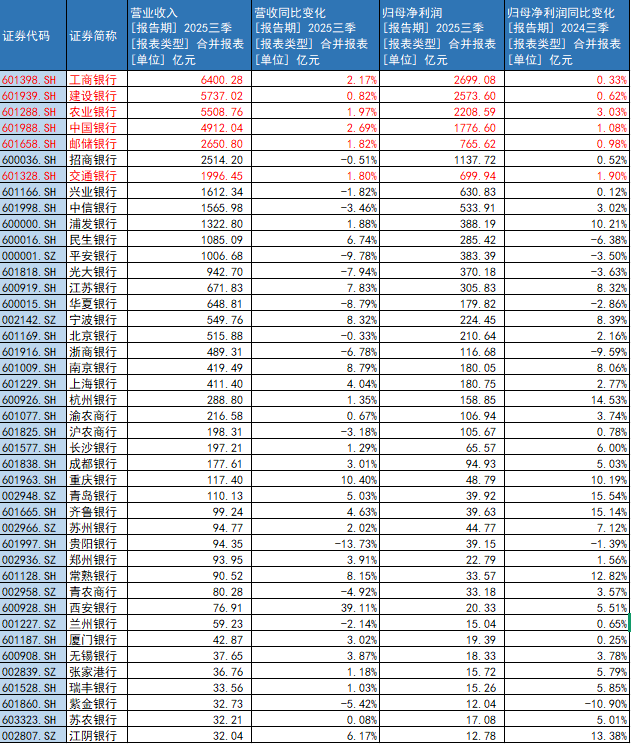
Core Insights - The overall performance of A-share listed banks in the first three quarters of the year is positive, with over 80% achieving year-on-year growth in net profit attributable to shareholders [2][3] - The growth in net profit is primarily driven by stable net interest income and improved asset quality, despite a decline in non-interest income due to bond market fluctuations [2][3] - The six major banks collectively reported over 1 trillion yuan in net profit, marking a significant milestone [3][4] Financial Performance - Among the 42 listed banks, 35 reported year-on-year growth in net profit, while only 7 experienced a decline [3][4] - The top four state-owned banks (Industrial and Commercial Bank of China, China Construction Bank, Agricultural Bank of China, and Bank of China) all achieved growth in both revenue and net profit [4][5] - Industrial and Commercial Bank of China led in revenue with 640.03 billion yuan, a 2.17% increase year-on-year, and a net profit growth of 0.33% [4][6] Non-Interest Income and Market Impact - Many banks faced a decline in non-interest income due to volatility in the bond market, with several banks reporting significant losses in fair value changes [9][10] - For instance, China Merchants Bank reported a fair value loss of 8.83 billion yuan, transitioning from profit to loss [10][12] - The decline in non-interest income is attributed to reduced earnings from bond and fund investments [10][13] Interest Income Trends - Some banks, particularly city commercial banks, saw substantial growth in interest income, with Xi'an Bank's interest income increasing over 60% [7][8] - Conversely, banks like Guiyang Bank and Capital Bank reported declines in interest income of 12.29% and 17.34%, respectively [8][9] Net Interest Margin - The overall net interest margin for listed banks has narrowed compared to the end of the previous year, although some banks have seen a recovery from the second quarter [16][20] - As of the end of the third quarter, Xi'an Bank's net interest margin was 1.79%, reflecting a 0.43% increase from the end of the previous year [16][17] - The stability of net interest margins in the fourth quarter will depend on the banks' ability to optimize their liability structures and find high-quality investment opportunities [20]





上市银行三季报透视:营业收入合计超4.3万亿元
Zhong Guo Zheng Quan Bao· 2025-11-04 23:25
Core Insights - The overall performance of A-share listed banks in the first three quarters of 2025 exceeded expectations, with a total operating income surpassing 4.3 trillion yuan, and over 60% of banks reporting year-on-year growth in operating income [1][2] - The stabilization of net interest margin (NIM) is identified as a key factor supporting the revenue growth of listed banks, despite being in a downward trend [1][3] Revenue Performance - As of the end of Q3 2025, the total assets of listed banks grew by 9.3% year-on-year, indicating steady expansion [2] - The overall operating income of listed banks increased by 0.9% year-on-year, while net profit rose by 1.5% [2] - More than 25 out of 42 listed banks achieved year-on-year growth in operating income, with Xi'an Bank, Chongqing Bank, and Nanjing Bank leading with growth rates of 39.11%, 10.40%, and 8.79% respectively [2] - Nanjing Bank reported an operating income of 41.949 billion yuan, with net interest income accounting for 60.09% and non-interest income for 39.91% [2] Net Interest Margin Trends - The net interest margin for listed banks in Q3 2025 was 1.33%, remaining stable compared to the first half of 2025 [3] - The decline in funding costs and the stable LPR contributed to the stabilization of NIM, with banks optimizing their asset and liability structures [3] - Changshu Bank led the industry with a net interest margin of 2.57% [3] - Despite a 10 basis point decrease in NIM for Industrial Bank to 1.72%, the decline was relatively small compared to peers [3] Non-Interest Income Challenges - The volatility in the bond market has pressured non-interest income, with many banks reporting significant declines in fair value changes [4] - Nanjing Bank's non-interest income fell by 11.63% year-on-year, with a fair value loss of 334 million yuan in Q3 2025 compared to a profit of 4.676 billion yuan in the same period last year [4] - China Merchants Bank reported a slight decline in operating income by 0.51% year-on-year, with non-interest income down by 4.23% [5] - The decline in non-interest income is attributed to reduced returns from bond and fund investments, with China Merchants Bank reporting a fair value loss of 8.827 billion yuan in the first three quarters [5]