
高股息投资策略

Search documents
年内险资举牌银行股达14次 未来银行股的资金吸引力依然较强
Zheng Quan Ri Bao· 2025-08-17 23:59
Group 1 - Ping An Life Insurance has increased its stake in Postal Savings Bank of China (PSBC) H-shares to 15.05%, triggering a third regulatory notice [1] - The stock price of PSBC H-shares has risen by 25.2% this year, indicating a strong upward trend [1] - Ping An Life has made nine significant investments in bank stocks this year, with multiple stakes in PSBC and other banks [1] Group 2 - Other insurance institutions have also shown interest in bank stocks, with several instances of shareholding increases in various banks [2] - The appeal of listed banks lies in their stable operations, good liquidity, high dividend yields, and potential for appreciation [2] - The H-shares of listed banks are perceived to be undervalued compared to A-shares, providing a greater potential for future gains [2] - Policies encouraging long-term capital inflow into the market have increased the demand for insurance capital to invest in bank stocks [2] - The banking sector is highlighted for its high dividend yield, making it an attractive option for insurance capital in a low-interest-rate environment [2]
为何险资偏爱银行股?机构解读未来增持空间
Huan Qiu Wang· 2025-08-12 04:35
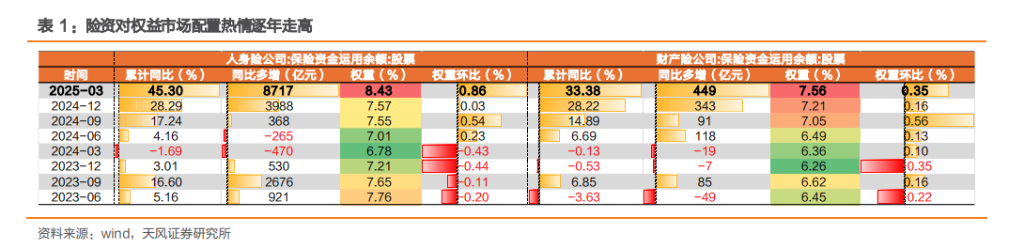
Core Viewpoint - The insurance capital's adjustment in stock market investments, particularly the increased allocation to bank stocks, has garnered significant market attention, with a notable year-on-year growth in investments [1][3]. Group 1: Investment Trends - As of the end of Q1 2025, life and property insurance companies have collectively invested 2.82 trillion in the stock market, representing a 44.5% year-on-year increase and a 19.5 percentage point rise compared to the end of 2024 [1]. - Insurance companies show a strong preference for high-dividend stocks, particularly in the banking sector, which is evident in their investment strategies [3]. Group 2: Investment Structure - The OCI (Other Comprehensive Income) account has become increasingly important as a vehicle for equity allocation by insurance capital [3]. - The focus of insurance capital's stock investments is primarily on high-dividend sectors, with bank stocks being a significant target for recent capital increases [3]. Group 3: Market Analysis - The banking sector is favored due to its high dividend yield of 3.73% as of August 5, combined with stable dividends and sound operational characteristics, making it an attractive investment option [3]. - Bank stocks are currently undervalued at a price-to-earnings ratio of 0.77x, which is significantly lower than other high-dividend sectors like coal and oil [3]. Group 4: Future Projections - Forecasts suggest that insurance capital will bring an additional 1,404 billion and 737 billion to bank stocks in 2025, with a projected 29% increase in incremental funds compared to 2024 [4]. - Long-term investments in bank stocks are viewed as a necessary strategy, with expectations of continued support from favorable funding conditions, stable fundamentals, and ongoing policy catalysts [4].


天风证券:险资或将带来可观的增量资金 银行股估值仍有修复空间
智通财经网· 2025-08-11 23:52
Group 1 - The core viewpoint is that insurance capital is expected to continue increasing its allocation to bank stocks, driven by new premium investments and the utilization of equity asset allocation limits [1][4] - Insurance capital's investment in the stock market has accelerated, with a total investment of 2.82 trillion in stocks by life and property insurance companies as of Q1 2025, representing a year-on-year increase of 44.5% and a 19.5 percentage point increase from the end of 2024 [2] - Bank stocks are favored due to their high dividend yields, with the banking sector's dividend yield at 3.73% as of August 5, 2025, making them attractive in a low-interest-rate environment [3][4] Group 2 - The potential for insurance capital to increase its allocation to bank stocks can be analyzed through two main aspects: new premium investments in A-shares and maximizing equity asset allocation limits [4] - The China Securities Regulatory Commission has mandated that large state-owned insurance companies invest 30% of their new premiums in the A-share market starting in 2025, which could lead to an estimated increase of 1.404 billion and 737 million in incremental funds for bank stocks in 2025 [4] - The theoretical equity asset allocation limit for most insurance companies is 30% of their total assets from the previous quarter, which could lead to an expansion of at least 2.432 billion in insurance capital holdings in bank stocks [4]

天风证券:险资对银行股的增持空间还有多少?
智通财经网· 2025-08-11 13:28
Core Viewpoint - The trend of insurance capital increasing equity allocation is evident, with banks and other high-dividend sectors likely to be the main beneficiaries. Group 1: Insurance Capital Allocation Trends - By the end of Q1 2025, life and property insurance companies had invested a total of 2.82 trillion yuan in the stock market, a year-on-year increase of 44.5%, and a 19.5 percentage point increase from the end of 2024 [1] - The stock investment of life and property insurance companies accounted for 8.4% and 7.6% of the total insurance fund utilization balance, respectively, both reaching their highest levels in nearly two years [1][2] - The stock investment of life insurance companies increased by 871.7 billion yuan year-on-year, while property insurance companies saw an increase of 44.9 billion yuan, marking the highest expansion levels in the past two years for both categories [1] Group 2: Investment Preferences - Insurance companies prefer high-dividend stocks, particularly in the banking sector, as evidenced by the significant increase in OCI account allocations, which accounted for 28.4% of stock investments by the end of 2024, up 7.6 percentage points from the end of 2023 [4] - By Q1 2025, the market value of insurance capital holdings in the banking sector reached 3.924 trillion yuan, representing a 30 billion yuan increase from the previous quarter, making it the highest among all Wind secondary industries [6][8] Group 3: Regulatory Environment and Future Outlook - Policies promoting long-term capital market investments have been introduced, including a requirement for large state-owned insurance companies to invest 30% of new premiums in A-shares starting in 2025 [12][20] - The banking sector is expected to remain a key focus for insurance capital due to its high dividend yields and low volatility, with banks being a primary target for recent capital increases [9][12] - The insurance sector's solvency ratios indicate that there is still significant room for increasing equity investments, with potential additional investments in bank stocks estimated at 2.432 trillion yuan [29][32]
开源证券:把握银行板块轮动效应 关注PB-ROE曲线演变
Zhi Tong Cai Jing· 2025-07-31 02:13
Group 1 - The current PB-ROE curve has flattened compared to previous periods, indicating a shift in valuation drivers from fundamental factors to dividend logic [1] - The evolution of the curve suggests that bank stock valuations are still based on dividends, with institutional fund preferences and timing differences driving rotation within the banking sector [1] - The implied necessary return rate calculated using the DDM model is approximately 5.2%, with a spread of about 3.5% over the risk-free rate, indicating potential for PB valuation enhancement if the spread narrows [1] Group 2 - Insurance capital continues to allocate to bank stocks, with room for increased investment in FVOCI stock and long equity trials [1] - The ongoing rise in bank stocks is driven by capital market dynamics, with a focus on the reasons and potential for insurance capital to increase bank stock allocations [2] - The five factors driving insurance capital to increase allocation to high-dividend assets include the need for higher yields amid declining asset returns and optimized capital pressure management [2] Group 3 - Marginal changes in liabilities, products, and assets may lead to reduced allocation of insurance capital to bank stocks [3] - On the liability side, a decrease in preset rates may enhance the attractiveness of fixed-income assets, potentially diverting funds from high-dividend allocations [3] - If bank performance pressures continue, particularly if earnings decline further by Q2 2025, it may lead to a stock price correction and temporary pressure on insurers' solvency [3]
《投资蓝皮书:中国投资发展报告》发布
Zheng Quan Ri Bao Wang· 2025-04-24 07:42
Core Insights - The report titled "Investment Blue Book: China Investment Development Report (2025)" was jointly released by China Jianyin Investment Limited and Social Sciences Academic Press, marking the 14th consecutive year of publication by the China Jianyin Investment Research Institute [1] Group 1: Overall Economic Analysis - The report includes two main sections analyzing the current macroeconomic environment in China and globally, particularly focusing on interest rate trends, and proposes investment strategies under a low-interest-rate backdrop [2] - It suggests that the investment market will exhibit specific characteristics in a low-interest-rate environment, emphasizing the need for strategic asset allocation [2] Group 2: Market Outlook - The market outlook section reviews five key markets: A-shares, bonds, private equity, real estate, and non-performing assets, predicting that national policies will enhance A-share value and reshape valuations [2] - It forecasts that monetary policy will continue to ease in 2025, leading to a general downward trend in bond market yields [2] - The report highlights the importance of equity investment in supporting small and medium enterprises, technological innovation, and industrial upgrades, with a focus on new productive forces and hard technology sectors [2][3] Group 3: Real Estate and Asset Management - The report indicates that the Chinese real estate market has stabilized after a period of significant adjustment, laying a foundation for recovery [3] - It notes that the transfer of equity in Asset Management Companies (AMCs) will provide historical opportunities for industry reform, signaling a new development phase for the asset management sector [3] Group 4: Specialized Research Topics - The specialized research section addresses critical issues in financial investment, including the development of patient capital, the cyclical logic of stock and bond investments, high-dividend investment strategies, "Artificial Intelligence +" investment strategies, and the empowerment of new productive forces through financial technology [3]