
AI产业发展

Search documents
机构年末科技投资抉择:谁在坚守 谁在撤退 又是谁在观望?
Shang Hai Zheng Quan Bao· 2025-11-17 19:25
Core Viewpoint - As the year-end approaches, institutional investors are adjusting their portfolios, with a notable divergence in views on technology stocks, where some remain optimistic, some are retreating, and others are taking a wait-and-see approach [1] Group 1: Optimists ("坚守者") - The AI industry is still in its early development stage, and significant growth in AI applications is expected in the coming years, leading to a positive cycle of capital investment and revenue [2] - Domestic companies are expected to increase their capital expenditure on AI, with Alibaba planning to invest 380 billion yuan over three years, indicating substantial growth potential compared to international counterparts [2][3] - Despite discussions about AI bubbles in overseas markets, there are no such concerns domestically, and funds continue to flow into AI-related investments, with a recent net subscription of 4.868 billion yuan for AI-themed ETFs [3] Group 2: Retreaters ("撤退者") - The rapid rise in stock prices poses risks, and some fund managers have reduced their positions in technology stocks after observing that strong earnings reports did not lead to expected stock price increases [4] - As of the end of Q3, public funds' allocation to technology sectors reached 40.16%, indicating a historically high level of investment in this area [4] - The concentration of holdings in technology stocks is at a high level, with significant over-allocations in the electronics and communications sectors, exceeding 10% [4][5] Group 3: Observers ("观望者") - Many fund managers are currently undecided about whether to increase or decrease their positions in technology stocks, as they face profit-taking challenges [7] - There has been a marked increase in institutional research on technology sectors, with over 2,000 instances of institutional inquiries in semiconductor, electronic equipment manufacturing, and computer software industries in the past month [7] - The focus is shifting towards the performance and core business development of technology companies, with a heightened sensitivity to earnings and valuation expectations [7]
华泰证券:四季度出口增速中枢或小幅回落 但仍保持较高景气度
Xin Lang Cai Jing· 2025-10-14 00:10
Core Insights - The core viewpoint of the article highlights a rebound in China's export growth, with a year-on-year increase of 8.3% in September 2025, surpassing Bloomberg's consensus estimate of 6.6% [1] - Import values also showed significant growth, rising by 7.4% year-on-year, exceeding the expected 1.8% [1] - The trade surplus increased to $90.5 billion, reflecting an additional $8.8 billion compared to the previous year, indicating a positive contribution from net exports to economic growth [1] Export and Import Analysis - September 2025 saw a recovery in dollar-denominated exports, with growth rebounding from 4.4% in August to 8.3% [1] - Imports experienced a notable increase, with a year-on-year growth rate of 7.4%, up from 1.3% previously [1] - The trade surplus reached $90.5 billion, marking an increase of $8.8 billion year-on-year, which continues to support economic growth through net exports [1] Future Outlook - The demand for exports related to the AI industry is expected to remain strong, alongside ongoing investments from the Belt and Road Initiative, which may provide structural support for China's export growth [1] - A recovery in the global manufacturing cycle and an expansionary fiscal policy overseas could stabilize external demand [1] - Despite a potential slight decline in export growth rates due to high base effects in the fourth quarter, the overall outlook remains positive with sustained high levels of economic activity [1]

20cm!多重催化,引爆整个板块
Ge Long Hui· 2025-08-22 09:53
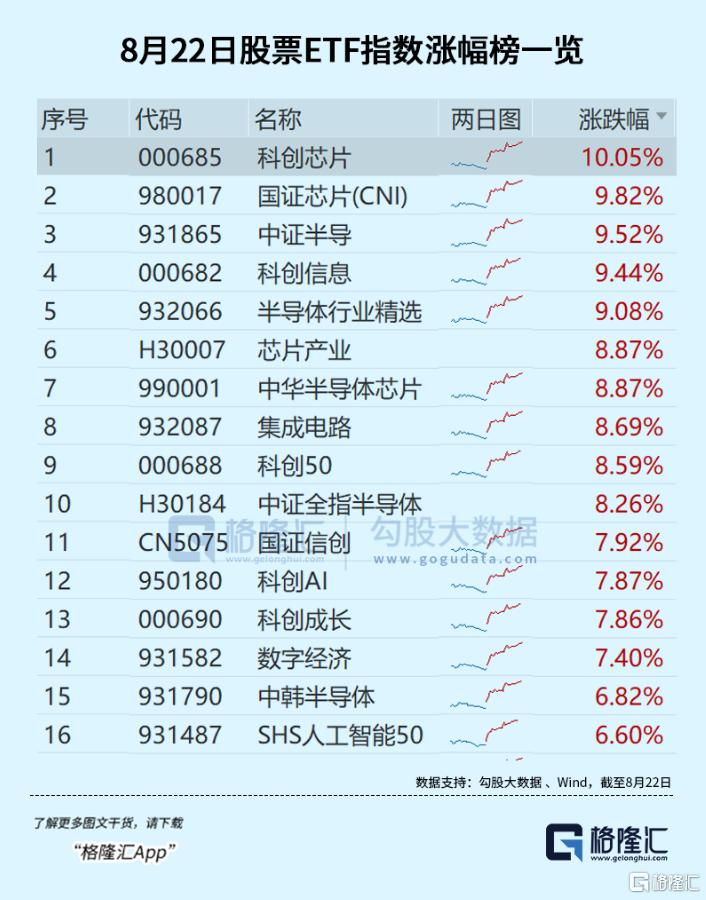
Core Viewpoint - The A-share market continues its upward trend, with the Shanghai Composite Index surpassing 3800 points, marking a ten-year high, driven primarily by domestic chip stocks as a key component of the technology bull market [1] Group 1: Market Performance - The domestic chip sector has seen significant gains, with the Kweichow Moutai stock hitting a 20% limit up, pushing its market capitalization above 500 billion yuan, and its stock price exceeding 1200 yuan [1] - The ChiNext chip index surged by 10.05%, leading the major chip indices, while the ChiNext chip ETF (588200) skyrocketed by 11.92% [1] - The semiconductor sector experienced a broad rally, with various sub-sectors such as securities, small metals, education, software, and rare earth magnets also showing strong performance [3] Group 2: Key Stocks and Indices - The top-performing stocks in the semiconductor sector included companies like Cambrian (20% increase), Haiguang Information (20% increase), and several others with gains exceeding 10% [5][9] - The ChiNext chip index has shown a cumulative increase of 46.62% since April 8, outperforming other indices such as the CSI Semiconductor Index (37.80%) and the National Chip Index (36.11%) [10][11] Group 3: Catalysts and Innovations - The recent surge in the chip sector is attributed to the release of DeepSeek-V3.1, which introduced significant advancements in AI chip technology, particularly in FP8 computation [6][7] - The market anticipates that DeepSeek's innovations will enhance the capabilities of domestic chips, reducing reliance on foreign technologies [8] Group 4: Future Outlook - The growth trajectory of the ChiNext chip index is expected to continue, with projected revenue growth rates for 2025 reaching 24.93%, indicating strong future performance [15] - The ongoing IPO processes for key domestic semiconductor companies are likely to attract more capital and policy support, further accelerating the trend towards AI chip autonomy [18][21]


中信证券:关注传媒行业AI及IP方向机会
news flash· 2025-05-09 00:46
Group 1 - The core viewpoint is that the media sector is supported by a friendly policy environment, new technological changes, and new consumption trends, which drive valuation increases [1] - The positive performance expectations are crucial for sustaining high valuations and maintaining elevated valuation levels [1] - The current situation indicates that all three factors—supportive policies, technological advancements, and consumption trends—are present [1] Group 2 - The focus on new technological changes highlights the development of the AI industry [1] - The emphasis on new consumption trends points to the commercialization of intellectual property (IP) [1]

科创、海外市场策略深度研究:本轮美股调整级别分析
ZHESHANG SECURITIES· 2025-04-27 07:25
Group 1: Market Adjustment Insights - The current adjustment level of the US stock market is expected to be significantly higher than in 2011 but weaker than in 2000 due to the AI industry's turning point and high valuations[1] - The adjustment is primarily driven by the leading industry's transition phase, with high valuations impacting the adjustment level[2] Group 2: Industry Development Patterns - Emerging industries face a critical turning point when upstream penetration rates approach 40%, as seen in the PC and mobile internet eras[2] - For AI, the upstream computing power investment growth is slowing as it nears a 40% penetration rate, leading to dual pressure on valuations and profits for related companies[3] Group 3: Valuation Metrics - Current valuation metrics indicate that the US stock market's total market value to GDP ratio is around 200%, similar to the year 2000[3] - The Shiller P/E ratio for the S&P 500 is currently close to 40 times, indicating high valuation levels compared to historical standards[3] Group 4: Macro Factors - Macro events are not the primary cause of adjustments but can act as triggers; for instance, trade tensions are seen as a potential trigger for the current AI turning point[4] - Historical examples show that macroeconomic events like the European debt crisis and continuous Fed rate hikes have previously triggered market adjustments during turning points[4] Group 5: Risk Factors - Potential risks include the AI industry's development falling short of expectations and the diminishing effectiveness of historical patterns[5]