AI助理

Search documents
读书 | 2049年的AI世界会带来怎样的可能
淡水泉投资· 2025-11-26 09:35
Core Insights - Kevin Kelly's new book "2049: The Possibilities of the Next 10,000 Days" presents a forward-looking vision of technology and society's deep integration over the next 25 years [3][17] - The concept of a "Mirror World" is introduced, which envisions a digital twin universe that corresponds entirely with the real world, allowing for immersive experiences and enhanced human interaction with technology [4][6] Mirror World: The Rise of the Next Generation Internet - The "Mirror World" will enable users to interact with a digital representation of reality, where smart glasses will replace most smartphones and serve as the primary interface [6] - This new internet will facilitate an explosion of user-generated content (UGC) and immersive experiences, transforming traditional activities like reading into interactive experiences [6] AI Era: Coexistence of Humans and Technology - The primary principle of interacting with AI is to not view it as human; the focus should be on developing specialized AI (ACI) rather than pursuing general AI (AGI) [9] - The collaboration between humans and machines will lead to a symbiotic relationship where machines enhance efficiency while humans drive innovation [9] AI Assistants: 24/7 Digital Companions - By 2049, everyone is expected to have a personal AI assistant that can manage various roles, from medical advisor to career consultant, enhancing daily life [10] - The concept of "Bot to Bot" (B2B) communication will allow AI assistants to interact directly, streamlining tasks and improving efficiency [10] Impact of AI on Future Society - AI will lead to flatter organizational structures in companies, with many managerial tasks being automated, resulting in a dual existence of large corporations and "one-person companies" [13] - The educational landscape will shift towards personalized learning experiences, emphasizing human traits like curiosity and creativity rather than merely training workers [13][14] Healthcare Transformation - The development of digital twins based on personal data will revolutionize personalized medicine, while AI will facilitate remote healthcare services [14] - The integration of AI in healthcare will reduce reliance on experienced surgeons and reshape service delivery models [14] Building an Optimistic Future - Kelly emphasizes that the future is not a passive fate but a construct of possibilities, advocating for a "protopia" where gradual progress is valued over perfection [17] - The unique human qualities of curiosity, creativity, empathy, and critical thinking will become essential competitive advantages in a world increasingly dominated by technology [17]


百度最大的变量还是搜索
Tai Mei Ti A P P· 2025-11-21 04:13
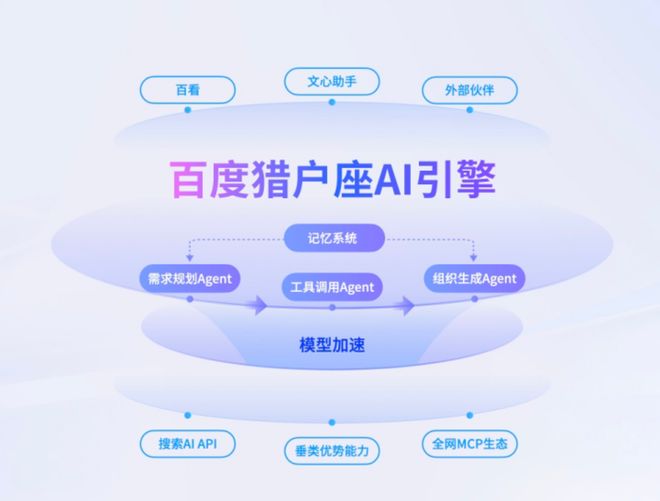
Core Insights - Baidu's third-quarter AI business revenue grew over 50% year-on-year, with intelligent cloud infrastructure revenue at 4.2 billion yuan, AI application revenue at 2.6 billion yuan, and AI native marketing service revenue at 2.8 billion yuan, which saw a 262% increase [1][2] - However, Baidu's total revenue and core revenue both declined by 7% year-on-year, primarily due to a decrease in online marketing revenue, which fell by 18% to 15.3 billion yuan, accounting for nearly half of total revenue [1][2] - The 2025 Baidu World Conference highlighted Baidu's ambition to position itself as a central hub for task execution in the AI era, showcasing innovations like the Orion AI engine and various AI applications [1][4] Revenue Trends - Baidu's online marketing revenue has been on a downward trend since 2024, indicating a significant challenge for the company [1][2] - The decline in online marketing revenue is attributed to the loss of traffic distribution capability, impacted by competition from platforms like Douyin, Kuaishou, Xiaohongshu, and WeChat [2][3] AI Search Development - Baidu's AI search is evolving into a task execution hub, integrating various AI capabilities to understand complex user needs and deliver personalized results [3][5] - The new search engine aims to provide a richer user experience by offering results in various formats, including text summaries, AI-generated videos, and direct task execution [5][11] Strategic Positioning - Baidu is building a more complex and open task execution hub that integrates multi-modal capabilities and memory systems to enhance user interaction [11][12] - The company is exploring new commercial opportunities, such as testing e-commerce components in AI search, which generated peak daily transaction volumes close to 6 million yuan during the Double 11 shopping festival [12] Future Outlook - Baidu's ability to establish the Orion AI engine as a foundational pillar for the industry will significantly influence its position in the AI era, determining whether it remains a key player in entry control or transitions to a provider of large models and cloud infrastructure [12]

OpenAI预告了AI时代「Windows系统」的诞生
3 6 Ke· 2025-10-13 01:40
Core Insights - OpenAI is advancing its strategy to build a comprehensive AI ecosystem centered around ChatGPT, aiming to create a "super system" rather than just a "super app" [4][12][17] - The company has made significant investments in computing power, estimated to be close to $1 trillion, to support the evolution and application of large models [3][4] - The newly introduced "Apps in ChatGPT" feature aims to integrate traditional applications with AI assistants, although its current capabilities are still limited [5][8][11] Group 1: Strategic Developments - OpenAI's strategy involves three interdependent AI infrastructures: substantial investment in computing resources, development of powerful model families, and the creation of an AI application ecosystem centered on ChatGPT [3][13] - The CEO, Sam Altman, highlighted that ChatGPT's user growth and engagement exceeded expectations, providing a competitive advantage due to the slow response from tech giants [2][3] Group 2: Apps in ChatGPT - Initial partners for the "Apps in ChatGPT" feature include Booking.com, Canva, and Spotify, with plans to reveal monetization details for developers later this year [5][11] - Current functionality of the "Apps in ChatGPT" is limited to basic operations, lacking the ability to perform more complex tasks [8][11] - Altman emphasized the importance of maintaining a direct and transparent connection between users and original services, even if it compromises user experience slightly [12][17] Group 3: AI Assistant Evolution - ChatGPT is positioned as a central AI assistant, with all interactions and tools designed around it, suggesting a shift from traditional browsing to AI-driven interactions [13][14] - The future of AI assistants may involve a clearer distinction between the roles of AI assistants and browsers, with AI assistants taking a more proactive role [14][15] - OpenAI's vision includes the development of a comprehensive account system that understands user preferences and manages privacy, ultimately leading to a universal AI tool [17][18]
未来25年,凯文·凯利的85个预言|大家谈
高毅资产管理· 2025-07-03 05:33
Core Viewpoint - The article emphasizes the transformative impact of artificial intelligence (AI) and related technologies on global society, suggesting that a proactive approach to shaping the future is essential for creating a better world. Group 1: Mirror World - By 2049, most smartphones will be replaced by smart glasses, creating a "mirror world" where reality and virtuality overlap [7] - The mirror world will represent the next generation of the internet, enabling immersive experiences powered by AI [7] - Companies providing data support for the mirror world will become the largest and wealthiest globally [7] - Immersive experiences will become commonplace, leading to an explosion of content and unique experiences shared by users [7] - Real experiences will become more precious as virtual experiences become more accessible [7] - Individuals will need to balance personalization and privacy in the mirror world [8] Group 2: Human-Machine Interaction - The relationship between humans and AI will be collaborative, with humans participating in AI operations rather than AI acting independently [9] - AI will not think like humans, and interactions with AI should not be based on human standards [10] - AI will take time to permeate various industries, requiring a decade or more for significant changes [11] - By 2049, everyone will have AI assistants akin to personal secretaries, integrated into smart glasses or wearables [12] - AI assistants will function similarly to operating systems, facilitating B2B interactions through bots [10] Group 3: Workplace Challenges - The future will see a "human + machine" model where machines enhance efficiency, allowing humans to focus on less efficient, innovative tasks [15] - Many blue-collar jobs requiring technical skills will still need human workers, potentially with higher wages [16] - Middle management will be most affected by AI, as their roles can be easily replaced by AI systems [18] - Organizational structures will become flatter, with AI taking over tasks like reporting and budgeting [18] - AI will enhance performance transparency, making peer evaluations more common [20] Group 4: Business Opportunities - The next 25 years will see significant advancements in AI, digital governance, and organizational change [28] - AI will be dominated by major players, with entry barriers for startups being high [29] - The most promising sectors will be those that deeply integrate with cutting-edge technologies [33] - Customization and personalization will be key trends, driven by comprehensive data collection [34] Group 5: Content Explosion - The next 25 years will witness a content explosion, continuing the trend of information proliferation and personalized creation [41] - AI will significantly impact the publishing industry, enabling personalized content recommendations [42] - Future books will be interconnected, forming a comprehensive repository of human knowledge [43] - The film industry will be disrupted, allowing individuals to create their own films easily [44] Group 6: Education Development - Personalized education will become widespread due to AI, transforming traditional educational models [50] - Experience-based learning will gain importance, utilizing VR/AR technologies [52] - Non-linear, highly virtualized learning experiences will become common in universities [53] - Lifelong learning will be essential, with a focus on effective learning methods [56] Group 7: Customized Healthcare - The mirror world will drive the growth of personalized medicine through digital twins [62] - Quantifying personal health data will be fundamental to customized healthcare [63] - 3D pill machines will enable the creation of tailored medications for individuals [64] - AI doctors will assist human doctors in diagnosing and treating patients [68] Group 8: Technological Explosions - Five key areas will experience significant breakthroughs: robotics, autonomous driving, space exploration, life sciences, and brain-computer interfaces [72] - The future will see the rise of unmanned factories, transforming traditional manufacturing [73] - Electric vehicles will dominate the market, with China emerging as a leading manufacturer [75] - Space exploration will focus on Mars, with potential human habitation [81]