
文心助手

Search documents
计算机行业事件点评:AI应用持续落地
Bank of China Securities· 2026-03-01 09:58
Investment Rating - The industry investment rating is "Outperform the Market," indicating that the industry index is expected to perform better than the benchmark index over the next 6-12 months [11]. Core Insights - The report highlights that major domestic internet companies invested over 4.5 billion yuan during the Spring Festival to promote AI applications, marking a shift towards an ecosystem competition and user habit cultivation phase in AI [1]. - The development of large models is accelerating, with domestic firms catching up in performance and market application, suggesting a dual development path towards "general large models" and "vertical industry applications" [1]. - Despite concerns about AI replacing human jobs, the industry is shifting towards a more pragmatic approach, focusing on commercialization and practical applications [1]. Summary by Sections Investment Recommendations - The report suggests focusing on companies in the large model and AI Agent sectors, including Zhihui, MINIMAX-WP, iFlytek, Tuolisi, Hand Information, Zhongkong Technology, Baoxin Software, Suochen Technology, Wanxing Technology, Kingsoft Office, Hehe Information, Yonyou Network, Daotong Technology, Shiji Information, Shuiyou Co., and Anheng Information [3]. Industry Developments - Major tech companies are heavily investing in AI marketing, with significant promotional activities during the Spring Festival, including cash giveaways and product promotions to encourage user engagement with AI [1]. - Domestic models are evolving, with Alibaba's Tongyi Qianwen 3.5 series and MiniMax's new text model M2.5 demonstrating significant advancements in capabilities and competitive pricing [1]. - The report notes a growing concern in the market due to dystopian predictions about AI's impact on employment, but emphasizes that current AI tools are limited in their ability to replace complex human tasks [1]. Market Dynamics - The report indicates that the AI industry is entering a phase of rational capital expenditure adjustments, signaling a shift towards refined operations and commercial validation [1]. - The future of large model development may see a bifurcation, with major internet companies focusing on general model research while specialized firms leverage their industry-specific data and understanding to develop vertical models and AI Agents [1].
百度离不开AI,但AI扛得起百度吗?
Xin Lang Cai Jing· 2026-02-27 12:56
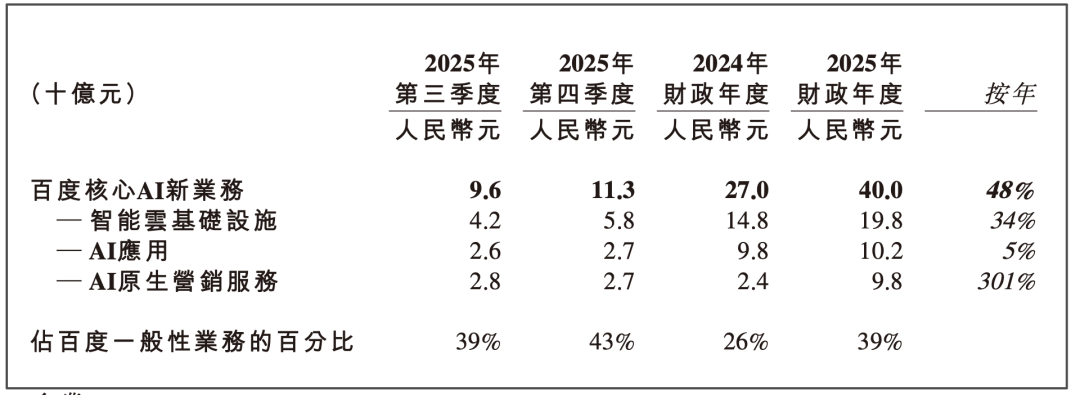
Core Insights - Baidu's financial report for Q4 and the full year of 2025 reveals that AI business revenue reached 40 billion RMB, accounting for 43% of Baidu's general business revenue, marking a significant shift in the company's revenue structure [1][2][3] - Despite the strong performance of the AI segment, Baidu's total revenue for 2025 was 129.1 billion RMB, a 3% decline year-on-year, and net profit dropped by 76% to 5.6 billion RMB, indicating ongoing struggles in traditional business areas [2][11][24] - The market response to Baidu's financial results has been polarized, with a 6% drop in stock price following the report, while some investment banks raised target prices due to optimism about the AI business's long-term potential [2][17][26] AI Business Performance - Baidu's AI new business segment, which includes intelligent cloud infrastructure, AI applications, and AI-native marketing services, exceeded market expectations with quarterly revenue surpassing 11 billion RMB [3][5] - The growth drivers for AI business include intelligent cloud infrastructure, which generated approximately 20 billion RMB in revenue for the year, a 34% increase, and AI-native marketing services, which saw a staggering 301% year-on-year growth [5][6] - AI applications revenue crossed 10 billion RMB for the year, but its growth rate of 5% was significantly lower than other segments, indicating potential challenges in scaling this area [7][9] Traditional Business Challenges - Baidu's traditional business continues to decline, with a 4% revenue drop in Q4, marking the third consecutive quarter of revenue decline, primarily due to the weakening of its advertising business [12][13] - The company's search dominance is under threat, exacerbated by the rise of AI search technologies, which are altering traditional advertising models and impacting revenue streams [13][16] - Despite efforts to innovate in advertising formats, such as AI-native marketing services, the traditional business remains under pressure, necessitating a strategic pivot to stabilize revenue [16][24] Market and Competitive Landscape - Baidu faces intensified competition in the AI space, with rivals aggressively investing in AI applications and cloud services, which could impact Baidu's market share [21][22] - The company is also pursuing a spin-off of Kunlun Chip, which could enhance its valuation and provide a new growth avenue, with optimistic market expectations surrounding its potential listing [18][20] - The overall investment in AI has exceeded 100 billion RMB since 2023, reflecting Baidu's commitment to this strategic pivot, although profitability from AI is still lagging behind expenditures [23][24] Future Outlook - Baidu's transition from a traditional advertising company to an AI infrastructure and service provider is reshaping its valuation logic, with increasing recognition from the market of its AI capabilities [20][26] - The company must continue to demonstrate the effectiveness of its AI applications and their ability to generate revenue, as the market remains cautious about the sustainability of its business model [26] - As Baidu navigates this transformation, it will require time and innovative strategies to balance traditional revenue streams with the growth of its AI business [24][26]


百度年报不负众望:AI落地了
水皮More· 2026-02-27 09:38
Core Viewpoint - Baidu's AI business has transitioned from a cost center to a profit center, with AI revenue accounting for 43% of total revenue in Q4 2025, indicating a successful integration of technology and business [2][5][3]. Financial Performance - The financial data presented in Baidu's report showed stability, but the significant disclosure of AI revenue as a core income source marks a strategic shift, allowing for measurable tracking of AI's contribution to the business [5][4]. - Baidu's AI cloud revenue grew by 34% year-over-year, with high-performance computing subscription revenue soaring by 143% in Q4 [8]. Business Model and Growth - Baidu has effectively utilized its AI capabilities across various sectors, including B2B services and C2C applications, creating a sustainable growth model that leverages technology investments for multiple revenue streams [7]. - The company has positioned itself as a "road builder" in the AI space, simplifying the adoption of AI for enterprises through its self-developed Kunlun chip and comprehensive AI solutions [8]. B2B and B2C Insights - In the B2B sector, Baidu's AI cloud services have gained significant traction, with 110 projects won, the highest among competitors, demonstrating strong market trust [9]. - In the B2C sector, AI application revenue surpassed 10 billion, with the monthly active users of Wenxin Assistant reaching 200 million, indicating genuine user engagement and value derived from AI applications [10][11]. Physical AI Implementation - Baidu's "Luobo Kuaipao" service has seen a 200% increase in global ride service instances, expanding its reach to 26 cities, showcasing the practical application of AI in the physical world [12]. Capital Operations and Market Confidence - Baidu announced a $5 billion stock buyback, representing about 10% of its market value, signaling confidence in its undervalued stock [16]. - The company plans to initiate dividend payments in 2026, indicating stable cash flow and sustained profitability from its AI business [16][17]. Strategic Positioning - The planned IPO of Kunlun chip division aims to enhance market perception and valuation of Baidu's AI capabilities, aligning it with leading chip companies [17]. - Analysts have begun to adjust their valuation methods for Baidu, recognizing the tangible results of its AI transformation, with target prices being raised significantly [18]. Conclusion - Baidu's AI revenue growth to 43% is not just a milestone but a new starting point for its commercial success, reflecting a robust foundation built over years of investment and development in AI technology [18][19].
2025年百度靠AI赚了多少钱?答案首次揭晓
Xin Lang Cai Jing· 2026-02-27 09:37
Core Viewpoint - Baidu's AI business has become a significant growth engine, contributing over 40% to its revenue, marking a shift from a cost center to a profit center [1][3][19] Financial Performance - In 2025, Baidu's total revenue reached 129.1 billion yuan, with AI business revenue at 40 billion yuan, and Q4 revenue at 32.7 billion yuan, exceeding market expectations [5][26] - The core AI new business revenue surpassed 11 billion yuan in Q4, accounting for 43% of Baidu's general business revenue [5][26] - Operating cash flow turned positive in the second half of 2025, generating 3.9 billion yuan, with Q4 operating profit increasing by 28% to 2.8 billion yuan [7][29] AI Business Transformation - Baidu's AI business has transitioned from a long-term investment focus to a quantifiable and trackable core revenue segment, reflecting a clear commercialization strategy [3][27] - The AI cloud infrastructure revenue for 2025 was 19.8 billion yuan, a 34% year-on-year increase, with Q4 revenue at 5.8 billion yuan [8][30] - The self-evolving super-intelligent agent "Famu" attracted over 2,000 enterprise applications in its first month, demonstrating significant efficiency improvements in various sectors [8][32] User Engagement and Market Penetration - Baidu's AI applications generated over 10.2 billion yuan in revenue for 2025, with Q4 revenue reaching 2.7 billion yuan [8][34] - The monthly active users of Wenxin Assistant reached 202 million by December 2025, with a fourfold increase since the Spring Festival promotional activities [8][34] Capital Market Response - Baidu announced a new share repurchase plan of $5 billion (approximately 34.3 billion yuan), representing nearly 10% of its current market value, signaling confidence in future cash flow and profitability [15][37] - The planned IPO of Kunlun Chip, which holds a 40.4% market share in the self-developed GPU cloud market, indicates a shift towards a segmented valuation approach for Baidu's various business units [15][38] - Major financial institutions have raised their target prices for Baidu, with Morgan Stanley increasing its target to $200 and Benchmark to $215, reflecting a positive market sentiment towards Baidu's AI commercialization [18][40]

百度首度披露AI收入占比,全栈能力进入利润兑现期
Xin Lang Cai Jing· 2026-02-27 09:19
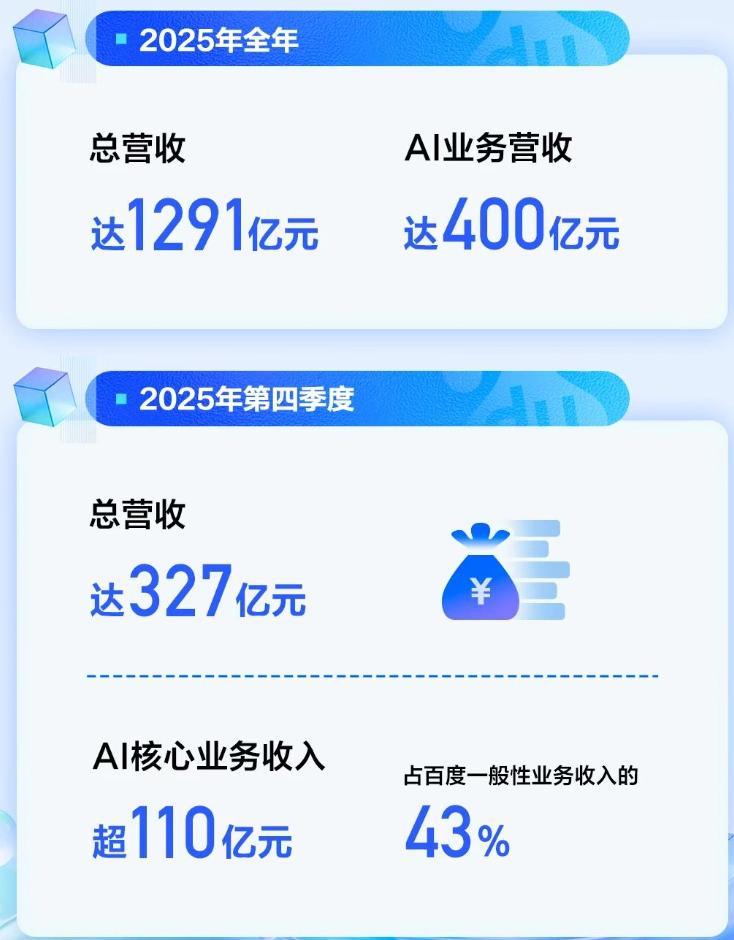
Core Insights - Baidu's Q4 2025 financial report reveals total revenue of 129.1 billion yuan, with AI business revenue reaching 40 billion yuan, marking a significant milestone in the company's AI strategy [2][3] - The report highlights AI's transition from a "cost center" to a "profit center," indicating a successful shift in Baidu's business model and strategy [2][3] AI Business Revenue - For the first time, Baidu disclosed the revenue proportion of its AI business, which accounted for 43% of its general business revenue in Q4 2025, exceeding market expectations [2][3] - This strategic move signifies Baidu's commitment to making AI a core revenue segment, allowing for ongoing market evaluation and tracking [2][3] Growth Model and Market Position - Baidu's AI revenue growth is driven by a collaborative effort across B-end, C-end, and autonomous driving sectors, creating a positive cycle from cost reduction to revenue growth [4][5] - The company has established itself as a leader in the AI cloud market, with a 34% year-on-year revenue increase in 2025, and a 143% growth in AI high-performance computing subscription revenue in Q4 [4][5] C-end Market Developments - Baidu's AI applications have shifted from merely attracting traffic to delivering value, with a 301% year-on-year revenue increase in AI native marketing services for 2025 [6][7] - The "Wenxin Assistant" has become a leading AI application in China, achieving 202 million monthly active users and significantly enhancing user engagement and service delivery [6][7] Autonomous Driving Expansion - Baidu's autonomous driving service "Luobo Kuaipao" saw a remarkable growth of over 200% in global driverless ride services in Q4 2025, with plans for further international expansion [8] - The service has entered multiple global markets, including Abu Dhabi and Dubai, showcasing Baidu's leadership in the global autonomous driving sector [8] Capital Actions and Valuation - Baidu announced a $5 billion stock buyback plan, representing nearly 10% of its market value, which is significantly higher than industry norms, indicating strong confidence in future AI business growth [9][10] - The planned spin-off of Kunlun Chip is expected to unlock independent business value, with Citibank estimating its worth at $13.3 billion, leading to a more accurate market valuation of Baidu's various business segments [11][12] Ecosystem and Talent Development - Baidu's ongoing investments in ecosystem development and talent cultivation are expected to support long-term growth, with initiatives like the AICA AI architect training program and partnerships with over 100 AI hardware companies [12] - The "Creator Dream Plan" aims to assist 1 million creators in generating income, further solidifying Baidu's commitment to fostering innovation within its AI ecosystem [12] Conclusion - Q4 2025 marks a pivotal moment for Baidu's AI strategy, transitioning from quantitative growth to qualitative transformation, with a clear path for future expansion and value realization [13] - The combination of AI revenue growth, capital return plans, and strategic asset spin-offs positions Baidu for a new growth cycle, reinforcing its status as a key player in the AI infrastructure landscape [13]
百度发布最新财报:2025年营收1291亿元 四季度AI业务收入占比43%
Zhong Guo Jing Ji Wang· 2026-02-27 07:44
Core Insights - In 2025, Baidu's total revenue reached 129.1 billion yuan, with AI business revenue at 40 billion yuan, exceeding market expectations [1] - The year 2025 is highlighted as a pivotal year for AI to become Baidu's new core, with strong momentum in AI cloud services [1] - Baidu's AI-native marketing services saw a significant revenue increase of 301% in 2025 [2] Group 1: Financial Performance - Baidu's total revenue for Q4 was 32.7 billion yuan, with AI business revenue accounting for 43% of general business revenue [1] - AI cloud revenue for the full year 2025 grew by 34% year-on-year, with Q4 AI high-performance computing subscription revenue increasing by 143% [1] - The number and amount of winning bids for large models in Baidu's intelligent cloud reached first place for two consecutive years [1] Group 2: User Engagement and AI Applications - Monthly active users of the Baidu App reached 679 million, while Wenxin Assistant had 202 million monthly active users, with a fourfold increase since the launch of the Spring Festival red envelope activity [2] - AI applications surpassed 10 billion yuan in revenue for the year 2025, with the no-code generation platform outperforming in functionality and application quality [2] - The "Luo Bo Kua Pao" service recorded 3.4 million global autonomous driving service instances in Q4, with a year-on-year growth of over 200% [2] Group 3: Technological Advancements - The official version of Wenxin 5.0 was launched, featuring 2.4 trillion parameters and supporting multiple information types [3] - Baidu's ESG performance has shown further improvement, as noted in the S&P Global Sustainability Yearbook 2026 [3]
OpenAI巨亏80亿美金背后,百度凭什么靠AI赚到了400亿?
Sou Hu Cai Jing· 2026-02-27 05:30
Core Insights - The global tech industry is experiencing a shift towards a more realistic evaluation of AI investments, moving from a focus on capital expenditure to a demand for tangible returns [2] - Baidu has emerged as a leader in AI monetization, reporting significant revenue growth and transforming AI from a cost center to a profit center [5][12] - The structural advantages of Baidu's integrated technology stack have allowed it to efficiently convert investments into scalable revenue [6][8] Group 1: Financial Performance - Baidu's total revenue for 2025 reached 129.1 billion yuan, with AI business revenue accounting for 40 billion yuan, representing 43% of its general business revenue in Q4 [5] - The company has announced a $5 billion stock buyback plan and plans to distribute dividends for the first time in 2026, signaling strong cash flow and shareholder returns [15] Group 2: Competitive Advantages - Baidu's success is attributed to its "chip-cloud-model-intelligent body" full-stack architecture, which has been developed over more than a decade, providing a significant structural advantage [6][8] - The company has achieved a leading position in the self-developed GPU cloud market in China, holding a 40.4% market share [8] Group 3: Market Position and Valuation - Baidu's ability to monetize AI effectively has led to a fundamental shift in its valuation approach, moving from traditional PE models to SOTP (sum-of-the-parts) valuation methods [12][13] - Major investment banks have collectively raised their target prices for Baidu, reflecting the company's growing market value and potential [13] Group 4: Innovation and Application - Baidu's AI applications, such as the GenFlow 3.0 and Wenxin Assistant, have seen significant user engagement, with the latter reaching 202 million monthly active users [10] - The company's autonomous driving service, Apollo, has achieved over 3.4 million service instances in Q4 2025, demonstrating its capability to scale in real-world applications [12]
百度2025财报:AI动能切换「奇点」已至,价值重估开启「王者归来」
3 6 Ke· 2026-02-27 03:25
Core Insights - Baidu's financial report for Q4 and the full year of 2025 shows a revenue of 129.1 billion RMB, with Q4 revenue at 32.7 billion RMB, indicating significant growth [1] - The AI business revenue reached 40 billion RMB in 2025, with Q4 AI revenue accounting for 43% of Baidu's general business revenue, exceeding market expectations [3][4] - This report signifies a transformation in Baidu's business model, with AI evolving from a cost center to a core growth driver, generating real income across multiple business segments [3][6] AI Business Performance - The AI business revenue proportion of 43% in Q4 marks a significant shift in Baidu's business structure, placing it among the few internet giants driven by AI revenue growth [4] - Baidu's AI cloud revenue grew by 34% year-on-year in 2025, with Q4 AI high-performance computing subscription revenue increasing by 143% [7] - The introduction of self-evolving AI tools like "Famo" has attracted over 2,000 enterprise applications, showcasing Baidu's strong B-end market presence [8] C-end and Physical AI Developments - On the C-end, Baidu's AI application revenue surpassed 10 billion RMB in 2025, reflecting a shift from user growth to monetization through AI productivity [9][11] - The "LuoBo Kuaipao" service achieved over 3.4 million global rides in Q4, marking a growth of over 200% year-on-year, and has expanded to 26 cities globally [12][14] Capital Strategy - Baidu announced a significant capital return plan, including a $5 billion stock buyback, representing about 10% of its current market value, and plans to initiate dividends in 2026 [13][15] - The spin-off of Kunlun Chip for independent listing is expected to reshape Baidu's valuation logic, with projected sales of 3.5 billion RMB in 2025 and potential growth to 6.5 billion RMB in 2026 [16][17] - Major financial institutions have raised Baidu's target price, reflecting a shift in market perception towards Baidu's investment value amid its AI-driven transformation [17]
百度股价绩后震荡回升,市场对“AI烧钱而不赚钱”的担忧有所减轻
Mei Ri Jing Ji Xin Wen· 2026-02-27 03:01
Core Insights - Baidu's Q4 and full-year financial report highlights significant growth in AI business, with AI revenue surpassing 40% of total revenue, and continued strong growth in intelligent cloud services [1] - The company is advancing the independent listing of its self-developed chip company, Kunlun [1] - Baidu's stock price showed volatility post-earnings, reflecting mixed performance among constituents of the Hang Seng Internet ETF [1] Financial Performance - In Q4, Baidu's AI new business revenue reached 11.3 billion yuan, accounting for 43% of total general business revenue, up from 39% in the previous quarter [1] - The monthly active users of Baidu's AI application, Wenxin Assistant, are projected to reach 202 million by the end of Q4 2025 [1] Strategic Direction - Baidu plans to integrate Baidu Wenku and Baidu Netdisk to accelerate AI application innovation [1] - The company emphasizes that application is more important than the model, as the value of the model is realized through its application [1] Market Context - Industry analysts note a shift in the valuation anchor for Hong Kong tech giants from traditional advertising and traffic-based growth to AI infrastructure and service provision, which adds valuation flexibility [1] - Baidu's stock had previously surged by 40% at the end of last year but has recently faced adjustments alongside the Hang Seng Tech Index [1] Investment Opportunities - Investors can leverage the Hang Seng Internet ETF and other mainland-listed ETFs to capture recovery opportunities among Hong Kong internet giants [2] - Baidu is considering upgrading its secondary listing in Hong Kong to a "dual primary listing" to attract mainland capital [2]
中经评论:春节AI热潮后多点冷思考
Jing Ji Ri Bao· 2026-02-27 00:08
Group 1 - The core theme of the news is the significant integration of AI technology into various sectors, highlighted by the AI-driven innovations showcased during the Spring Festival Gala, emphasizing the need for AI to transition from consumer-focused applications to deep integration in manufacturing and other industries [1][3][4] - The "red envelope war" during the Spring Festival saw major tech companies like Tencent, Alibaba, Baidu, and ByteDance investing heavily, with Tencent distributing 1 billion yuan, Alibaba 3 billion yuan, and Baidu 500 million yuan, indicating a fierce competition for user engagement in the AI ecosystem [1][2] - The advancements in AI technology were evident in the Gala's performances, where AI-generated imagery and real-time interaction between human performers and digital avatars showcased the maturity of AIGC technology and the capabilities of AI in creating immersive experiences [2][3] Group 2 - The integration of AI into real-world scenarios is crucial for its value realization, as the complexities of live performances expose challenges that cannot be predicted in laboratory settings, thus driving technological advancements [3][4] - The industry must focus on long-term strategies rather than short-term consumer engagement, leveraging China's comprehensive industrial system to embed AI into production processes, enhancing efficiency and reliability [3][4] - The future of AI in China lies in its ability to merge with manufacturing, requiring a shift from consumer applications to core production processes, where AI can optimize workflows and improve operational safety [4]