ASI(超级人工智能)

Search documents
吴泳铭的演讲把阿里市值又拉升了2000多亿 但「全栈」的护城河可能没那么深
Di Yi Cai Jing· 2025-09-25 06:25
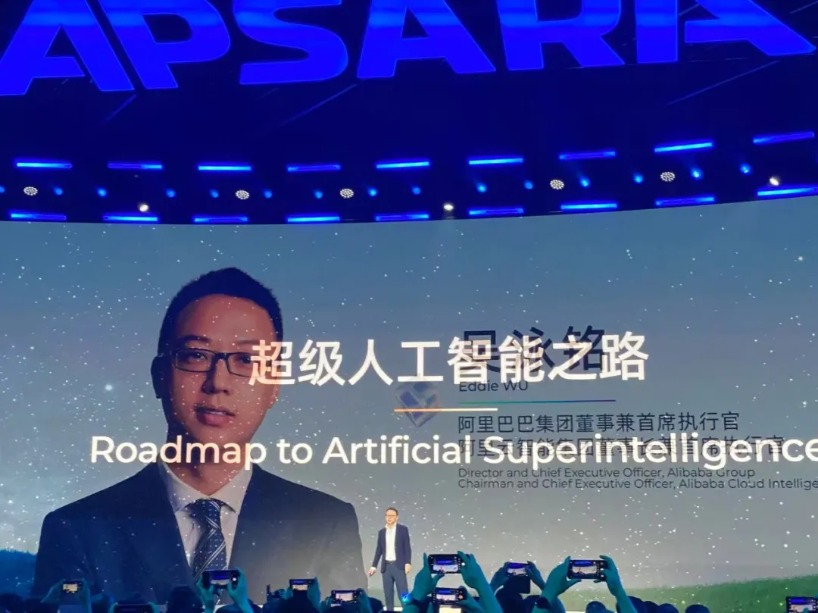
Group 1 - The core idea presented by Wu Yongming at the Yunqi Conference is the development framework of ASI (Artificial Superintelligence), which consists of three stages: emergent intelligence, autonomous action, and autonomous learning. Currently, the industry is in the second stage [1][4][7] - Wu emphasizes that the future AI era will involve numerous agents and robots in homes, factories, and companies, suggesting that individuals may need to utilize 100 GPU chips for their tasks [1][12] - Alibaba Cloud aims to become the computer of the AI era, with the Qwen model serving as the operating system on this supercomputer. The company plans to invest significantly in AI infrastructure, adding to its existing budget of 380 billion yuan over three years [1][9][12] Group 2 - In the capital market, Alibaba has demonstrated that ideas can be more valuable than results. Following the release of its Q2 2025 financial report, Alibaba's stock rose by 12.9% after executives provided insights into the company's strategy in local services [2][4] - Wu's speech at the Yunqi Conference led to a 9.16% increase in Alibaba's stock price, adding approximately 278.5 billion HKD (about 254.6 billion RMB) to the company's market value [4][12] - The Omdia report indicates that over 70% of the Fortune China 500 companies have adopted Generative AI, with Alibaba Cloud and the Qwen model having the highest penetration rate at 53% [15] Group 3 - The AI landscape is evolving, with Wu noting that AI's coding capabilities are crucial for achieving AGI (Artificial General Intelligence). Current AI agents primarily handle standardized and short-cycle tasks [7][8] - Wu highlights the need for models to autonomously learn and iterate to surpass human capabilities, although he does not provide a clear path for achieving this self-iteration [7][8] - The competition in AI and cloud computing is becoming inseparable, with Alibaba Cloud positioned as one of the few companies capable of full-stack self-research and joint innovation in both areas [21][23] Group 4 - Alibaba Cloud's market share in the AI cloud market is reported to be 35.8%, surpassing the combined share of its closest competitors, including Volcano Engine, Huawei Cloud, and Tencent Cloud [23] - However, in terms of token consumption, Volcano Engine has surpassed Alibaba Cloud, holding a 49.2% market share in the public cloud model usage [25]

阿里云饱和式投入Agent,这是ASI蓝图的关键拼图
Sou Hu Cai Jing· 2025-09-24 14:34
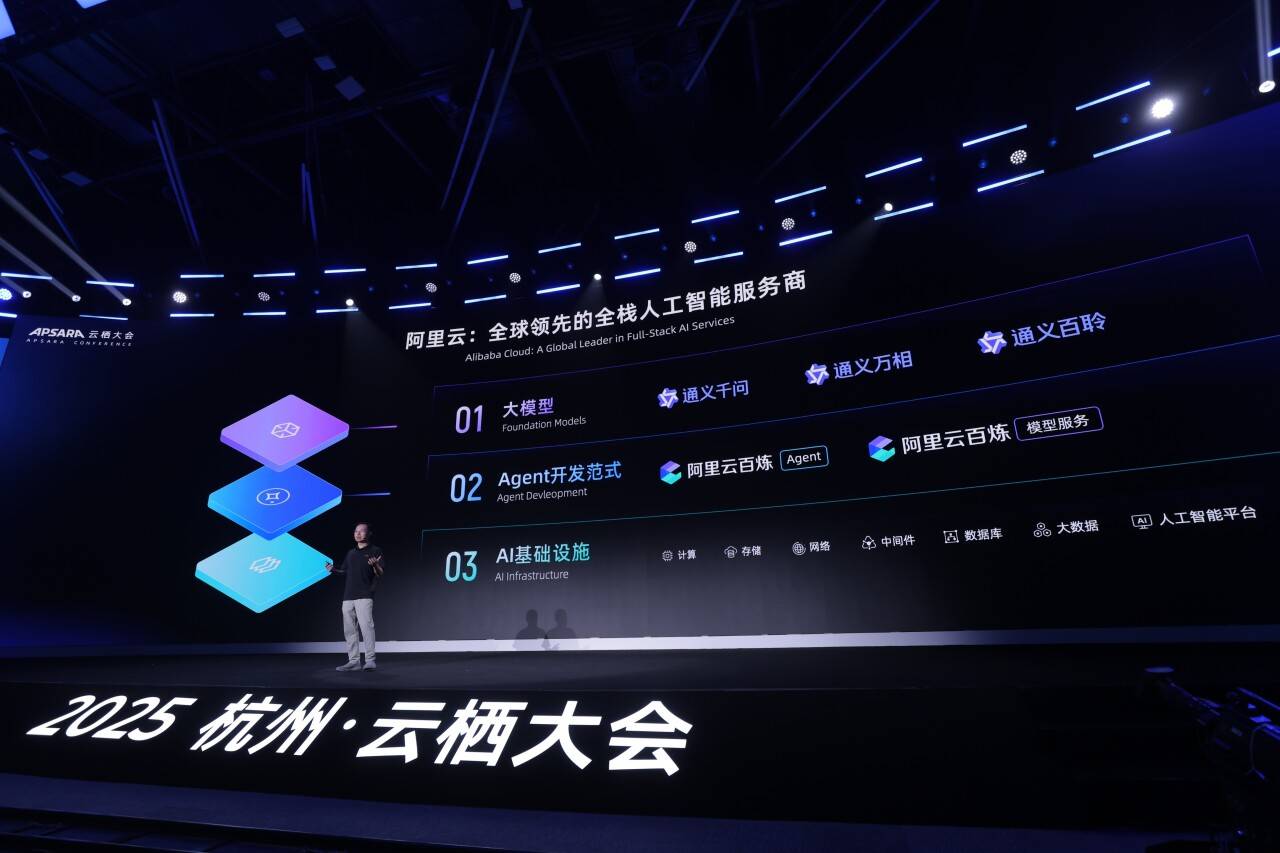
Core Insights - The cloud conference this year has a higher profile and intensity than previous years, with a focus on AI and the concept of Agent intelligence as a key driver for AI implementation [1][4] - The future may see more Agents and robots than the global population, significantly impacting the real world, as Agents are viewed as the best medium connecting the digital and physical worlds [3][4] Technology Developments - Alibaba Cloud introduced seven advanced models led by Qwen3-Max, achieving breakthroughs in intelligence, tool utilization, coding capabilities, deep reasoning, and multimodal functions, with Qwen3-Max outperforming GPT-5 [4] - The vision of "ASI (Super Artificial Intelligence)" was presented, indicating that large models will serve as the next generation operating system, with super AI cloud as the next computing paradigm [4] Agent Definition and Market Trends - Agents are defined as AI applications that understand human needs, autonomously plan decisions, and execute complex tasks, existing in various forms from software applications to hardware-integrated systems [7] - The Agent market is rapidly evolving, with predictions of over 100,000 Agents in China by December 2024, and potentially reaching millions by 2025, although many current Agents lack significant breakthroughs compared to foundational models [10] Development Frameworks - Alibaba Cloud launched the ModelStudio-ADK, a high-code Agent development framework that allows for efficient development of Agents with autonomous decision-making and multi-round reflection capabilities [4][13] - The ModelStudio-ADK framework supports cloud deployment and integrates various enterprise-level capabilities, enabling developers to convert complex business logic into executable Agent logic [15] Industry Positioning - Alibaba Cloud aims to be a full-stack AI service provider, similar to Google, offering public cloud infrastructure, cloud computing capabilities, and Agent toolchains, which is crucial for the commercialization of Agents [21] - The company supports both high-code and low-code development for Agents, allowing for a range of applications from simple to complex business scenarios [19][16]

吴泳铭掌舵两周年,阿里穿过峡谷
36氪· 2025-09-24 13:39
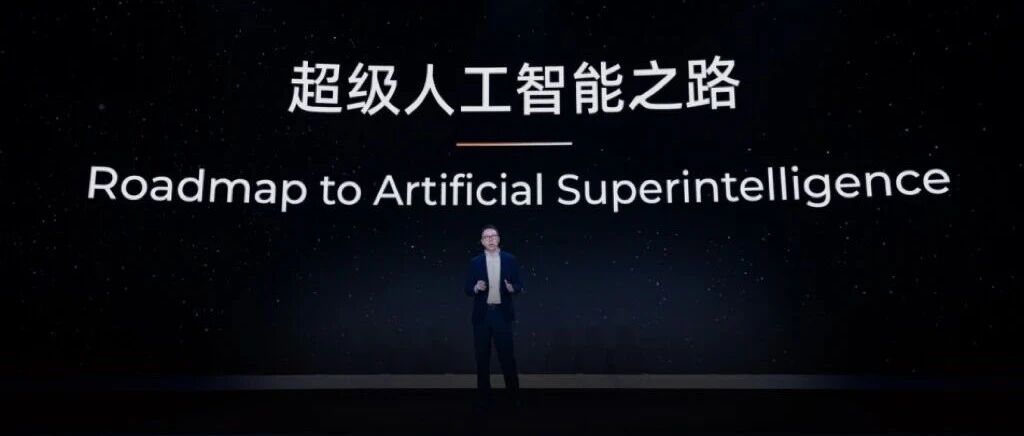
Core Viewpoint - The future of AI is seen as a journey towards Artificial Super Intelligence (ASI), with significant investments in AI infrastructure and a focus on creating a new operating system for AI applications [4][11][27] Group 1: Leadership and Vision - Wu Yongming, the CEO of Alibaba, has maintained a low public profile while driving the company's AI strategy, emphasizing the importance of AI in future business models [2][5] - His vision includes a clear path towards ASI, with AI evolving through three stages: learning from humans, assisting humans, and ultimately self-iterating beyond human intelligence [7][9] Group 2: AI Infrastructure and Investment - Alibaba plans to invest 380 billion yuan over three years to build AI infrastructure, aiming for a tenfold increase in energy consumption by 2032 compared to 2022 [4][17] - The company is focusing on creating a "super AI cloud" that will serve as the next generation of computing resources, essential for supporting numerous AI agents [11][19] Group 3: Strategic Decisions and Market Position - The decision to prioritize public cloud services was made to align with the growing demand for scalable AI solutions, despite previous revenue challenges in this area [15][18] - Alibaba's AI model, Tongyi, has become a leading open-source model, with over 300 models released and significant adoption across various industries, including finance and consumer electronics [17][22] Group 4: Future Outlook and Industry Impact - The company is positioning itself as a full-stack player in the AI space, integrating AI chips, cloud computing, and foundational models to enhance its competitive edge [19][22] - The overarching goal is to prepare for the ASI era, where AI will significantly augment human capabilities and transform industries [23][24]
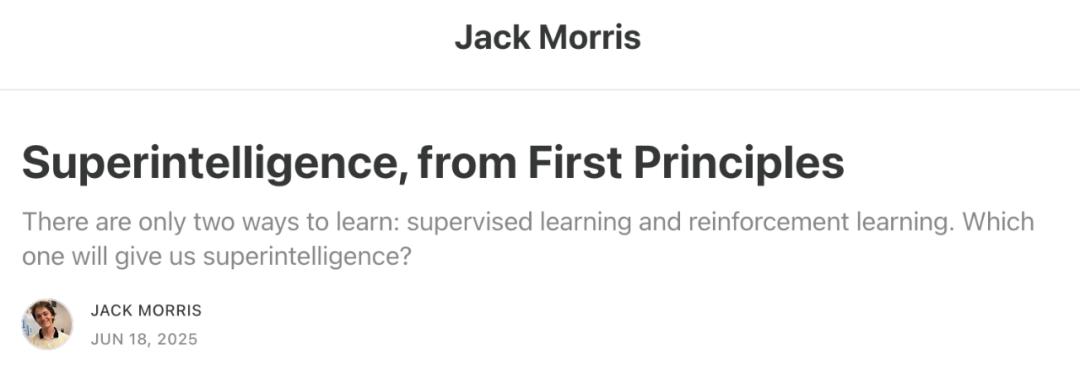
OpenAI路线遭质疑,Meta研究员:根本无法构建超级智能
3 6 Ke· 2025-06-20 12:00
Core Insights - The pursuit of "superintelligence" represents a significant ambition among leading AI companies like Meta, OpenAI, and Google DeepMind, with substantial investments being made in this direction [1][3][4] - Sam Altman of OpenAI suggests that building superintelligence is primarily an engineering challenge, indicating a belief in a feasible path to achieve it [3][4] - Meta AI researcher Jack Morris argues that the current approach of using large language models (LLMs) and reinforcement learning (RL) may not be sufficient to construct superintelligence [1][2] Group 1: Current Approaches and Challenges - Morris outlines three potential methods for building superintelligence: purely supervised learning (SL), RL from human validators, and RL from automated validators [2] - The integration of non-text data into models is believed not to enhance overall performance, as human-written text carries intrinsic value that sensory inputs do not [2][6] - The concept of a "data wall" or "token crisis" is emerging, where the availability of text data for training LLMs is becoming a concern, leading to extensive efforts to scrape and transcribe data from various sources [8][19] Group 2: Learning Algorithms and Their Implications - The two primary learning methods identified for potential superintelligence are SL and RL, with SL being more stable and efficient for initial training [10][22] - The hypothesis that superintelligence could emerge from SL alone is challenged by the limitations of current models, which may not exhibit human-level general intelligence despite excelling in specific tasks [15][16] - The combination of SL and RL is proposed as a more viable path, leveraging human feedback or automated systems to refine model outputs [20][22][28] Group 3: Future Directions and Speculations - The potential for RL to effectively transfer learning across various tasks remains uncertain, raising questions about the scalability of this approach to achieve superintelligence [34] - The competitive landscape among AI companies is likely to intensify as they seek to develop the most effective training environments for LLMs, potentially leading to breakthroughs in superintelligence [34]