
公司治理

Search documents
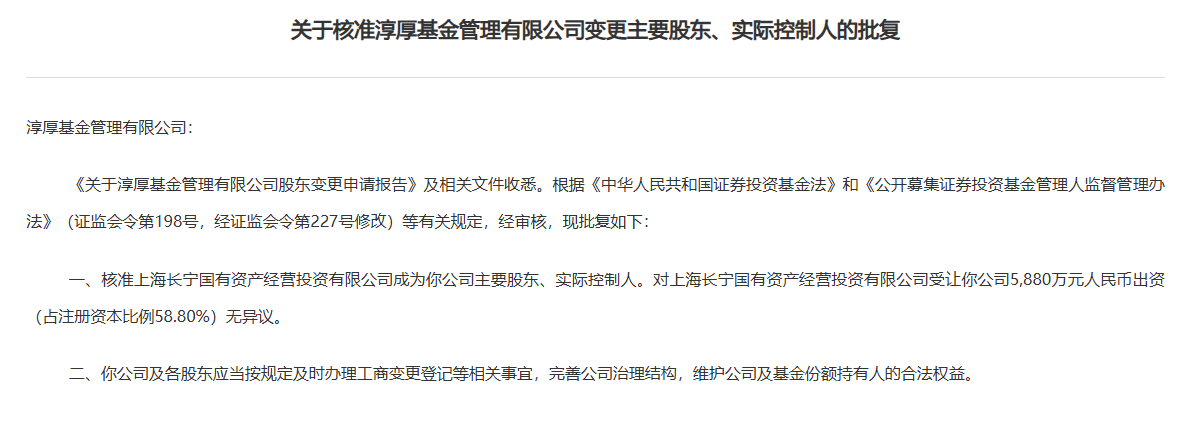
淳厚基金股权乱局落幕:长宁国投入主掌舵,柳志伟等4股东退出
Di Yi Cai Jing· 2026-01-11 12:05
Core Viewpoint - The control dispute over Chunhou Fund has concluded with state-owned enterprise Shanghai Changning State-owned Assets Management Investment Co., Ltd. becoming the major shareholder and actual controller, marking a transition from a privately held public fund to a state-controlled entity [1][3]. Group 1: Shareholder Changes - The China Securities Regulatory Commission approved Changning State-owned Assets to acquire 58.80% of Chunhou Fund's shares, ending a four-year shareholder dispute [3]. - Original shareholders, including Liu Zhiwei and others, transferred their shares to Changning State-owned Assets, resulting in a new ownership structure [3][5]. - The new management team has been established, with significant changes in key positions, including the departure of the original chairman and general manager [5]. Group 2: Management Restructuring - The new management team is characterized by strong financial and state-owned enterprise backgrounds, with the new chairman Chen Hong and general manager Zuo Jiqing bringing extensive experience in asset management [5][6]. - The primary mission of the new management is to enhance the fiduciary responsibility and protect investor interests [6]. Group 3: Governance Crisis and Regulatory Actions - The governance crisis began in 2022, leading to regulatory scrutiny, including multiple fines and investigations due to violations in information disclosure and governance failures [7][8]. - The Shanghai Securities Regulatory Bureau issued several penalties and corrective measures against Chunhou Fund and its shareholders for failing to manage shareholder affairs properly [8]. Group 4: Impact on Business Operations - The prolonged internal conflict and regulatory penalties have severely impacted Chunhou Fund's operations and market reputation, resulting in a significant reduction in assets under management [9]. - As of the third quarter of 2025, Chunhou Fund's total asset value was approximately 19.91 billion, down over 40% from its peak of 35.46 billion in mid-2022, with many funds below the 50 million threshold [9].

五项违规被警示 投资者可发起索赔
Sou Hu Cai Jing· 2026-01-11 05:35
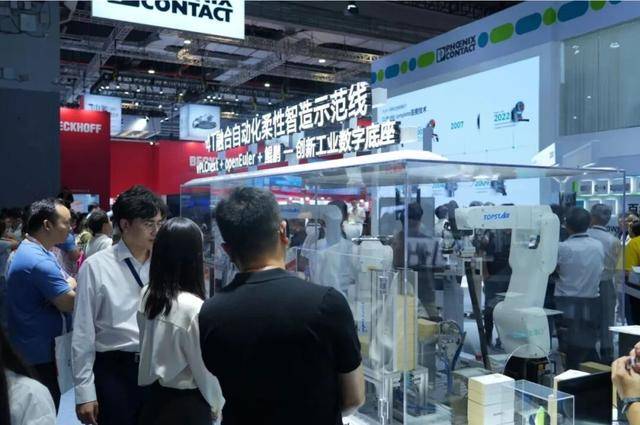
Core Viewpoint - The company TuoSiDa (300607.SZ) has received regulatory warnings from the Guangdong Securities Regulatory Bureau and the Shenzhen Stock Exchange regarding issues related to revenue recognition, cost accounting, accounts receivable impairment provisions, and other compliance matters, which may impact its upcoming Hong Kong listing and investor confidence [2][4][9]. Group 1: Regulatory Warnings and Compliance Issues - TuoSiDa has been warned for inaccuracies in revenue recognition, cost accounting, accounts receivable impairment provisions, improper use of raised funds, and insider information management, violating relevant laws and regulations [2][4]. - In 2023, TuoSiDa prematurely recognized revenue of 7.9686 million yuan, leading to an overstatement of income and profit for that year, which will result in lower recognition in 2024 [3]. - The company failed to adequately account for impairment provisions for accounts receivable, resulting in an under-provision of 1.1301 million yuan in 2024 [3]. Group 2: Impact on Investor Confidence - The regulatory warnings may undermine investor confidence, affecting the company's valuation and subscription situation for its upcoming IPO [5][9]. - The company's history of regulatory issues, including a previous warning to its chairman for short-term trading, raises concerns about its governance and compliance culture [6][8]. Group 3: Corporate Governance Deficiencies - The repeated regulatory scrutiny indicates long-standing internal management issues, including inadequate financial processing and compliance oversight [6]. - The concentration of power in the hands of the chairman, who also serves as the CEO, may lead to governance issues and a lack of internal checks [6][7]. Group 4: Potential for Investor Claims - Investors may initiate claims against TuoSiDa for information disclosure violations, particularly if they can demonstrate a direct causal relationship between the company's actions and their financial losses [10][11]. - The regulatory warnings serve as preliminary evidence for potential claims, but formal recognition of violations by regulatory authorities is necessary for successful litigation [11].
筑牢不敢假、不能假、不想假防线
Sou Hu Cai Jing· 2026-01-10 23:19
Core Viewpoint - The Chinese capital market is intensifying efforts to combat financial fraud, with multiple departments collaborating to establish a comprehensive prevention and punishment system, signaling a strong regulatory stance against fraudulent activities [2][3]. Group 1: Regulatory Actions - Since July 2024, the China Securities Regulatory Commission (CSRC) has handled 159 financial fraud cases, imposing fines totaling 8.1 billion yuan, and has held major shareholders and actual controllers accountable in 43 cases [3][4]. - The regulatory approach has shifted from a single agency (CSRC) to a collaborative effort involving 12 departments, enhancing the overall enforcement capability [4]. - The comprehensive punishment and prevention system has evolved from post-incident penalties to a full-chain governance model that includes preemptive measures, ongoing supervision, and post-incident punishment [4][5]. Group 2: Accountability and Governance - The accountability framework has expanded from solely focusing on listed companies to include major shareholders, actual controllers, intermediary institutions, and third-party collaborators, addressing the low cost of illegal activities and high cost of rights protection for investors [4][5]. - The regulatory bodies are emphasizing a multi-faceted approach to accountability, ensuring that both primary offenders and accomplices are held responsible, thereby promoting fairness in the market [5][6]. - The role of intermediary institutions is being reinforced, with a shift in their responsibility from merely serving listed companies to protecting the interests of investors and maintaining market integrity [5][6]. Group 3: Preventive Measures - The construction of a comprehensive prevention and punishment system is entering a critical phase, focusing on enhancing legal frameworks and improving regulatory collaboration across administrative, criminal, and civil domains [6][7]. - There is a push for internal controls within listed companies and a call for the activation of independent directors to ensure that investors have rights and powers to supervise and voice concerns [6][7]. - The future direction includes leveraging technology, such as big data and artificial intelligence, to improve the detection and early intervention of fraudulent activities, thereby creating a more robust regulatory environment [7].

江苏迈信林航空科技股份有限公司关于变更公司注册资本暨修订《公司章程》的公告
Shang Hai Zheng Quan Bao· 2026-01-09 21:06
Group 1 - The company has approved a change in registered capital from 145,426,667 yuan to 146,851,667 yuan following the completion of the first vesting period of the 2024 restricted stock incentive plan [1][2] - The total number of shares has increased from 145,426,667 to 146,851,667 shares [1] - The company's articles of association will be revised to reflect the change in registered capital, with other provisions remaining unchanged [1] Group 2 - A temporary shareholders' meeting is scheduled for January 27, 2026, to discuss the approved proposals from the board meeting [5][6] - The meeting will utilize both on-site and online voting methods, with specific time slots for voting [6][7] - Shareholders must register to attend the meeting, with detailed procedures provided for both individual and corporate shareholders [15][18] Group 3 - The board has received resignation letters from two directors, which will not affect the board's operational capacity [25][26] - The company plans to nominate new non-independent directors and appoint a new board secretary, with the proposals pending shareholder approval [26][27] - The adjustments to the board's specialized committees will be made to ensure effective governance [27]

永兴股份:公司一直致力于强化公司治理、提高经营效率和持续盈利能力
Zheng Quan Ri Bao Wang· 2026-01-09 13:15
Group 1 - The core viewpoint of the article emphasizes that the quality of the company's core business is fundamental to investment value and an important aspect of market capitalization management [1] - The company is committed to strengthening corporate governance, improving operational efficiency, and maintaining sustainable profitability to enhance investment value through solid performance in its core business [1] - The company places a high priority on shareholder returns, with cumulative cash dividends since its listing amounting to 64.86% of the cumulative net profit attributable to shareholders during the same period, sharing development results with investors [1]
拉近网娱委任容诚(香港)会计师事务所为新核数师
Zhi Tong Cai Jing· 2026-01-09 09:36
Core Viewpoint - The company has announced the resignation of its auditor, Lixin Dehao, effective January 9, 2026, due to a failure to reach an agreement on the audit fee for the year ending December 31, 2025 [1] Group 1 - The resignation of Lixin Dehao is effective from January 9, 2026 [1] - The reason for the resignation is the inability to agree on the audit fee level for the fiscal year ending December 31, 2025 [1] - The company has appointed Rongcheng (Hong Kong) CPA Limited as the new auditor, effective from January 9, 2026, to fill the vacancy left by Lixin Dehao [1]
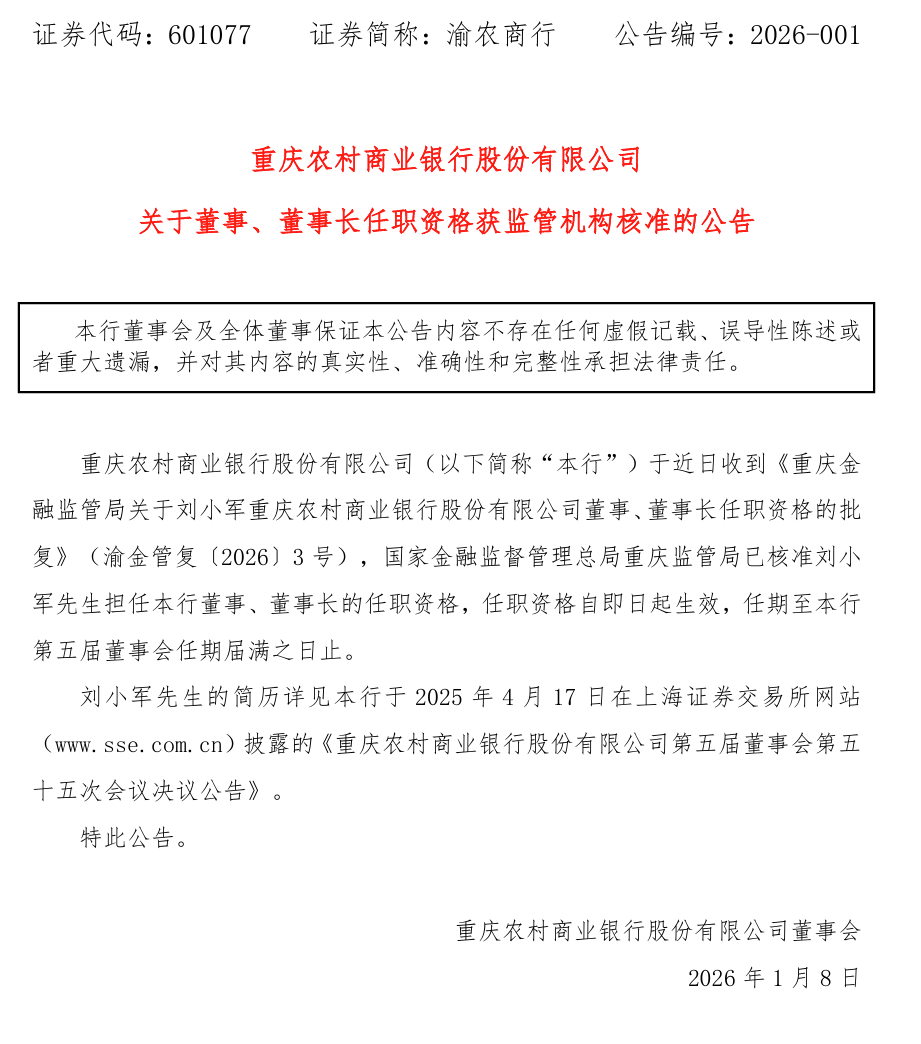
9个月后终获批,刘小军出任渝农商行董事长
Sou Hu Cai Jing· 2026-01-09 08:40
Core Viewpoint - After nearly a year of transitional governance, Chongqing Rural Commercial Bank (渝农商行) has officially appointed Liu Xiaojun as its chairman, marking a significant leadership change for the bank with over one trillion in assets [1][11]. Group 1: Leadership Transition - Liu Xiaojun has been approved as the chairman of Chongqing Rural Commercial Bank, effective from January 8, 2026, after a lengthy waiting period of nine months since he took on the role of party secretary in March 2025 [1][5]. - Liu Xiaojun, born in December 1976, has a strong background in finance, starting his career at China Construction Bank and later moving to CITIC Trust, where he spent 18 years [3][4]. - The bank experienced a prolonged "temporary state" of governance, with Liu Xiaojun's formal appointment being delayed, which created challenges for compliance and daily operations [6][7]. Group 2: Governance Challenges - During the interim period, the bank's president, Sui Jun, had to assume additional responsibilities, acting as both chairman and secretary, which violated regulatory guidelines regarding the duration of such arrangements [7][8]. - The prolonged vacancy of the chairman position reflects a broader trend of instability within the bank's management, with four leadership changes occurring in just over three years [8][11]. - The bank's governance issues were exacerbated by the departure of several senior executives, including a significant incident involving former vice president Shu Jing, who was dismissed for serious violations [9][10]. Group 3: Management Team Restructuring - In response to the leadership changes, Chongqing Rural Commercial Bank has been restructuring its executive team, promoting internal talent and bringing in experienced external professionals to strengthen its management [10]. - The new team includes individuals familiar with the bank's operations and culture, as well as seasoned executives from other financial institutions [10].
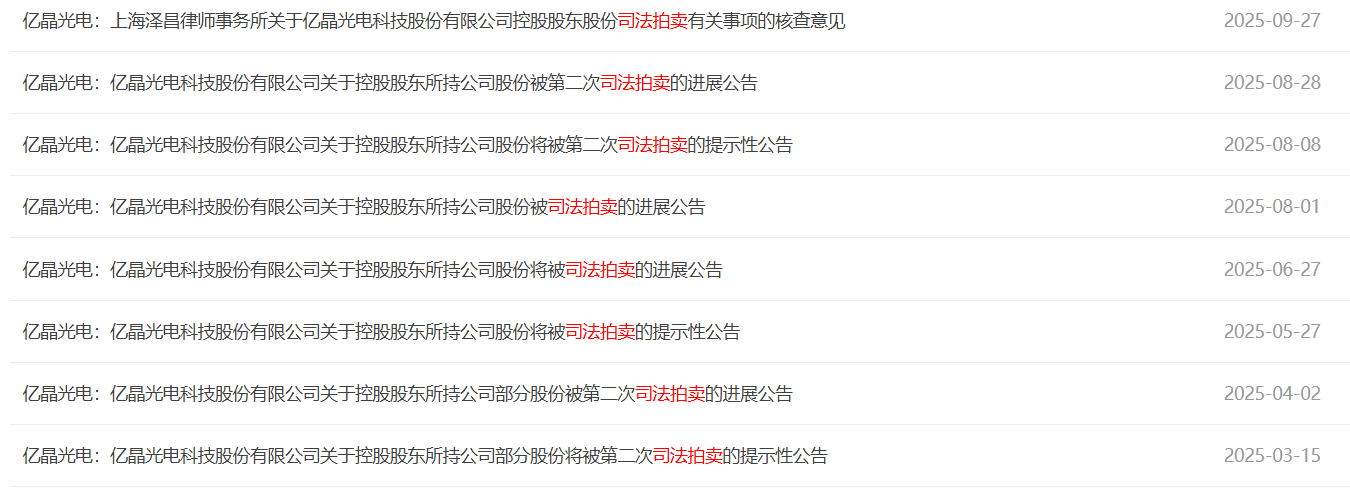
亿晶光电“90后”前证代当上董事长,低薪任要职遭遇20.9亿元巨亏后再面临“*ST”风险
Mei Ri Jing Ji Xin Wen· 2026-01-09 08:03
Core Viewpoint - Yichin Photovoltaic is expected to report a significant loss in 2025, potentially exceeding its net assets from the previous year, which raises concerns about the risk of delisting from the stock exchange [1][5]. Group 1: Company Performance and Financial Outlook - The company anticipates a net profit loss for 2025, which may lead to negative net assets by year-end [1]. - The projected loss for 2024 is reported at 2.09 billion yuan [3]. - As of the end of 2023, the company's equity attributable to shareholders was 2.524 billion yuan, indicating a complete erosion of its financial base within two years if the losses materialize [5]. Group 2: Leadership and Governance Issues - Chen Jiangming, born in 1991, rapidly ascended from a securities representative to the position of Chairman and Secretary of the Board, signing off on the company's significant losses shortly after his appointment [2][3]. - His salary as Secretary of the Board in 2024 was only 416,000 yuan, significantly lower than his predecessor and below the industry average for similar positions [3]. - The company is currently without a controlling shareholder due to the previous major shareholder's shares being judicially auctioned off [3]. Group 3: Legal and Operational Challenges - Yichin Photovoltaic is involved in multiple legal disputes, with 23 cases reported, including 10 currently under trial [5]. - The company faces accountability from local state-owned assets for failing to fulfill prior agreements, which could lead to the termination of investment agreements and the recovery of 140 million yuan [5]. - The dual role of Chen Jiangming as both Chairman and Secretary of the Board raises concerns about governance and the effectiveness of oversight within the company [6].

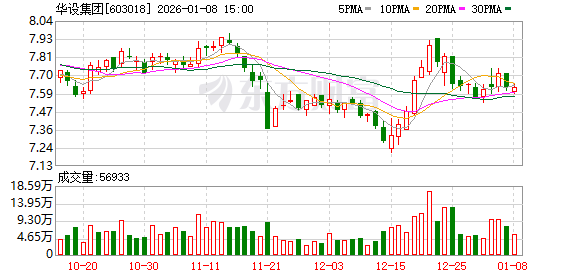
华设集团陷中小股东话语权之争 持股3.001%股东杭州中易坤拟向全体股东征集表决权 反对公司章程修订
Zheng Quan Ri Bao· 2026-01-08 17:12
Core Viewpoint - The core issue revolves around a power struggle between shareholders and the management of Huasheng Design Group, particularly regarding the proposed amendments to the company's articles of association concerning cumulative voting rights [2][4]. Shareholder Voting Rights - Hangzhou Zhongyikun Management Consulting Co., Ltd., holding 3.001% of Huasheng Group's shares, is seeking to collect voting rights from all shareholders to oppose all proposals at the upcoming 2026 first extraordinary general meeting [2][3]. - The voting rights collection period is set from January 7 to January 12, 2026, with the main contention being the adjustment of conditions for the application of cumulative voting in the company's articles of association [2][4]. Shareholding History - Hangzhou Zhongyikun's shareholding in Huasheng Group has increased from 1.97% in June 2025 to 3.001% by the end of 2025, making it one of the top ten circulating shareholders [3]. - The company attempted to nominate a director in December 2025, but the proposal received only 11.83% approval and was ultimately rejected [3]. Governance Dispute - The board of Huasheng Group rejected the nomination of a director from Hangzhou Zhongyikun, citing concerns about the candidate's qualifications and potential impact on the board's professional structure [3][4]. - The proposed amendment to the articles of association would limit cumulative voting to situations where a single shareholder or their concerted parties hold 30% or more of the shares, which could hinder the ability of minority shareholders to participate in governance [4][5]. Legal and Regulatory Context - Legal experts indicate that while a 3% shareholder has the legal right to collect voting rights, the success of this initiative depends on the support from securities service institutions for convenient authorization [5]. - The current shareholder structure of Huasheng Group is highly dispersed, with the top three shareholders holding only about 11% of the shares, which complicates governance and decision-making processes [5][6]. Current Developments - Following the announcement of the voting rights collection, some small shareholders have expressed support for Hangzhou Zhongyikun, indicating a willingness to delegate their voting rights [6].

华设集团陷中小股东话语权之争
Zheng Quan Ri Bao· 2026-01-08 16:45
Core Viewpoint - Hangzhou Zhongyikun, a shareholder with 3.001% stake in Huasheng Design Group, is seeking to collect voting rights from all shareholders to oppose amendments to the company's articles of association, particularly regarding the cumulative voting system [1][2]. Group 1: Shareholder Actions - Hangzhou Zhongyikun plans to gather voting rights from January 7 to January 12, 2026, to oppose all proposals at the upcoming shareholder meeting [2]. - The conflict stems from a failed proposal to nominate a director by Hangzhou Zhongyikun, which received only 11.83% approval at the last shareholder meeting [3]. Group 2: Governance and Voting Rights - The proposed amendment to the articles of association changes the conditions under which cumulative voting is applied, limiting it to situations where a single shareholder holds 30% or more of the shares [4]. - Hangzhou Zhongyikun argues that this change will hinder minority shareholders' ability to participate in governance, potentially leading to an imbalance in the company's governance structure [4]. Group 3: Company Response - Huasheng Group's board believes that the proposed changes do not deprive shareholder rights, as shareholders with over 1% still retain the right to propose and vote on matters [4]. - The board emphasizes the need for diverse professional expertise in governance and aims to enhance the company's development through qualified board members [4][6]. Group 4: Legal and Structural Considerations - Legal experts note that while a 3% shareholder can legally collect voting rights, the success of this initiative depends on the support from securities service institutions for streamlined authorization processes [5]. - The company’s ownership structure is characterized by significant fragmentation, with the top three shareholders holding only about 11% of the shares, complicating governance dynamics [5][6].