AI概念

Search documents
美政府“停摆”将破纪录!纳指跌近500点,英伟达市值一夜蒸发1.4万亿元,比特币跌破10万美元,加密货币超40万人爆仓
Mei Ri Jing Ji Xin Wen· 2025-11-05 00:07
Group 1 - The U.S. Senate failed to pass a temporary funding bill, leading to an ongoing government shutdown that may become the longest in U.S. history, surpassing the previous record of 35 days from late 2018 to early 2019 [1][3] - The primary contention between the Democratic and Republican parties revolves around healthcare spending, particularly related to the Affordable Care Act, which has resulted in significant increases in insurance premiums [3][5] - Approximately 4 million Americans may lose their health insurance due to the inability of both parties to reach an agreement on government subsidies [3] Group 2 - The ongoing government shutdown has led to approximately 13,000 air traffic controllers and 50,000 airport security personnel working without pay, exacerbating staffing shortages and safety concerns in air travel [8] - The stock market reacted negatively to the shutdown, with major indices experiencing declines; the Nasdaq fell by 486.08 points (2.04%), and significant losses were observed in major tech stocks like Intel and Tesla [8][9] - The market sell-off was partly triggered by a sharp decline in AI-related stocks, raising concerns about overvaluation in the tech sector [10][11]


刚刚,全线崩跌!投资大佬“杀疯”,泡沫破了?
Zheng Quan Shi Bao· 2025-11-05 00:02
Core Viewpoint - Michael Burry, a well-known investor, is heavily shorting AI stocks like Nvidia and Palantir, raising concerns about potential market corrections and the sustainability of current valuations in the tech sector [1][2][6]. Group 1: Market Performance - The U.S. stock market experienced significant declines, with the Nasdaq dropping over 2%, the S&P 500 falling more than 1%, and the Dow Jones decreasing by 0.53% [1]. - Major tech stocks faced severe sell-offs, including Tesla down over 5%, Nvidia down nearly 4%, and Palantir down almost 8% [1]. Group 2: Burry's Short Position - Michael Burry's Scion Asset Management has a short position in Nvidia and Palantir, with a total nominal value of over $1 billion in put options, representing 80% of the firm's portfolio [2][3]. - The put options for Palantir are valued at approximately $912 million, while those for Nvidia are around $186 million [2]. Group 3: Stock Price Movements - Despite the recent downturn, both Palantir and Nvidia saw price increases after September 30, with Palantir rising 4.6% and Nvidia increasing 6.5% [3]. - Palantir reported a 63% year-over-year revenue growth in Q3, reaching $1.181 billion, and raised its revenue guidance for Q4 and 2025 [4]. Group 4: Company Background - Palantir specializes in big data analytics, primarily serving U.S. defense and financial sectors, and has launched an AI platform integrating large language models [4]. - The company's stock has surged over 152% year-to-date, with a market capitalization of approximately $452.5 billion [4]. Group 5: Market Sentiment and Warnings - Several Wall Street executives, including Goldman Sachs' CEO, have expressed concerns about high valuation levels in the U.S. stock market, predicting potential corrections of 10% to 20% in the next 12 to 24 months [2]. - Burry's warnings about market bubbles and the potential for significant losses highlight the risks associated with current market conditions [6][7].
全线崩跌!投资大佬“杀疯” 大举做空“AI大牛股” 泡沫破了?
Zheng Quan Shi Bao Wang· 2025-11-04 23:55
Core Viewpoint - Michael Burry, a well-known investor, is heavily shorting AI stocks like Nvidia and Palantir, indicating a bearish outlook on the market amid concerns of overvaluation and potential market corrections [1][3][5]. Group 1: Market Performance - The U.S. stock market experienced significant declines, with the Nasdaq dropping over 2%, the S&P 500 down more than 1%, and the Dow Jones falling 0.53% [1]. - Major tech stocks faced severe sell-offs, including Tesla down over 5%, Nvidia nearly 4%, and Palantir dropping close to 8% [1]. Group 2: Michael Burry's Position - Burry's Scion Asset Management has approximately 80% of its portfolio in put options on Nvidia and Palantir, with a total nominal value exceeding $10 billion [3]. - The put options for Palantir are valued at $9.12 billion (equivalent to 5 million shares), while those for Nvidia are valued at $1.86 billion [3]. - Despite the recent drop in stock prices, both Palantir and Nvidia have seen price increases since the reporting date, potentially leading to significant losses for Burry's short positions [3][6]. Group 3: Company Performance and Outlook - Palantir reported a strong Q3 with a 63% year-over-year revenue increase to $1.181 billion, surpassing market expectations [4]. - The company raised its revenue guidance for Q4 and 2025, projecting over 104% growth in U.S. commercial business revenue [4]. - Analysts express concerns that Palantir's stock price may be detached from its fundamentals, especially if the AI hype fades or customer growth slows [4]. Group 4: Broader Market Concerns - Several Wall Street executives, including Goldman Sachs' CEO, have warned about the current valuation levels of U.S. stocks, predicting a potential 10% to 20% correction in the next 12 to 24 months [2]. - Burry's recent warnings about market bubbles suggest a broader concern regarding the sustainability of the current market rally, particularly in AI stocks [5].
全线崩跌!投资大佬“杀疯”,泡沫破了?
Zheng Quan Shi Bao· 2025-11-04 23:52
Core Viewpoint - Michael Burry, a well-known investor, is heavily shorting AI stocks like Nvidia and Palantir, indicating a bearish outlook on the market, particularly in the tech sector, amidst concerns of overvaluation and potential market corrections [1][3][6]. Group 1: Market Performance - The U.S. stock market experienced significant declines, with the Nasdaq dropping over 2%, the S&P 500 down more than 1%, and the Dow Jones falling 0.53% [1]. - Major tech stocks faced severe sell-offs, including Tesla down over 5%, Nvidia down nearly 4%, and Palantir down nearly 8% [1]. Group 2: Burry's Short Positions - Michael Burry's Scion Asset Management has approximately 80% of its portfolio concentrated in short positions on Nvidia and Palantir, with a total nominal value of over $10 billion in put options [3]. - The put options for Palantir are valued at $912 million (equivalent to 5 million shares), while those for Nvidia are valued at $186 million [3]. Group 3: Company Performance and Valuation Concerns - Palantir reported a third-quarter revenue growth of 63% year-over-year, reaching $1.181 billion, significantly exceeding market expectations [4]. - Despite strong earnings, analysts express concerns about Palantir's stock price being detached from its fundamentals, especially if the AI hype fades [4]. - Nvidia has become the first company to surpass a market capitalization of $5 trillion, raising concerns about its valuation relative to broader economic indicators [6]. Group 4: Market Sentiment and Warnings - Several Wall Street executives, including Goldman Sachs' CEO, have warned of potential market corrections of 10% to 20% within the next 12 to 24 months due to high valuation levels [2]. - Burry's previous warnings about market bubbles and his recent social media activity suggest he believes the current AI stock frenzy may be unsustainable [6][7].
刚刚,全线崩跌!投资大佬"杀疯",泡沫破了?
券商中国· 2025-11-04 23:47
Core Viewpoint - The article discusses the significant short-selling activities by investor Michael Burry on AI stocks, particularly Palantir and Nvidia, amidst a broader market downturn, raising concerns about potential market bubbles and overvaluation in the tech sector [1][2][3][4][8]. Group 1: Market Performance - The U.S. stock market experienced a sharp decline, with the Nasdaq falling over 2%, the S&P 500 down more than 1%, and the Dow Jones decreasing by 0.53% [1]. - Major tech stocks faced heavy selling, including Tesla down over 5%, Nvidia down nearly 4%, and Palantir down nearly 8% [1]. Group 2: Michael Burry's Short Position - Michael Burry's Scion Asset Management has concentrated approximately 80% of its portfolio on short positions in Palantir and Nvidia, with a total nominal value of over $10 billion in put options [3][4]. - The nominal value of put options for Palantir is reported at $9.12 billion, while for Nvidia it is $1.86 billion [3]. Group 3: Company Performance and Valuation Concerns - Palantir reported a third-quarter revenue growth of 63% year-over-year, reaching $1.181 billion, and raised its guidance for future earnings significantly [4][5]. - Despite the strong earnings, analysts express concerns that Palantir's stock price may be detached from its fundamentals, especially given its year-to-date increase of over 152% [5]. Group 4: Broader Market Warnings - Several Wall Street executives, including Goldman Sachs' CEO David Solomon, have warned of potential market corrections of 10% to 20% within the next 12 to 24 months due to high valuation levels [2]. - Burry's previous warnings about market bubbles and his recent actions suggest a cautious outlook on the sustainability of the current market rally, particularly in AI stocks [7][8].

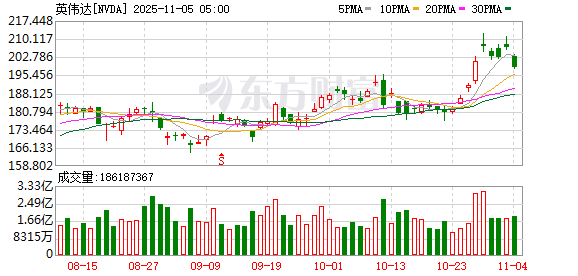
纳指跌近500点 英伟达市值一夜蒸发1.4万亿元!比特币一度失守10万美元关口 24小时加密币全网40万人爆仓!发生了什么?
Mei Ri Jing Ji Xin Wen· 2025-11-04 22:35
Market Overview - On November 4, US stock indices collectively declined, with the Nasdaq dropping 486.08 points, a decrease of 2.04%, the S&P 500 falling by 1.17%, and the Dow Jones down by 0.53% [2] - Major tech stocks experienced significant declines, with Intel down over 6%, Tesla down over 5% (losing $80.2 billion in market value), Nvidia down over 3% (losing $199 billion), and Google down over 2% [3] Company-Specific Developments - Tesla's annual shareholder meeting on November 6 will see Norway's sovereign wealth fund voting against a proposal to grant Elon Musk stock as a performance reward, which could amount to $1 trillion if he meets ambitious targets over the next decade [3] - Despite Palantir reporting record revenue and raising its annual performance forecast, its stock plummeted, triggering broader market sell-offs and concerns over tech stock valuations [3] - Michael Burry's Scion Asset Management disclosed bearish positions on Nvidia and Palantir shortly after warning retail investors about market exuberance, indicating a strategy to profit from potential declines in these stocks [3] Broader Market Sentiment - Statements from CEOs of Goldman Sachs and Morgan Stanley have unsettled investors, with predictions of a potential 10% to 20% market pullback in the next 12 to 24 months [4] - The Nasdaq Golden Dragon China Index fell by 2.05%, with several Chinese stocks experiencing notable declines, while Baidu and Vipshop saw gains of over 3% and 2%, respectively [4] Commodity and Cryptocurrency Markets - FTSE A50 futures fell by 0.24%, and international oil futures also saw slight declines, with WTI crude oil down 0.8% to $60.56 per barrel and Brent crude down 0.69% to $64.44 per barrel [5] - The cryptocurrency market faced severe sell-offs, with Bitcoin dropping below $100,000 and over 40,000 traders liquidated, resulting in $1.799 billion evaporated in 24 hours [6][8] Federal Reserve Outlook - There are concerns regarding whether the Federal Reserve will implement a third consecutive rate cut in December, with decisions dependent on upcoming data and the impact of tariffs on inflation [10]

深夜,全球市场一片绿!黄金突然跳水、油价下跌、加密货币崩盘
Mei Ri Jing Ji Xin Wen· 2025-11-04 22:26
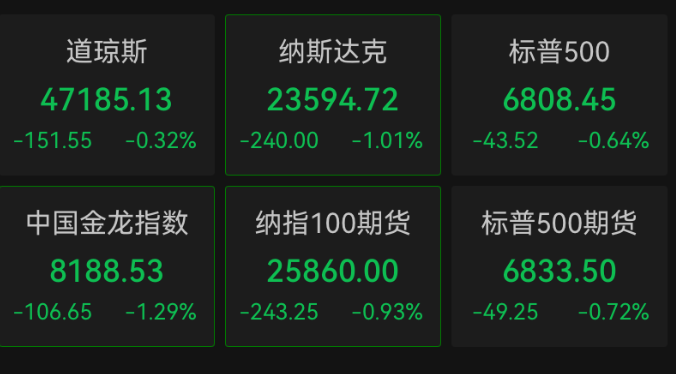
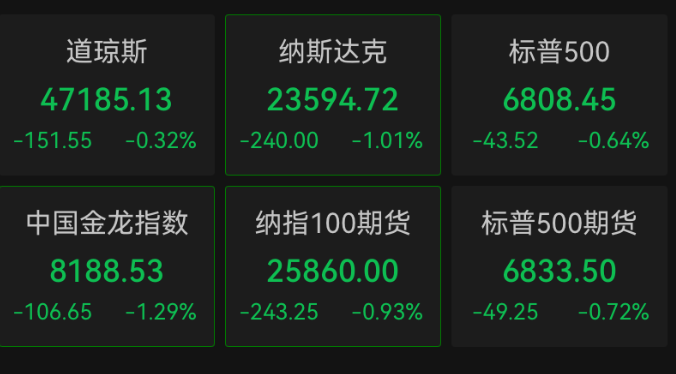
Core Viewpoint - The U.S. stock market is experiencing a downturn, with major indices showing declines, particularly in technology stocks, amid concerns over high valuations and potential market corrections [1][14]. Market Performance - As of November 4, major U.S. indices closed lower: Dow Jones down 0.32% at 47185.13, S&P 500 down 0.64% at 6808.45, and Nasdaq down 1.01% at 23594.72 [1][2]. - The Nasdaq Golden Dragon China Index fell by 1.4%, reflecting a broader decline in Chinese stocks listed in the U.S. [4]. Technology Stocks - Prominent technology stocks saw significant declines: Intel down 4.20%, Tesla down 3.53%, and Nvidia down 2.08% [3][4]. - Palantir Technologies reported a record revenue of $1.18 billion for Q3, a 63% year-over-year increase, but its stock price fell, raising concerns about the high valuations in the tech sector [14]. Analyst Insights - Wall Street executives expressed caution regarding the current market valuations, particularly in technology stocks, with predictions of a potential 10% to 20% market correction [14]. - The forward P/E ratio of the S&P 500 has risen above 23, nearing the highest levels since 2000, indicating heightened valuation concerns [14]. Global Market Trends - European markets also showed weakness, with major indices like Germany's DAX30 down over 1% [4]. - Asian markets experienced declines, with the South Korean index down 2.4% and Japan's Nikkei 225 down 1.7% [5]. Commodity and Cryptocurrency Markets - Gold prices fell sharply, with spot gold down 1.4% to $3944.9 per ounce [5]. - The cryptocurrency market faced significant losses, with Bitcoin dropping over 3% to $104,289, and a total of $1.399 billion in liquidations reported across the market [11][12].


深夜 全球市场一片绿!黄金突然跳水 油价下跌 美股集体下挫 中概股也在跌!加密货币崩盘 超34万人爆仓
Mei Ri Jing Ji Xin Wen· 2025-11-04 16:36
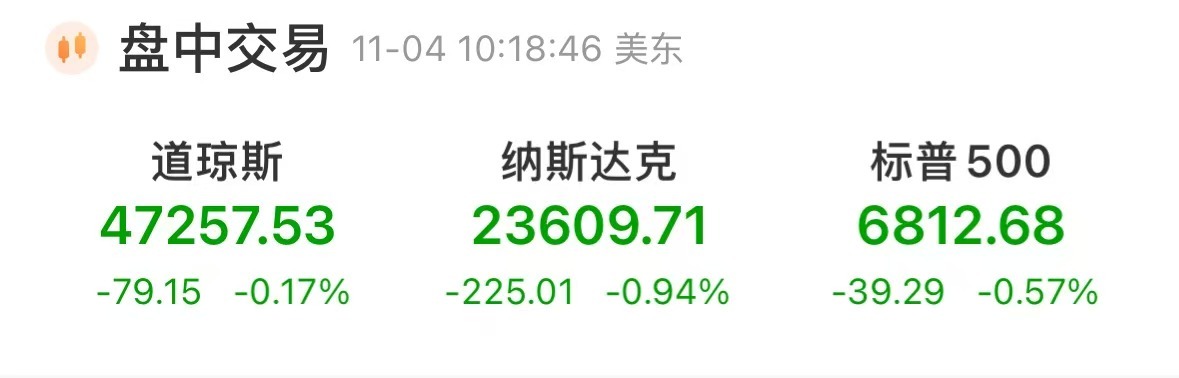
Market Overview - US stock indices opened lower and saw slight gains, with the Dow Jones down 0.32%, S&P 500 down 0.64%, and Nasdaq down 1.01% as of 23:10 Beijing time [1] - Major tech stocks mostly declined, with Intel down over 4%, Tesla down 3.53%, and Nvidia down over 2% [1] Tech Stocks Performance - Notable declines in tech stocks include: - Intel: $37.839, down 4.20% - Micron Technology: $225.734, down 3.82% - Tesla: $451.829, down 3.53% - Oracle: $251.810, down 2.34% - AMD: $253.590, down 2.33% - Nvidia: $202.570, down 2.08% [2] Chinese Stocks - The Nasdaq Golden Dragon China Index fell by 1.4%, with significant drops in: - WeRide: down 7.61% - Pony.ai: down 7.18% - Xpeng Motors: down 3.64% - NIO: down 2.36% - JD Group: down 2.15% - Alibaba: down 0.87% [2] European Market - European stock markets also showed weakness, with: - DAX30 down over 1% - CAC40 down 0.93% - Euro Stoxx 50 down 0.82% - FTSE 100 down 0.5% [3] Commodity Market - Gold prices dropped significantly, with spot gold down 1.4% to $3944.9 per ounce, and COMEX gold down 1.73% to $3944.5 per ounce [4] - Other metals like silver, copper, and zinc also saw declines, with silver down 1.8% to $47.2 per ounce [4] - International oil prices slightly decreased, with Brent crude at $64.22 per barrel and WTI crude at $60.34 per barrel [4] Cryptocurrency Market - The cryptocurrency market experienced a sharp decline, with Bitcoin down over 3% to $104,289 per coin [4] - Over 340,000 traders were liquidated in the past 24 hours, with a total liquidation amount of $1.399 billion [4][6] Palantir's Impact - Palantir's stock drop, despite reporting record revenue and raising full-year guidance, triggered market sell-offs, raising concerns about tech stock valuations [7] - Palantir reported Q3 revenue of $1.18 billion, a 63% year-over-year increase, and projected Q4 revenue of $1.33 billion [7] - Wall Street executives expressed caution regarding current market valuations, particularly in tech stocks, with predictions of a potential 10% to 20% market correction [7] Investor Sentiment - The shift in market sentiment highlights the dilemma investors face, balancing inflation pressures that may limit Federal Reserve policy easing against high valuations in tech stocks [8] - The sensitivity of the US stock market to macroeconomic data and Federal Reserve policy changes has increased following the AI-driven market rally [9]
深夜,全球市场一片绿!黄金突然跳水,油价下跌,美股集体下挫,中概股也在跌!加密货币崩盘,超34万人爆仓
Mei Ri Jing Ji Xin Wen· 2025-11-04 16:25
Market Overview - The U.S. stock market opened lower and saw slight gains, with the Dow Jones down 0.32%, S&P 500 down 0.64%, and Nasdaq down 1.01% as of 23:10 Beijing time [1] - Major technology stocks experienced declines, with Intel down over 4%, Tesla down 3.53%, and Nvidia down over 2% [2][3] Chinese Stocks - The Nasdaq Golden Dragon China Index fell by 1.4%, with notable declines in stocks such as WeRide down 7.61%, Pony.ai down 7.18%, and Xpeng down 3.64% [4] European Market - European stock markets also showed weakness, with Germany's DAX30 index down over 1%, France's CAC40 down 0.93%, and the UK FTSE 100 down 0.5% as of 22:00 Beijing time [5] Asian Market - In the Asian trading session, the South Korean KOSPI fell 2.4%, the Nikkei 225 dropped 1.7%, and the Hang Seng Index decreased by 0.79% [5] Commodity Prices - Gold prices saw a significant drop, with spot gold falling by 1.4% to $3944.9 per ounce, while COMEX gold dropped 1.73% to $3944.5 per ounce [5][6] - International oil prices also declined slightly, with Brent crude at $64.22 per barrel and WTI crude at $60.34 per barrel [8][9] Cryptocurrency Market - The cryptocurrency market faced a sharp decline, with Bitcoin dropping over 3% to $104,289 per coin, and over 340,000 traders liquidated, totaling $1.399 billion in liquidations [11][12] Company Earnings and Market Sentiment - Palantir reported a record revenue of $1.18 billion for Q3, a 63% year-over-year increase, but the stock price fell, reflecting investor profit-taking and concerns over tech stock valuations [13][14] - Wall Street executives expressed caution regarding the U.S. stock market, predicting a potential correction of 10% to 20% due to high valuation levels, particularly in tech stocks [14][15]
深夜 全线大跌!中概股下挫!黄金突然直线跳水
Mei Ri Jing Ji Xin Wen· 2025-11-04 16:16
Group 1 - Major US tech stocks experienced a significant decline, with Tesla and Nvidia dropping over 2%, and other companies like Oracle, Intel, Google, Microsoft, and Amazon also following suit [1] - Palantir, known as an "AI darling" stock, saw its price plummet by over 10% at one point during trading [1] - Despite Palantir reporting record revenue and raising its full-year guidance, investors opted to take profits, which triggered a broader sell-off in the tech sector [4] Group 2 - The Nasdaq Golden Dragon China Index fell by 1.11%, with notable declines in Chinese stocks such as Bilibili, NIO, XPeng Motors, Alibaba, JD.com, and Li Auto [5] - Gold prices accelerated their decline, dropping below $3940 per ounce, with a daily decrease of 1.63%, while silver fell over 2% to $47.016 per ounce [5] - Bitcoin and Ethereum also saw significant drops, with Bitcoin falling to $102,979 (down 4.45%) and Ethereum to $3,475.39 (down 6.69%) [6]