代币化

Search documents
香港,重磅发布!
中国基金报· 2025-06-26 13:15
Core Viewpoint - The Hong Kong Special Administrative Region government aims to establish Hong Kong as a global innovation center in the digital asset sector through the release of the "Hong Kong Digital Asset Development Policy Declaration 2.0" [2][3]. Regulatory Framework - The government is constructing a unified and comprehensive regulatory framework for digital asset service providers, which includes digital asset trading platforms, stablecoin issuers, and custodians [5]. - The Securities and Futures Commission will be the main regulatory body for licensing digital asset trading and custody service providers [5]. - A comprehensive review of laws will be conducted to facilitate the tokenization of real-world assets and financial instruments, including the issuance and trading of tokenized bonds [5]. Tokenization Product Expansion - The government plans to regularize the issuance of tokenized government bonds and support the tokenization of real-world assets to enhance liquidity and accessibility [5]. - There will be initiatives to promote the trading of tokenized exchange-traded funds on licensed digital asset trading platforms [5]. - The government aims to showcase the diverse applications of tokenization technology across various sectors, including precious metals and renewable energy [5]. Application Scenarios and Cross-Sector Collaboration - A licensing mechanism for stablecoin issuers will be implemented on August 1, which will help advance practical application scenarios [6]. - The government is committed to enhancing collaboration among regulatory bodies, law enforcement agencies, and technology providers to develop digital asset infrastructure [6]. - A funding program will be launched to support blockchain and digital asset pilot projects with significant market impact [7]. Talent and Partnership Development - The government is focused on collaborating with industry and academia to foster talent development, aiming to build a sustainable talent pool of entrepreneurs, researchers, and technical experts [7]. Industry Insights - The policy declaration signifies a new phase in building a digital asset ecosystem in Hong Kong, establishing a benchmark for "compliance innovation" in the sector [10]. - Major financial institutions and companies are entering the digital asset space, with firms like Guotai Junan International and Ant Group actively pursuing licensing for virtual asset services [10]. - JD Group has already obtained a sandbox entry qualification for stablecoin issuance from the Hong Kong Monetary Authority, indicating a proactive approach to digital asset integration [10].


35次提到“代币化”,香港新数字资产发展路线图强调RWA发展
Hua Xia Shi Bao· 2025-06-26 13:04
Core Viewpoint - The Hong Kong government has released the "Hong Kong Digital Asset Development Policy Declaration 2.0," outlining a new roadmap for the development of digital assets, emphasizing the importance of tokenization, particularly for Real World Assets (RWA) [2][3][4]. Group 1: Policy Framework - The declaration aims to position Hong Kong as a global innovation center for digital assets, transitioning from "virtual assets" to "digital assets," reflecting the industry's maturation [3][4]. - The "LEAP" framework introduced in the declaration focuses on optimizing legal and regulatory aspects, expanding tokenized product categories, promoting application scenarios and cross-sector collaboration, and developing talent and partnerships [3][4]. Group 2: Tokenization and Regulation - The government is establishing a comprehensive regulatory framework for digital asset service providers, including trading platforms and custodians [4][7]. - The declaration includes plans to normalize the issuance of tokenized government bonds and provide incentives for RWA tokenization, such as clarifying stamp duty arrangements for tokenized ETFs [4][7]. Group 3: Market Development and Innovation - The government supports stablecoins and other tokenized projects, exploring the use of stablecoins as payment tools, which is expected to enhance the digital asset ecosystem [5][8]. - The total value of tokenized RWAs on public blockchains has reached nearly $23.4 billion, representing about 10% of the stablecoin market, indicating significant market potential [6][8]. Group 4: Future Directions - The Hong Kong government is actively promoting the tokenization of various assets, including green bonds and carbon credits, to enhance market accessibility and investor confidence [8][9]. - The declaration emphasizes the need for regulatory clarity to facilitate the growth of RWA projects, which are crucial for establishing Hong Kong as a digital asset hub [9].

BIS警告稳定币存结构性缺陷 各国应加快货币代币化进程
2 1 Shi Ji Jing Ji Bao Dao· 2025-06-26 12:33
Core Viewpoint - Stablecoins have become a focal point in the global financial sector, especially following regulatory developments in Hong Kong and the U.S. The International Bank for Settlements (BIS) has highlighted that while stablecoins show potential in tokenization, they currently fail to meet the requirements to be a pillar of the monetary system, performing poorly in three key tests: singularity, elasticity, and integrity [1][2][4]. Group 1: Performance in Key Tests - Stablecoins exhibit structural flaws in singularity, elasticity, and integrity, limiting their role to that of an auxiliary rather than a foundational currency [2][4]. - In terms of singularity, asset-backed stablecoins resemble digital promissory notes, lacking the necessary attributes to pass the singularity test, as they are tied to specific issuers and do not guarantee uniform value [2][3]. - The elasticity test reveals that stablecoins cannot flexibly adjust supply based on market demand due to their prepayment mechanism, which restricts their ability to provide liquidity in times of need [4][5]. Group 2: Integrity and Compliance Issues - Stablecoins face significant integrity challenges, particularly in compliance with anti-money laundering (AML) and counter-terrorism financing (CFT) regulations, as they can easily be used for illicit activities due to their anonymous nature [5][6]. - The reliance on decentralized wallets and mixing services complicates the enforcement of KYC regulations, making it difficult to monitor transactions effectively [5][6]. - While some measures exist to freeze accounts and track illicit transactions, these are insufficient for the scale of daily transactions, leaving stablecoins vulnerable to misuse by criminal organizations [6]. Group 3: Future of Tokenization - The report emphasizes that tokenization of central bank reserves, deposits, and government securities could serve as a foundation for the next-generation monetary and financial system, with central banks playing a catalytic role [1][9]. - The "Pine Project" initiated by the New York Federal Reserve and BIS showcases the potential advantages of a fully tokenized financial system, including improved operational efficiency and automated backend processes [9][10]. - However, transitioning to a fully tokenized system presents challenges, particularly in ensuring interoperability between existing account-based systems and new tokenized infrastructures [10].
香港特区政府发表《香港数字资产发展政策宣言2.0》
Zheng Quan Ri Bao Wang· 2025-06-26 11:29
Group 1 - The Hong Kong government aims to establish itself as a global innovation hub in the digital asset sector through the release of the "Hong Kong Digital Asset Development Policy Declaration 2.0" [1] - The declaration emphasizes building a trustworthy and innovative digital asset ecosystem, prioritizing risk management and investor protection while delivering tangible benefits to the real economy and financial markets [1] - A unified and comprehensive regulatory framework for digital asset service providers is being developed, covering exchanges, stablecoin issuers, trading service providers, and custodians [1] Group 2 - The government plans to regularize the issuance of tokenized government bonds and clarify stamp duty arrangements for tokenized exchange-traded funds to enhance liquidity and accessibility [2] - A licensing mechanism for stablecoin issuers will be implemented on August 1, facilitating the development of practical application scenarios [2] - The government is committed to collaborating with industry and academia to foster talent development, positioning Hong Kong as a center for digital asset knowledge sharing and international cooperation [2]
“央行的央行”,突发警告!
中国基金报· 2025-06-26 11:07
【导读】稳定币热度持续飙升,国际清算银行发出"降温"信号 根据国际清算银行的定义,稳定币被设计为通往加密生态系统的门户,承诺在公链上运行, 并相对于法定货币(主要是美元)保持稳定的价值。 国际清算银行认为,稳定币未能通过构建货币体所需的三项关键测试,因此无法达到成为货 币体系支柱的要求。 这三项关键测试分别是:货币的单一性、弹性和完整性。 报告称,作为无边界公链上的数字不记名工具,稳定币缺乏央行提供的结算功能,因此,稳 定币的交易汇率经常变化,从而破坏了单一性。 在弹性方面,稳定币通常由名义上等值的资产支持,任何额外发行都需要持有人全额预付 款,这通过施加预付现金的限制而破坏了弹性。 中国基金报记者 王思文 在稳定币市场热度持续飙升的背景下,素有"央行的央行"之称的国际清算银行发出了"降 温"信号。 近日,国际清算银行发布年度经济报告称,建议各国央行加快推动代币化进程,稳定币在代 币化方面展现出一些前景,但在单一性、弹性和完整性这三个关键测试中表现不佳,未能达 到成为货币体系支柱的要求。 与此同时,国际清算银行认为稳定币引发了许多其他担忧。稳定币的不记名性质使其能够在 不受发行人监管的情况下流通,这引发了人们 ...

国际清算银行最新报告:稳定币未达到成为货币体系支柱的要求 未来角色尚不明朗
Sou Hu Cai Jing· 2025-06-26 10:54
Core Insights - The report by the Bank for International Settlements (BIS) expresses concerns about the risks associated with stablecoins, highlighting their potential in tokenization but indicating they do not meet the necessary criteria to become a pillar of the monetary system [1][2][3] - The future role of stablecoins in the monetary system remains uncertain, as their poor performance in key tests suggests they may only serve an auxiliary role [2] Group 1: Key Tests for Stablecoins - Stablecoins fail to meet the three critical tests of singularity, elasticity, and integrity required for a robust monetary system [2] - The lack of central bank settlement functionality undermines the singularity of stablecoins, as their exchange rates fluctuate, leading to instability [2] - The anonymity of stablecoins facilitates illegal activities due to the absence of traditional financial system standards like Know Your Customer (KYC) [2] Group 2: Concerns and Risks - Stablecoins face inherent contradictions between their promise of stable value and the demands of their business models, which involve liquidity or credit risks [2] - The potential loss of monetary sovereignty and capital flight poses significant concerns, particularly for emerging markets and developing economies [2] - The report warns that the growth of stablecoins could lead to financial stability risks, including the tail risk of safe asset sell-offs [2] Group 3: Regulatory Challenges - Effective regulation of stablecoins is complicated by their operation on permissionless public blockchains, which limits the regulatory scope compared to traditional intermediaries [3] - The cross-border nature of stablecoins presents significant challenges for national regulatory frameworks, making it difficult to manage cross-border risks without international coordination [3] - The report suggests that central banks must play a catalytic role in providing new forms of currency to meet the evolving needs of the monetary and financial system [3]
稳定币未达货币体系关键要求 国际清算银行报告称前景不明
news flash· 2025-06-26 10:40
Core Insights - The report from the Bank for International Settlements indicates that stablecoins have not met the requirements for single currency, resilience, and integrity within the monetary system [1] - The future role of stablecoins remains unclear, although they show potential in tokenization [1] - The report suggests that stablecoins may only serve as auxiliary instruments due to significant limitations [1] Regulatory Recommendations - Implementation of technology-neutral regulations is necessary to ensure the stability and integrity of the financial system [1] - The central bank's critical role in tokenized systems is emphasized, highlighting the need for tokenized central bank reserves and government securities as potential foundations for future monetary systems [1]
方向、措施、监管明确,香港数字资产发展 “路线图” 来了 !
Di Yi Cai Jing· 2025-06-26 09:53
Core Viewpoint - The Hong Kong government aims to establish the region as a global innovation hub for digital assets through the release of the "Hong Kong Digital Asset Development Policy Declaration 2.0" which introduces the "LEAP" framework focusing on legal and regulatory optimization, expanding tokenized product varieties, advancing use cases and cross-sector collaboration, and talent and partnership development [1][10] Group 1: Legal and Regulatory Optimization - The policy declaration outlines a comprehensive regulatory framework for digital asset service providers, including trading platforms, stablecoin issuers, and custodians, with the Hong Kong Securities and Futures Commission (SFC) as the main regulatory body [3][5] - The government will conduct a thorough review of existing laws to facilitate the tokenization of real-world assets and financial instruments, including the issuance and trading of tokenized bonds [3][11] - Hong Kong will continue to implement international standards related to digital assets, aligning with recommendations from various global financial regulatory bodies [3][4] Group 2: Expansion of Tokenized Products - The government has issued tokenized green bonds totaling approximately HKD 6.8 billion, showcasing the benefits of tokenization and plans to regularize the issuance of tokenized government bonds [8] - Tax exemptions for tokenized ETFs will be clarified to encourage market development, with proposals for tax relief expected to take effect in the 2025/2026 tax year [8] - The government aims to promote broader tokenization of assets and financial instruments across various sectors, including precious metals and renewable energy [8] Group 3: Advancing Use Cases and Cross-Sector Collaboration - A licensing mechanism for stablecoin issuers will be implemented on August 1, aimed at fostering practical applications of digital assets [9] - The government will enhance collaboration among regulatory bodies, law enforcement, and technology providers to develop digital asset infrastructure [9] - Initiatives such as the Digital Port's blockchain and digital asset pilot funding program will support projects with significant market impact [9] Group 4: Talent and Partnership Development - The government is committed to collaborating with industry and academia to foster talent development in the digital asset space [9] - Hong Kong aims to position itself as a center for knowledge sharing in digital assets and promote international cooperation through joint research initiatives [9][12]
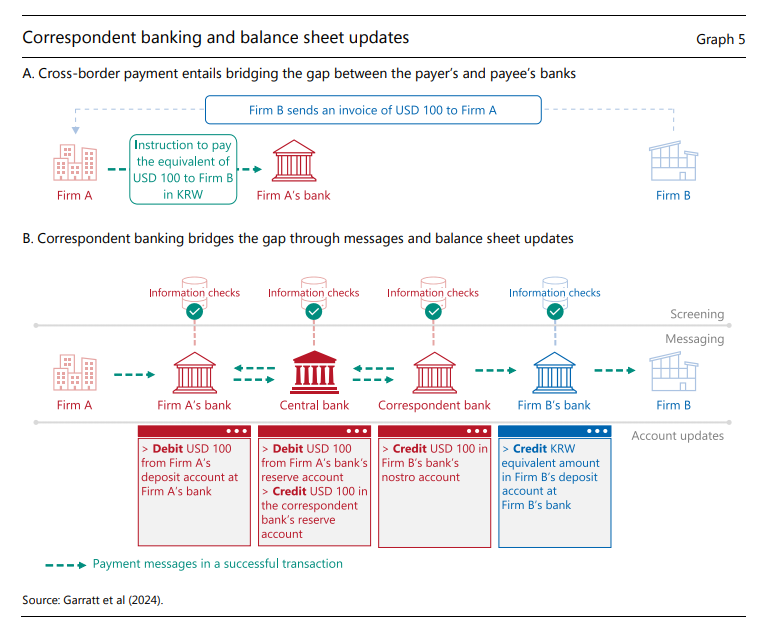
“代币化”--下一代货币和金融体系?
Hua Er Jie Jian Wen· 2025-06-26 09:04
Core Insights - The International Bank for Settlements (BIS) report highlights the transformative potential of tokenization in the evolution of the monetary and financial system, emphasizing the need for a triad of central bank digital reserves, commercial bank digital currencies, and tokenized government bonds as foundational elements of the future financial system [1][2][4] Group 1: Tokenization and Financial System - Tokenization represents a significant innovation in the monetary and financial system, transferring asset rights from traditional ledgers to programmable platforms, enabling integrated operations for information transfer, reconciliation, and asset transfer [2] - The core advantage of tokenization lies in its ability to execute conditions automatically, reducing counterparty risk and minimizing custody requirements through mechanisms like Delivery versus Payment (DvP) [3] Group 2: Central Bank's Role and Stablecoins - Central banks are positioned as catalysts for the transformation of the financial system, with BIS outlining four ways they can drive change [4] - Stablecoins have been evaluated against three critical tests: - They failed the unitary test, as they represent liabilities of specific issuers rather than a stable monetary unit [4] - They failed the elasticity test, as their issuance is constrained by the need for full upfront payment from holders, limiting liquidity support [4] - They failed the integrity test, as their use in public blockchains can facilitate illicit activities due to anonymity [4] Group 3: Market Dynamics and Regulatory Framework - The stablecoin market is rapidly growing but is highly concentrated, with USDT and USDC dominating the market, accounting for over 99% of stablecoins being dollar-denominated [5] - BIS emphasizes the need for a regulatory framework to ensure the safe development of tokenized finance, including compliance with anti-money laundering and counter-terrorism financing regulations [10]
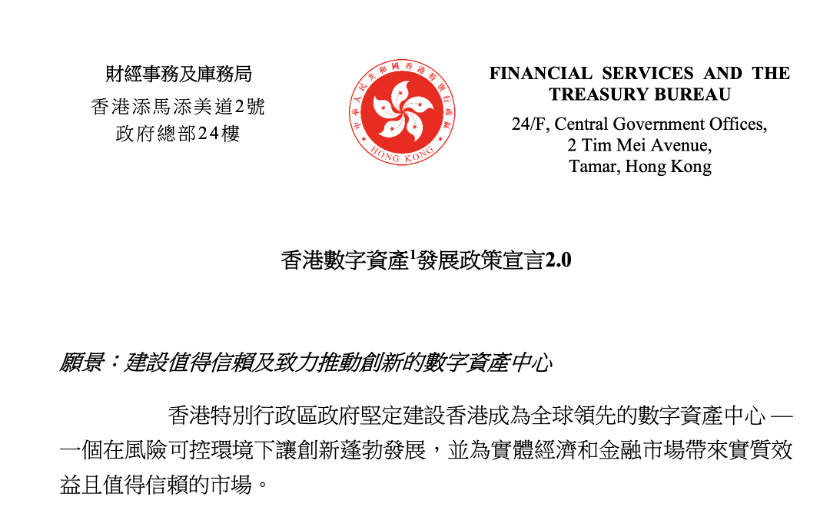
香港发表数字资产发展政策宣言2.0!
证券时报· 2025-06-26 08:27
Core Viewpoint - The Hong Kong Special Administrative Region government aims to establish Hong Kong as a global innovation hub in the digital asset sector through the release of the "Hong Kong Digital Asset Development Policy Declaration 2.0," building on initiatives from the first declaration issued in October 2022 [1] Group 1: Legal and Regulatory Optimization - The Hong Kong government is developing a unified and comprehensive regulatory framework for digital asset service providers, which includes digital asset trading platforms, stablecoin issuers, trading service providers, and custodians [2] - The Securities and Futures Commission (SFC) will be the main regulatory body for licensing digital asset trading and custody service providers, while the Financial Services and the Treasury Bureau and the Hong Kong Monetary Authority will lead a comprehensive review of laws to facilitate the tokenization of real-world assets [2] Group 2: Expansion of Tokenized Products - The government plans to regularize the issuance of tokenized government bonds and provide incentives for the tokenization of real-world assets, including clarifying stamp duty arrangements for exchange-traded funds [3] - There is an intention to promote broader tokenization of assets and financial instruments, showcasing the technology's application across various sectors, including precious metals and renewable energy [3] Group 3: Advancing Use Cases and Cross-Sector Collaboration - A licensing mechanism for stablecoin issuers will be implemented on August 1, which will help advance practical application scenarios [3] - The government aims to enhance collaboration among regulatory bodies, law enforcement, and technology providers to develop digital asset infrastructure, alongside launching a pilot funding program for blockchain and digital asset projects with market impact [3] Group 4: Talent and Partnership Development - The government is committed to collaborating with industry and academia to foster talent development, positioning Hong Kong as a center for knowledge sharing in digital assets and promoting international cooperation [4] - The Financial Secretary emphasized the potential of digital assets in financial technology, aiming to create a sustainable talent pool through the cultivation of entrepreneurs, researchers, and technical experts [4]