AI制药

Search documents
年内最大Biotech IPO落定,英矽智能(3696.HK)手握全球进展最快AI药物今起招股
Ge Long Hui· 2025-12-18 07:08
英矽智能(3696.HK)于12月18日至12月23日正式招股,拟全球发售94,690,500股。此次招股采用机制B,香港公开发售 初始分配比例10%,不设回拨机制。每股发售价24.05港元,每手500股,一手入场费12146.27港元。预计将于12月30日 挂牌上市。 作为今年香港资本市场规模最大的Biotech IPO,英矽智能目前公布的基石投资者堪称"全明星"阵容。 英矽智能获得一众机构热捧的核心逻辑在于,2025年起Biotech融资"强者恒强"的格局。 当传统药企仍困于"十年十亿美元"的研发魔咒,AI制药同行多停留于"讲故事"和"找方向"的阶段,英矽智能四年内已 推进30多个管线,依托自有AI平台实现了持续、稳定的创新成果输出。而其核心管线ISM001-055的IIa期积极数据,更 成为AI制药领域首个药效概念验证案例。 "技术突破+临床兑现"的双重确定性使英矽智能成为资本押注AI制药的最佳标的。 礼来公司、腾讯、淡马锡、施罗德、瑞银、橡树资本、易方达、泰康人寿等15家全球顶级机构豪掷1.15亿美元认购, 这份覆盖全球制药龙头、全球互联网龙头、国际主权基金、大型资产管理公司、全球主题基金、国内龙头公 ...

AI制药公司英矽智能今起招股,募资至多23亿港元
Xin Lang Cai Jing· 2025-12-18 04:05
英矽智能计划在本次IPO中全球发行94,690,500股。其中,香港公开发售9,469,500股,国际发售 85,221,000 股。以每股24.05港元的发行价计算,英矽智能将通过本次IPO募集至多约23亿港元,IPO市 值则将达134.06亿港元。 来源:视频滚动新闻 ...
2025港股最大Biotech IPO!英矽智能开启招股:坐拥全球进展最快AI药物
Zhi Tong Cai Jing· 2025-12-17 22:47
手握全球进展最快AI药物的英矽智能(03696)于12月18日至12月23日招股。本次IPO拟发行94,690,500股 H股,其中香港公开发售占10%,国际发售占90%。每股发售价24.05港元,每手500股,一手入场费 12146.27港元。公司预期将于12月30日挂牌买卖,从募资金额上看预计将是2025年港股市场上最大的 Biotech IPO。 值得注意的是,基石投资者中礼来公司和腾讯分别代表了英矽智能所处的两大产业赛道——生物医药和 科技领域的头部力量,这也是礼来首次入局基石投资者。与此同时,本次基石投资者呈现鲜明国际化属 性,不仅资金实力雄厚,更以"长线持有、价值成长"著称。此外,英矽智能IPO前投资阵容就已十分庞 大,包括华平资本、B Capital、Prosperity7、礼来亚洲基金、百度风投、启明创投、红杉中国、药明康 德(603259)等知名机构。 英矽智能已通过自主开发的生成式人工智能平台Pharma.AI产生逾20项临床或IND申报阶段的资产,其 中三项资产已授权予国际制药及医疗保健公司,最高合约总价值20亿美元,包括总额约110.0百万美元 的预付款项以及约19亿美元的里程碑付款, ...
2025港股最大Biotech IPO!英矽智能(03696)开启招股:坐拥全球进展最快AI药物
智通财经网· 2025-12-17 22:43
智通财经APP获悉,手握全球进展最快AI药物的英矽智能(03696)于12月18日至12月23日招股。本次IPO 拟发行94,690,500股H股,其中香港公开发售占10%,国际发售占90%。每股发售价24.05港元,每手500 股,一手入场费12146.27港元。公司预期将于12月30日挂牌买卖,从募资金额上看预计将是2025年港股 市场上最大的Biotech IPO。 英矽智能依托自研的Pharma.AI平台,高效搭建涵盖超过30个创新项目的管线组合,在需求广泛的肿 瘤、免疫、纤维化、代谢等领域都有涉及。据公司披露的研发数据,一款创新分子从0到1的研发耗时平 均不超过18个月,远短于传统方法(平均需时4.5年)。公司的核心资产Rentosertib(ISM001-055)也有望成 为全球首款经AI赋能发现并进入III期临床的候选药物。 商业化方面,英矽智能的业务遍及全球,全球收入最高的20家药企中13家和英矽智能有软件平台合作。 此外,英矽智能与Exelixis、美纳里尼等全球制药企业达成了3项管线授权合作,为公司带来20亿美元的 潜在收入。同时,包括赛诺菲、礼来、复星医药等在内的多家全球知名制药企业与英 ...
诺泰生物:行政处罚落地 轻装上阵推动稳健发展与创新布局
Zheng Quan Shi Bao Wang· 2025-12-17 12:28
Core Viewpoint - The recent administrative penalty imposed on Nuotai Bio (688076.SH) due to past issues has not negatively impacted the company's current operational performance, with significant revenue and profit growth reported for the first three quarters of 2025. Financial Performance - For the first three quarters of 2025, the company achieved a revenue of 1.527 billion yuan, representing a year-on-year increase of 21.95% - The net profit attributable to shareholders reached 445 million yuan, up 26.92% year-on-year - The net profit excluding non-recurring items was 437 million yuan, reflecting a 23.20% year-on-year growth [1] Business Growth and Strategy - The company's peptide raw material drug business continues to grow significantly, driven by the expanding GLP-1 market, and is a core driver of its performance [1] - Nuotai Bio is committed to a development strategy focused on time and technology leadership, with a foundation in peptide drugs and small molecule drugs, while strategically expanding into oligonucleotide business and cutting-edge fields like synthetic biology and AI drug development [1] Innovation and R&D - The company has made a significant breakthrough in innovative R&D, with its subsidiary, Hangzhou Nuoao Biopharmaceutical Technology Co., Ltd., receiving acceptance for the clinical trial application of the new drug Semaglutide tablets, marking a milestone in oral peptide delivery technology for weight management [1] - Currently, there are no approved oral Semaglutide formulations for weight management in the domestic and international markets, indicating a substantial market opportunity for Nuotai Bio [1] Global Influence and Collaborations - Nuotai Bio has established itself as a leading enterprise in the peptide raw material drug sector, overcoming technical bottlenecks in large-scale production of long-chain peptide drugs, and is one of the few companies capable of producing over 10 kilograms of Semaglutide and other long-chain modified peptide drugs in a single batch [2] - The company has engaged in collaborations with several leading generic drug companies for the development of Semaglutide and other raw material drug projects, maintaining high growth in peptide raw material sales [2] Pipeline Development - The company has comprehensively covered its GLP-1 pipeline products, building on the success of first-generation Liraglutide, second-generation Semaglutide, and dual-target Teplizumab, while also developing a three-target Retatrutide, with an initial investment of approximately 5.08 million yuan [2] - In addition to peptide drugs, Nuotai Bio is advancing in the oligonucleotide field, with plans for commercial production capacity expected to be completed by 2025, aiming for an annual production of 1,000 kilograms of oligonucleotides and 200 kilograms of PEG-conjugated cyclic peptides [3] Strategic Partnerships - The company has formed partnerships with NuoVision and DeepTech in the areas of synthetic biology and AI empowerment, accelerating the exploration of new business fields [3] - With the gradual rollout of new production capacity and breakthroughs in cutting-edge technology, Nuotai Bio is positioned for high-quality development across multiple tracks, creating long-term value for investors [3]

1.24亿!上市药企加码合成生物,剑指千吨级产能!
合成生物学与绿色生物制造· 2025-12-17 07:49
Core Viewpoint - SynBioCon reports that the biomanufacturing company, Saito Bio, has announced a change in part of its fundraising investment projects, adjusting the total investment of the original project from 367 million yuan to 229 million yuan, and reallocating 124 million yuan to a new project focused on biosynthetic technology research and industrialization [3]. Group 1: Investment Project Changes - The new investment project, "Biosynthetic Technology Research and Industrialization Project," has a total investment of 237 million yuan, with the implementation led by its wholly-owned subsidiary, Jinweiduo, aiming to establish production lines for 1,000 tons/year of Tartrate Tylosin and 200 tons/year of Phosphate Tylosin [5]. - Tartrate Tylosin and Phosphate Tylosin are commonly used drugs for preventing and treating mycoplasma infections in animals, significantly reducing the incidence of respiratory diseases in livestock, indicating strong market demand [5]. Group 2: Company Background and Strategy - Established in 2010, Saito Bio was the first to utilize genetic engineering and synthetic biology for the large-scale production of steroid drug raw materials, becoming a leading supplier of steroid drug raw materials in China [5]. - In 2019, Saito Bio set a long-term industrial upgrade strategy to create a biomanufacturing enterprise integrating "pharmaceutical intermediates - active pharmaceutical ingredients - formulations," successfully producing five major steroid raw material series using synthetic biology [5]. Group 3: Strategic Collaborations - In 2024, the company formed a strategic partnership with AI pharmaceutical company, InSilico Medicine, to leverage cutting-edge AI technology and optimize key steps in the engineering transformation process for synthetic biology research and innovative drug development [6].
英矽智能通过上市聆讯 与国际制药巨头礼来达成AI制药合作
Zheng Quan Shi Bao Wang· 2025-12-16 14:34
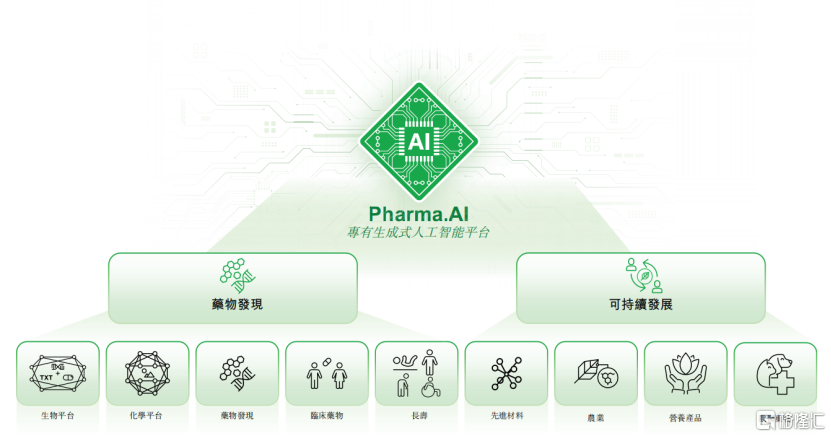
Pharma.AI是一个AI驱动的药物发现及开发平台,提供包括新靶点识别到小分子生成及临床结果预测的 端到端服务。Pharma.AI由Biology42、Chemistry42、Medicine42及Science42组成,旨在覆盖整个药物发 现和开发过程。Pharma.AI能够识别新的药物靶点,针对新型及既定的靶点从头设计分子,并优化候选 药物的临床开发。具体而言,公司的生成式AI驱动方法已识别出一种调节多种纤维化通路的潜在靶 点,从而引领开发出一种有潜力成为临床差异化疗法的新型小分子候选药物。 AI制药独角兽英矽智能于日前通过港交所上市聆讯,联席保荐人为摩根士丹利、中金公司 (601995)、广发证券(香港),距离登陆港股主板迈出关键一步。 根据招股书,本次英矽智能香港IPO募资净额目前计划将用于以下用途:为公司关键临床阶段管线候选 药物的进一步临床研发提供资金;开发新的生成式AI模型及相关的验证研究工作;进一步开发及扩展 公司的自动化实验室;为早期药物发现及开发(包括公司其他管线候选药物的临床前及临床阶段)提供资 金;将用作营运资金及其他一般企业用途。 英矽智能成立于2014年,为一家AI驱动药物发现及 ...
AI4S理解疾病机制,「哲源科技」获亿元A1轮融资
3 6 Ke· 2025-12-16 14:13
Core Insights - The core principle of drug development should be disease treatment, emphasizing the importance of understanding diseases and their mechanisms to improve drug research efficiency and success rates [3] Group 1: Company Overview - Zheyuan Technology, an AI4S (AI For Science) company, recently completed a financing round of over 100 million yuan, led by Guoke Investment [2] - The company positions itself as an "AI4S + disease" firm, focusing on a "computational medicine" platform to empower drug innovation, particularly in discovering new mechanisms and targets, as well as enhancing clinical trial processes [3] Group 2: Technological Innovations - Zheyuan Technology has developed a "virtual clinical trial" capability, which involves creating digital twins of patients to simulate drug responses based on individual omics data [4] - The platform allows for the evaluation of drug effects across thousands of potential indications during the drug pipeline validation phase, demonstrating AI's predictive capabilities in real projects [4] Group 3: Clinical Applications - In collaboration with Beijing Cancer Hospital, Zheyuan Technology conducted a virtual clinical parallel trial, predicting drug responses for eight enrolled patients, with AI predictions aligning perfectly with actual clinical trial results [5] - This approach enables the identification of suitable indications for drugs before formal human trials, potentially accelerating the clinical trial process [5] Group 4: Industry Challenges and Methodology - The market remains skeptical about the technological capabilities and commercial value of AI in drug development, particularly in complex areas like new target discovery and virtual clinical trials [6] - Zheyuan Technology's CEO outlines a five-level methodology for assessing innovative technology capabilities, ranging from identifying opportunities to producing verifiable results [6] Group 5: Business Model and Industry Impact - Zheyuan Technology aims to create an innovative drug "IP factory," leveraging a mature supply chain in the pharmaceutical industry to efficiently convert resources into drug assets [7] - The company seeks to transform drug development from an art into a predictable and replicable engineering process, addressing the industry's challenges of high costs and low success rates [7]
AI4S理解疾病机制,「哲源科技」获亿元A1轮融资 | 36氪首发
3 6 Ke· 2025-12-16 00:25
Core Insights - Zheyuan Technology, an AI4S company, has recently completed a financing round of 100 million yuan, led by Guoke Investment, with participation from Zeyuan Fund and Ruizi Pharmaceutical [1] - The AI pharmaceutical sector in China is gradually returning to rationality, with challenges in target discovery and clinical trials remaining significant despite advancements in AI tools [1][2] - The company positions itself uniquely by focusing on "AI4S + disease," aiming to enhance drug innovation through a computational medicine platform that emphasizes understanding diseases and their mechanisms [2] Industry Challenges - The development of mature targets has become highly competitive, while the discovery of new targets is facing depletion, leading to substantial financial investments in clinical trials with high failure risks [1][2] - The primary challenge in drug innovation is a deep understanding of diseases, which is essential for determining causal relationships between diseases and targets, as well as identifying potential indications and patient characteristics [2] Technological Innovations - Zheyuan Technology has developed a "digital twin" solution for life functions, creating virtual patients that reflect individual biological characteristics and disease features through high-dimensional mathematical models [3] - The company’s virtual clinical trial capabilities allow for the evaluation of drug effects across thousands of indication subtypes during the drug pipeline validation phase, significantly accelerating the clinical trial process [3] Validation and Results - The company has established a methodology for assessing the capabilities of innovative technologies, which includes five levels from identifying opportunities to producing verifiable results [4][5] - Zheyuan Technology has produced verifiable outcomes, including a class 1 innovative drug for pancreatic cancer that has entered clinical phase I and insights on over 200 potential targets, each with the potential to develop billion-dollar drug IP assets [5][6] Business Model - The company aims to create an innovative drug "IP factory," leveraging the mature supply chain in the pharmaceutical industry to efficiently convert resources into drug assets for patient benefit [5] - By building a foundational technology system, the company seeks to transform drug development from an art into a predictable and replicable engineering process, addressing the industry's historical challenges of long timelines and low success rates [6]
4000万美元投资收益挡不住日内近15%股价跳水,维亚生物当前价值几何?
Zhi Tong Cai Jing· 2025-12-15 12:36
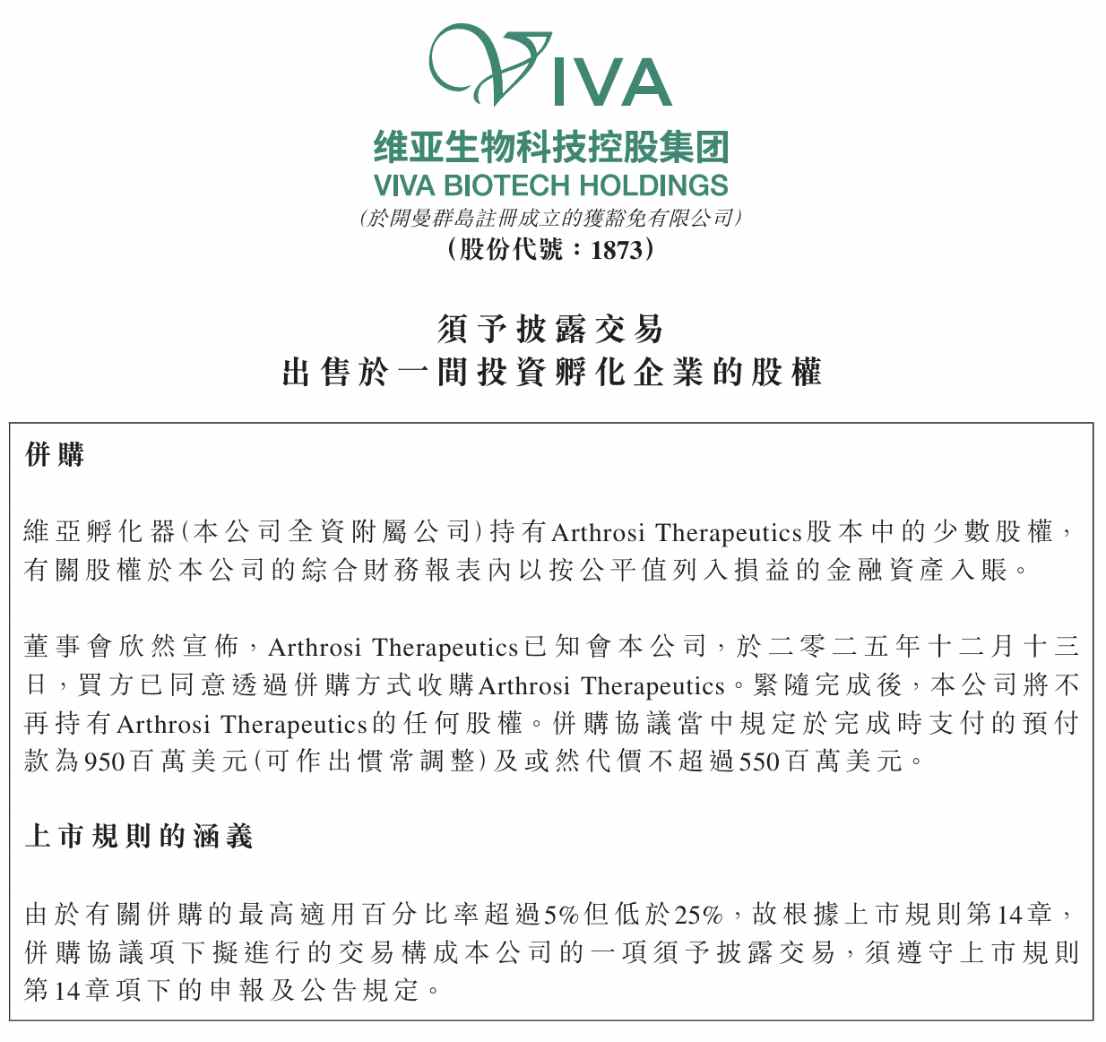
Group 1: Acquisition Announcement - Via Biotechnology (01873) announced that Swedish Orphan Biovitrum AB (Sobi) has reached an acquisition agreement for Arthrosi, with a total transaction value of up to $1.5 billion, including $950 million upfront and up to $550 million in regulatory and commercial milestone payments, expected to be completed in the first half of 2026 [1] - Via Biotechnology anticipates a maximum investment return of approximately $40 million from this transaction, contingent on subsequent regulatory approvals and commercialization milestones [6] Group 2: Stock Performance - Following the announcement, Via Biotechnology's stock opened high on December 15, reaching a peak of HKD 2.21, a 13.92% increase, but the market sentiment quickly reversed, leading to a significant drop in stock price later in the day [6] - The stock has been in a downward trend for two months, with a peak of HKD 3.27 on October 8, followed by a decline to a low of HKD 1.80 on November 24, representing a maximum drop of 44.95% [7] - The stock's trading volume during the recent price increases was significantly higher than during previous periods, indicating a "volume-price rise" characteristic, but the October rally showed signs of weakness with declining trading volumes [8][9] Group 3: Market Sentiment and Valuation - The stock's profit-taking behavior has been observed, with the proportion of profitable shares dropping from 100% on October 8 to 24.69% by December 12, while the average cost remains at HKD 2.30 [11] - The current market sentiment reflects a cautious approach towards AI investments, with a shift from enthusiasm to prudence, impacting Via Biotechnology as an AI concept stock [13] - Despite recent declines, Via Biotechnology's price-to-sales (PS) ratio is currently at 2.05, significantly lower than the industry average of 8.66, suggesting that the company may be undervalued [18] Group 4: Business Model and Financial Performance - Via Biotechnology has been actively investing in and incubating high-potential biotech startups through an "Equity for Service" model, exchanging early drug development services for equity stakes, with 93 companies incubated and 18 achieving partial or full exits [15] - The company's AI-driven drug development services are becoming a significant revenue driver, with AI-related orders accounting for 12% of new signed orders [14] - For the first half of 2025, the company reported revenues of RMB 832 million, a 15.27% decrease year-on-year, while net profit attributable to shareholders increased by 4.28% to RMB 122 million, with a gross margin of 40.8% [14]