反洗钱

Search documents
明确规则,惩治掩饰、隐瞒犯罪所得犯罪
Ren Min Ri Bao· 2025-08-25 22:27
Core Viewpoint - The Supreme People's Court and the Supreme People's Procuratorate jointly released an interpretation regarding the handling of criminal cases related to concealing and disguising criminal proceeds, effective from August 26, 2025, aiming to clarify judicial rules and unify legal application [1]. Group 1: Legal Framework and Context - The crime of concealing and disguising criminal proceeds is the most prevalent type of money laundering crime, closely linked to telecom fraud and online gambling [1]. - From 2020 to 2024, prosecutors initiated 230,200 cases of this crime, while courts concluded 220,900 first-instance cases, effectively deterring upstream crimes such as telecom fraud and online gambling [1]. Group 2: New Challenges and Legal Adaptations - The evolving nature of crime, including more sophisticated methods and the shift from theft to fraud, particularly telecom fraud, presents new challenges for legal application [2]. - The interpretation clarifies that any actions that conceal or disguise criminal proceeds, such as transferring funds or converting assets, fall under the scope of the law [2]. Group 3: Standards for Criminal Liability - The interpretation emphasizes strict adherence to the requirement of "knowing the proceeds are criminal" and modifies the standards for determining this knowledge to prevent overreach in criminal prosecution [3]. - A comprehensive assessment of social harm will be used to determine criminal liability, considering factors such as the relationship to upstream crimes, subjective malice, methods used, amounts involved, and consequences [3]. Group 4: Penalty Guidelines - The interpretation introduces differentiated standards for severe cases based on the type of upstream crime, setting thresholds of 5 million and 500,000 yuan for aggravated penalties [3]. - It also includes provisions for leniency in sentencing for individuals who significantly assist in tracing upstream crimes, encouraging cooperation in recovering losses [4].
不做犯罪“工具人”!最高法发布掩隐罪典型案例
21世纪经济报道· 2025-08-25 11:29
Core Viewpoint - Money laundering crimes severely threaten national security and financial safety, with the crime of concealing and disguising criminal proceeds being the most prevalent in practice [1]. Summary by Sections Overview of Money Laundering Crimes - From 2020 to 2024, prosecutorial authorities filed 230,200 cases of concealing and disguising criminal proceeds, while courts adjudicated 220,900 first-instance cases [1]. Legal Interpretations and Case Examples - On August 25, the Supreme People's Court and the Supreme People's Procuratorate jointly issued interpretations regarding the application of laws in cases of concealing and disguising criminal proceeds, along with six selected typical cases to enhance public awareness of anti-money laundering [1]. Case 1: Virtual Currency - Three individuals were sentenced to prison and fined for using virtual currency to help transfer criminal funds, knowing they were proceeds of crime [2][3]. Case 2: Large Gold Transactions - An individual was sentenced to three years and six months in prison and fined 50,000 RMB for facilitating the transfer of criminal proceeds through large gold transactions [5]. Case 3: Recycling Industry - An individual was sentenced to six years in prison for selling road steel plates, knowing they were criminal proceeds, demonstrating the use of the recycling industry to conceal crime [9]. Case 4: Upstream Crimes - In a case involving illegal sand mining, individuals were convicted of concealing and disguising criminal proceeds despite the upstream crime not being legally adjudicated [12][13]. Case 5: Distinction of Knowledge - A court clarified the distinction between concealing and disguising criminal proceeds and aiding crimes, adjusting the conviction based on the individual's knowledge and the nature of assistance provided [16][17]. Case 6: Role in Criminal Chain - The court evaluated the defendants' roles in the criminal chain and imposed sentences based on their acknowledgment of guilt and return of illegal gains [21].


不做犯罪“工具人”!最高法发布掩隐罪典型案例
2 1 Shi Ji Jing Ji Bao Dao· 2025-08-25 09:08
Core Viewpoint - Money laundering crimes severely threaten national security and financial safety, with the crime of concealing and disguising criminal proceeds being the most prevalent in practice [1] Group 1: Legal Proceedings and Statistics - From 2020 to 2024, the prosecution of the crime of concealing and disguising criminal proceeds reached 230,200 cases, while the courts concluded 220,900 first-instance cases [2] - On August 25, the Supreme People's Court and the Supreme People's Procuratorate jointly issued an interpretation regarding the application of laws in cases of concealing and disguising criminal proceeds, along with six selected typical cases to enhance public awareness of anti-money laundering [2] Group 2: Case Examples - Case 1: Three individuals were sentenced to prison and fined for using virtual currency to help transfer criminal funds, knowing they were proceeds of crime [3] - Case 2: An individual was sentenced to three years and six months in prison and fined for cooperating in a large gold transaction that concealed criminal proceeds [6] - Case 3: An individual was sentenced to six years in prison for selling road steel plates, knowing they were of unknown origin and likely criminal proceeds [9] - Case 4: In a case involving illegal sand mining, individuals were sentenced for transferring and transporting sand they knew was criminal proceeds, despite the upstream crime not being legally adjudicated [12] - Case 5: A court re-evaluated a case to correctly classify the crime as concealing and disguising criminal proceeds rather than aiding information network crime, leading to a different sentencing [15] - Case 6: Two defendants were sentenced to two years in prison and fined for their roles in the criminal chain, with the court considering their acknowledgment of guilt and return of illegal gains [18]
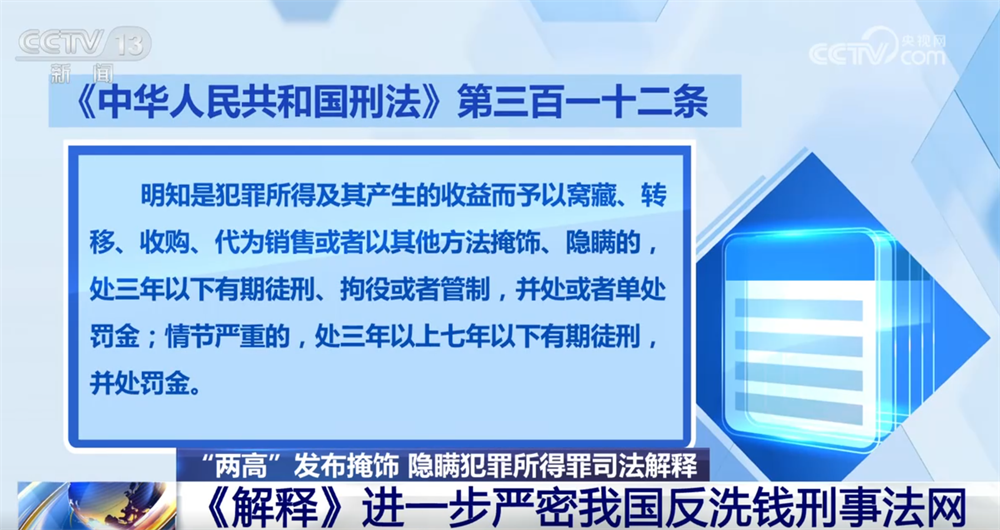
“两高”发布司法解释进一步严密我国反洗钱刑事法网 来看典型案例→
Yang Shi Wang· 2025-08-25 04:18
Core Viewpoint - The Supreme People's Court and the Supreme People's Procuratorate jointly released an interpretation regarding the handling of criminal cases related to concealing and disguising criminal proceeds, which aims to strengthen the legal framework against money laundering and related crimes, particularly in the context of rising telecommunications fraud and online gambling [1][3]. Summary by Sections Legal Framework - The interpretation consists of 12 articles and will take effect on August 26, 2025, providing clearer judicial guidelines for handling cases of concealing and disguising criminal proceeds [3]. - Article 312 of the Criminal Law defines the crime of concealing and disguising criminal proceeds, with penalties ranging from less than three years of imprisonment to seven years for serious cases [1]. Key Changes - The interpretation tightens the legal net by expanding the definition of "other methods" to include various actions that can conceal or disguise criminal proceeds, such as intermediary transactions, fund transfers, and cross-border asset transfers [5]. - It emphasizes the strict requirement of subjective knowledge, ensuring that individuals are only prosecuted if they knowingly handle criminal proceeds, thus preventing overreach in legal interpretations [5][6]. Adjustments in Penalties - The threshold for "serious circumstances" has been adjusted to 500,000 and 5 million yuan, depending on the type of upstream crime, to ensure proportionality in sentencing [8][10]. - The adjustment addresses discrepancies in sentencing between upstream and downstream crimes, particularly in cases involving illegal mining and related activities [12]. Encouragement for Cooperation - The interpretation includes provisions for leniency in sentencing for individuals who actively cooperate with judicial authorities in tracing upstream crimes, promoting a collaborative approach to law enforcement [12]. - Special consideration is given to minors and students involved in such crimes, allowing for potential dismissal or non-prosecution based on the specifics of the case [12]. Impact on Crime Statistics - From 2020 to 2024, prosecutors initiated 230,200 cases of concealing and disguising criminal proceeds, with courts concluding 220,900 first-instance cases, indicating a significant deterrent effect on telecommunications fraud and online gambling [14]. Case Example - A notable case involved a jewelry store owner who facilitated large purchases of gold with funds from telecommunications fraud, resulting in a sentence of three years and six months, highlighting the practical application of the new interpretation [15][21].
农发行贵州分行桐梓县支行积极开展 贵金属与宝石行业反洗钱宣传活动
Sou Hu Cai Jing· 2025-08-25 04:07
Core Viewpoint - The Agricultural Development Bank of China (ADBC) in Tongzi County has organized an anti-money laundering (AML) campaign aimed at enhancing risk awareness among specific non-financial industries, particularly in the precious metals and gemstones sectors, to create a safe and stable financial environment [1][3]. Group 1: Campaign Details - The campaign utilized innovative promotional methods, leveraging the branch's physical presence to engage the public [3]. - Various forms of outreach were employed, including eye-catching slogans, informative display boards, dedicated consultation desks, and distribution of AML knowledge brochures to customers and passersby [3]. - Bank staff acted as presenters, using simple language and real-life examples to explain the dangers of money laundering, common tactics, and potential risks in precious metals and gemstones transactions [3]. Group 2: Public Engagement - The event attracted significant public interest, particularly from consumers interested in investing in precious metals and gemstones, leading to in-depth discussions on identifying suspicious transactions and fulfilling legal obligations [3]. - Participants reported an increased ability to recognize money laundering activities and a better understanding of their responsibilities in AML efforts, expressing a commitment to cooperate in maintaining financial security [3]. Group 3: Future Initiatives - ADBC in Tongzi County is committed to fulfilling its AML obligations and social responsibilities, planning to continue innovating its promotional strategies and expanding outreach to enhance the effectiveness of its AML initiatives [4].

反洗钱利国又利民 持续推动打击治理洗钱违法犯罪
申万宏源证券上海北京西路营业部· 2025-08-22 02:27
Core Viewpoint - The article emphasizes the importance of anti-money laundering (AML) efforts, highlighting the direct and indirect harms caused by money laundering to society and the economy, and the government's commitment to strengthening legal frameworks and enforcement against such crimes [2][4][9]. Group 1: Direct Harms of Money Laundering - Money laundering undermines the stability of the economic system, leading to economic distortion and disorder [4]. - It acts as a financial lifeline for other serious criminal activities, including drug trafficking, terrorism, smuggling, corruption, fraud, and tax evasion [4]. - It poses significant risks to banks and financial institutions, damaging the credibility of the financial system [3]. Group 2: Government Actions and Legal Framework - Since 2020, the Supreme People's Procuratorate has significantly increased the prosecution of money laundering cases, with 2,971 individuals prosecuted in 2023, nearly 20 times the number in 2019 [5]. - In the first half of 2024, 1,391 individuals were prosecuted for money laundering, representing a year-on-year increase of 28.4% [5]. - The legal basis for prosecuting money laundering includes various articles in the Criminal Law, which have been expanded to include self-money laundering and other related offenses [6][7]. Group 3: Legal Revisions and Enforcement - The Criminal Law Amendment (XI) made significant changes to the definitions and penalties for money laundering, removing terms like "knowingly" and "assist," and including self-money laundering in the scope of prosecution [7]. - The recent legal interpretations clarify the standards for recognizing self-money laundering and other related crimes, providing a clearer legal basis for enforcement [8]. - The government is committed to enhancing the effectiveness of AML measures through improved collaboration between prosecutorial and judicial bodies, establishing mechanisms for better case handling [8]. Group 4: Public Awareness and Prevention - The article encourages the public to enhance their awareness of AML practices and to be cautious with personal financial information [10][11]. - It provides guidelines on what individuals should avoid to protect themselves from potential money laundering activities, such as not sharing personal financial information and being wary of high-return investment schemes [11].

民生银行济南千佛山支行走进社区开展反洗钱宣传
Qi Lu Wan Bao· 2025-08-21 09:29
Core Viewpoint - The community outreach event organized by Minsheng Bank's Jinan Qianfoshan branch focused on anti-money laundering education, engaging over 100 residents in a lively atmosphere to enhance financial security awareness [1] Group 1: Event Overview - The event featured interactive sessions where bank staff explained anti-money laundering concepts using relatable examples, making the topic accessible to residents [1] - Over 100 anti-money laundering pamphlets were distributed, serving as a "safety manual" for residents, covering legal interpretations and prevention techniques [1] Group 2: Community Engagement - Residents actively participated by asking questions and sharing their concerns, fostering a warm and engaging environment [1] - The initiative aimed to demystify money laundering, with residents expressing newfound awareness of its relevance in everyday life [1] Group 3: Future Plans - Minsheng Bank's Jinan Qianfoshan branch plans to continue similar outreach activities to further promote anti-money laundering awareness within the community [1] - The goal is to strengthen the financial security framework of the community by educating more families about the risks associated with money laundering [1]

年内二度受罚!京东旗下支付机构因十项违规被罚近千万元!
Nan Fang Du Shi Bao· 2025-08-19 12:16
京东旗下支付公司年内再次被罚!近日,中国人民银行北京市分行最新公布的行政处罚决定信息显示, 支付机构网银在线(北京)支付科技有限公司(下称"网银在线")因十项违法行为被警告,并被没收违 法所得219万元,并处罚款约743万元,罚没共计962万元。 此外,先后时任网银在线产品部门负责人、副总裁、总裁等职位的黄某,因对其中的部分违法行为负有 直接责任,被警告并处罚款33万元。 值得一提的是,这已不是网银在线年内首次收罚单,2025年2月,该公司曾被罚超100万元。 涉及10项违法行为 具体来看,本次网银在线被罚主要因十项违法行为,分别是:1.未按规定建立并落实特约商户实名制管 理制度;2.未按规定保存特约商户档案;3.支付接口管理不规范;4.未按规定建立特约商户信息共享联 防机制;5.服务协议约定不规范;6.开立单位支付账户未按规定核实法定代表人开户意愿;7.违规进行 支付账户到银行账户的非同名划转;8.未按规定开展代收业务;9.未能确保交易信息真实、完整、可追 溯;10.未按规定办理备付金业务。 从违法行为来看,网银在线涉及反洗钱管理不力、特约商户管理存在漏洞、支付接口与系统管理缺陷、 清算与账户管理违规、备付 ...
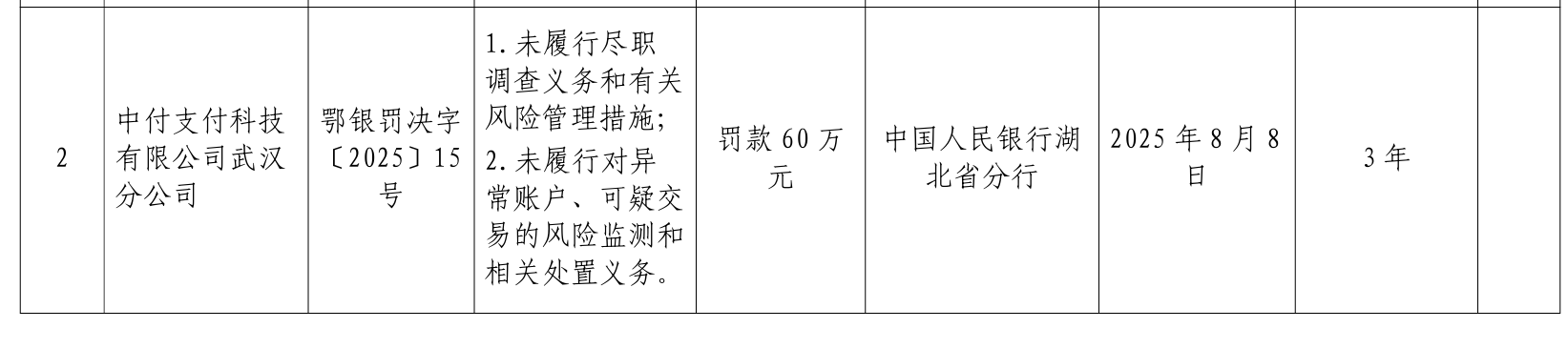
中付支付武汉分公司被罚款60万元 因违反反洗钱相关规定等违规
Feng Huang Wang Cai Jing· 2025-08-18 08:24
凤凰网财经讯 近日,据中国人民银行湖北省分行官网消息显示,中付支付武汉分公司因未履行尽职调查义务和有关风险管理措施,未履行对异常账户、可 疑交易的风险监测和相关处置义务等2项违规,被罚款60万元。 上述"未履行尽职调查义务和有关风险管理措施"违规行为出自金融机构反洗钱规定第九条"金融机构应当按照规定建立和实施客户身份识别制度";"未履行 对异常账户、可疑交易的风险监测和相关处置义务"违规行为出自金融机构反洗钱规定第十一条"金融机构应当按照规定向中国反洗钱监测分析中心报告人民 币、外币大额交易和可疑交易"。 | | | | 1. 未履行尽职 调查义务和有关 | | | | --- | --- | --- | --- | --- | --- | | | 中付支付科技 | 鄂银罚决字 | 风险管理措施; | 罚款 60 万 | 中国人民银行 | | 2 | 有限公司武汉 | [2025] 15 | 2.未履行对异 | 元 | 北省分行 | | | 分公司 | 특 | 常账户、可疑交 | | | | | | | 易的风险监测和 | | | | | | | 相关处置义务。 | | | ...
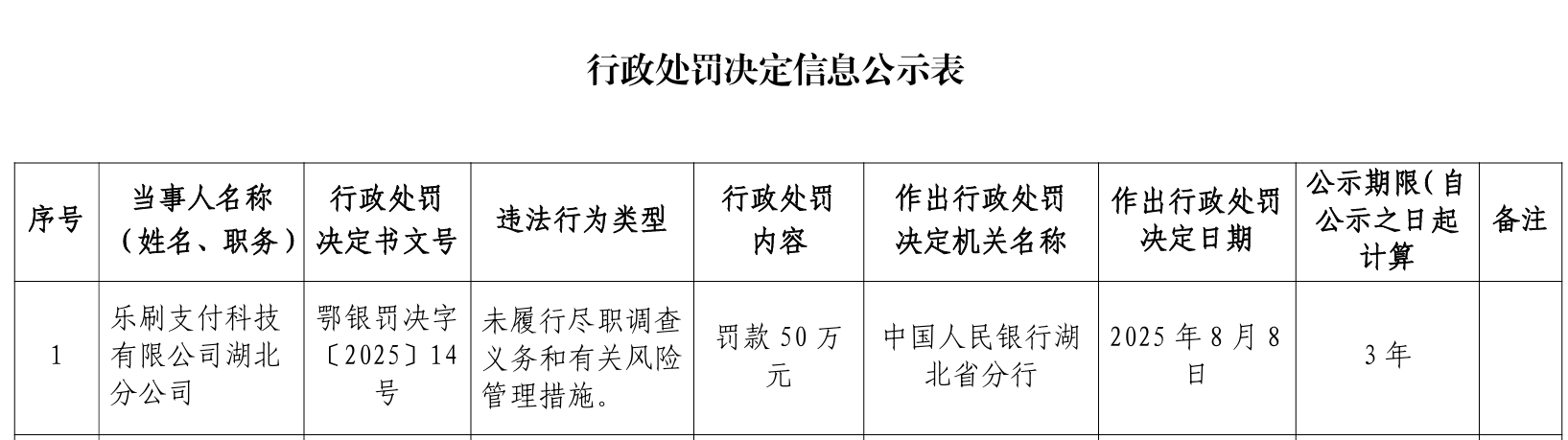
乐刷支付湖北分公司被罚款50万元 因违反反洗钱相关规定违规
Feng Huang Wang Cai Jing· 2025-08-18 07:13
Group 1 - The company LeShua Payment Technology Co., Ltd. was fined 500,000 yuan for failing to fulfill due diligence obligations and related risk management measures [2] - The violation was identified under the anti-money laundering regulations, specifically Article 9, which mandates financial institutions to establish and implement customer identity recognition systems [2]