
育儿补贴制度

Search documents
重磅利好,每孩每年3600元!国家育儿补贴方案发布
新浪财经· 2025-07-29 09:36
Core Viewpoint - The implementation plan for the national childcare subsidy system has been announced, which will provide annual subsidies for children under three years old starting from January 1, 2025, with a base standard of 3,600 yuan per child per year [1][2]. Summary by Sections Subsidy Implementation - The childcare subsidy will be issued to children under three years old who are born in accordance with legal regulations starting from January 1, 2025 [2]. - The subsidy will be paid annually, with the current national base standard set at 3,600 yuan per child per year, continuing until the child turns three [1][2]. Application Process - Parents or guardians of the child must apply for the subsidy at the child's registered household location [2][9]. - Applications can be submitted online through the childcare subsidy information management system or offline [2][9]. - The subsidy will be disbursed through the bank account of the applicant or the child, with encouragement to use the "one card" system for financial subsidies or the child's social security card [2][9]. Eligibility and Calculation - The subsidy is available for all children, regardless of whether they are the first, second, or third child, as long as they meet the legal birth requirements [2]. - Children born before January 1, 2025, who are under three years old will also be eligible for the subsidy, calculated based on the number of months eligible for the subsidy [2][5].


事关育儿补贴,明天四部门将举行重磅发布会
第一财经· 2025-07-29 09:16
Group 1 - The State Council Information Office will hold a press conference on July 30, 2025, at 2 PM to discuss the childcare subsidy system and fertility support measures [1]

中共中央办公厅 国务院办公厅印发《育儿补贴制度实施方案》
Xin Hua She· 2025-07-29 09:15
新华社北京7月28日电 近日,中共中央办公厅、国务院办公厅印发了《育儿补贴制度实施方案》, 并发出通知,要求各地区各部门结合实际认真贯彻落实。 《育儿补贴制度实施方案》主要内容如下。 为贯彻落实党中央关于完善生育支持政策体系和激励机制的决策部署,推动建设生育友好型社会, 制定本方案。 一、总体要求 坚持以习近平新时代中国特色社会主义思想为指导,深入贯彻党的二十大和二十届二中、三中全会 精神,坚持以人民为中心的发展思想,在发展中保障和改善民生,建立实施育儿补贴制度,营造生育友 好社会氛围。 工作中要做到:坚持改善民生、惠民利民,有效降低家庭生育养育成本;坚持统筹衔接、保障公 平,与现行民生政策相衔接,确保符合条件的婴幼儿平等享受补贴;坚持尽力而为、量力而行,统筹考 虑人口发展状况和经济社会发展水平,合理确定补贴范围和标准,确保财政可负担、政策可持续;坚持 安全规范、简便易行,严格资格审核,规范发放流程,提高办事效率,确保资金安全,切实把好事办 好。 二、补贴对象和标准 (一)补贴对象。从2025年1月1日起,对符合法律法规规定生育的3周岁以下婴幼儿发放补贴,至 其年满3周岁。 (二)初审。婴幼儿户籍所在地乡镇政 ...
宏观研究报告:育儿补贴快评:“投资于人”具像化
Yin He Zheng Quan· 2025-07-29 08:38
网:lvlei_yj@chinastock.com.cn 分析师登记编码:S0130524080002 宏观研究报告 育儿补贴快评:"投资于人"具像化 事件:7月28日,中办、国办印发《育儿补贴制度实施方案》,从2025年1月 1 日起,对 3 周岁以下婴幼儿每年发放 3600元补贴。 2025 年 7 月 29 日 分析师 张迪 ☎:010-8092-7737 网: zhangdi_yj@chinastock.com.cn 分析师登记编码:S0130524060001 目雷 ☎: 010-8092-7780 www.chinastock.com.cn 证券研究报告 请务必阅读正文最后的中国银河证券股份有限公司免责声明。 一、育儿补贴正式公布,财政支持千亿规模。育儿补贴成为国家制度,是"投 o 资于人"政策方向的坚实一步。根据方案公布的补贴标准,育儿补贴按年发放, 现阶段国家基础标准为每孩每年 3600 元。其中对 2025 年 1 月 1 日之前出生、不 满 3 周岁的婴幼儿(2022~2024 年出生),按应补贴月数折算计发补贴。2022- 2024 年我国出生人口数量分别为 956、902、954 万人 ...
重要预告:明日14时!
Shang Hai Zheng Quan Bao· 2025-07-29 08:24
Group 1 - The State Council Information Office will hold a press conference on July 30, 2025, at 2 PM to discuss the childcare subsidy system and fertility support measures [1] - Key officials from the National Health Commission, Ministry of Finance, National Healthcare Security Administration, and All-China Federation of Trade Unions will be present to provide information and answer questions [1]
东兴证券晨报-20250729
Dongxing Securities· 2025-07-29 08:14
Economic News - The Ministry of Industry and Information Technology proposed to formulate financial support guidelines for new industrialization, emphasizing the importance of value creation and industry governance [1] - The State Council issued a plan for a childcare subsidy system, providing annual subsidies of 3600 yuan per child for those under three years old starting January 1, 2025 [1] - The National Energy Administration emphasized the need for monitoring electricity supply and demand, aiming to establish a unified national electricity market by the end of the year [1] - Malaysia revised its 2025 economic growth forecast down to between 4% and 4.8%, with inflation expectations adjusted to 1.5%-2.3% [1] - China and the U.S. held trade talks in Sweden to implement previous agreements and promote bilateral economic relations [1] - The Guangdong Paper Industry Association called for resisting low-price competition and maintaining market order in the paper industry [1] - The China Federation of Logistics and Purchasing reported a stable growth in social logistics, with a total of 171.3 trillion yuan in the first half of the year, a 5.6% increase year-on-year [1] Company News - Zhonghua International plans to acquire 100% equity of Nantong Xingchen from Bluestar Group through a share issuance, with the valuation and transaction price yet to be determined [5] - Huahua Co., Ltd. intends to raise up to 586 million yuan through a private placement for automation and information technology upgrades in its production lines [5] - China Tungsten High-Tech plans to acquire machinery and land use rights from Minmetals Tungsten for 123 million yuan to enhance production capacity [5] - Jidian Co. announced the full production of its integrated green hydrogen and ammonia project, which includes 700 MW of wind power and 100 MW of solar power [5] - Rejing Bio developed a rapid test kit for Chikungunya virus antibodies, although it has not yet received regulatory approval for medical use [5][6] Industry Analysis - Western Mining (601168.SH) reported a 26.59% increase in revenue to 31.619 billion yuan and a 15.35% increase in net profit to 1.869 billion yuan for the first half of 2025, indicating a new expansion cycle [7] - The company achieved significant growth in the production of various minerals, including copper (9.18 million tons, +7.65%), zinc (6.29 million tons, +18.61%), and lead (3.51 million tons, +24.63%) [8] - The copper segment remains the core business, contributing 76% of revenue and 67% of gross profit, with a notable increase in both volume and price [8] - The company’s smelting production also saw improvements, with copper production rising by 49.94% to 182,200 tons in the first half of 2025 [9] - The company maintained stable profitability, with a slight decrease in gross margin from 21.06% to 19.98% but an increase in ROE from 10.45% to 11.10% [10][11] - Future revenue projections estimate 56.03 billion yuan in 2025, 58.64 billion yuan in 2026, and 60.9 billion yuan in 2027, with corresponding net profits of 3.84 billion yuan, 4.11 billion yuan, and 4.53 billion yuan [11]

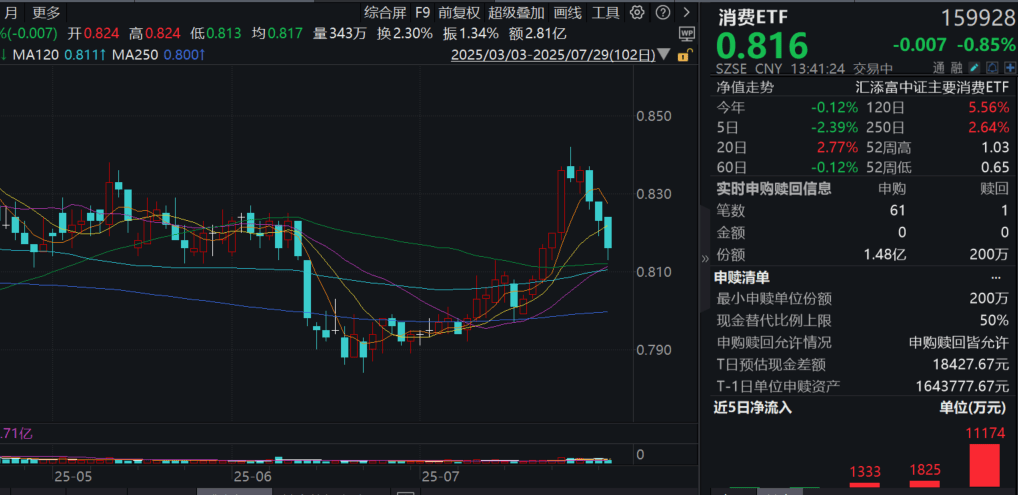
育儿补贴重磅落地,3周岁前每娃每年3600元!消费ETF(159928)跌近1%,盘中获的资金大举净申购超1.4亿份,连续第4日“吸金”!
Sou Hu Cai Jing· 2025-07-29 06:11
Group 1: Market Overview - A-shares mostly declined, with the consumer sector experiencing a third consecutive day of pullback [1] - The Consumer ETF (159928) fell nearly 1%, with a trading volume of nearly 300 million yuan [1] - The Consumer ETF has seen net subscriptions of 14.6 million units over the past four days, with a total scale exceeding 12.2 billion yuan, leading its peers [1] Group 2: Policy Announcement - On July 28, the national childcare subsidy policy was announced, providing an annual subsidy of 3,600 yuan for each child under three years old starting January 1, 2025 [3] - The policy aims to reduce the cost of raising children for families and is expected to benefit over 20 million families annually [3] - The implementation of this policy marks a significant shift from local pilot programs to a nationwide system [5] Group 3: Investment Opportunities - The childcare subsidy is expected to create opportunities in four sectors: dairy products, mother-baby chains, infant products, and postpartum care services [6] - The dairy sector, particularly infant formula and liquid milk, is likely to see direct demand benefits from the subsidy [6] - Mother-baby chains are expected to experience improved same-store sales performance due to increased birth rates [6] - The postpartum care market in mainland China has significant growth potential, with a current penetration rate of 17% compared to higher rates in Singapore, South Korea, and Taiwan [7] Group 4: Economic Impact - The annual subsidy scale is estimated to be around 100 billion yuan, which will directly increase disposable income for families [8] - The direct cash subsidy is expected to stimulate consumption, particularly in childcare-related spending and among the young adult demographic [8] - The policy is seen as a step towards investing in human capital, with potential long-term benefits for the economy [9]
育儿补贴怎么申领?哪些家庭可领取?六大热点问答
天天基金网· 2025-07-29 03:32
国家卫健委网站发布育儿补贴制度政策问答。其中提到,目前,各地正在抓紧制定育儿补贴制度具体实施 方案,积极做好各项准备工作,预计各地可以在8月下旬陆续开放申领育儿补贴。 哪些家庭可以申领育儿补贴?补贴标准为何如此设定?地方已有补贴政策怎样衔接?记者采访 多位专家,对热点问题做出解读。 一问:哪些家庭可领取育儿补贴? 从2025年1月1日起,每孩每年发放育儿补贴3600元,至其年满3周岁——国家育儿补贴制度实 施方案28日公布。这是一项全国性的重要民生政策,面向育儿家庭全国范围全面直接发放现金 补贴,有助于缓解家庭养育压力。 根据方案, 补贴对象为从2025年1月1日起,符合法律法规规定生育的3周岁以下婴幼儿。换言 之,无论一孩、二孩、三孩,均可申领育儿补贴。 2025年1月1日前出生、不满3周岁的婴幼儿,也可享受政策,按应补贴月数折算计发补贴。 中国人口与发展研究中心主任贺丹表示,一孩、二孩、三孩均可领取补贴,且标准相同,实现 了三孩生育政策下家庭支持的全面覆盖,体现了政策的普惠性和公平性。 首都经济贸易大学劳动经济学院教授姜全保认为,一孩生育是家庭生育决策的关键,将一孩也 纳入补贴范畴,能一定程度帮助缓解年轻 ...

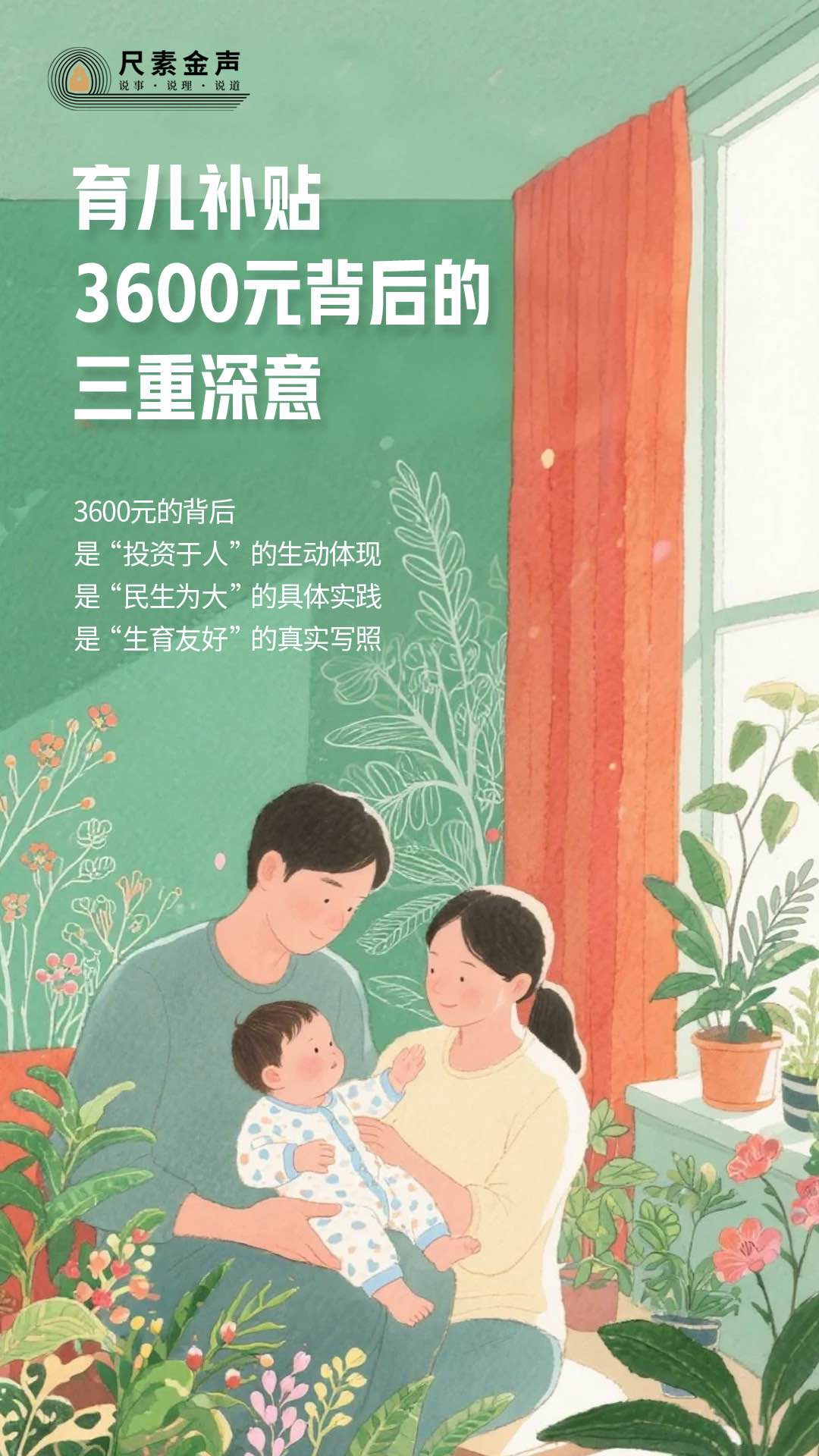
育儿补贴,3600元背后的三重深意
Ren Min Ri Bao· 2025-07-29 00:54
Group 1 - The core viewpoint of the news is the implementation of a universal childcare subsidy policy in China, which will provide financial support to families with children under three years old starting from January 1, 2025, with an annual subsidy of 3,600 yuan per child [1][2][4] - The subsidy is part of a broader strategy to address demographic challenges, including declining birth rates and an aging population, and aims to promote high-quality population development and long-term national growth [2][3][7] - The policy reflects the government's commitment to improving people's livelihoods and reducing the economic burden of raising children, which has been a significant concern for many families [4][5][6] Group 2 - The childcare subsidy is seen as a significant investment in human capital, contributing to the long-term accumulation of human resources and supporting multiple policy goals such as increasing household income, boosting consumption, and expanding domestic demand [2][3] - The initiative is part of a comprehensive approach to create a "birth-friendly" society, which includes improving the overall environment for childbirth, child-rearing, and education, thereby fostering a positive cycle of population reproduction [7][8] - The policy aims to lower the costs associated with childbirth and child-rearing, thereby encouraging families to have more children and addressing the societal value of caregiving [6][7]
中信证券:育儿补贴制度落地,四大领域迎接机遇
news flash· 2025-07-29 00:37
Core Viewpoint - The implementation of the childcare subsidy system is expected to create opportunities in four key sectors: dairy products, maternal and infant chains, baby products, and postpartum care services [1] Summary by Relevant Categories Policy Overview - The State Council issued the "Implementation Plan for Childcare Subsidy System," which provides an annual subsidy of 3,600 yuan per child for infants under three years old [1] - The total annual subsidy amount is estimated to be around 100 billion yuan, funded by the central government [1] Coverage and Local Adaptation - The policy significantly expands the coverage to include all infants under three years old [1] - There is potential for differentiated local subsidies, allowing financially strong provinces with high population inflow to increase subsidies based on local needs [1] Investment Recommendations - The report recommends focusing on four sectors that are likely to benefit from the new subsidy: 1. Dairy products 2. Maternal and infant chains 3. Baby products 4. Postpartum care services [1]
