
增强现实

Search documents
智能眼镜或将重塑人机交互方式
Ke Ji Ri Bao· 2025-04-29 23:55
Core Viewpoint - Smart glasses are evolving from futuristic concepts to real products, driven by advancements in AI, display technology, and miniaturization, potentially revolutionizing human-computer interaction and personal computing [1][2]. Group 1: Technological Advancements - Major breakthroughs in augmented reality (AR) display technology have significantly enhanced the clarity, color accuracy, and field of view, creating an unprecedented immersive experience [2]. - The introduction of AI has transformed smart glasses from mere tech gadgets into intelligent assistants that improve daily life quality through features like instant translation and object recognition [2]. - Improvements in battery life and interaction methods, such as gesture control and voice commands, are essential for the development of smart glasses [2]. Group 2: Applications in Various Fields - In the medical field, smart glasses can provide real-time access to patient data, enhancing surgical precision and efficiency [3]. - In education, they create immersive learning environments that make abstract concepts more tangible [3]. - In navigation and tourism, smart glasses offer real-time route guidance and information about attractions, enriching the travel experience [3]. - In daily life and entertainment, they seamlessly integrate social information and digital content into the user's view, redefining human-computer interaction [3]. Group 3: Industry Players and Market Dynamics - Meta leads the consumer smart glasses market, having sold over 1 million Ray-Ban Meta smart glasses by 2024, and has introduced real-time translation features [4]. - Google has entered the smart glasses space with its Android XR smart glasses, which include voice interaction, real-time translation, and environmental awareness capabilities [4]. - Other companies like Seiko Epson, Snap, Amazon, Huawei, and Lenovo are also actively developing smart glasses, while Apple is laying the groundwork for future entry with its AR Kit and XR technology [5]. Group 4: Standardization and Future Outlook - As smart glasses gain popularity, data security and privacy concerns are prompting regulatory bodies to establish guidelines to balance functionality and privacy [6]. - Industry organizations are collaborating to create unified production standards focusing on interoperability, data security, and comfort, which are crucial for a sustainable smart glasses ecosystem [7]. - The future of smart glasses may extend beyond being mere electronic devices, potentially evolving into the next generation of personal computing platforms that integrate digital information into the physical world [7].
研判2025!中国消费品零售行业相关政策、行业现状及重点企业分析:消费升级趋势持续深化,服务性消费与新兴品类成增长新引擎[图]
Chan Ye Xin Xi Wang· 2025-04-16 01:20
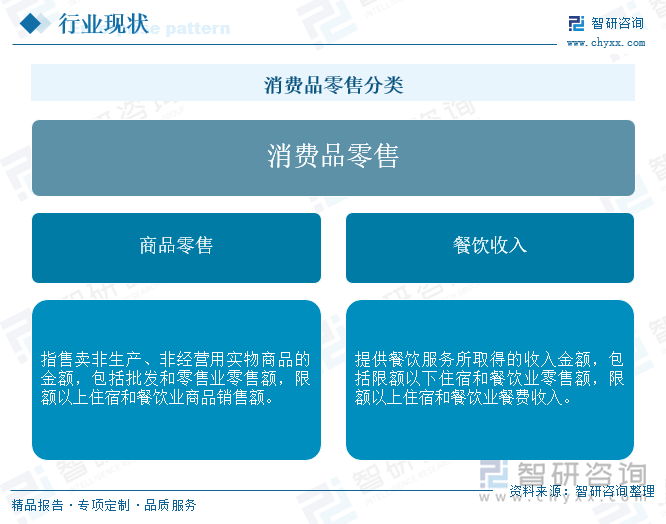
Core Viewpoint - The Chinese consumer goods retail industry is showing signs of gradual recovery, with a total retail sales of 8.37 trillion yuan in January-February 2025, reflecting a year-on-year growth of 2.98% despite external challenges [1][12]. Industry Overview - Consumer goods retail refers to the commercial activity of selling final consumer goods directly to consumers, playing a crucial role in the distribution of goods from producers to consumers [2]. - The industry has evolved through three main stages: the essential goods phase (1978-1995), rapid growth phase (1996-2010), and the personalized consumption phase (2011-present) [4][5][6]. Industry Development - The retail sales of goods increased by 3.9% year-on-year, with significant growth in specific categories such as communication equipment (26.2%) and cultural office supplies (21.8%) [1][12]. - The retail sales of new energy passenger vehicles surged by 35.5%, with a retail penetration rate of approximately 45%, indicating strong growth in the automotive consumption market [1][12]. Industry Chain - The upstream of the consumer goods retail industry includes suppliers from various sectors such as food and beverages, daily necessities, cosmetics, clothing, and electronics, providing resources for the midstream retail sector [8]. Policy Environment - The Chinese government is implementing policies to enhance consumption quality and structure, with the "Three-Year Action Plan for Optimizing the Consumption Environment (2025-2027)" aiming for significant improvements in consumer experience and market order by 2027 [10][11]. Current Industry Status - The service retail sector grew by 4.9% year-on-year, outpacing goods retail growth, with notable increases in dining (4.3%) and travel services [1][12]. - During the Spring Festival, domestic tourist spending increased by 7.0%, and box office revenue reached a record high of 9.51 billion yuan [1][12]. Key Companies - Major players in the industry include JD.com, Suning.com, Yonghui Superstores, and Walmart, with a trend towards digital transformation and online-offline integration [16][18][20]. Future Trends - The industry is expected to witness continuous innovation in consumption models, with trends such as instant retail, membership retail, and community commerce becoming mainstream [22]. - Technological advancements, including AI and big data, will significantly alter operational models and enhance customer experiences [23]. - The shift towards green and sustainable practices is becoming increasingly important, with companies needing to adapt to consumer preferences for environmentally friendly products [24].


4.14犀牛财经早报:满仓百亿级私募占比罕见接近七成 苹果CEO库克视AR眼镜为头等大事
Xi Niu Cai Jing· 2025-04-14 01:54
Group 1 - The domestic stock private equity position index has reached a nearly seven-month high, with the proportion of fully invested (over 80% position) hundred billion-level private equity funds approaching 70% [1] - Major private equity firms like Gao Yi Asset and Chongyang Investment are maintaining high positions in Chinese assets, expecting good returns despite recent market fluctuations [1] - Public fund rankings have shifted significantly, with a focus on defensive strategies and balanced industry allocation, as investors prioritize risk control [1] Group 2 - Ten listed brokerages reported strong first-quarter performance, with three firms achieving over 100% year-on-year profit growth, driven by wealth management and proprietary trading [2] - Analysts predict that listed brokerages will see double-digit profit growth in the first quarter, with estimates ranging from a minimum of 23% to a maximum of 77.7% [2] Group 3 - Apple CEO Tim Cook is focused on developing a lightweight augmented reality (AR) glasses, considering it a top priority for the company [3] - Cook's vision for AR glasses has been a long-term goal, aiming to create a leading product in the industry before competitors like Meta [3] Group 4 - Google is developing a feature in Android Auto 14.2 that allows navigation information to be projected through AR glasses, indicating advancements in AR technology [4] Group 5 - The U.S. government's tariff policy is significantly impacting the wedding industry, with wedding dress prices potentially doubling due to high tariffs on Chinese-made products [5] - Approximately 90% of wedding dresses in the U.S. are manufactured in China, leading to increased costs for consumers [5] Group 6 - Lotus Cars plans to cut up to 270 jobs due to market fluctuations and U.S. tariff impacts, while also restructuring to enhance competitiveness [6] - The company is investing £500 million to promote electrification and is currently producing electric SUVs and sports cars [6] Group 7 - ST Xiangxue has received court approval for pre-restructuring, with a three-month period designated for this process and temporary management appointed [7] Group 8 - Rongbai Technology reported a significant decline in performance, with a 33.41% drop in revenue and a 49.06% decrease in net profit, attributed to falling product prices [8] - Despite the downturn, the company announced its highest cash dividend since listing, while executive salaries have increased significantly [8] Group 9 - Youan Design announced a net loss of 220 million yuan for 2024, with a 43.61% decrease in revenue, marking a shift from profit to loss [9] - The company plans not to distribute cash dividends or issue new shares [9] Group 10 - U.S. stock indices saw significant gains, with the S&P 500 rising 5.7% for the week, marking its largest weekly increase in 2023 [10] - Major tech stocks like Apple and Nvidia experienced substantial weekly gains, while Chinese concept stocks also saw positive movement [10]
特斯拉将Model Y降本20%,以捍卫在华份额;英特尔首次聘用华人CEO;宝可梦制造商将游戏部门卖给沙特公司 丨硅谷周报
创业邦· 2025-03-16 03:11
Core Insights - Intel appointed Lip-Bu Tan as its new CEO, marking a significant leadership change in the semiconductor industry with all four major chip companies now led by individuals of Chinese descent [3][4] - Tesla plans to reduce the production cost of its Model Y by at least 20% with a new lower-cost version aimed at maintaining its market share in China [9][10][11] - Meta is testing its first internally developed AI training chip to reduce reliance on external suppliers like Nvidia, with plans for large-scale deployment if testing is successful [7][8] - Alphabet's Waymo has expanded its autonomous vehicle service in Silicon Valley, covering a 27-square-mile area [12][13] - SoftBank-backed Wayve is preparing for its commercial debut, focusing on partnerships with global automakers for its driving assistance system [14][15] - Google plans to acquire AdHawk Microsystems for $115 million to enhance its smart glasses development with eye-tracking technology [17][19] - CoreWeave signed a $11.9 billion contract with OpenAI ahead of its IPO, providing AI infrastructure support [26][27] - Niantic Labs is selling its gaming division to Scopely for $3.5 billion, allowing it to focus on its geospatial AI business [28][29] - ServiceNow announced the acquisition of Moveworks for $2.85 billion to enhance its AI capabilities [30][31] - Bolt is expanding into the North American market, competing with Uber by recruiting drivers and launching a localized app [32][33] Company Developments - Intel's new CEO Lip-Bu Tan has a strong background in technology and leadership, previously leading Cadence Design Systems [3][4] - Meta's AI training chip, designed for energy efficiency and optimized for AI tasks, is part of a broader investment in AI infrastructure [7][8] - Tesla's new Model Y variant aims to counter declining market share in China, with a projected price around 210,000 yuan [9][10][11] - Waymo's expansion in Silicon Valley is a significant step in its autonomous driving strategy, with plans for further service area growth [12][13] - Wayve's innovative approach to autonomous driving, focusing on software sales to automakers, distinguishes it in the market [14][15] - Google's acquisition of AdHawk is a strategic move to enhance its capabilities in augmented reality and smart devices [17][19] - CoreWeave's contract with OpenAI is a major development in the AI infrastructure space, indicating strong demand for high-performance computing [26][27] - Niantic's sale to Scopely allows it to pivot towards geospatial technology, supported by significant funding for its new venture [28][29] - ServiceNow's acquisition of Moveworks is aimed at integrating advanced AI solutions into its enterprise platform [30][31] - Bolt's entry into North America reflects its ambition to capture market share in a competitive landscape [32][33] Investment and Financing - Chainguard is seeking new funding with a valuation of $3.5 billion, focusing on software supply chain security [42][43] - Flock Safety completed a $275 million funding round, aiming to enhance its AI-based security solutions [44][45] - Celestial AI raised $250 million to commercialize its photonic technology for AI chip connectivity [46][47] - Insilico Medicine is considering a Hong Kong IPO after raising $110 million, focusing on AI drug development [48][49] - Dexterity completed a $95 million funding round, with a valuation of $1.65 billion, to advance its AI robotics technology [50][51] - Zolve raised $251 million in its largest funding round to date, planning to expand its financial services [52][53] - Terabase Energy secured $130 million to enhance its solar technology deployment [54][55] - Supabase raised over $100 million, achieving a valuation of $2 billion, to expand its developer platform [56][57]




【国信电子胡剑团队|AI眼镜系列专题报告(一)】AI眼镜发展势如破竹,光学显示系统成决胜关键
剑道电子· 2025-02-23 11:49
点击 关注我们 报告摘要 证券研究报告 | 2025年02月21日 报告发布日期:2025年2月21日 报告名称:《AI眼镜系列专题报告(一)- AI眼镜发展势如破竹,光学显示系统成决胜关键 》 分析师:胡剑 S0980521080001/胡慧 S0980521080002/ 叶 子 S0980522100003 / 詹浏洋 S0980524060001 / 张大为 S0980524100002/李书颖S0980522100003 联系人:连欣然 完整报告请扫描下方二维码 Al眼镜系列专题报告(一) AI眼镜发展势如破竹,光学显示系统成决胜关键 行业研究 · 行业专题 曲子 投资评级:优于大市(维持) 证券分析师:胡剑 021-60893306 hujian 1@guosen.com.cn S0980521080001 证券分析师:胡慧 021-60871321 huhui2@guosen.com.cn S0980521080002 证券分析师:叶子 0755-81982153 yezi3@guosen.com.cn S0980522100003 证券分析师:张大为 021-61761072 zhangdaw ...
思看科技(688583) - 思看科技首次公开发行股票并在科创板上市招股说明书
2025-01-09 16:00
业绩不稳定、退市风险高等特点,投资者面临较大的市场风险。投资者应充分 了解科创板的投资风险及本公司所披露的风险因素,审慎作出投资决定。 发行人声明 思看科技(杭州)股份有限公司 (浙江省杭州市余杭区五常街道文一西路 998 号 12 幢 1 单元 102 室) 首次公开发行股票并在科创板上市 招股说明书 保荐人(主承销商) 广东省深圳市福田区中心三路 8 号卓越时代广场(二期)北座 本次发行股票拟在科创板市场上市,科创板公司具有研发投入大、经营风险高、 思看科技(杭州)股份有限公司 招股说明书 中国证监会、交易所对本次发行所作的任何决定或意见,均不表明其对发行 人注册申请文件及所披露信息的真实性、准确性、完整性作出保证,也不表明其 对发行人的盈利能力、投资价值或者对投资者的收益作出实质性判断或保证。任 何与之相反的声明均属虚假不实陈述。 根据《证券法》规定,股票依法发行后,发行人经营与收益的变化,由发行 人自行负责;投资者自主判断发行人的投资价值,自主作出投资决策,自行承担 股票依法发行后因发行人经营与收益变化或者股票价格变动引致的投资风险。 1 思看科技(杭州)股份有限公司 招股说明书 致投资者的声明 公司 ...