
投资者保护

Search documents
纳斯达克拟改小型IPO上市规则,中企赴美受影响?
Sou Hu Cai Jing· 2025-09-05 01:13
Core Viewpoint - The proposed changes to Nasdaq's IPO listing standards will significantly raise the entry barriers for companies, particularly affecting Chinese firms seeking to go public in the U.S. market [3][4][13]. Summary by Relevant Sections Proposed Changes - Nasdaq has proposed three main changes to its IPO listing standards: 1. Minimum public holding market value for companies choosing to list based on net profit will increase to $15 million from the current $5 million [3]. 2. Companies with listing deficiencies and a market value below $5 million will face accelerated delisting processes [3]. 3. A minimum fundraising requirement of $25 million will be set for new companies primarily operating in China [3][4]. Impact on Chinese Companies - The new rules will raise the listing threshold for many small and medium-sized Chinese enterprises, making it more challenging for them to meet the new standards [4]. - The increased delisting risk due to accelerated processes will affect existing Chinese companies with low market values or other listing deficiencies [4]. Market Reactions - Some companies may consider shifting their IPO plans to other markets, particularly the Hong Kong market, which has seen a surge in IPO activity and recently revised its own IPO rules [4][5]. - Nasdaq's adjustments are seen as a response to potential market manipulation and a move to enhance investor protection and market integrity [5][6]. Regulatory Context - The proposed changes are part of Nasdaq's ongoing efforts to improve market quality and competitiveness amid a challenging global capital market environment [7]. - If approved by the SEC, the new requirements will be implemented immediately, with a 30-day grace period for companies already in the IPO process [7].


建发致新: 与投资者保护相关的承诺
Zheng Quan Zhi Xing· 2025-09-04 13:19
Group 1 - The issuer and its actual controllers, major shareholders, and senior management have made important commitments regarding investor protection and the measures for non-fulfillment of these commitments [1]
重大调整 中国企业赴美上市受影响
Sou Hu Cai Jing· 2025-09-04 07:57
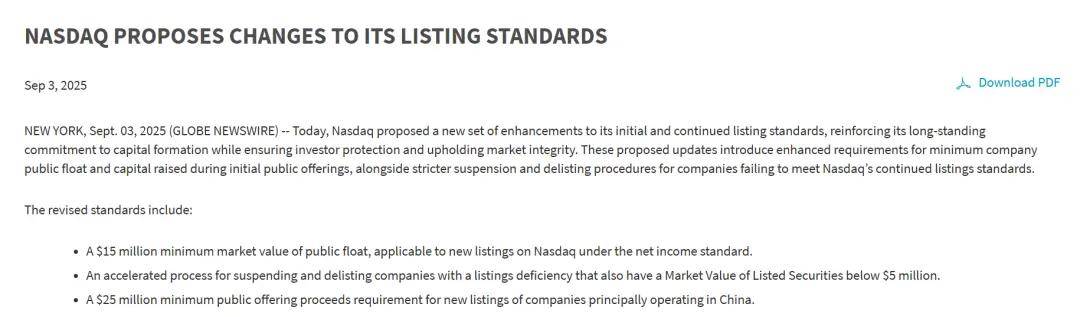
Core Points - Nasdaq proposes to amend listing standards, particularly increasing minimum fundraising requirements for companies primarily operating in China [1][3] - The new standards include a minimum public float market value of $15 million for companies choosing the net income listing standard, up from $5 million [1] - Companies with listing deficiencies and a market value below $5 million will face accelerated delisting processes [1][4] - The minimum public offering fundraising requirement for new listings primarily operating in China is set at $25 million [1][3] Summary by Category Listing Standards - Nasdaq's revised standards include a minimum public float market value of $15 million for net income listing standard companies, an increase from the previous $5 million [1] - The minimum public offering fundraising requirement for companies primarily operating in China is established at $25 million, consistent with previous regulations [1][3] Delisting Procedures - Nasdaq has previously implemented rules to accelerate the delisting process for companies with stock prices below $0.10 for ten consecutive trading days [4] - New proposals will allow for accelerated delisting if a company's stock price remains below $0.10 and is suspended for ten consecutive trading days [4] Regulatory Context - Nasdaq emphasizes that these changes aim to enhance investor protection and market integrity, reflecting ongoing efforts by regulators and market participants [3] - The proposed rules will be submitted to the SEC for review, with an immediate implementation plan upon approval [4]

重大调整!中国企业赴美上市受影响
Zheng Quan Shi Bao· 2025-09-04 02:25
Core Points - Nasdaq has proposed changes to its listing standards, particularly increasing the minimum fundraising requirements for companies primarily operating in China [1][3] - The new rules include a minimum public float market value of $15 million for companies choosing the net income listing standard, an expedited delisting process for companies with market values below $5 million, and a minimum public offering requirement of $25 million for new listings from China [1][4] Group 1 - Nasdaq's mission emphasizes investor protection and market integrity, with the new standards aimed at providing healthier liquidity for public investors while still allowing access to emerging company stocks [3] - The introduction of the minimum public offering requirement for companies from "restricted markets" is a continuation of previous regulations aimed at enhancing investor protection and liquidity [3][4] - Nasdaq has previously implemented rules to accelerate the delisting process for companies that fail to meet certain criteria, including stock price thresholds [4][5] Group 2 - The proposed rules will be submitted to the SEC for review, with a 30-day period for companies already in the initial listing process to comply with prior standards, after which all new listings must meet the new requirements [5] - The expedited delisting procedures are set to be implemented 60 days after SEC approval [5]
重大调整!中国企业赴美上市受影响!
证券时报· 2025-09-04 02:20
Core Viewpoint - Nasdaq is proposing to amend its listing standards, particularly increasing the minimum fundraising requirements for companies primarily operating in China, which aims to enhance investor protection and market integrity [1][4]. Group 1: Proposed Changes to Listing Standards - The revised standards include three main changes: 1. Companies choosing to list based on net profit must have a minimum public float market value of $15 million (up from $5 million) [2]. 2. Companies with listing deficiencies and a market value below $5 million will face expedited delisting processes [2]. 3. New companies primarily operating in China must raise a minimum of $25 million in public offerings [2]. Group 2: Rationale Behind Changes - Nasdaq emphasizes that these changes are part of its mission to protect investors and maintain market integrity, providing healthier liquidity conditions for public investors while still allowing access to emerging company stocks [4]. - The introduction of the $25 million minimum public offering requirement for companies from "restricted markets" is consistent with previous regulations established in 2020 [4]. Group 3: Accelerated Delisting Procedures - Nasdaq has previously implemented rules to accelerate the delisting process for companies, including restrictions on excessive reverse stock splits and immediate delisting for stocks trading below $0.10 for ten consecutive days [5]. - The proposed changes will be submitted to the SEC for review, with a 30-day grace period for companies already in the initial listing process to comply with the old standards before the new requirements take effect [5].

日本东京证交所被要求就管理层收购进行更多披露
Xin Lang Cai Jing· 2025-09-01 00:59
Core Viewpoint - The Tokyo Stock Exchange is under pressure to implement more measures to protect minority shareholders during management buyouts, following new regulations that took effect on July 22 [1] Group 1: Regulatory Changes - The Tokyo Stock Exchange has mandated increased disclosure for management buyouts and transactions involving controlling shareholders to ensure fair treatment of investors [1] - Companies like Pacific Industrial Co., Ltd. and Soft99 Corporation have announced plans for privatization through management buyouts since the new rules were implemented [1] Group 2: Investor Protection - The exchange requires explanations regarding the procedures and fairness of pricing for companies that are delisted due to management buyouts or controlling shareholder acquisitions, aiming to shield investors from losses due to undervaluation [1] - Despite these measures, some transactions are still perceived as unfair to investors, prompting the exchange to consider further necessary actions after rule modifications [1]
昊创瑞通: 与投资者保护相关的承诺
Zheng Quan Zhi Xing· 2025-08-27 13:17
Group 1 - The article discusses the lock-up arrangements for shareholders before the issuance, including voluntary lock-up shares and extended lock-up periods [1] - It highlights the commitments regarding shareholders' holdings and intentions for share reduction [1]
“手把手教你看行情”短视频将持续投放 为投资者搭建便捷信息获取渠道
Zheng Quan Ri Bao Wang· 2025-08-27 09:45
Group 1 - The core initiative is the "Hand-in-Hand Teaching You to Read Market Trends" series of short videos launched by the Shanghai Stock Exchange and its information subsidiary to enhance investor education and protection [1][2] - The short videos aim to simplify complex financial knowledge into easily understandable content, covering a wide range of investment topics including stocks, funds, bonds, and derivatives [2][3] - The series includes practical and targeted content, focusing on understanding market trends, data interpretation, and warning against illegal stock recommendations and market risks [2] Group 2 - The initiative reflects a shift towards using short videos as a key medium for investor services, driven by the rise of 5G technology and generative AI, marking a new phase of intelligent, automated, and scalable investor services [3] - The series has received significant attention on various platforms such as Douyin, Kuaishou, Bilibili, and Xiaohongshu, showcasing innovative formats that engage viewers [2] - Future plans include ongoing releases of the short videos and live events to provide deeper and more convenient information access for retail investors [3]
民生银行济南阳光舜城社区支行开展投资者保护宣传
Qi Lu Wan Bao· 2025-08-27 07:25
Group 1 - The core viewpoint emphasizes the importance of enhancing public financial literacy and protecting investors' legal rights through diverse promotional activities [1][2] - The bank conducts ongoing educational campaigns in its branches, utilizing posters, brochures, and electronic screens to disseminate basic financial knowledge, focusing on concepts like "diversifying investment risks" and "identifying legitimate financial products" [1] - Specific initiatives target elderly clients, promoting the idea of "suitable investment" by using typical cases of high-risk product purchases to guide them [1] Group 2 - The bank engages in targeted outreach by leveraging opportunities such as payroll distribution to educate employees about financial fraud, using simple language to explain scams and prevention techniques [1][2] - Outdoor promotional efforts are intensified, distributing flyers on illegal fundraising and personal information protection to community members, particularly focusing on vulnerable groups [2] - The bank commits to maintaining a customer-centric approach, viewing investor protection as a key social responsibility while aiming to provide high-quality financial services and contribute to market stability [2]

退市不是“免责金牌”
Zheng Quan Ri Bao· 2025-08-24 16:14
Group 1 - Recent administrative penalties have been imposed on three delisted companies, namely Taihe Group, Huatie Co., and Meishang Ecology, due to violations of information disclosure laws during their listing period [1] - The regulatory authorities are committed to pursuing accountability for delisted companies, emphasizing that delisting does not equate to escaping responsibility [1][2] - The delisting system is crucial for optimizing resource allocation in the capital market, aiming to remove companies that lack sustainable operational capabilities or engage in serious violations [1][3] Group 2 - The legal framework for holding delisted companies accountable has become increasingly stringent, with the China Securities Regulatory Commission (CSRC) having investigated 64 delisted companies for violations since the beginning of 2024 [2] - Various channels for investor protection and compensation have been established, including representative litigation and administrative enforcement, providing robust support for investors seeking redress [2] - The CSRC has intensified criminal referrals for serious violations, with 33 delisted companies referred to law enforcement for suspected information disclosure crimes in 2024 [2]

