
全球安全倡议

Search documents
新华时评丨以多边主义之光照亮全球治理新未来
Xin Hua Wang· 2025-09-28 00:50
Group 1 - The article emphasizes the need for a return to genuine multilateralism to address global challenges and maintain the authority of the United Nations [2][3] - It highlights the erosion of multilateralism due to geopolitical conflicts and unilateral actions, which have led to a weakened global governance system [1][2] - The article calls for increased representation and voice for developing countries in international affairs, acknowledging their significant contribution to global economic output [2][3] Group 2 - The concept of "pseudo-multilateralism" is criticized, as it serves specific geopolitical goals and undermines the fairness and effectiveness of international rules [3] - China's initiatives, such as the Belt and Road Initiative and various global governance proposals, are presented as efforts to enhance collective voice and development opportunities for the Global South [4] - The article asserts that multilateralism is deeply embedded in international relations and calls for a collective commitment to uphold the principles of the UN Charter [4]
用行动促进南南合作,反霸权引起多国共鸣,中方在联大捍卫多边主义
Huan Qiu Shi Bao· 2025-09-27 22:39
Core Points - Chinese Premier Li Qiang emphasized the need for unity, peace, and common prosperity during his speech at the 80th United Nations General Assembly, calling for the defense of multilateralism and cooperation amid global turmoil [1][2] - The Chinese government reiterated its support for the United Nations' central role in global affairs and advocated for "true multilateralism," aiming to reduce U.S.-centric global policy-making [2][4] - A new China-UN South-South Development Support Mechanism was announced, with an initial funding of $10 million to promote sustainable development goals through practical South-South cooperation [3] Group 1 - The speech marked the first time in a decade that a high-ranking Chinese official addressed the UN General Assembly in person, highlighting China's commitment to global governance [2] - The Chinese leadership criticized unilateralism and protectionist measures, implicitly targeting the U.S. while positioning China as a defender of global order [3][4] - The call for multilateralism resonated with leaders from developing countries, indicating a growing alignment against unilateral actions and sanctions [4][5] Group 2 - The global governance initiative proposed by China emphasizes sovereign equality, adherence to international law, and a people-centered approach, aiming to create a fairer global governance system [2][3] - The remarks from various leaders at the UN, including those from Brazil and Kazakhstan, underscored a collective demand for a credible multilateral system to address pressing global issues [5]
新华时评|以多边主义之光照亮全球治理新未来
Xin Hua She· 2025-09-27 12:21
Core Points - The article discusses the challenges facing the international order, emphasizing the erosion of multilateralism and the impact of geopolitical conflicts such as the Israel-Palestine conflict and the Ukraine crisis [2][3] - It highlights the need for the international community to return to genuine multilateralism and strengthen the authority of the United Nations, which is seen as the cornerstone of post-World War II international order [2][4] - The article calls for increased representation and voice for developing countries in international affairs, noting that despite accounting for over 40% of the global economy, their influence remains insufficient [3][4] Group 1 - The current international order is facing severe challenges, with unilateralism and protectionism on the rise, leading to a sluggish global economy [2][3] - The authority and effectiveness of the United Nations are under multiple pressures, hindering its ability to play a core role in international affairs [2][4] - The article stresses the importance of recognizing the equal rights of all countries and providing institutional platforms for developing nations to participate in global governance [3] Group 2 - China is portrayed as a key player in promoting the development of the Global South and advocating for reforms in the global governance system [4] - Initiatives proposed by China, such as the concept of a community with a shared future for mankind and various global initiatives, are highlighted as contributions to addressing global challenges [4] - The article concludes by emphasizing the deep integration of multilateralism into the fabric of international society and the need for collective adherence to the principles of the UN Charter [4]
柬埔寨代理国家元首:中国为地区及全球经济增长做出重大贡献
Zhong Guo Xin Wen Wang· 2025-09-27 05:06
Group 1 - The core viewpoint emphasizes China's significant achievements in various fields over the past 76 years, contributing to global economic growth and becoming a center for trade, investment, and technology innovation [1] - Cambodia views China as a crucial trade and investment partner, providing substantial aid that supports Cambodia's socio-economic development and infrastructure [2] - The relationship between Cambodia and China has evolved into a comprehensive strategic partnership, characterized by mutual respect and trust, with plans to elevate their cooperation to new heights [1][2] Group 2 - Cambodia expresses gratitude towards China for its long-term support in various sectors, including infrastructure and energy, particularly highlighting the assistance for the Dechoing Phnum Water Resources Project [2] - Both countries are committed to enhancing trade, investment, and cultural exchanges, including initiatives like the "Cambodia-China Tourism Year" to attract more Chinese tourists [2] - China reaffirms its support for Cambodia's sovereignty and development interests, positioning itself as a reliable partner in Cambodia's development journey [3]
李强在第80届联合国大会一般性辩论上的讲话(全文)
证监会发布· 2025-09-27 02:56
Core Viewpoint - The speech emphasizes the importance of peace, development, unity, and justice in the context of global governance and the role of the United Nations in maintaining international order and cooperation [2][3][4]. Group 1: Peace and Development - Peace and development are the most fervent common aspirations of people worldwide, with the past 80 years witnessing significant economic growth due to overall global peace [3]. - The responsibility to further strengthen the forces of peace and development lies with the current generation [3]. Group 2: Unity and Cooperation - Unity and cooperation are the strongest sources of human progress, as demonstrated by the collaboration of diverse nations during the anti-fascist war and subsequent global challenges [4]. - The principle that unity leads to progress while division results in harm is highlighted as a fundamental truth [4]. Group 3: Fairness and Justice - Fairness and justice are the most important values pursued by the international community, with historical lessons indicating that the absence of these principles leads to chaos and decline [4]. - The need for true multilateralism and equal treatment of all nations is emphasized to ensure the protection of interests [4]. Group 4: Global Challenges and Cooperation - In the face of new global challenges, such as climate change and technological advancements, there is a call for collaborative efforts to address these issues [9][10]. - China is positioned as a responsible participant in global challenges, advocating for green development and international cooperation in various fields [10]. Group 5: China's Role in Global Governance - China has actively participated in global affairs, proposing initiatives aimed at enhancing human welfare and addressing pressing global issues [6]. - The country has contributed significantly to global economic growth, maintaining a contribution rate of around 30% to world economic growth [8]. - China is committed to high-quality development and expanding domestic demand, which will continue to support global economic growth [8].

李强出席第80届联合国大会一般性辩论并发表讲话
证监会发布· 2025-09-27 01:25
Core Viewpoint - The speech emphasizes the importance of peace, development, and international cooperation, highlighting the need for a fair and just global order in the face of current global challenges [2][3][4]. Group 1: Global Initiatives and Proposals - China has actively participated in global affairs and proposed several initiatives, including the concept of a community with a shared future for mankind, global development, security, civilization, and governance initiatives [3][5]. - The recent global governance initiative emphasizes principles such as sovereign equality, adherence to international law, and a people-centered approach, aiming to create a more just and reasonable global governance system [3][5]. Group 2: Current Global Challenges - The world is experiencing a period of turmoil and transformation, with a resurgence of unilateralism and Cold War mentality, leading to significant disruptions in international rules and order [4]. - There is a call for greater awareness and rationality among nations to treat each other with respect and to address humanitarian crises and injustices without silence or submission to power [4]. Group 3: Commitment to Peace and Development - China positions itself as a staunch defender of world peace and security, a key promoter of global development, and an active participant in addressing global challenges [5]. - The commitment to uphold the purposes and principles of the UN Charter and to promote multilateralism is reiterated, with a focus on advancing the four global initiatives towards the goal of building a community with a shared future for mankind [5].
第四届全球数字贸易博览会在杭州举办
Xin Hua Wang· 2025-09-25 07:06
Core Insights - The Fourth Global Digital Trade Expo was held in Hangzhou, emphasizing the importance of digital trade in driving China's economic development and global trade recovery [1] - China expresses willingness to collaborate with other countries to promote a shared future, advocating for multilateralism and a favorable business environment [1] Group 1 - Digital trade is seen as a new driving force for China's economic growth and a catalyst for global trade and economic recovery [1] - The Chinese government aims to establish a global digital trade governance system and promote the innovative application of digital technologies [1] - The focus is on ensuring that the benefits of digital trade are shared among all countries, fostering mutual benefit, common prosperity, and sustainable development [1] Group 2 - Following the opening ceremony, key national leaders attending the expo were met by Wang Dongming, indicating the significance of international collaboration in digital trade [2]
“中国是维护世界和平的重要力量”(跨越时空的精神回响)
Ren Min Ri Bao· 2025-09-25 01:31
Core Viewpoint - The article highlights the significant achievements of China's national defense and military modernization, as well as its commitment to peace and international justice, as expressed during the grand military parade commemorating the 80th anniversary of the victory in the Chinese People's War of Resistance Against Japanese Aggression and the World Anti-Fascist War [1][2]. Group 1 - The military parade showcased China's advancements in defense and military modernization, reflecting its determination to uphold international fairness and justice [1]. - The historical context emphasizes the collaboration between China and the Soviet Union during World War II, where both nations made decisive contributions to the victory over fascism [1][2]. - The article mentions that China suffered over 35 million casualties during the Anti-Japanese War, underscoring the immense sacrifices made by the Chinese people [2]. Group 2 - The commitment of both Russia and China to defend the hard-won results of World War II and to prevent any attempts to distort historical facts is emphasized [2]. - The article notes that China is an important force for maintaining world peace and has achieved significant progress in modernization, which is highly regarded [2]. - China's proposed global initiatives, including development, security, civilization, and governance, are highlighted as crucial for addressing global challenges and promoting collective development [2].

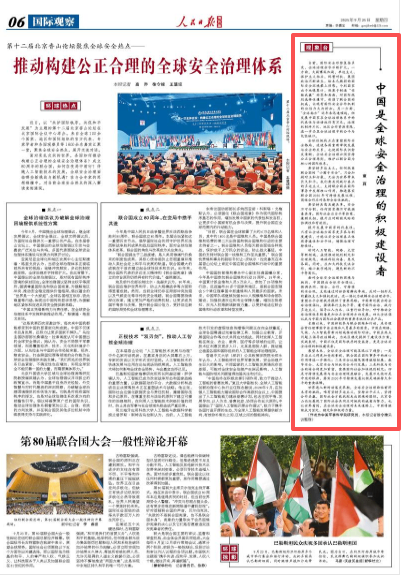
中国是全球安全治理的积极建设者(观象台)
Ren Min Ri Bao Hai Wai Ban· 2025-09-25 00:28
Group 1 - The article emphasizes the complexity and variability of the current international security situation, highlighting the rise of unilateralism and protectionism, which exacerbate the fragile international security environment [1] - It points out the insufficient representation and voice of developing countries in the global governance system, despite the rapid rise of the "Global South" [1][2] - The article advocates for multilateralism and the central role of the United Nations in international affairs, stressing that any security arrangements outside the UN will only increase division and conflict [1][2] Group 2 - The need to enhance the representation of developing countries in institutional building is highlighted, as this is essential for achieving universal and equitable security governance [2] - The article discusses the urgency of establishing rules and ethical norms in new fields such as artificial intelligence, cyberspace, and outer space to ensure technology benefits all nations [2] - China's global security initiative is presented as a significant approach to address security governance deficits and reshape a fair and reasonable order, emphasizing dialogue and cooperation [2][3] Group 3 - Future trends in global security governance are anticipated to include a greater emphasis on multilateralism and the strengthening of the UN's core role in international affairs [3] - The scope of security issues is expected to expand, with digital security and space security developing alongside traditional security concerns [3] - The integration of sustainable development with security governance is highlighted as crucial, with the implementation of the 2030 Sustainable Development Agenda seen as vital for lasting peace [3]
坚定支持多边主义的重大举措
Zhong Guo Xin Wen Wang· 2025-09-24 05:22
(对外经济贸易大学国际经贸学院教授、中国世界贸易组织研究会首席专家崔凡) 来源:中国新闻网 在多边贸易体制面临严峻挑战的背景下,中国宣布在世贸组织当前和未来谈判中,将不再寻求新的特殊 和差别待遇,体现了中国的大国责任和担当,为多边贸易体制提供了有力的支持。中国的这一承诺是实 事求是的,必定是会说到做到的。与此同时,我们也需要准确理解中国的这一承诺。2024年,中国人均 国内生产总值约为1.34万美元,大体相当于世界平均水平。中国作为最大的发展中国家的事实没有改 变。中国不会放弃自己的发展中国家地位,中国的这一承诺恰恰是基于自身的发展中国家地位作出的承 诺。 中国的这一承诺不影响中国享受现有世贸组织协定中特殊和差别待遇条款的权利。例如,根据世贸组织 《农业协定》和中国加入世贸组织议定书,中国可以在国内支持方面相对发达成员有更多的政策灵活 度;根据授权条款,作为发展中成员,中国有权和其他发展中成员达成优惠贸易安排。这些权利,中国 将继续享受。中国的这一承诺也不影响中国在任何其他国际组织和国际条约中的地位和待遇。 中国的这一承诺是根据自身国情做出的。世贸组织的其他发展中成员可以根据世贸组织规则和各自的情 况维护自身 ...