中国资本市场

Search documents
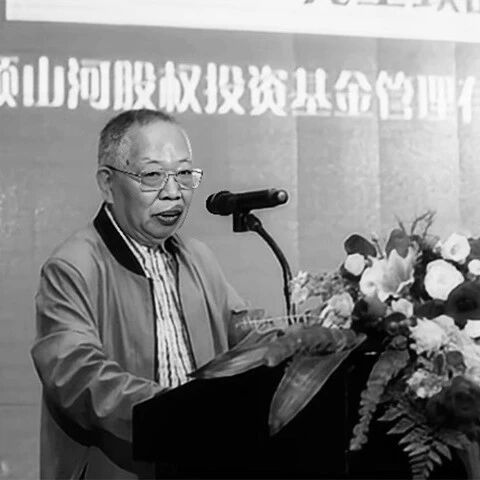
传奇人生落幕,「中国证券教父」管金生逝世
36氪· 2025-10-10 13:34
Core Viewpoint - The article highlights the life and contributions of Guan Jingsheng, a significant figure in the development of China's capital markets, detailing his achievements, challenges, and the impact of his work on the financial industry [4][5]. Group 1: Early Life and Career - Guan Jingsheng was born on May 19, 1947, in a poor farming family in Jiangxi Province and later graduated with a master's degree in French literature from Shanghai International Studies University [7]. - He began his career at Shanghai International Trust Investment Company before being appointed to establish China's first securities company, Wangguo Securities, in February 1988 [8]. Group 2: Achievements in Securities Industry - Under Guan's leadership, Wangguo Securities became a dominant player, capturing 70% of A-share trading volume and nearly all B-share trading volume in China [9]. - He played a crucial role in the establishment of the Shanghai Stock Exchange, contributing to the design of trading rules and the development of a comprehensive trading system [9]. Group 3: Challenges and Setbacks - The "327 bond incident" in February 1995 marked a turning point in Guan's career, leading to his resignation and subsequent imprisonment for 17 years due to the financial fallout [11][12]. - Following his release in 2003, Guan publicly reflected on his past mistakes, acknowledging the importance of humility and adaptability in the face of challenges [13]. Group 4: Later Career and Legacy - At the age of 69, Guan founded Jiusu Fund, positioning it as a parallel fund aimed at fostering Sino-foreign cooperation in the private equity sector [14]. - His contributions to technology innovation and industry upgrades were recognized by Jiusu Fund, which expressed deep respect and gratitude for his efforts following his passing on October 7, 2025 [14].

传奇人生落幕 “中国证券教父”管金生逝世
经济观察报· 2025-10-10 02:42
Core Viewpoint - The article highlights the life and contributions of Guan Jingsheng, a pivotal figure in the development of China's capital markets, detailing his achievements, challenges, and the impact of his work on the industry [2][4]. Group 1: Early Life and Career - Guan Jingsheng was born on May 19, 1947, in a poor farming family in Jiangxi Province and later graduated with a master's degree in French literature from Shanghai International Studies University [4]. - He began his career at Shanghai International Trust Investment Company after struggling to find a job in his field [4]. Group 2: Founding of WanGuo Securities - In February 1988, Guan was appointed to establish China's first securities company, WanGuo Securities [5]. - Under his leadership, WanGuo Securities quickly rose to prominence, capturing 70% of domestic A-share trading volume and nearly all B-share trading volume, making it the largest brokerage in China at the time [6]. Group 3: Contributions to Market Infrastructure - Guan played a significant role in the establishment of the Shanghai Stock Exchange, contributing to the design of trading rules, equipment, and training for traders [7]. - WanGuo Securities was the first to enable cross-regional trading and promote paperless transactions [7]. Group 4: Challenges and Setbacks - The "327 bond incident" in February 1995 marked a turning point in Guan's career, where he heavily invested WanGuo Securities' assets in government bonds, leading to significant losses [9]. - Following the incident, Guan resigned and was imprisoned for 17 years, which severely impacted WanGuo Securities, leading to its merger with ShenYin & WanGuo Securities in 1996 [10][11]. Group 5: Later Life and New Ventures - After being released in 2003, Guan publicly reflected on his past mistakes and the importance of humility in leadership [11]. - In June 2016, at the age of 69, he launched a new venture, Jiu Song Fund, marking his third entrepreneurial endeavor [11][12]. - Jiu Song Fund was positioned as a parallel fund aimed at fostering Sino-foreign cooperation and innovation in the private equity sector [12].

证监会:目前外资持有A股市值3.4万亿元
2 1 Shi Ji Jing Ji Bao Dao· 2025-09-22 09:04
Group 1 - The core viewpoint is that the value of A-shares held by foreign investors has reached 3.4 trillion yuan, indicating a growing interest in China's capital markets [2] - There are currently 269 companies listed overseas, reflecting the expanding global presence of Chinese enterprises [2] - The remarks by the Chairman of the China Securities Regulatory Commission highlight the increasing integration of China's capital markets with the global financial system [2]
吴清:外资持有A股市值3.4万亿元 中国资本市场的“朋友圈”越来越大
Xin Lang Zheng Quan· 2025-09-22 07:54
Group 1 - During the "14th Five-Year Plan" period, 13 foreign-controlled securities, fund, and futures institutions were approved to operate in China [1] - Foreign ownership of A-shares reached 3.4 trillion yuan, indicating a significant increase in foreign investment [1] - A total of 269 companies have listed overseas, expanding the "circle of friends" for China's capital market [1]
董少鹏:外资再怎么大举进入A股也只占百分之三四
Feng Huang Wang Cai Jing· 2025-09-18 08:06
Core Viewpoint - The current market has misconceptions regarding foreign capital allocation in A-shares, with foreign investment in A-shares peaking at only 4.8% in 2011 and currently standing at 2.7%, indicating a consistently low proportion [1] Group 1 - Foreign capital is welcomed in China's capital market for investment in A-shares [1] - The movements of foreign capital should be referenced but not used as the primary standard for investment decisions to avoid potential misjudgments [1]
“十五五”前瞻初探
2025-09-07 16:19
Summary of Key Points from Conference Call Records Industry Overview - The conference call discusses the "14th Five-Year Plan" (2021-2025) and its implications for China's economic development and various sectors, including technology, environment, and social welfare [1][3][11]. Core Insights and Arguments - **Economic Growth**: China's GDP is projected to reach 140 trillion yuan by 2025, with final consumption contributing significantly, averaging 56.2% to economic growth, an increase of 8.6 percentage points from the previous five-year period [1][5][11]. - **Income Levels**: Per capita national income is nearing the threshold for high-income countries, with a current per capita GDP of over $13,300, although it remains slightly below the world average of $13,700 [1][5]. - **Social Welfare**: The average disposable income has grown at an annual rate of 5.5%, with the middle-income group expanding to 400 million people, representing 30% of the population [6][7]. - **Environmental Progress**: The number of new energy vehicles has significantly increased, reaching 31.4 million by the end of 2024, marking a growth of over five times since the previous five-year period [8]. - **R&D Investment**: China ranks second globally in R&D spending, with an investment of 3.6 trillion yuan, accounting for 2.68% of GDP, and a 72.6% increase in integrated circuit production [9][10]. Challenges Identified - **Technological Barriers**: Key core technology issues remain unresolved, impacting innovation and competitiveness [4]. - **Consumer Mechanisms**: Long-term consumer spending mechanisms have yet to be established, affecting economic stability [4]. - **Environmental Concerns**: Pollution and carbon emissions remain high, necessitating further action to meet future targets [4]. Additional Important Content - **Capital Market Developments**: The Chinese capital market is seeing increased participation from long-term funds, with ETF assets reaching a historical high of over 4 trillion yuan and a notable rise in insurance capital entering the market [2][19][20]. - **State-Owned Enterprise Reforms**: Significant measures have been introduced to reform state-owned enterprises, focusing on optimizing structures and enhancing mixed ownership [16][17]. - **Unified Market Construction**: The construction of a unified national market is progressing, with an emphasis on improving the business environment and regulatory efficiency [15]. This summary encapsulates the key points discussed in the conference call, highlighting the current state and future outlook of China's economy, social welfare, environmental initiatives, and capital market developments.
圣阳股份:控股股东山东发展集团坚定看好中国资本市场发展前景
Zheng Quan Ri Bao Wang· 2025-09-03 09:43
Core Viewpoint - The controlling shareholder of Shengyang Co., Ltd. expresses strong confidence in the development prospects of the Chinese capital market and commits to supporting the listed company in optimizing its industrial layout and enhancing core competitiveness [1] Group 1 - The controlling shareholder, Shandong Development Group, is committed to fulfilling its responsibilities and supporting the listed company in its high-quality development [1] - The company aims to focus on its main responsibilities and core business [1] - The commitment is aimed at protecting the interests of a wide range of investors [1]

中国平安高管:中国资本市场当前的估值水平与全球其他市场比较起来,仍处于合理区间。
Xin Lang Cai Jing· 2025-08-27 04:46
Core Viewpoint - The valuation level of the Chinese capital market is currently considered reasonable when compared to other global markets [1] Group 1 - The executives of China Ping An have expressed confidence in the current valuation levels of the Chinese capital market [1]

中央汇金:已再次增持ETF
Xin Hua Wang· 2025-08-12 05:58
Core Viewpoint - Central Huijin Investment Company expresses strong confidence in the development prospects of China's capital market and recognizes the current allocation value of A-shares, indicating plans to continue increasing investments in exchange-traded funds (ETFs) to maintain market stability [1] Group 1 - Central Huijin has announced its intention to further increase its holdings in ETFs [1] - The company emphasizes its commitment to supporting the stable operation of the capital market [1] - The announcement reflects a positive outlook on the A-share market's investment potential [1]
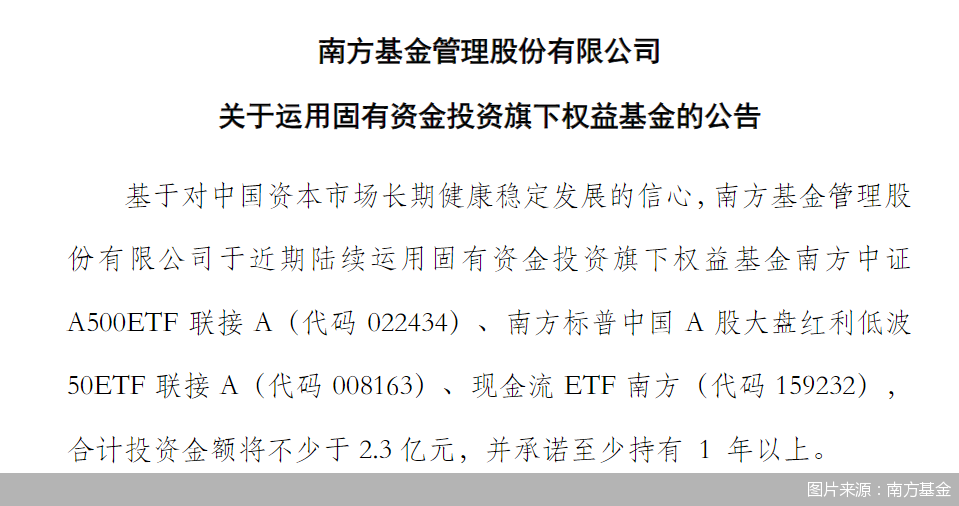
公募“自购潮”再起,南方基金拟出手2.3亿元布局权益
Bei Jing Shang Bao· 2025-08-11 12:55
Core Viewpoint - The recent trend of public fund self-purchases in China reflects confidence in the long-term stability and health of the capital market, with significant investments being made by various fund companies [1][3][4]. Group 1: Public Fund Self-Purchases - On August 10, Southern Fund announced a self-purchase of at least 230 million yuan using its own funds to invest in its equity funds, committing to hold these investments for over one year [1][3]. - Other public funds, including ICBC Credit Suisse Fund and Huashang Fund, have also engaged in similar self-purchase activities, indicating a resurgence of self-purchase trends in the industry [1][4]. - Since the beginning of the year, over 20 public funds have announced self-purchases, with amounts typically ranging from 1.55 million to 54 million yuan [4][6]. Group 2: Performance and Market Confidence - The three funds targeted by Southern Fund's self-purchase have shown positive returns this year, with yields of 3.78%, 6.78%, and 11.46% respectively [3]. - Industry experts suggest that such large-scale self-purchases, like that of Southern Fund, serve as a benchmark in the industry, enhancing investor trust through a binding interest mechanism [3][6]. - The overall net subscription amount for actively managed equity funds by public institutions has reached 1.579 billion yuan this year, reflecting a strong belief in the high-quality development of the Chinese capital market [6][9]. Group 3: Regulatory Environment and Future Trends - Recent regulatory guidance encourages fund companies to allocate a portion of their annual profits to self-purchase their equity funds, which is expected to promote a trend of continuous self-purchases [8][9]. - The "Action Plan for Promoting the High-Quality Development of Public Funds" emphasizes long-term assessments and increases the scoring for self-purchase metrics by 50% [8]. - Experts predict that the trend of public funds self-purchasing equity funds will continue, potentially leading to a more stable market structure [9].