
中国资本市场

Search documents
中国平安联席CEO郭晓涛:今年中国资本市场整体向好 基础设施、医疗健康养老、高股息等是相对确定性的资产
Xin Lang Cai Jing· 2026-03-27 05:59
Core Viewpoint - The overall outlook for China's capital market is positive for the year, despite global market volatility and uncertainties [1] Group 1: Investment Opportunities - The company emphasizes the importance of finding certainty within uncertainty in investments this year [1] - Key sectors identified as relatively certain assets include infrastructure, healthcare and elderly care, and high-dividend stocks [1] - Investment in gold has met expected returns and will continue to be included in asset categories and portfolio strategies [1]

中国资本市场:龙马精神,未来可期|马年大咖谈
第一财经网· 2026-02-17 01:59
Core Viewpoint - The Chinese capital market is expected to demonstrate a solid foundation for medium to long-term value, driven by six positive factors that enhance its resilience and ability to support high-quality economic development by 2026 [1] Group 1: Valuation Potential - The relative advantage of China's capital market in terms of valuation is evident both in static and dynamic aspects, with the CSI 300 index and Hang Seng index having price-to-earnings ratios of approximately 14.18 and 12.47 respectively as of January 30, 2026, which are significantly lower than major US and European indices [2] - Since 2023, the global capital market has experienced a valuation recovery, with US and Japanese markets seeing cumulative increases of over 70%, while the CSI 300 and Hang Seng indices rose by approximately 21.7% and 40% respectively, indicating a more stable recovery pace for Chinese assets [2] Group 2: Financial Environment - The global financial environment is becoming increasingly favorable for the Chinese capital market, with the easing of monetary policy by the Federal Reserve leading to lower discount rates and reduced liquidity constraints [3] - The relative stability of China's interest rates and valuation structure makes its assets less sensitive to changes in discount rates, providing a risk-hedging function in global asset reallocation [3] Group 3: Foreign Capital Expansion - Foreign capital's attitude towards the Chinese capital market is shifting from cautious observation to active participation, supported by upgraded economic growth forecasts from major international organizations for China by the end of 2025 [4] - The current foreign capital participation is characterized by a more rational approach, focusing on assets with stable returns and global competitiveness within the Chinese market [4] Group 4: Economic Quality Advantage - The capital market serves as a barometer for economic growth quality rather than just growth speed, with optimal capital market performance often correlating with improved economic quality and structural optimization [5] - The Chinese capital market is expected to enhance its role in guiding resources towards more efficient and sustainable sectors, aligning with the high-quality development framework outlined in the "14th Five-Year Plan" [5] Group 5: Financial Deepening - The continuous improvement of the multi-tiered capital market system in China enhances its ability to serve the real economy, optimize financing structures, and improve resource allocation efficiency [6] - The rise in direct financing reduces reliance on indirect financing, while the development of various financial instruments allows for better matching of investment preferences [6] Group 6: Hub Functionality - The Chinese capital market is increasingly playing a pivotal role in the macroeconomic system, acting as a hub for information, expectations, and resource allocation [7] - The market influences consumer confidence and corporate investment willingness, while also supporting technological innovation and the cultivation of new industries, contributing to a virtuous cycle between market value and economic fundamentals [7]
程实|中国资本市场:龙马精神,未来可期|马年大咖谈
Di Yi Cai Jing· 2026-02-17 01:54
Group 1 - The core viewpoint emphasizes that six positive factors are collaboratively emerging, forming a solid foundation for the medium to long-term value of China's capital market [1] - By 2026, China's capital market is expected to demonstrate enhanced resilience and significant potential in supporting high-quality development [1] Group 2 - The potential space for valuation is highlighted, with the Shanghai Composite Index and Hang Seng Index having price-to-earnings ratios of approximately 14.18 and 12.47, respectively, as of January 30, 2026, indicating a relative undervaluation compared to major global markets [2] - Since 2023, the recovery in global capital markets has seen the Shanghai Composite Index rise by about 21.7% and the Hang Seng Index by approximately 40%, showcasing a more stable recovery rhythm for Chinese assets [2] Group 3 - The financial environment is continuously improving, with the easing of monetary policy by the Federal Reserve leading to a decline in global discount rates and reduced liquidity constraints, making Chinese assets more attractive [3] - China's capital market is less sensitive to changes in discount rates, providing a risk-hedging function in global asset reallocation [3] Group 4 - Foreign capital allocation is steadily expanding, with global institutions adjusting their economic growth forecasts for China to a more optimistic outlook, indicating a shift in foreign investment behavior towards more rational participation [4] - Chinese capital markets are gaining comprehensive attractiveness due to relative valuation advantages and stable growth expectations [4] Group 5 - The comparative advantage in economic quality is emphasized, with capital markets reflecting the quality of economic growth rather than just the speed of growth, aligning with the high-quality development framework of the "14th Five-Year Plan" [5] - The capital market is expected to guide resources towards more efficient and sustainable sectors, enhancing its role in high-quality development [5] Group 6 - Financial deepening continues to empower the capital market, improving its ability to serve the real economy and optimize financing structures [6] - The development of a multi-tiered capital market system enhances the stability and resilience of the overall financial system [6] Group 7 - The hub function of the capital market is increasingly prominent, acting as a crucial point for the intersection and adjustment of various economic factors [7] - The capital market influences consumer confidence and investment willingness, supporting the release of consumption potential and fostering a virtuous cycle between market value and economic fundamentals [7]
粤开证券首席经济学家罗志恒荣膺“2025年度十大影响力经济学家”
Xin Lang Cai Jing· 2026-02-11 07:12
Core Insights - The "Top Ten Influential Economists of 2025" list has been announced, highlighting the resilience and quality improvement of China's economy amidst multiple challenges [1][2] - The evaluation was conducted by a committee considering five dimensions: professionalism, influence, innovation, foresight, and activity level, with results based on voting and data on output and impact [2] Group 1: Award Recognition - Luo Zhiheng, Chief Economist of Yuekai Securities, has been awarded the title of "Top Ten Influential Economists of 2025" [3] Group 2: Key Perspectives by Luo Zhiheng - Insights on the export situation in China for 2026, emphasizing resilience despite pressures [3][4] - Analysis of the Chinese capital market outlook for 2026, focusing on A-shares and investment strategies [3][4] - Considerations on the impact of anti-involution on the economy and related policy implications [4] - Discussion on understanding the fiscal and tax deployment arrangements in the "14th Five-Year Plan" [4] - Recommendations for optimizing holiday systems to boost consumption, highlighting its necessity [4]
【金麒麟】吴晓求:中国资本市场未来成长可期
Zheng Quan Ri Bao Zhi Sheng· 2026-01-16 04:51
Group 1 - The core viewpoint is that the positive trend of China's capital market in 2026 is expected to continue, driven by both reform logic and industrial structure transformation logic [1][2] - The first dimension of development is systematic reforms in the asset, funding, and institutional aspects, with ongoing reforms in the asset side focusing on optimizing the structure of listed companies through the registration system and the Sci-Tech Innovation Board [2] - The second dimension emphasizes funding reforms, particularly the orderly entry of large funds into the market, including the gradual involvement of social security funds and commercial insurance funds, along with the innovation of product tools like broad-based ETFs [2] - The third dimension highlights institutional reforms aimed at enhancing market transparency and implementing severe legal penalties for serious violations, shifting from administrative penalties to criminal and civil liabilities [2] Group 2 - The significance of these reforms lies in their ability to restore market confidence and stabilize development expectations through coordinated reforms in the asset, funding, and institutional dimensions [3] - These reforms align with the major transformation of China's economic structure, as traditional economic theories struggle to explain new phenomena, such as the dominance of high-tech enterprises, which is altering the relationship between GDP growth and labor income [3] - The changing economic structure significantly impacts the market, as high-tech and innovative enterprises, traditionally viewed as "bubbles" under conventional valuation methods, are undergoing profound changes in valuation logic due to the transformation of development models [3]

让牛市真正涨起来、慢起来!2025年度私享会年度私享会圆满落幕,财经大V共话中国经济新机遇
Xin Lang Cai Jing· 2026-01-16 02:57
Group 1 - The 2025 Weibo Finance Night and Beijing Financial Influencer Alliance Annual Meeting will be held on January 15, 2026, in Beijing, featuring prominent figures from the finance sector and engaging discussions on hot topics [1][41] - Keynote speakers include Sina Finance CEO Deng Qingxu, Tsinghua University’s Professor He Ping, Morgan Stanley's Chief Economist Xing Ziqiang, and others, who will share insights on the current economic landscape [1][41] - The event will include a peak dialogue session and a roundtable forum focusing on the impact of AI and new production capabilities in the finance sector [1][41] Group 2 - Deng Qingxu emphasized the need for reliable voices in the market and the importance of making finance accessible to the public, stating that the bull market should rise steadily and sustainably [4][42] - He Ping highlighted two significant changes in the Chinese capital market: the shift from a policy-driven market to a more effective market and the increasing influence of international capital flows [6][46] - Xing Ziqiang pointed out that China is expected to maintain a growing share in the global export market, with current exports accounting for one-seventh of the global total, projected to rise to over 17% in five years [7][50] Group 3 - Song Xuetao discussed the importance of "investing in people" to enhance consumer spending, suggesting increased transfer payments and improved public services to encourage spending [11][52] - Former economist Fu Peng stated that the discussion around whether AI is a bubble is less important than the potential for investment returns, advocating for risk-taking in early-stage investments [14][55] - Wu Qilun expressed optimism about China's economic growth driven by a large domestic market and high-level openness, supported by government initiatives to boost consumer income [17][58] Group 4 - Li Daxiao expressed a positive outlook for the A-share market, emphasizing the importance of good companies contributing positively to various stakeholders [21][59] - Lin Yixiang raised concerns about the impact of high-frequency trading on retail investors, suggesting that halting such practices could benefit the market [25][63] - Niu Wenxin stressed the need for better capital liquidity in the stock market to ensure long-term stability [27][66] Group 5 - The roundtable discussion on AI highlighted the potential of embodied intelligent robots, with estimates suggesting a market value reaching trillions of dollars [31][71] - Wan Zhe pointed out that the concept of embodied intelligence should be clarified, emphasizing the importance of emotional value in technology adoption [36][73] - The discussion underscored that the AI sector is far from saturated, with ongoing transformations in societal and work structures due to AI advancements [38][75]


清华大学何平:中国资本市场正成为全球资产配置重要部分
Xin Lang Cai Jing· 2026-01-15 11:03
Group 1 - The core viewpoint is that China's capital market is transitioning from a policy-driven market to a more effective market, with increasing influence from international capital flows, making it an important part of global asset allocation [1][3][4] - Over the past few decades, China has continuously promoted market-oriented reforms, transitioning from administrative pricing to inquiry-based pricing and from approval systems to registration systems, marking the entry into a market-oriented era [1][3] - The primary goal of market-oriented construction is to enhance market effectiveness, allowing quality assets to be reasonably priced and resources to be effectively allocated, which is also the foundation for market openness [1][3] Group 2 - The opening of the capital market and market-oriented reforms have increased the impact of international capital flows on China's capital market, with rapid growth in the capital market and stock indices closely related to international capital trends over the past year [1][3] - Five current international factors influencing China's capital market have been summarized: 1) Decline of dollar credit 2) Overvaluation of the dollar exchange rate 3) Weakness in the European economy 4) Recovery of the Japanese economy 5) Bubble in the US stock market [1][3]
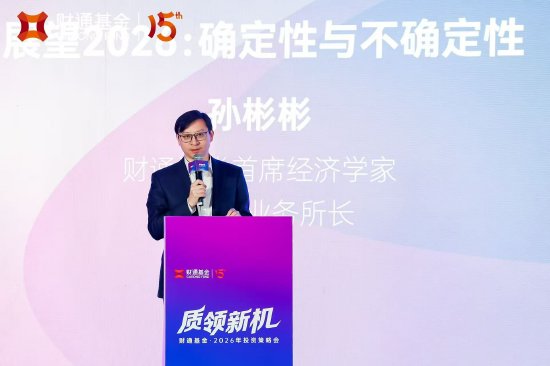
财通证券孙彬彬:看好中国企业全球竞争力与人民币资产中的确定性机会
Xin Lang Cai Jing· 2026-01-15 02:43
Group 1 - The core viewpoint emphasizes that despite overall macroeconomic uncertainties, there are localized opportunities that are certain [1][3] - The speaker expresses optimism regarding the global competitiveness of Chinese enterprises and the investment opportunities within Chinese assets [1][3] - The Chinese capital market is highlighted as a new area of focus, serving as a crucial channel for resolving existing issues and a key support for incremental growth [1][3]

经济学家研判:中国资本市场长期发展动能持续积聚
Zhong Guo Xin Wen Wang· 2026-01-10 15:06
Group 1 - The core viewpoint of the articles highlights the steady development of China's capital market, driven by the recovery of the real economy, the acceleration of new productivity cultivation, and clearer policy expectations [1][2] - The recovery of market confidence is closely linked to the structural upgrade of the real economy, with increasing demand for capital markets from high-tech industries and new productivity [1] - The bond market is operating steadily, while the stock market is expected to experience long-term growth momentum, indicating a positive outlook for the capital market in 2026 and beyond [1] Group 2 - International investors are increasingly optimistic about Chinese assets, with 2025 being a pivotal year for reassessing these investments, influenced by advancements in technology and industry upgrades [1][2] - The understanding of China's cyclical policies among overseas investors has deepened, leading to a reduced sensitivity to short-term fluctuations and a greater focus on long-term strategic layouts and structural opportunities [2] - The development of China's capital market relies on institutional support and theoretical guidance, with a call for a domestic theoretical framework that aligns with China's unique conditions and market characteristics [2]
吴晓求:“924”行情以来,中国资本市场发生了根本性变化
Di Yi Cai Jing Zi Xun· 2026-01-10 05:05
Core Viewpoint - The Chinese capital market has undergone fundamental changes over the past year, particularly since the "924" market rally, leading to a restoration of market confidence [1] Group 1: Market Reforms - The capital market requires three key reforms: asset side (restructuring of listed companies), investment side (expansion of market liquidity), and regulatory side (enhancing transparency and fairness of rules) [1] - Emphasis on removing "landmines" in the capital market, with severe penalties for those who create or assist in creating fraudulent listings [1] Group 2: Enforcement and Penalties - Proposed shift from administrative penalties to criminal prosecution and civil compensation for fraudulent activities in the capital market [1] - Equal penalties for intermediary institutions that assist in fraudulent activities [1]