
应收账款

Search documents
14只医药股应收账款超百亿元,血液制品企业普遍大增
Bei Jing Shang Bao· 2025-11-03 12:48
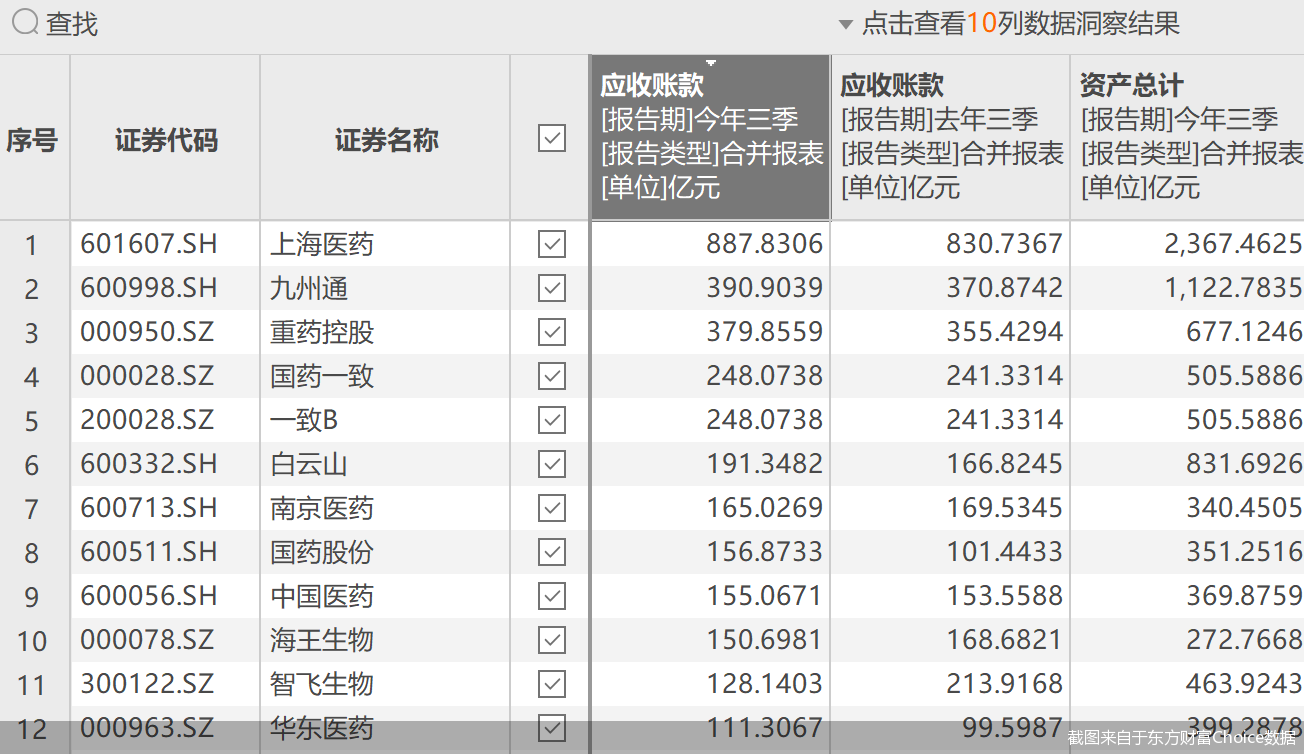
Core Viewpoint - The report highlights the increasing accounts receivable among A-share pharmaceutical companies, with a significant number exceeding 10 billion yuan, indicating potential liquidity issues and financial health concerns in the industry [1][3]. Accounts Receivable Overview - As of the end of Q3, 14 A-share pharmaceutical companies reported accounts receivable exceeding 10 billion yuan, with Shanghai Pharmaceuticals leading at 88.783 billion yuan, followed by Jiuzhoutong at 39.09 billion yuan [3][4]. - The blood products sector has seen a notable increase in accounts receivable, with companies like Tiantan Biological and Boya Biological reporting significant year-on-year growth [5][6]. Industry Characteristics - The pharmaceutical distribution sector is primarily responsible for high accounts receivable, as public hospitals, which dominate the market, often negotiate longer payment terms, leading to increased receivables for distributors [3][10]. - Companies may adopt lenient credit policies to attract more clients, which can temporarily boost sales but also result in higher accounts receivable [3][10]. Financial Ratios - Eight companies have accounts receivable constituting over 50% of their total assets, with Renmin Tongtai having the highest ratio at 62.1% [8][9]. - *ST Suwu and Zhongyao Holdings follow, with accounts receivable ratios of 56.28% and significant increases compared to the previous year [9][10]. Performance Implications - High accounts receivable can lead to reduced cash flow and increased opportunity costs, potentially impacting profitability due to higher bad debt provisions [10]. - However, in certain scenarios, elevated accounts receivable may not be detrimental if they align with healthy revenue and profit growth, and if customer quality and payment terms are managed effectively [10].






中电港:回应应收账款及减值问题,称回款状况良好
Xin Lang Cai Jing· 2025-10-31 00:52
Core Insights - The company has experienced an increase in accounts receivable and inventory, primarily due to a significant rise in operating revenue [2] - The increase in credit impairment losses is attributed to a higher provision for bad debts, but the company has established a robust business process and internal control system for order acceptance to sales collection, resulting in a good collection status [2] - The rise in asset impairment losses is mainly due to an increase in provisions for inventory write-downs, influenced by market price fluctuations [2]
工业利润高增:低基数是主因,高技术制造业发力多重支撑
Di Yi Cai Jing· 2025-10-30 12:01
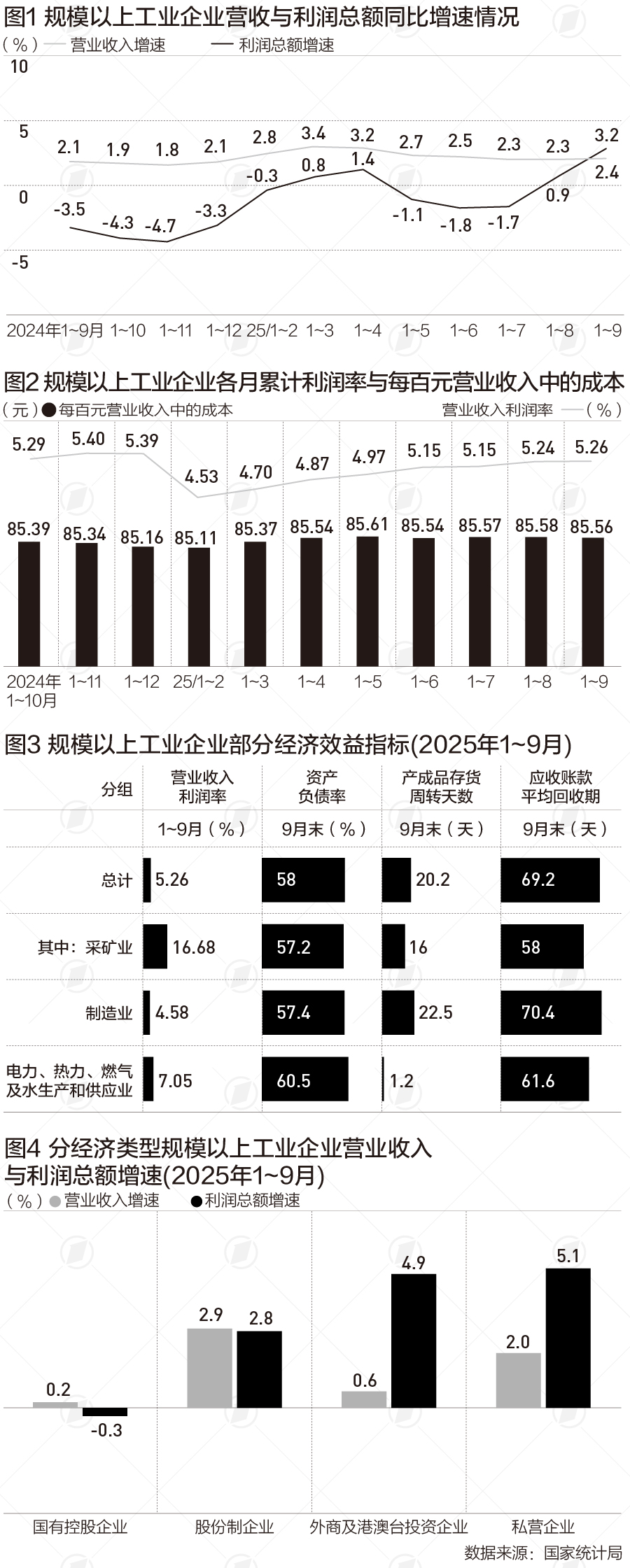
Core Insights - The profit growth of industrial enterprises has accelerated for two consecutive months, driven by proactive macro policies and a low base effect, with a year-on-year increase of 3.2% from January to September, marking the highest cumulative growth since August of the previous year [1][3]. Revenue and Profit Trends - In September, the profit of industrial enterprises increased by 21.6% year-on-year, accelerating by 1.2 percentage points compared to August, primarily due to low base effects, unexpected production increases, and price recoveries [2][3]. - From January to September, the revenue of industrial enterprises grew by 2.4% year-on-year, with September's revenue growth reaching 2.7%, an increase of 0.8 percentage points from August [4]. Profitability Metrics - The profit margin for industrial enterprises from January to September was 5.26%, up by 0.04 percentage points year-on-year, while in September, the profit margin was 5.49%, reflecting a significant increase of 0.85 percentage points year-on-year [4][11]. - The average collection period for accounts receivable was 69.2 days, indicating a slight improvement in the receivables situation, although it remains at historically high levels [11]. Sector Performance - High-tech manufacturing has shown significant growth, with profits increasing by 8.7% year-on-year from January to September, contributing 1.6 percentage points to the overall profit growth of industrial enterprises [12]. - Among 41 industrial sectors, 23 reported profit growth in the first three quarters, with 30 sectors experiencing profit increases in September, indicating a broad recovery across industries [12][13]. Future Outlook - The profit growth is expected to show a "front high, back low" trend in the fourth quarter due to the impact of last year's low profit levels and rising bases, although cumulative growth is anticipated to steadily improve [15][16]. - Continuous efforts to expand domestic demand and optimize supply-side structures are crucial for sustaining profit improvements in the industrial sector [16].
闪电速度上会!两年分红上亿,这家公司净利却忽高忽低
Guo Ji Jin Rong Bao· 2025-10-30 10:55
Core Viewpoint - Hongban Technology Co., Ltd. has successfully completed its IPO process in just four months, but faces significant scrutiny due to its fluctuating net profits, large dividends, and concentrated ownership structure [1][11]. Company Overview - Hongban Technology specializes in the research, production, and sales of printed circuit boards (PCBs), particularly focusing on high-density interconnect (HDI) boards, which are known for their high precision, density, and reliability [3][7]. - The company has established a comprehensive product structure, including HDI boards, rigid boards, flexible boards, and IC substrates, with applications in consumer electronics, automotive electronics, high-end displays, and communication electronics [3]. Financial Performance - The company's revenue has shown consistent growth, with figures of 2.205 billion, 2.340 billion, and 2.702 billion yuan for the years 2022, 2023, and 2024 respectively [4]. - However, net profit has been highly volatile, recorded at 141 million, 105 million (a 25.4% year-on-year decline), and 214 million (a 103.87% year-on-year increase) for the same years, resulting in a fluctuation exceeding 129% [6]. Pricing and Market Dynamics - The significant fluctuation in net profit is attributed to a decline in the average selling price of HDI boards, which dropped by 19.94% in 2023 and an additional 5.26% in 2024, totaling over 25% in two years [7]. - The overall average price of products decreased by 10.57% in 2023, with a smaller decline of 1.94% in 2024 [7]. Capacity and Investment - The company plans to raise 2.057 billion yuan for a new project aimed at producing 1.2 million square meters of high-precision circuit boards, despite existing capacity utilization rates not exceeding 90% [8]. - Capacity figures for 2022 to 2025 show an increase from 1.7529 million square meters to 2.0308 million square meters, with utilization rates improving but still below optimal levels [8]. Research and Development - Hongban Technology's R&D expenses as a percentage of revenue have been lower than industry averages, with figures of 4.56%, 4.69%, 4.63%, and 3.65% compared to the industry averages of 4.70%, 5.14%, 5.13%, and 4.89% [9][10]. - The company’s lower investment in R&D may impact its future competitiveness in the capital and technology-intensive PCB industry [10]. Dividend Policy and Ownership Structure - The company distributed a total of 138 million yuan in dividends over the reporting period, with 74% of the 2023 net profit allocated to dividends [11]. - The ownership structure is highly concentrated, with the actual controller, Ye Senran, holding over 95% of the shares, leading to significant control over company decisions [11]. Accounts Receivable - Accounts receivable have been increasing, with balances of 622 million, 758 million, 919 million, and 1.136 billion yuan over the reporting period, representing 28.21%, 32.42%, 34%, and 33.22% of revenue respectively [13][14]. - The accounts receivable turnover ratio has been consistently below the industry average, indicating potential liquidity issues [13].

红板科技:高毛利与低研发并存,应收账款计提存疑,债务压顶仍向控股股东大额分红|IPO观察
Sou Hu Cai Jing· 2025-10-30 04:49
Core Viewpoint - Hongban Technology's upcoming IPO is notable for its impressive financial performance, particularly a significant increase in net profit driven by a rising gross margin, despite low R&D investment compared to peers [2][4][5]. Financial Performance - For the reporting period from 2022 to 2025, Hongban Technology achieved revenues of 2.2045894 billion, 2.3395341 billion, 2.7024782 billion, and 1.7100181 billion respectively, with net profits of 140.6591 million, 104.926 million, 213.9141 million, and 239.8521 million, indicating a 103.87% year-on-year increase in net profit for 2024 [4][5]. - The gross margin for Hongban Technology increased from 13.28% in 2022 to 21.36% in the first half of 2025, surpassing the industry average of 17.95% during the same period [5][7]. R&D Investment - Hongban Technology's R&D expenses were significantly lower than those of comparable companies, with R&D expenditures of 100.6196 million, 107.9188 million, 125.1981 million, and 62.438 million, while the average for peers was 498.3288 million, 532.2085 million, 620.0087 million, and 325.3905 million [7][8]. - The R&D expense ratio for Hongban Technology was 4.56%, 4.69%, 4.63%, and 3.65%, consistently below the industry average [7][8]. Accounts Receivable - Hongban Technology's accounts receivable increased from 622.1 million to 1.136 billion, with a compound annual growth rate of 21.55% from 2022 to 2024, significantly outpacing the revenue growth rate of 10.72% [8][10]. - The company maintains a high provision for bad debts at 5% to 5.1%, which is much higher than the industry average of 2.28% to 2.6%, raising questions about the rationale behind this policy given the low historical default rates [10][12]. Debt and Dividend Policy - Hongban Technology's liquidity ratios, including current and quick ratios, are consistently below industry averages, indicating significant short-term debt pressure [13][14]. - Despite the debt pressure, the company distributed a total of 738 million in cash dividends from 2021 to 2024, primarily benefiting its controlling shareholder, Hong Kong Hongban, which holds 95.12% of the shares [13][14][15].

【濮耐股份(002225.SZ)】耐材主业承压,拖累经营表现——2025年三季报点评(孙伟风/鲁俊)
光大证券研究· 2025-10-28 23:08
Core Viewpoint - The company reported a mixed performance in its Q1-Q3 2025 financial results, with revenue growth but a significant decline in net profit and cash flow [4][5]. Financial Performance Summary - For Q1-Q3 2025, the company achieved revenue of 4.18 billion, a year-on-year increase of 4.3%, while net profit attributable to shareholders was 90 million, down 22.8% [4]. - The operating cash flow for the same period was 280 million, reflecting a decrease of 23.6% year-on-year [4]. - In Q3 alone, the company recorded revenue of 1.38 billion, a 5.9% increase year-on-year, and turned a profit with a net profit of 30 million [4]. Profitability Analysis - The gross margin for Q1-Q3 2025 was 17.6%, down 1.0 percentage points year-on-year, primarily due to weak demand and reduced settlement prices from customers [5]. - The expense ratio decreased to 13.9%, down 1.5 percentage points year-on-year, with specific reductions in sales, management, financial, and R&D expense ratios [5]. - The final net profit margin was 2.3%, a decline of 0.7 percentage points year-on-year [5]. Q3 Specifics - In Q3 2025, the gross margin improved to 18.4%, up 0.6 percentage points year-on-year, while the expense ratio was 16.1%, down 3.0 percentage points [5]. - The net profit margin for Q3 was 1.8%, an increase of 2.8 percentage points year-on-year [5]. Accounts Receivable and Cash Flow - As of the end of Q3, accounts receivable stood at 2.35 billion, a year-on-year increase of 20.1%, indicating slower customer payments [6]. - The operating cash flow for Q3 was 40 million, a significant decline of 67.7% year-on-year, attributed to weak customer payments [6].


热点思考 | 投资“失速”的真相?(申万宏观·赵伟团队)
申万宏源宏观· 2025-10-27 14:16
Core Viewpoint - The article discusses the significant decline in fixed asset investment in China since the second half of 2025, highlighting a broad downturn across various sectors including infrastructure, services, real estate, and manufacturing [1][10][19]. Investment Growth Decline - Fixed asset investment growth has dropped sharply by 9.1 percentage points to -6.5% in September 2025, marking a five-year low. The actual investment growth, excluding price disturbances, fell by 7.8 percentage points to -4.1% [1][10]. - Investment in broad infrastructure, services, real estate, and manufacturing has all seen declines, with respective drops of 13.1, 11.1, 9.3, and 9.1 percentage points [1][10][19]. - Specific sectors like major projects, consumer infrastructure, and manufacturing have also experienced notable declines, with infrastructure investments in IT services, public utilities, and facility management dropping around 20 percentage points [1][12]. Reasons for Investment Slowdown - The primary reason for the investment slowdown is the acceleration of debt resolution, which has occupied investment funds, explaining over half of the investment decline. The Ministry of Finance allocated 800 billion for special refinancing bonds, with issuance rising to 1.2 trillion since June, reducing available government investment funds [2][29]. - Companies have been increasing investments through debt, but the current push for debt repayment has led to a reduction in available funds for new investments. This has particularly affected state-owned enterprises, which are under pressure to clear debts more quickly [3][40]. - A lack of new projects has also contributed to the investment decline, with new and expansion projects seeing significant drops in growth rates, while renovation projects maintain a higher growth rate [4][44]. Policy Optimization Impact - Historical data suggests that debt issues can significantly constrain corporate cash flow and economic performance. The proportion of accounts receivable has risen to around 15%, with private enterprises having the highest share [5][53]. - The ongoing debt resolution process may improve corporate cash flow, potentially restoring economic momentum. Recent data shows a decline in accounts receivable growth for both private and state-owned enterprises, which could alleviate the "triangle debt" issue [5][60]. - Recent fiscal measures have introduced new funding aimed at addressing the investment decline, particularly in economically significant provinces. The central government has allocated 500 billion for local debt resolution and project construction, which may help mitigate the investment downturn [6][66].

8月规上工企利润同比增长20.4%
Mei Ri Jing Ji Xin Wen· 2025-09-28 13:16
Core Insights - In August, profits of large-scale industrial enterprises in China showed a significant recovery, with a year-on-year increase of 20.4%, reversing a 1.5% decline in July [1] - From January to August, total profits reached 46,929.7 billion yuan, a year-on-year growth of 0.9%, ending a continuous decline since May [2] - The manufacturing sector's profit growth accelerated to 7.4%, while the electricity, heat, gas, and water supply industries saw a profit increase of 9.4% [1][4] Profit and Revenue Analysis - In August, the monthly profit was approximately 6,726.2 billion yuan, marking the second-highest point since the second quarter [2] - The revenue of large-scale industrial enterprises grew by 2.3% year-on-year from January to August, with August's revenue growth accelerating to 1.9% [2] - The profit margin for August was 5.83%, an increase of 0.90 percentage points year-on-year [2] Cost and Accounts Receivable - The cost situation improved in August, with costs per 100 yuan of revenue decreasing by 0.20 yuan, marking the first year-on-year decrease since July 2024 [2] - As of the end of August, accounts receivable reached 27.24 trillion yuan, a year-on-year increase of 6.6%, indicating a continued rise in absolute value [3] - The average collection period for accounts receivable extended to 70.1 days, slightly longer than the previous value [3] Sector Performance - The equipment manufacturing sector showed a profit increase of 7.2%, contributing 2.5 percentage points to the overall profit growth of large-scale industrial enterprises [4] - The consumer goods manufacturing sector turned from a decline of 2.2% to a growth of 1.4%, with significant profit growth in the beverage and agricultural sectors [4] - The raw materials manufacturing sector experienced a profit increase of 22.1%, driven by rising market demand and recovering prices [4] Enterprise Type Analysis - From January to August, profits of state-controlled enterprises saw a reduced decline, while private enterprises experienced a profit growth of 3.3%, surpassing the average growth of large-scale industrial enterprises [5] - The profit growth for state-owned enterprises rebounded significantly to 50%, while private enterprises and joint-stock companies also showed notable increases [6] - Medium and small enterprises reported profit growth of 2.7% and 1.5%, respectively, indicating a positive trend in smaller enterprise performance [6]
13亿元募投项目被深交所问询 广电计量回应:系对现有业务扩产、升级
Mei Ri Jing Ji Xin Wen· 2025-09-28 13:00
Core Viewpoint - The company, Guangdian Jiliang, has responded to regulatory inquiries regarding its fundraising plans and the high levels of accounts receivable, emphasizing the necessity and rationale behind its investment projects aimed at expanding and upgrading its existing business capabilities [1][2][4]. Fundraising and Investment Projects - Guangdian Jiliang plans to raise up to 1.3 billion yuan through the issuance of no more than 67.13 million shares, targeting projects in aviation equipment testing, AI chip testing, and satellite internet quality assurance [1]. - The company asserts that the fundraising projects are not duplicative investments but rather enhancements to existing services, focusing on strategic emerging fields [3][4]. Accounts Receivable Concerns - The company's accounts receivable have been a focal point for regulators, with values reported at 1.202 billion yuan, 1.274 billion yuan, 1.328 billion yuan, and 1.375 billion yuan for the years 2022, 2023, 2024, and the first half of this year, respectively [1][2]. - Accounts receivable accounted for over 45% of current assets in the latest reporting period, with a turnover rate of only 0.46 times [1][2]. Client Classification and Payment Terms - The company categorizes clients into three groups (A, B, C) based on transaction size and payment history, with a significant portion of accounts receivable attributed to government and special industry clients, which typically have longer payment cycles [2]. - The company indicates that the high proportion of accounts receivable relative to revenue is due to the time required for clients to settle payments after receiving inspection reports [2]. Capacity and Market Position - Guangdian Jiliang claims its current capacity utilization is above the industry average, necessitating further investment to enhance competitiveness and meet market demands [4]. - The company has secured substantial orders for its new testing platforms, indicating a strong pipeline to support future revenue growth [5]. Previous Fundraising and Project Adjustments - In May 2021, the company raised 1.486 billion yuan for various projects, but some of these have been delayed until 2025 due to market conditions and operational assessments [5][6]. - The company has reallocated unspent funds from previous projects to new initiatives aimed at expanding its business coverage in the central region of China [6].
长高电新回应可转债审核问询:多项业务细节披露,发展布局明晰
Xin Lang Cai Jing· 2025-09-26 09:33
Core Viewpoint - Changgao Electric New Technology Co., Ltd. has responded in detail to the Shenzhen Stock Exchange's inquiry regarding its application for issuing convertible bonds, addressing key issues such as business dependence and fundraising projects, which has attracted market attention [1] Customer Dependence and Response Strategy - The main business of Changgao Electric New includes power transmission and transformation equipment, as well as power survey design and engineering contracting services, with power transmission and transformation equipment being the core business. Sales revenue from State Grid and its subsidiaries accounted for over 85% during the reporting period. The company believes this high customer concentration aligns with industry characteristics, as the downstream market primarily consists of the power grid construction sector, where State Grid holds a significant market share. The investment plans and bidding policies of State Grid are stable, with total investments planned by State Grid and Southern Grid exceeding 825 billion yuan from 2022 to 2025 [2] - To mitigate potential performance volatility risks, the company has developed response strategies across three dimensions: product, technology, and market. In terms of products, it aims to expand its product line through three fundraising projects to cover all voltage levels and smart products. Technologically, it continues to increase investment in R&D and quality control. In the market dimension, it seeks to deepen multi-level market development, optimize customer structure, and actively expand customers outside the State Grid system [2] Profit Margin Analysis of Power Transmission and Transformation Equipment - From 2022 to 2024, the gross profit margins of Changgao Electric New's medium and high-voltage switches, closed combined electrical appliances, and complete electrical appliances showed an overall upward trend, with some fluctuations in the first half of 2025. Factors driving this include product structure optimization, State Grid policies driving price increases, declining raw material prices, and cost dilution from economies of scale. For example, the gross profit margin of closed combined electrical appliances increased from 2022 to 2024 due to price increases, economies of scale, and declining raw material prices, while it declined in the first half of 2025 mainly due to delivery cycles and raw material price changes. The gross profit margin of complete electrical appliances improved due to the growth of main product margins and an increase in the proportion of high-margin products, while it declined in the first half of 2025 due to procurement policy adjustments. The gross profit margin of high-voltage switch products overall increased due to the combined effects of raw material prices, product structure, and State Grid policies. Compared to peer companies, the trend of gross profit margin changes for Changgao Electric New is generally consistent, and future gross profit margin levels are expected to remain stable [3] Accounts Receivable and Goodwill Situation - As of March 31, 2025, Changgao Electric New had accounts receivable of 80.93 million yuan, other receivables of 514.25 thousand yuan, and contract assets of 19.19 million yuan from Chunhua Zhonglue Wind Power Co., Ltd. that have not been recovered. The 80MW wind power project meets the conditions for inclusion in the subsidy project list but has not yet been declared, and the electricity price subsidy has not been implemented. If the project is subsequently included in the subsidy project list and receives the electricity price subsidy, the related receivables will not face recovery risks; otherwise, there may be risks, but the company has made corresponding provisions for bad debts, which will have a minimal impact on performance and ongoing operations. Other similar projects do not face similar risks, and the receivables do not belong to non-operating fund occupation by related parties, with effective internal control measures in place [4] - The company assesses accounts receivable credit risk characteristics to make provisions for bad debts, with a higher overall provision ratio for accounts receivable over five years compared to China West Electric, aligning closely with the average of comparable companies. The provision for bad debts is deemed sufficient and reasonable. The book value of goodwill is 65.41 million yuan, arising from the acquisition of Hunan Changgao Electric Co., Ltd. and Hunan Changgao Senyuan Power Equipment Co., Ltd. Both companies have performed well during the reporting period, and goodwill impairment testing has shown that the relevant parameters and assumptions are reasonable, with no impairment occurring, making the lack of goodwill impairment provisions reasonable [5] Fundraising Project Details - On May 16, 2025, the board of directors of Changgao Electric New approved an increase in fundraising, which does not directly apply to the provisions of the "Securities and Futures Legal Application Opinion No. 18" but has followed internal review procedures. The fundraising projects involve multiple entities and are deemed reasonable, with the fundraising products aligning with the main business of the implementing entities, allowing for separate and accurate accounting of investments and benefits. The newly added product, mutual inductors, is closely related to existing products in terms of raw materials, technology, and customers. The company has mastered the key technologies for mutual inductors and possesses the capability for mass production and sales, with no significant uncertainties in the implementation of the fundraising projects. The fundraising will be directed towards the main business, ensuring self-control over mutual inductors, reducing costs, and enriching the product matrix. The scale of new production capacity from the fundraising projects has been cautiously evaluated, considering State Grid's centralized procurement policies, industry development, and competition, with minimal risks of being unable to digest the new capacity through State Grid's centralized procurement. The existing production capacity utilization rate was low in the first quarter due to seasonal and production mode impacts but significantly improved in the second quarter, with no idle risks for existing capacity and no impairment risks for related fixed assets. The pricing basis for each fundraising product is reasonable, with some products expected to have gross profit margins higher than similar products during the reporting period, which is deemed reasonable. The new depreciation and amortization from the fundraising projects will increase in the short term but is not expected to have a significant adverse impact on the company's performance [8][9]
