
投资于物和投资于人紧密结合

Search documents
第一观察 | 学习领悟中央经济工作会议提出的“五个必须”
Sou Hu Cai Jing· 2025-12-12 15:36
Core Viewpoint - The Central Economic Work Conference emphasized the "Five Musts" for economic work in 2026, focusing on leveraging economic potential, integrating policy support with reform innovation, balancing market and government roles, combining investments in physical and human capital, and strengthening internal capabilities to face external challenges [4][6][9]. Group 1: Economic Potential - The conference highlighted the importance of fully tapping into economic potential, leveraging China's large-scale market and strong production capacity to foster new growth opportunities [4][5]. - It was noted that China's economic foundation remains stable, with strong advantages and resilience, indicating a long-term positive trend [4]. Group 2: Policy Support and Reform - The meeting called for a dual approach of policy support and reform innovation to address existing structural, systemic, and cyclical issues [6]. - A more proactive fiscal policy and moderately loose monetary policy were emphasized, alongside the need for comprehensive reforms in key areas such as state-owned enterprises and market regulations [6][7]. Group 3: Market and Government Balance - The relationship between government and market roles was underscored, advocating for a balance where both can effectively contribute to economic development [7]. - The need for a refined approach to governance was highlighted, focusing on enhancing the quality of regulation while allowing market vitality [7]. Group 4: Investment Focus - The conference stressed the importance of combining investments in physical infrastructure with investments in human capital, aiming to enhance resource allocation in education, healthcare, and social security [8]. - This approach is intended to drive high-quality economic development by transforming human resources into sustainable human capital [8]. Group 5: Internal Strengthening - The need to strengthen internal capabilities to respond to external challenges was emphasized, with a focus on building a robust domestic market and fostering new growth drivers [9][10]. - The conference recognized the resilience of the Chinese economy despite external pressures, advocating for a concentrated effort on domestic development [9].

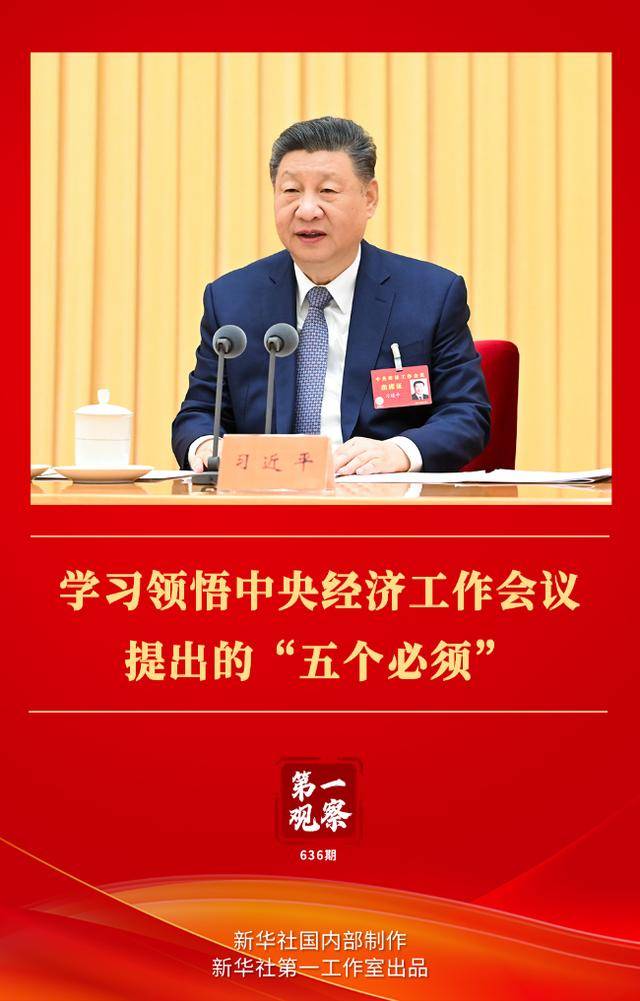
学习领悟中央经济工作会议提出的“五个必须”
Xin Hua She· 2025-12-12 00:53
Group 1 - The core message of the Central Economic Work Conference emphasizes the "Five Musts" for economic work in 2026, which serve as a guide for current and future economic strategies [1] - The first "Must" is to fully tap into economic potential, leveraging China's large market size, strong production capacity, and rich talent resources to create new growth points [2] - The second "Must" is to combine policy support with reform and innovation, focusing on both existing and new challenges while implementing proactive fiscal and monetary policies [3] Group 2 - The third "Must" is to achieve a balance between allowing market freedom and effective government regulation, ensuring that both the market and government play their respective roles in economic development [4][5] - The fourth "Must" emphasizes the importance of combining investments in physical assets with investments in human capital, enhancing resource allocation towards education, employment, and social welfare to drive high-quality economic growth [7] - The fifth "Must" stresses the need for internal strengthening to face external challenges, highlighting the resilience of the Chinese economy despite global uncertainties [8][9]
闫萍:坚持投资于物和投资于人紧密结合
Jing Ji Ri Bao· 2025-12-12 00:17
Core Viewpoint - The integration of investment in physical assets and human capital is a significant enhancement of China's investment philosophy, aimed at optimizing investment structure and stimulating economic growth during the high-quality development phase [1] Group 1: Current Economic Context - China's economy is undergoing a critical transition in development methods, economic structure optimization, and growth momentum conversion, making the integration of investment in physical and human capital highly relevant and urgent [2] - Investment in both physical and human capital is essential for overcoming key technological bottlenecks and achieving self-reliance in technology, requiring funding for both infrastructure and talent development [2] - The shift from traditional comparative advantages to new advantages based on quality and brand necessitates a collaborative approach to investment in physical and human capital for industrial transformation and upgrading [3] Group 2: Domestic Circulation and Consumption - Enhancing human capital through education and skills training directly increases labor income, thereby boosting consumer confidence and laying a solid foundation for expanding consumption [3] - A strong domestic consumption market encourages enterprises to invest in technology and brand development, creating a dynamic balance between supply and demand [3] Group 3: Social Equity and Common Prosperity - Investment in infrastructure and public services is crucial for achieving social equity and promoting common prosperity, while human capital investment plays a significant role in reducing income disparities [4] - Developing a high-quality labor force through human capital investment enhances overall productivity and innovation capabilities, contributing to a larger and more equitably distributed economic "cake" [4] Group 4: Systematic Approach to Investment - The relationship between investment in physical and human capital is inherently unified, requiring a systematic approach to optimize the structure of existing capital and promote a virtuous cycle of economic development and improved livelihoods [5] - Both forms of investment are interdependent; physical capital provides the platform for human capital to realize its value, while human capital enhances the effectiveness and technological advancement of physical capital [5] Group 5: Long-term Mechanisms and Policy Framework - Establishing long-term mechanisms to improve the quality and efficiency of investments in both physical and human capital is essential for sustainable economic growth [8] - Coordinated development strategies should be integrated into national economic and social development plans, ensuring that policies for human capital development accompany industrial policies [8] - A collaborative evaluation system should be established to assess the contribution of human capital to the efficiency of physical capital, preventing disconnection between the two [8] Group 6: Investment Structure Optimization - Maintaining a reasonable scale of physical capital investment while optimizing investment layout is crucial, with increased focus on new infrastructure and advanced manufacturing [9] - Precision and effectiveness in human capital investment should be enhanced, with targeted training programs to meet the demands of new productive forces [9] - Encouraging diverse stakeholders through fiscal and financial policies can stimulate investment in advanced equipment and employee training [9] Group 7: Comprehensive Policy System - A comprehensive policy framework should address the entire lifecycle of human capital needs, from early childhood education to elderly care, ensuring continuous accumulation and quality improvement of human capital [10] - Investments should focus on enhancing educational quality, improving labor market matching, and providing adequate healthcare and housing support [10]
坚持投资于物和投资于人紧密结合
Jing Ji Ri Bao· 2025-11-15 01:01
Core Viewpoint - The essence of Chinese-style modernization is the modernization of people, which requires a close integration of investment in material and investment in people [1][2] Group 1 - The "15th Five-Year Plan" emphasizes the need to combine investment in material and investment in people, highlighting the importance of expanding domestic demand as a strategic foundation [2] - The plan aims to enhance the quality of life for the people by improving the supply of quality products and services, thereby supporting the overall development of society [2] - The focus is on creating a comprehensive population service system that addresses various life stages, including marriage, childbirth, education, employment, healthcare, housing, and elderly care [2]
聚焦“十五五”规划建议|建设强大国内市场 坚持投资于物和投资于人紧密结合
Xin Hua Wang· 2025-10-29 01:08
Group 1 - The core viewpoint emphasizes the importance of a strong domestic market as a strategic support for Chinese-style modernization, highlighting the need for a combination of investment in physical and human capital to promote consumption and investment [1][2] - The proposal outlines practical measures to boost consumption and expand effective investment, including increasing government investment in people's livelihoods and enhancing human resource development [1] - The document stresses the necessity of breaking down barriers to the construction of a unified national market, proposing measures to unify market rules and regulations, and to address "involution" competition [2] Group 2 - The focus on expanding domestic demand is identified as a strategic basis for economic development, aiming to create a robust domestic economic circulation system [2] - The recommendations aim to release the benefits of China's super-large market by addressing various market obstacles [2] - The integration of policies for human capital investment and material capital investment is highlighted as essential for sustainable economic growth [1]
聚焦“十五五”规划建议丨建设强大国内市场 坚持投资于物和投资于人紧密结合
Xin Hua Wang· 2025-10-29 00:40
Group 1 - The core viewpoint emphasizes the importance of a strong domestic market as a strategic support for Chinese-style modernization, focusing on the integration of investment in material and human capital to promote consumption and investment [1] - The proposal highlights the need for a balanced approach to infrastructure investment while increasing investments in education, healthcare, and skills training, ensuring the sustainability of human capital investments [1] - A series of practical measures are outlined to boost consumption and expand effective investment, reflecting the requirement for a close connection between improving people's livelihoods and promoting consumption [1] Group 2 - The proposal addresses the need to eliminate obstacles to the construction of a unified national market, including establishing unified market rules and standards, which will effectively break down market barriers and unleash the benefits of China's large-scale market [2] - Emphasizing the strategic basis of expanding domestic demand, the proposal aims to accelerate the formation of a robust domestic economic cycle, injecting strong momentum into high-quality economic development [2]
“投资于人”是经济高质量发展的强支撑
Zheng Quan Ri Bao· 2025-10-26 16:20
Core Viewpoint - The Fourth Plenary Session of the 20th Central Committee of the Communist Party of China emphasizes the importance of expanding domestic demand as a strategic foundation, integrating investment in material resources and human capital to stimulate economic growth and enhance the internal circulation of the economy [1][2]. Group 1: Investment in Material and Human Capital - Investment in material resources directly enhances production conditions and efficiency, while investment in human capital focuses on optimizing resource allocation to transform human resources into sustainable value [1]. - The integration of investment in material and human capital is crucial for aligning the service efficiency of material resources with the developmental needs of individuals, thereby releasing significant economic potential [1][2]. Group 2: High-Quality Development - The shift from high-speed growth to high-quality development necessitates a focus on human capital development and welfare enhancement as sustainable drivers of economic growth [2]. - The traditional resource-driven development model is no longer viable, and innovation, primarily driven by talent, must take precedence [2]. Group 3: Addressing Consumer Demand - As the world's second-largest economy, China has both the space and potential to expand domestic demand, but it faces challenges in ensuring consumers have the financial means to spend [3]. - The combination of investment in material and human capital can create numerous job opportunities and enhance the employment capabilities of workers, thereby increasing household income and consumption capacity [3]. Group 4: Promoting Technological Innovation - The integration of investments will encourage stakeholders to increase capital investments in strategic emerging industries and future sectors, promoting R&D and technological breakthroughs [3]. - This approach aims to expand the effective labor force and unlock new demographic dividends, contributing to a virtuous cycle of economic development and improved living standards [3].