政治干预

Search documents
美联储“换帅”风波,为何值得世界关注
Sou Hu Cai Jing· 2025-07-17 01:05
Core Viewpoint - The selection process for the next Federal Reserve Chairman has officially begun, reflecting uncertainties in U.S. governance and its potential impact on global capital flows and economic policies [1][2]. Group 1: Federal Reserve's Role and Independence - The Federal Reserve's benchmark status in the global central banking system is attributed to its relative independence, which is now being challenged by political pressures [2][4]. - Recent years have seen the Fed adopt unconventional monetary policies, including significant money supply increases and low interest rates, which have been perceived as aligned with White House economic policies [2][4]. Group 2: Political Influence on Monetary Policy - The current political landscape has led to a conflict between the Fed's aggressive interest rate hikes to combat inflation and the White House's desire for a more compliant Fed Chair to stimulate economic growth ahead of midterm elections [2][3]. - Historical precedents exist where political pressures have directly influenced monetary policy, with the current situation being more overt and direct than in the past [3]. Group 3: Implications for Global Markets - The uncertainty surrounding the Fed Chair selection has implications beyond the U.S., affecting global markets through the dollar's dominance and U.S. Treasury yields [4]. - A potential departure of Chair Powell could lead to significant market reactions, including a sell-off of the dollar and U.S. bonds, particularly if policy adjustments are driven by political needs rather than economic fundamentals [4]. Group 4: Economic and Political Challenges - The U.S. economy faces challenges such as high debt, slow growth, and persistent inflation, complicating the effectiveness of traditional economic stimulus measures [4]. - Political polarization and short-term electoral considerations hinder the ability to formulate long-term economic policies, increasing the challenges to the Fed's independence [4].
原来特朗普搁这等着呢,推动巴西变天,迎回老友,换掉卢拉
Sou Hu Cai Jing· 2025-07-14 08:28
Core Points - Trump's actions against Brazil signify an escalation in the economic conflict between the two nations, driven by political motives rather than purely economic considerations [1][3] - The imposition of a 50% tariff on all Brazilian exports to the U.S. is an unprecedented move, indicating a deeper political strategy rather than a typical trade dispute [3][5] Economic Context - The U.S. has maintained a significant trade surplus with Brazil over the past 15 years, totaling over $410 billion, with a surplus of $7.4 billion in 2024 alone, making the high tariffs unusual [3][5] - Trump's tariffs are seen as a means to exert economic pressure on Brazil, aiming to influence the judicial proceedings against former President Bolsonaro [5][7] Political Dynamics - The relationship between Trump and former Brazilian President Bolsonaro is highlighted, with Bolsonaro's political style closely mirroring Trump's, and both having collaborated on various initiatives [3][10] - Bolsonaro faces serious legal challenges, including accusations of attempting to orchestrate a coup after losing the 2022 election, which has prompted Trump's public support for him [5][10] Geopolitical Implications - Trump's strategy appears to be aimed at re-establishing U.S. influence in South America by supporting Bolsonaro and applying economic pressure on Lula's government [12][14] - Lula's administration is responding to the tariffs by seeking to diversify Brazil's trade partnerships, reducing reliance on the U.S. and strengthening ties with other nations [14][16] International Reactions - The U.S. actions have drawn criticism from various international entities, including the EU and Latin American countries, which have expressed solidarity with Brazil against perceived U.S. interference [16] - Lula's call for a multipolar world order at international forums has garnered support from numerous developing countries, further isolating the U.S. on the global stage [16]

美联储古尔斯比:经济学家一致认为货币政策必须摆脱政治干预。
news flash· 2025-06-26 12:51
Core Viewpoint - Economists unanimously agree that monetary policy must be free from political interference [1] Group 1 - The statement emphasizes the importance of maintaining the independence of monetary policy to ensure effective economic management [1]
持续蔓延的“哈佛危机”:学术生态遭破坏,“报复”仍在升级
Nan Fang Du Shi Bao· 2025-05-31 04:34
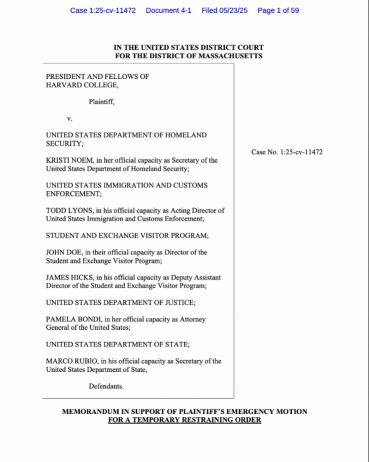
Core Viewpoint - The ongoing conflict between Harvard University and the Trump administration over the recruitment of international students has raised significant concerns about academic freedom and the future of international education in the U.S. [1][3][4] Group 1: Impact on Harvard University - The Trump administration's decision to revoke Harvard's eligibility to enroll international students has created a crisis for thousands of students, forcing them to consider transferring or facing loss of legal status [2][4] - Harvard University has responded by filing a lawsuit against the Trump administration, claiming that the actions taken are illegal and lack necessary procedures [4][6] - The university's international student population, approximately 6,800, constitutes about 27% of the total student body, highlighting the critical role these students play in the institution's financial structure [7] Group 2: Broader Implications for U.S. Education - The Trump administration's actions are not isolated to Harvard; they reflect a growing trend affecting multiple U.S. educational institutions, leading to a chilling effect on academic freedom [3][15] - The economic contribution of international students to the U.S. is substantial, with last year's international student population generating approximately $43 billion in revenue [8] - Concerns are rising about the potential decline in international student enrollment, which could have long-term negative effects on U.S. higher education and research funding [8][10] Group 3: Global Response and Talent Migration - The political climate in the U.S. is prompting many international students, particularly from China, to reconsider their future in American academia, with some opting for opportunities in Europe or returning to their home countries [12][14] - Several universities in Hong Kong and Europe are actively recruiting students affected by U.S. policies, indicating a shift in the global academic landscape [13][14] - The potential loss of top talent from the U.S. could reshape the future of higher education, as institutions abroad seek to attract those disillusioned by the current U.S. educational environment [11][15]