
数字金融创新

Search documents
佳兆业资本一度飙升逾380% 与持牌虚拟资产交易平台合作 推进RWA代币化发展
Zhi Tong Cai Jing· 2025-09-18 01:51
Group 1 - Kaisa Capital (00936) experienced a significant stock price increase, soaring over 380% at one point, and currently trading up 201.1% at HKD 0.56 with a trading volume of HKD 1.4704 million [1] - The company announced the initiation of a strategic transformation, leveraging shareholder resources, its own industry and regional advantages, and technological accumulation in the Web 3.0 field [1] - Kaisa Capital has partnered with a licensed virtual asset trading platform approved by the Hong Kong Securities and Futures Commission to promote the tokenization of real-world assets (RWA) under a compliant regulatory framework in Hong Kong [1] Group 2 - The company aims to continuously drive innovation and resource integration in the fields of financial technology, digital finance, and Web 3.0, creating long-term value that aligns with the trends of the new era [1]
港股异动 | 佳兆业资本(00936)一度飙升逾380% 与持牌虚拟资产交易平台合作 推进RWA代币化发展
智通财经网· 2025-09-18 01:46
Core Viewpoint - Kaisa Capital (00936) has initiated a strategic transformation focusing on digital financial innovation in the Web3.0 space, leveraging its resources and partnerships to explore opportunities within a compliant regulatory framework in Hong Kong [1] Group 1: Stock Performance - Kaisa Capital's stock surged over 380% at one point, currently up 201.1%, trading at HKD 0.56 with a transaction volume of HKD 1.4704 million [1] Group 2: Strategic Initiatives - The company announced a formal start to its strategic transformation, utilizing shareholder resources, industry strengths, and regional advantages [1] - Kaisa Capital has partnered with a licensed virtual asset trading platform approved by the Hong Kong Securities and Futures Commission to advance the tokenization of real-world assets (RWA) under Hong Kong's compliance framework [1] - The company aims to continuously drive innovation and resource integration in fintech, digital finance, and Web3.0, creating long-term value aligned with contemporary development trends [1]
兴业银行青岛分行:落地数字人民币公积金提取业务
Xin Lang Cai Jing· 2025-09-10 11:39
Core Viewpoint - The successful implementation of digital RMB for housing provident fund withdrawals by Industrial Bank's Qingdao branch marks a significant advancement in the application of digital currency in the housing fund sector [1] Group 1: Digital RMB Application - Industrial Bank's Qingdao branch has completed its first digital RMB housing provident fund withdrawal, showcasing a new breakthrough in the application of digital currency in this area [1] - The initiative allows housing fund contributors to directly transfer their funds into their digital RMB wallets, enhancing convenience for users [1] Group 2: Enhanced Services for Employers - Employers can utilize Industrial Bank's online banking and "Xingye Guanjia" app for online signing and changes related to housing fund contributions, improving the ease of payment processes [1] - This service aims to streamline the contribution process for companies, making it more efficient [1] Group 3: Future Prospects - The bank plans to continue expanding the application of digital RMB in various sectors, particularly in enhancing public welfare and financial innovation for citizens [1] - The collaboration with Qingdao's housing provident fund management center is expected to contribute to the development of the digital economy and smart city initiatives in Qingdao [1]


首批数据中心REITs上市
Shen Zhen Shang Bao· 2025-08-11 02:16
Core Viewpoint - The successful listing of the first batch of data center REITs in China marks a significant milestone for the REITs market, supporting technological, green, and digital financial innovations while enhancing investment in quality assets within the data center sector [1] Group 1: Market Performance - On their first trading day, both Southern Universal Data Center REIT and Southern Runze Technology Data Center REIT achieved a 30% limit-up [1] - Southern Universal Data Center REIT closed at 3.9 yuan with a trading volume of 2.34 billion yuan and a turnover rate of 25.37% [1] - Southern Runze Technology Data Center REIT closed at 5.85 yuan with a trading volume of 4.52 billion yuan and a turnover rate of 26.43% [1] Group 2: Fundraising and Structure - Southern Universal Data Center REIT issued 800 million shares at a price of 3 yuan per share, raising a total of 2.4 billion yuan [1] - Southern Runze Technology Data Center REIT issued 1 billion shares at a price of 4.5 yuan per share, raising a total of 4.5 billion yuan [1] Group 3: Industry Impact - The listing of these REITs provides a replicable and scalable "fundraising, investment, management, and exit" solution for the data center industry [1] - This development signifies important progress in the REITs market's ability to serve the new productive forces in China [1]
位列全国首批,上交所首单数据中心REITs上市
Zhong Zheng Wang· 2025-08-08 10:29
Group 1 - The Southern Universal Data Center REIT has been listed on the Shanghai Stock Exchange, marking it as the first data center REIT in the country and the first on the exchange [1] - The underlying asset of the REIT is the Guojin Data Cloud Computing Data Center project located in Kunshan, Jiangsu, which has maintained a 100% signing rate and over 92% billing rate for the past three years [1] - The project has a fundraising scale of 2.4 billion yuan, with net proceeds primarily allocated to enhance data center construction and improve computing power supply [1] Group 2 - As of August 8, there are 49 REITs listed on the Shanghai Stock Exchange, with a notable increase in the number of REITs launched in various sectors since 2024, including data centers [2] - The performance of listed REITs has shown positive trends, with over 60 dividend distributions in 2024 amounting to nearly 6 billion yuan, a 32% year-on-year increase [2] - The Shanghai Stock Exchange plans to accelerate the normalization of REITs issuance and improve operational standards to enhance the market ecosystem [2]
数币App上新!消费者、商户两端发力,多地披露“成绩单”
Bei Jing Shang Bao· 2025-07-27 11:51
Core Viewpoint - The continuous updates and optimizations of the digital RMB app indicate a strong push towards enhancing user experience and promoting the adoption of digital currency in the market [5][6][7]. Group 1: App Updates and Features - The digital RMB app has been updated to version 1.2.2, improving the bank card binding process and enabling one-click login [3][4]. - The app now supports binding bank cards from 81 banks, with 27 banks offering a feature that allows users to bind cards without entering card numbers [3]. - Users can add up to four high-frequency functions to their phone's home screen, including payment codes and cash red envelopes, enhancing convenience [4]. Group 2: Consumer Engagement and Marketing - The app's updates include features that allow merchants to display promotional activities, enhancing the marketing capabilities of the payment system [6][7]. - Various promotional activities, such as consumption coupons and cash red envelopes, have been launched to stimulate consumer spending [6][7]. - The integration of merchant-side discounts and promotions into the app's payment interface aims to improve user engagement and drive usage [6][7]. Group 3: Market Impact and Adoption - The digital RMB app's continuous updates reflect a market-oriented approach, enhancing user stickiness and facilitating broader adoption of digital currency [5][7]. - Data from various regions show significant growth in the number of digital RMB wallets and transaction volumes, indicating a positive trend in consumer adoption [8]. - The app's role as a unified entry point for managing digital RMB assets is crucial for enhancing user experience and promoting widespread use [4][7]. Group 4: Cross-Border and Trade Applications - The digital RMB is being explored for use in cross-border and offshore trade settlements, which could lower costs and improve transaction efficiency [9][10]. - The integration of digital RMB in border trade scenarios is being actively pursued, with new regulations being introduced to facilitate its use [8][9]. - The potential for digital RMB to enhance transparency and security in transactions is expected to drive its adoption in international trade [9][10].

数字人民币APP上新
Jin Rong Shi Bao· 2025-07-26 10:04
Core Insights - The central economic work conference emphasizes boosting consumption as a key task for the year, highlighting the importance of digital currency in enhancing payment convenience and supporting domestic demand [1][11]. Group 1: Digital Currency App Enhancements - The digital currency app has undergone continuous iterations since its launch in 2022, focusing on improving user experience and simplifying payment processes [2][10]. - Recent updates include an optimized bank card binding process, allowing users to link cards from 81 banks, with 27 banks offering a no-input card number feature [2][4]. - A "one-click login" feature has been introduced, enabling users to log in using their mobile number without entering a password or verification code [2][10]. Group 2: Desktop Widget Features - The app now includes a desktop widget that allows users to access frequently used functions such as payment codes and QR scanning directly from their home screen [4][6]. - Users can customize the widget's appearance with various themes, enhancing both functionality and aesthetic appeal [7][10]. Group 3: Consumer Incentives and Marketing - The government and market institutions continue to issue digital currency consumption red envelopes to stimulate consumer spending, aligning with national policies to enhance consumption mechanisms [11][13]. - The app's recent updates improve its marketing capabilities, allowing for a wider range of merchant discounts and promotional activities, enhancing consumer engagement [11][13]. - Digital currency subsidies are reported to effectively boost social consumption and local economic development, with smart contracts ensuring direct and efficient fund distribution [13][14].

数字人民币APP上新 支付更便捷高效
Zheng Quan Shi Bao Wang· 2025-07-26 04:35
Group 1 - The digital RMB app has recently optimized its features to enhance payment convenience, including improvements in the bank card binding process and the introduction of a one-click login feature [1] - The app now supports binding bank cards from 81 banks, with 27 banks offering a no-card-number input option, making the binding process more user-friendly [1] - A desktop widget feature has been launched, allowing users to quickly access frequently used functions such as payment codes and cash red envelopes directly from their phone's home screen [1] Group 2 - The digital RMB app serves as a unified entry point for managing and viewing all digital RMB assets, distinguishing it from other payment products [2] - The user experience for consumption red envelopes has been enhanced, with a clearer display of marketing discount categories in the app's cash register interface [2] - Local governments and market institutions have been actively issuing digital RMB consumption red envelopes, integrating digital financial innovation with public welfare policies [2] Group 3 - The digital RMB consumption subsidy activities have effectively stimulated social consumption and contributed positively to local economic development [3] - The use of smart contracts in digital RMB subsidies ensures that funds reach individuals or businesses directly, improving efficiency and security in fund circulation [3] - There is potential for further expanding the application scenarios of digital RMB in the consumption sector, leveraging smart contract technology to introduce more consumer incentive measures [3]
经济学家宋清辉:设数字人民币国际运营中心意义重大
Sou Hu Cai Jing· 2025-06-23 22:35
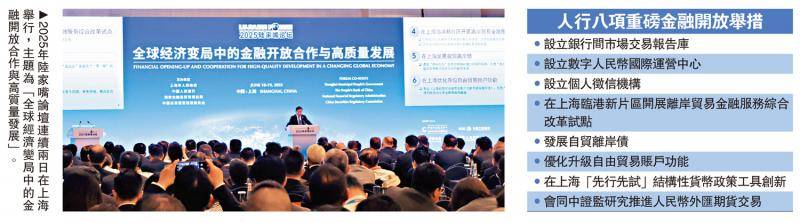
Group 1 - The core viewpoint is that multiple national policies have been introduced to support the high-quality development of Shanghai's financial industry, which will have a profound impact on the higher-level development of Shanghai as an international financial center [1][8] - Shanghai will become more competitive in attracting international financial institutions and multinational companies due to a favorable business and financial service environment, leading to an increase in the establishment of branches or expansion of operations by international financial institutions [1][8] Group 2 - The People's Bank of China announced eight significant financial opening measures, including the establishment of a digital RMB international operation center to promote the internationalization of digital RMB and the development of financial market business [4][5] - Other measures include the establishment of a personal credit agency, comprehensive reform pilot for offshore trade finance services in the Lingang New Area, and the development of offshore bonds to enhance financing channels for enterprises involved in the Belt and Road Initiative [4][5] - The measures also involve innovative structural monetary policy tools in Shanghai, such as blockchain credit certificate refinancing and cross-border trade refinancing, as well as promoting RMB foreign exchange futures trading to improve the foreign exchange market product series [5]
数字金融创新聚焦可信基础与风险管控 专家呼吁把握全球资产数字化机遇
Jing Ji Guan Cha Bao· 2025-06-20 01:15
Core Insights - The event highlighted the importance of focusing on credible foundations and risk management in digital financial innovation, as emphasized by industry experts [1][2] - The rise of digital assets and the need for financial institutions to adapt to new trends in the global digital asset market were discussed [1][3] Group 1: Digital Financial Innovation - Li Lihui stressed that short to medium-term digital financial innovation should not rely on vertical models to solve complex problems but should focus on credible foundations and risk management [1][2] - He proposed four key focus areas: high reliability, interpretability, legality, and economic efficiency in deploying AI models within financial institutions [2] - The need for a safe and efficient innovation system was highlighted, along with the importance of bridging the digital divide for smaller financial institutions [2] Group 2: Trends in Digital Assets - Huang Yiping pointed out significant changes in the global digital asset market, including the rise of stablecoins, which now account for over 90% of transactions in the virtual asset market [3] - The rapid development of asset tokenization was noted, with predictions of substantial growth in the next five years as traditional financial institutions engage in this area [3] - The emergence of virtual currency exchange-traded funds (ETFs) provides investors with a way to participate in the market without holding virtual currencies directly [3] Group 3: Risks and Opportunities - Huang Yiping indicated that the changes in the digital asset market could lead to a certain level of substitutability with central bank digital currencies, potentially affecting their future scenarios [3] - The correlation of risks between the virtual asset market and traditional asset markets is increasing, warranting caution despite no direct risk transmission to the dollar market observed yet [3] - The development of the global digital asset market is seen as a trend with both risks and opportunities, suggesting that engagement in trend-driven innovation should be pursued under controlled risk conditions [3]